
Method and device for producing a mixture of constituents with constraints, especially with premixing
a technology of constituents and constraints, applied in the direction of flow control, non-electric variable control, control of fluid mixing ratios with different temperatures, etc., can solve the problems of insufficient operation, typical feedback procedures, and application of mixture output by the mixer, so as to avoid the effect of affecting the quality of the mixture and the stability of the mixtur
Patent Information
- Authority / Receiving Office
- US · United States
- Patent Type
- Patents(United States)
- Current Assignee / Owner
- Publication Date
- 2014-09-16
- Estimated Expiration
- Not applicable · inactive patent
Smart Images
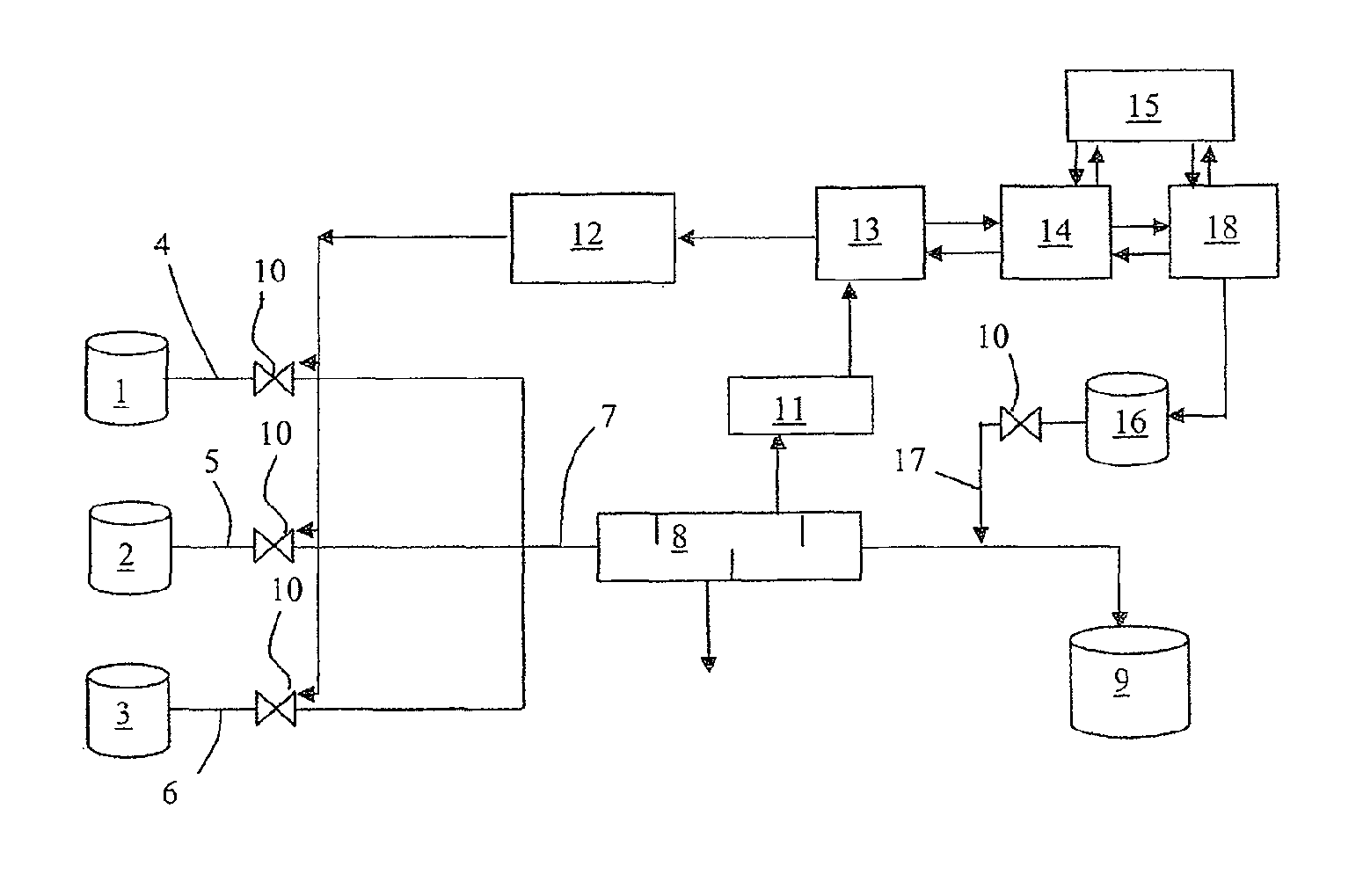
Figure 1 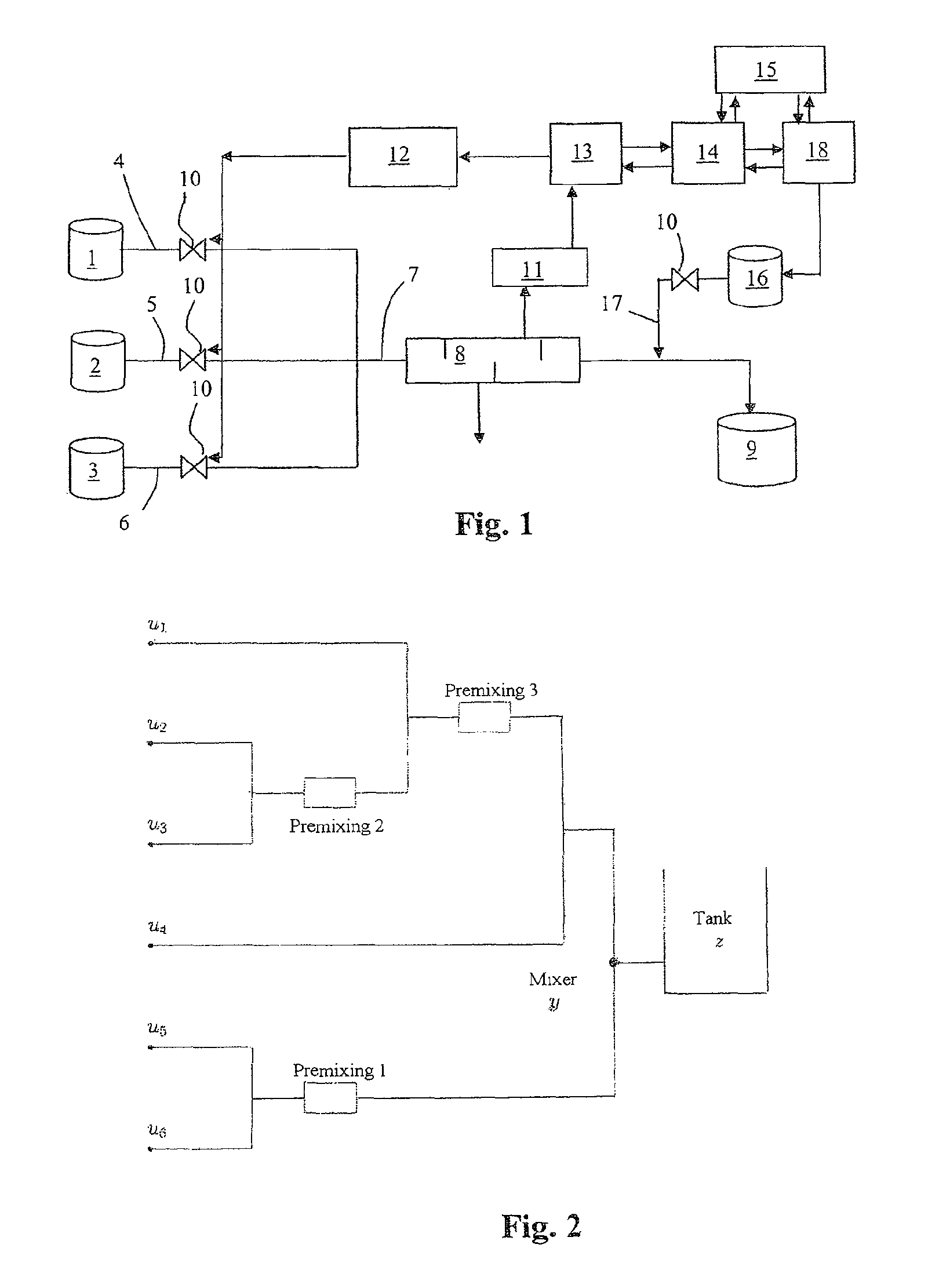
Figure 2 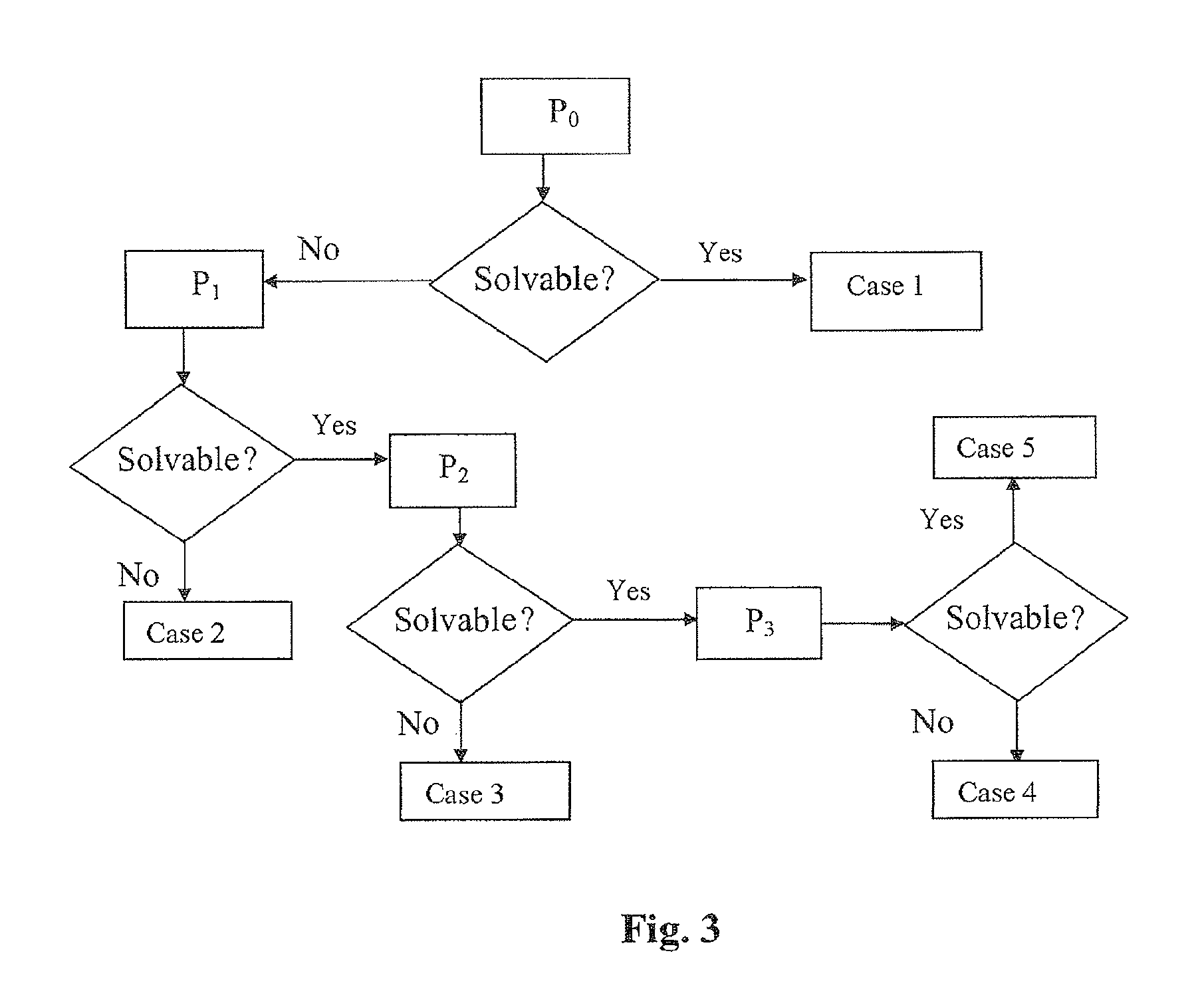
Figure 3
Abstract
Description
BACKGROUND OF THE INVENTION
[0001] The invention relates to a method and a system for controlling the production of a mixture of constituents, especially a mixture with premix dead volumes.
[0002] It applies more particularly to automatically regulating mixtures of constituents in line, such as for example mixtures of oil products, in which the mixtures produced comply with a set of specifications or significant parameters. In these applications, each product contained in the mixture acts on the set of characteristics or parameters of the final mixture obtained.
[0003] The invention applies in particular to the production of mixtures in which the characteristics or parameters of the various constituents are not well known or may change during production of the mixture. Mixtures of oil products in particular have these aspects, but the method and the system of the invention may apply to mixtures of other products, for example such as cements, paints, etc.
[0004] In all cases, the aim is to o...
Examples
example 1.1
Feedback without Premixing, Control in Instantaneous Mode
[0211]The aim of this example is to show how equation (1), used for implementing operation (2) of step (ii) of the method for producing and controlling a mixture, makes it possible to calculate a matrix of estimation of the base properties. This example corresponds to the case in which the bases are mixed directly, in order to produce the mixture without premixing.
[0212]Defining the following dynamic system for updating {circumflex over (B)}j on the basis of u and the measurement yjmes:
[0213]ⅆB^jtⅆt=-βjHu(yj-yjmes)(1)
where[0214]the matrix H is a positive definite symmetric matrix and equal in this example to:
[0215]1u_(1u_1⋱1u_n)[0216]Bjt is the transpose of BJ, and[0217]βj is a strictly positive real number,
it is possible to show that the function is
[0218]ψ(B^j)=12(B^j-Bj)H-1(B^j-Bj)t
a Lyapunov function for the dynamic system (1). This is because it is positive and its derivative as a function of time is negative:
[0219]...
example 1.2
Feedback with Return of the Estimate to the Latest Laboratory Analysis
[0228]Corrective terms δ that do not affect the final value of the predicted property (iso-prediction) may be added to the estimate {circumflex over (B)}jt described in Example 1.1. In this example, these corrections are introduced in order to take into account new laboratory measurements.
[0229]For each property, Bj refers to the new laboratory measurements of the bases. To calculate the corrective term δ, the following constrained minimization problem is considered:
[0230]minδ12δ+B^j-B_j2δu=0
[0231]The single constraint guarantees the iso-prediction: ŷj={circumflex over (B)}ju=({circumflex over (B)}j+δ)u. This minimization problem can be solved explicitly using a Lagrangian. The unique solution of the problem is:
[0232]δsol=B_j-B^j-(B_j-B^j)uu2uT
[0233]It is this correction to the matrix of the estimates of the properties of the constituents that is applied systematically at each iteration or from time to time ...
example 1.3
Feedback with the Constraints on the Estimates in the Adaptation Law Taken into Account
Subexample 1.3.A: Limit Management
[0234]We consider here a set of inequality constraints of the minimum / maximum type which it is desired that the matrix of the estimates of the properties of the constituents should respect asymptotically. For each property j, a non-empty interior admissible interval └Bjmin, Bjmax┘, assumed to contain the set of actual values of the properties of the constituents: ∀iε{base space}, Bj(i)ε└Bjmin, Bjmax┘, in which Bj(i) denotes the ith component of the vector Bj, is considered. Also considered is a regular function fj which makes an actual output value fj(x) having the following characteristics:
fj(x)=0 if xε[Bjmin,Bjmax]
fj(x)≦0 if x≧Bjmax
fj(x)≧0 if x≦Bjmin
correspond to an actual input value x.
[0235]The differential equation (1.11) is then considered:
[0236]ⅆB^jtⅆt=-βjHu(B^ju-yjmes)+f(B^jt)(1.11)
in which f is the column vector, the coordinates of which (here the i...