
System, apparatus for content delivery for internet traffic and methods thereof
a technology of internet traffic and content delivery, applied in the field of content delivery, can solve the problems of mbb and fbb network operators not benefiting from this increased traffic, media consumption using mobile devices has dramatically increased, and the telecommunication network is bursting at the seams
Patent Information
- Authority / Receiving Office
- US · United States
- Patent Type
- Patents(United States)
- Current Assignee / Owner
- Publication Date
- 2015-03-17
Smart Images
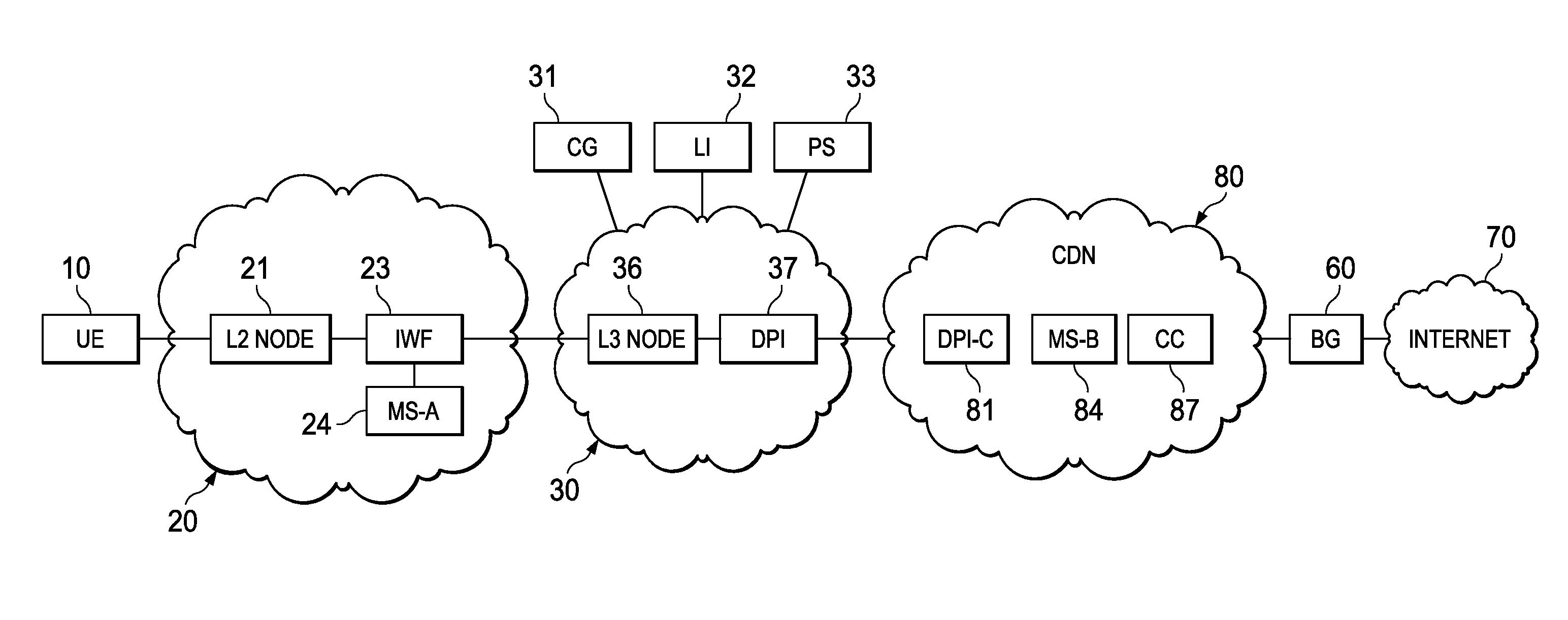
Figure 1 
Figure 2 
Figure 3
Abstract
Description
[0001] This application claims the benefit of U.S. Provisional Application No. 61 / 334,548, filed on May 13, 2010, which application is hereby incorporated herein by reference.TECHNICAL FIELD
[0002] The present invention relates generally to content delivery, and more particularly to system, apparatus for content delivery for internet traffic and methods thereof.BACKGROUND
[0003] In recent years, media consumption using mobile devices has dramatically increased. Consequently, telecommunication networks are bursting at the seams because of this explosive growth in traffic. This phenomenon is even more evident in the Mobile Broad Band (MBB) networks where the cost of infrastructure is much more (e.g., about 20-30 times) than that of the Fixed Broad Band (FBB) networks. The recent proliferation of mobile devices, such as smart-phones, tablets, netbooks, laptops, has kicked off a new era of wireless access to full web on the go. Consequently, the growth of multimedia traffic is expected to be...
Examples
first embodiment
[0143]In a first embodiment, as illustrated in FIG. 7, the GGSN 136 and MC 182 may have a direct private interface Gmc (a simple RESTful API, i.e., an application programming interface conforming to the representational state transfer constraints) for GGSN 136 to provide relevant PDP context information to MC 182 for request handling. There are two additional modes of operations of this private interface. In various embodiments, a direct interface between the GGSN 136 and the MC 182 is provided, which may use other type of protocol for request handling as known to one skilled in the art.
[0144]First, GGSN 136 may push any new creation, update, and deletion of active PDP contexts to the MC 182. Each GGSN 136 may only need to push the information to the MC 182 it is connected with assuming each GGSN directly connects with at most one MC 182.
[0145]Second, the MC 182 may always query GGSN 136 for the PDP context info using the current IP address of the UE 110 as the query key. The MC 182...
second embodiment
[0146]In a second embodiment, as illustrated in FIG. 7, the UE HTTP message parameter augmentation may be relied upon to pass on PDP information from GGSN 136 to the MC 182 through the DPI 137, the DPI-C 181. In this case, the GGSN 136 includes those relevant PDP context parameters (see Table 1) in the augmented HTTP header. This option may impact performance of the GGSN 136 because the augmentation of HTTP messages at GGSN 136 requires additional processing.
[0147]FIG. 8, which includes FIGS. 8A-8D, illustrates different configurations for configuring components in a content delivery network in accordance with embodiments of the invention.
[0148]In various embodiments, the DPI-C 181, the MC 182, and the MX-B 184 may be implemented in separate units (e.g., physically different computers) or integrated. FIG. 8A illustrates an embodiment in which the DPI-C 181, the MC 182, and the MX-B 184 are implemented as separate units in the CDN 180 while FIG. 8D illustrates an embodiment in which ...
fourth embodiment
[0196]In a fourth embodiment, the MC 182 is informed of the impending relocation and MC 182 and / or MX-A11241 perform a mid-stream redirect using a smart session. Therefore, the MC 182 and / or MX-A11241 are notified of an impending relocation (via SGSN 135 or RNC11221). The MC 182 and / or MX-A11241 perform a mid-stream redirect request to relocate the UE 110. This communication may be transmitted over the existing IWF11231 / RNC11221→NB1121→UE 110 or existing IWF11231 / RNC11221→IuR→RNC21222→NB2122→UE 110. The UE 110 media player is configured to support this mid-stream redirect request. The media player is configured to launch a request (with Byte Range starting from the current playback time code offset) to new MX-A21242 in response to the redirection instruction from the MC 182 and / or the MX-A11241. In the mean time, the UE is receiving the playback from the media player's buffer and does not experience any interruption. The delivery from the new MX-A21242 starts before the player buffe...