
Shaped sintered ceramic bodies composed of Y2O3-stabilized zirconium oxide and process for producing a shaped sintered ceramic body composed of Y2O3-stabilized zirconium oxide
a technology of y2o3-stabilized zirconium oxide and sintered shaped ceramics, which is applied in dental prosthetics, tooth crowns, medical science, etc., can solve the problems of causing enormous economic losses, tetragonal phase, and positive material behavior, and achieves more economical and process-efficient effects
Patent Information
- Authority / Receiving Office
- US · United States
- Current Assignee / Owner
- Publication Date
- 2017-10-31
Smart Images
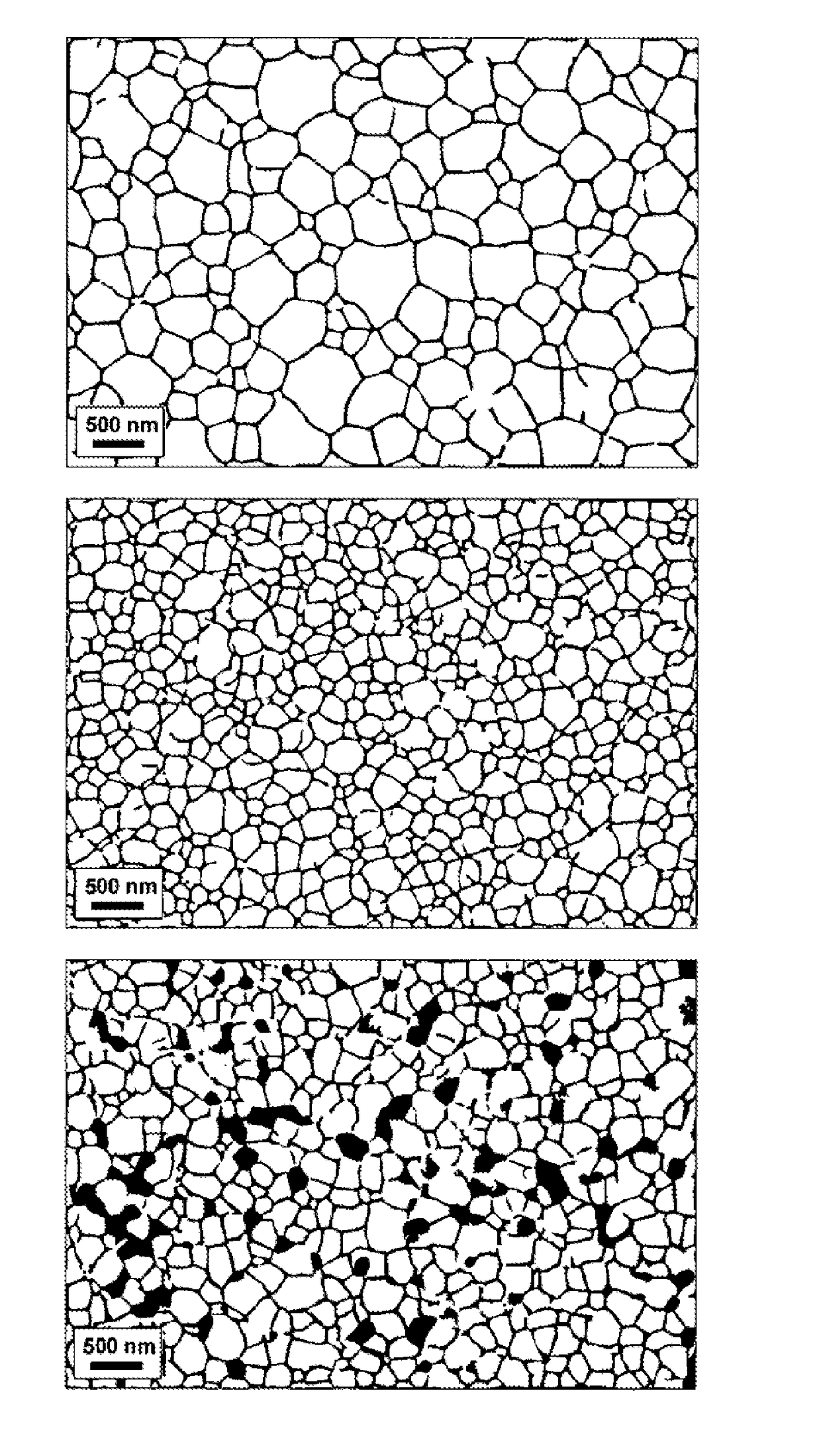
Figure 1 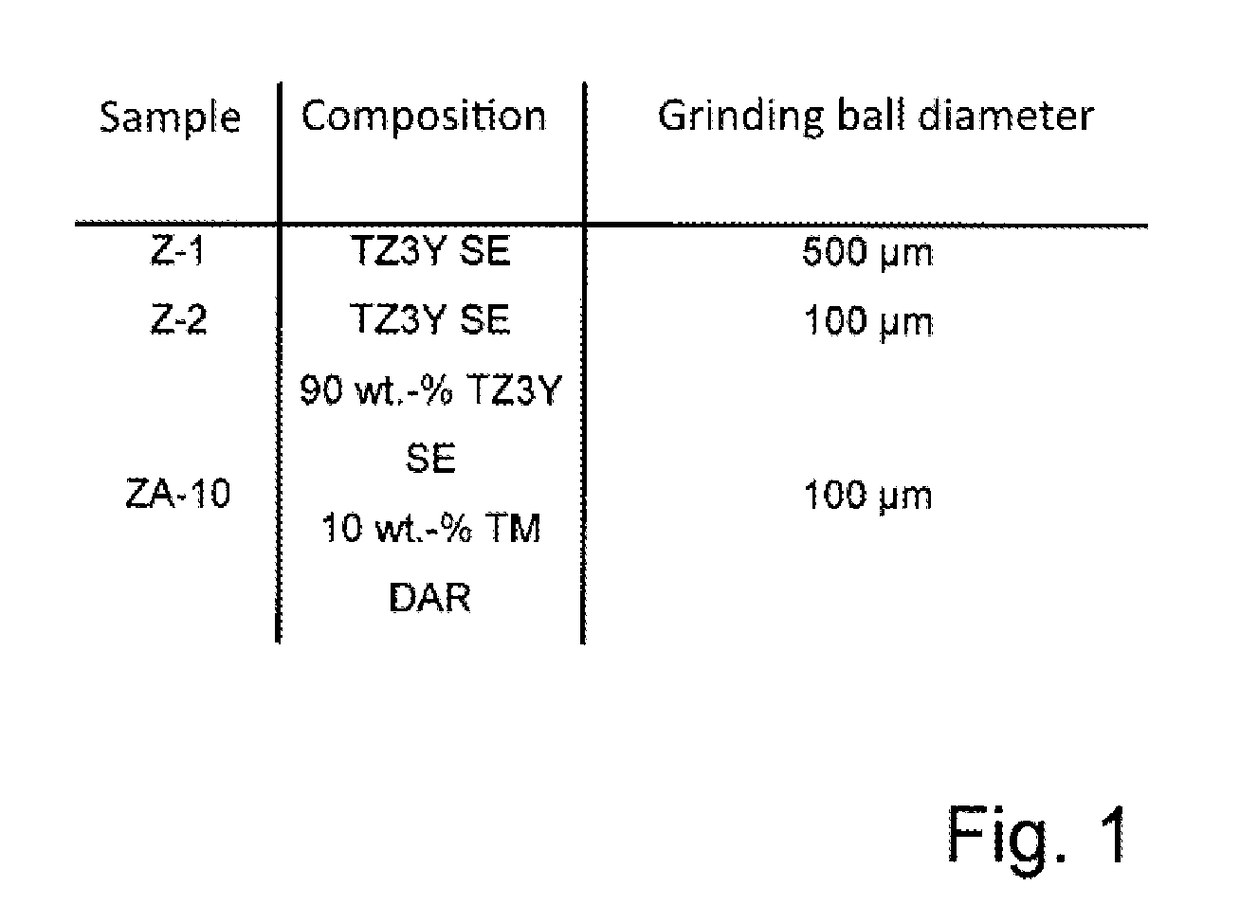
Figure 2 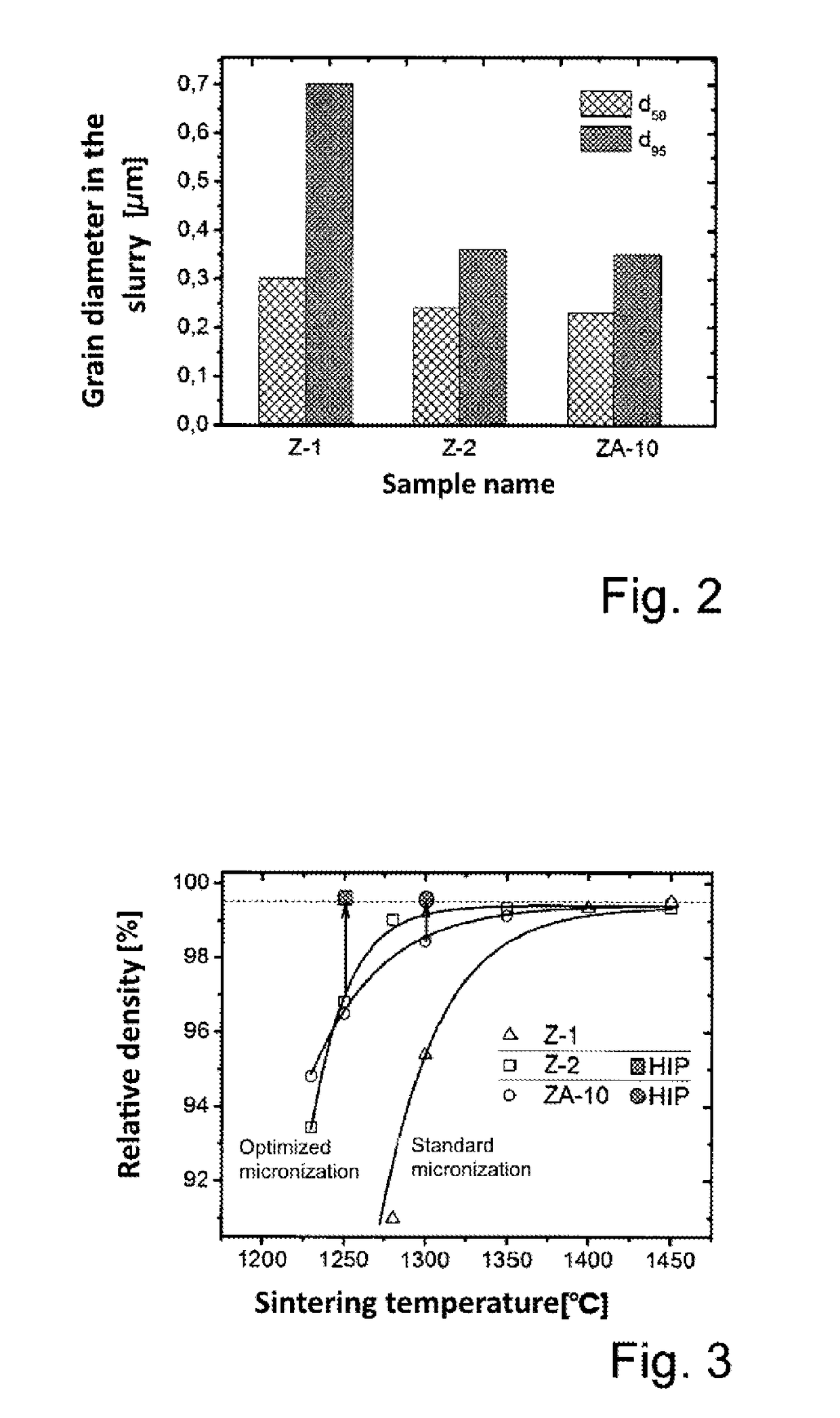
Figure 3
Abstract
Description
BACKGROUND OF THE INVENTION
[0001] 1. Field of the Invention
[0002] The invention is directed to a sintered shaped ceramic body formed of Y2O3-stabilized zirconia and to a process for producing a sintered shaped ceramic body formed of Y2O3-stabilized zirconia such as are known generically from the publication by Muñoz-Saldaña J., et al. (2003, Journal of Materials Research 18, 2415-2426).
[0003] 2. Discussion of Background Information
[0004] Zirconia (ZrO2) is a ceramic that is used, for example, as a refractory ceramic, as a technical ceramic and in prosthetics. The crystal structure of zirconia is classified in accordance with the crystal systems commonly used for the domain of crystallography. These crystal systems are listed, for example, in Hahn, T. (1983: International Table for Crystallography, Reidel, Dordrecht).
[0005] Tetragonal stabilized zirconia (hereinafter for brevity called TZP) is one of the strongest high-performance ceramics on the market. TZP ceramics are used, for example...
Examples
Embodiment Construction
[0062]Example 1: In a stirring unit, 270 ml of water are placed and a suitable dispersant is added. Next, 500 g of 3Y-TZP powder with a specific surface area of 6 m2 / g are stirred in. The slurry is put in an agitator ball mill. The mill is filled up to 85% by grinding balls having a diameter of 100 μm. The slurry is ground for two hours at 3500 R.P.M., which corresponds to a circumferential speed of 11 m / s, to a particle size distribution characterized in that the d95 value is 50 value is <0.3 μm.
[0063]The milling time is approximately two hours for this amount of solids. The slurry is cast in plaster molds which are dimensioned so as already to make allowances for shrinkage. The standing time is determined by the size of the component. The green bodies are dried in air at 50° C. and then sintered for two hours at 1250° C. The sintered shaped bodies have approximately 95% of the theoretical density. The shaped bodies are then subjected to hot isostatic pressing at 1250° C. and final...