

Sodium-ion battery electrolyte and sodium-ion battery
By using fluoroethylene carbonate, 1,3-propane sultone and 1,3-propene sultone in the sodium ion battery electrolyte, and adding sodium difluorophosphate, an optimized passivation film is formed to solve the problem It solves the problems of insufficient high-temperature performance and high impedance of sodium-ion batteries and achieves better high-temperature cycle and low-impedance performance.
Patent Information
- Application Number
- PCT/CN2024/070241
- Authority / Receiving Office
- WO · WO
- Patent Type
- Applications
- Current Assignee / Owner
- Priority Date
- 2023-03-31
- Filing Date
- 2024-01-03
- Publication Date
- 2024-10-03
AI Technical Summary
Existing sodium-ion batteries suffer from insufficient high-temperature performance and high impedance, resulting in degradation of low-temperature performance and rate performance.
A sodium ion battery electrolyte is used, containing fluoroethylene carbonate, 1,3-propane sultone and 1,3-propene sultone as additives, and sodium difluorophosphate is added to the sodium salt. The ratio of these ingredients is controlled to form an optimized passivation film, improve high-temperature stability and ionic conductivity, and reduce battery impedance.
It effectively improves the high-temperature storage and high-temperature cycle performance of sodium-ion batteries, reduces battery impedance, avoids negative impacts on low-temperature performance and rate performance, and improves the overall performance of the battery.
Smart Images
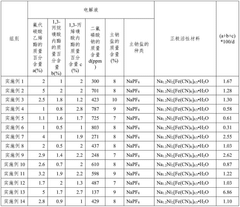
Figure PCTCN2024070241-FTAPPB-I100001 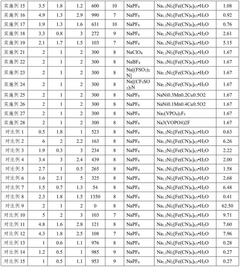
Figure PCTCN2024070241-FTAPPB-I100002 
Figure PCTCN2024070241-FTAPPB-I100003
Abstract
Description
Sodium ion battery electrolyte and sodium ion battery Technical Field
[0001] The present invention belongs to the technical field of secondary batteries, and in particular relates to a sodium ion battery electrolyte and a sodium ion battery. Background Art
[0002] Sodium-ion batteries have a similar principle and structure to lithium-ion batteries. Compared with lithium batteries, sodium-ion batteries have abundant resources, low costs and small fluctuations, and their wide temperature range and high safety performance give them alternative potential. With the continuous advancement of sodium-ion battery technology, sodium-ion batteries will occupy an important position in my country's energy system, especially in the field of energy storage, where they have broad growth space. Therefore, the development of high-performance, low-cost sodium-ion batteries is the decisive factor in determining whether they can be industrialized.
[0003] Some additives are usually added to the existing sodium ion battery electrolyte to improve the battery's cycle performance, such as fluoroethylene carbonate, 1,3-propane sultone, etc., but the existing additives are mainly film-forming additives. Their working principle is to form a passivation film through the decomposition of the additives on the negative electrode surface to protect the negative electrode material and the electrolyte. However, the formation of the passivation film will also have a certain effect on improving the battery's impedance. In particular, some existing additives have a competitive relationship during film formation. While playing their respective roles, they will also cause some changes in the film-forming effect, resulting in some adverse situations such as a decrease in film strength and an increase in film thickness, which in turn leads to insufficient high-temperature performance of the battery and an increase in impedance. The increase in impedance further deteriorates the battery's low-temperature performance and rate performance.
[0004] Summary of the Invention
[0005] In view of the problems of insufficient high-temperature performance and high impedance of existing sodium ion batteries, the present invention provides a sodium ion battery electrolyte and a sodium ion battery.
[0006] The technical solutions adopted by the present invention to solve the above technical problems are as follows:
[0007] In one aspect, the present invention provides a sodium ion battery electrolyte comprising a sodium salt, a non-aqueous organic solvent, and an additive, wherein the additive comprises fluoroethylene carbonate, 1,3-propane sultone, and 1,3-propene sultone, and the sodium salt comprises a main sodium salt and sodium difluorophosphate;
[0008] The sodium ion battery electrolyte meets the following conditions:
[0009] 0.3≤(a+b+c)*100 / d≤7, and 1≤a≤5, 0.5≤b≤2, 1≤c≤3, 100≤d≤1000;
[0010] Wherein, a is the mass percentage of fluoroethylene carbonate in the sodium ion battery electrolyte, in %;
[0011] b is the mass percentage of 1,3-propane sultone in the sodium ion battery electrolyte, in %;
[0012] c is the mass percentage of 1,3-propene sultone in the sodium ion battery electrolyte, in %;
[0013] d is the mass content of sodium difluorophosphate in the sodium ion battery electrolyte, in ppm.
[0014] Optionally, the sodium ion battery electrolyte meets the following conditions:
[0015] 0.6≤(a+b+c)*100 / d≤5.7.
[0016] Optionally, the mass percentage a of fluoroethylene carbonate in the sodium ion battery electrolyte is 2% to 4%.
[0017] Optionally, the mass percentage b of 1,3-propane sultone in the sodium ion battery electrolyte is 1% to 2%.
[0018] Optionally, the mass percentage c of 1,3-propene sultone in the sodium ion battery electrolyte is 1.5% to 2.5%.
[0019] Optionally, the mass content d of sodium difluorophosphate in the sodium ion battery electrolyte is 150 to 800 ppm.
[0020] Optionally, the main sodium salt includes at least one of sodium perchlorate, sodium tetrafluoroborate, sodium hexafluorophosphate, sodium trifluoroacetate, sodium tetraphenylborate, sodium trifluoromethanesulfonate, sodium bis(fluorosulfonyl)imide) and sodium bis(trifluoromethylsulfonyl)imide;
[0021] Preferably, based on the total weight of the sodium ion battery electrolyte being 100%, the mass percentage of the main sodium salt is 8% to 14%.
[0022] Optionally, the additive further comprises at least one of vinyl sulfate, 1,4-butane sultone and bisfluoroethylene carbonate;
[0023] Based on the total mass of the non-aqueous electrolyte being 100%, the mass percentage of the additive is 2.5% to 10%.
[0024] Optionally, the non-aqueous organic solvent includes at least one of carbonates, carboxylates and ethers.
[0025] Optionally, the carbonates include cyclic or chain carbonates having 3 to 5 carbon atoms, the cyclic carbonates include at least one of ethylene carbonate, vinylene carbonate, ethylene ethylene carbonate, propylene carbonate, γ-butyrolactone, and butylene carbonate; the chain carbonates include at least one of dimethyl carbonate, ethyl methyl carbonate, diethyl carbonate, and dipropyl carbonate;
[0026] The carboxylic acid esters include carboxylic acid esters having 2 to 6 carbon atoms, and the carboxylic acid esters include at least one of methyl acetate, ethyl acetate, propyl acetate, butyl acetate, and propyl propionate;
[0027] The ethers include cyclic ethers or chain ethers having 4 to 10 carbon atoms, wherein the cyclic ethers include at least one of 1,3-dioxolane, 1,4-dioxolane, tetrahydrofuran, 2-methyltetrahydrofuran, and 2-trifluoromethyltetrahydrofuran; the chain ethers include at least one of dimethoxymethane, 1,2-dimethoxyethane, and diethylene glycol dimethyl ether;
[0028] Taking the mass of the electrolyte as 100%, the mass percentage of the non-aqueous organic solvent is 70% to 92%.
[0029] On the other hand, the present invention provides a sodium ion battery comprising a positive electrode, a negative electrode and the sodium ion battery electrolyte as described above.
[0030] According to the sodium ion battery electrolyte provided by the present invention, fluoroethylene carbonate, 1,3-propane sultone and 1,3-propene sultone are added as additives. Fluorinated ethylene carbonate, 1,3-propane sultone and 1,3-propene sultone will jointly participate in the formation of a passivation film on the surface of the negative electrode. At the same time, a small amount of sodium difluorophosphate is added to the sodium salt. The inventors have found through research that sodium difluorophosphate has a relatively obvious regulating effect on the film formation of fluoroethylene carbonate, 1,3-propane sultone and 1,3-propene sultone on the negative electrode. In particular, when the mass percentage of fluoroethylene carbonate a and the mass percentage of 1,3-propane sultone in the sodium ion battery electrolyte are When b, the mass percentage content c of 1,3-propane sultone and the mass content d of sodium difluorophosphate in the sodium ion battery electrolyte meet the conditions: 0.3≤(a+b+c)*100 / d≤7, and 1≤a≤5, 0.5≤b≤2, 1≤c≤3, and 100≤d≤1000, fluoroethylene carbonate, 1,3-propane sultone, 1,3-propene sultone and sodium difluorophosphate jointly participate in film formation to form a passivation film with good high-temperature stability, low thickness and good ionic conductivity, which can effectively improve the high-temperature storage and high-temperature cycle performance of the sodium ion battery, while effectively reducing the battery impedance and avoiding the influence of the formed passivation film on the low-temperature performance and rate performance of the battery. DETAILED DESCRIPTION
[0031] In order to make the technical problems, technical solutions and beneficial effects solved by the present invention more clearly understood, the present invention is further described in detail below in conjunction with the embodiments. It should be understood that the specific embodiments described herein are only used to explain the present invention and are not intended to limit the present invention.
[0032] Fluoroethylene carbonate, 1,3-propane sultone, and 1,3-propylene sultone are film-forming additives used to decompose on the negative electrode surface of sodium-ion batteries to form a passivation film to improve the high-temperature performance of the battery. However, the inventors have discovered through research that when the three additives are added to the same electrolyte at the same time, their effects will affect each other. All three additives will increase the battery impedance due to their film-forming effect, thereby deteriorating the battery's low-temperature and rate performance.
[0033] In order to solve the above problems, the inventors further studied and provided a sodium ion battery electrolyte, comprising a sodium salt, a non-aqueous organic solvent and an additive, wherein the additive comprises fluoroethylene carbonate, 1,3-propane sultone and 1,3-propylene sultone, and the sodium salt comprises a main sodium salt and sodium difluorophosphate;
[0034] The sodium ion battery electrolyte meets the following conditions:
[0035] 0.3≤(a+b+c)*100 / d≤7, and 1≤a≤5, 0.5≤b≤2, 1≤c≤3, 100≤d≤1000;
[0036] Wherein, a is the mass percentage of fluoroethylene carbonate in the sodium ion battery electrolyte, in %;
[0037] b is the mass percentage of 1,3-propane sultone in the sodium ion battery electrolyte, in %;
[0038] c is the mass percentage of 1,3-propene sultone in the sodium ion battery electrolyte, in %;
[0039] d is the mass content of sodium difluorophosphate in the sodium ion battery electrolyte, in ppm.
[0040] The inventors found that sodium difluorophosphate has a relatively obvious regulating effect on the film formation of fluoroethylene carbonate, 1,3-propane sultone and 1,3-propene sultone on the negative electrode, especially when the mass percentage a of fluoroethylene carbonate in the sodium ion battery electrolyte, the mass percentage b of 1,3-propane sultone, the mass percentage c of 1,3-propene sultone and the mass content d of sodium difluorophosphate in the sodium ion battery electrolyte meet the conditions: 0.3≤(a+b+c)*100 When / d≤7, and 1≤a≤5, 0.5≤b≤2, 1≤c≤3, and 100≤d≤1000, fluoroethylene carbonate, 1,3-propane sultone, 1,3-propylene sultone, and sodium difluorophosphate jointly participate in film formation to form a passivation film having good high-temperature stability, low thickness, and good ionic conductivity, which can effectively improve the high-temperature storage and high-temperature cycle performance of sodium-ion batteries, while effectively reducing the battery impedance and avoiding the influence of the formed passivation film on the low-temperature performance and rate performance of the battery.
[0041] It should be noted that the usage of the above additives and sodium difluorophosphate should be within the above specified usage range and relationship conditions, otherwise it will deteriorate the battery performance.
[0042] In a preferred embodiment, the sodium ion battery electrolyte meets the following conditions:
[0043] 0.6≤(a+b+c)*100 / d≤5.7.
[0044] By further limiting the mass percentage a of fluoroethylene carbonate, the mass percentage b of 1,3-propane sultone, the mass percentage c of 1,3-propene sultone in the sodium ion battery electrolyte and the mass content d of sodium difluorophosphate in the sodium ion battery electrolyte to meet the above conditions, the high-temperature storage and cycle performance of the battery can be improved and gas production can be suppressed, thereby achieving the purpose of synergistically improving the high-temperature performance and low impedance of the battery.
[0045] In a specific embodiment, the mass percentage a of fluoroethylene carbonate in the sodium ion battery electrolyte can be 1%, 1.2%, 1.4%, 1.7%, 1.9%, 2.1%, 2.2%, 2.4%, 2.7%, 2.9%, 3%, 3.2%, 3.5%, 3.8%, 4%, 4.5% or 5%.
[0046] In a preferred embodiment, the mass percentage a of fluoroethylene carbonate in the sodium ion battery electrolyte is 2% to 4%.
[0047] Fluorinated ethylene carbonate can effectively improve the negative electrode film formation effect and enhance the stability of the battery during cycling. When the amount of fluoroethylene carbonate added is too low, it cannot effectively participate in the film formation, the film quality is poor, the positive and negative electrode interface stability is poor, the side reactions are aggravated, the capacity decays rapidly, and the cycle performance is poor; when the amount of fluoroethylene carbonate added is too high, it does not significantly improve the film formation quality of sodium ion batteries, but instead affects the content of the decomposition products of 1,3-propane sultone and 1,3-propylene sultone in the negative electrode passivation film, which is not conducive to the improvement of the film formation quality of sodium ion batteries.
[0048] In a specific embodiment, the mass percentage b of 1,3-propane sultone in the sodium ion battery electrolyte can be 0.5%, 0.55%, 0.6%, 0.65%, 0.7%, 0.75%, 0.8%, 0.85%, 0.9%, 0.95%, 1%, 1.1%, 1.15%, 1.2%, 1.25%, 1.3%, 1.35%, 1.4%, 1.45%, 1.5%, 1.55%, 1.6%, 1.65%, 1.7%, 1.75%, 1.8%, 1.85%, 1.9%, 1.95% or 2%.
[0049] In a preferred embodiment, the mass percentage b of 1,3-propane sultone in the sodium ion battery electrolyte is 1% to 2%.
[0050] 1,3-Propane sultone can decompose into a film at the negative electrode, effectively inhibiting the side reaction of the electrolyte on the negative electrode surface, thereby inhibiting the gas production of the battery, especially the gas production under high-temperature cycling and high-temperature storage, which can effectively improve the high-temperature storage performance; when the amount of 1,3-propane sultone added to the sodium-ion battery electrolyte is too small, the quality improvement of the negative electrode passivation film is not obvious; when the amount of 1,3-propane sultone added to the sodium-ion battery electrolyte is too high, it cannot effectively inhibit gas production, and at the same time deteriorates the high-temperature storage and cycling performance of the sodium-ion battery.
[0051] In a specific embodiment, the mass percentage c of 1,3-propene sultone in the sodium ion battery electrolyte can be 1%, 1.2%, 1.4%, 1.7%, 1.9%, 2.1%, 2.2%, 2.4%, 2.7%, 2.9% or 3%.
[0052] In a preferred embodiment, the mass percentage c of 1,3-propene sultone in the sodium ion battery electrolyte is 1.5% to 2.5%.
[0053] 1,3-Propene sultone can form a stable interfacial film on the electrode surface, inhibiting the decomposition of solvent molecules at the negative electrode, and effectively improving the battery's cycling and high-temperature storage performance. When the amount of 1,3-propene sultone added to the sodium-ion battery electrolyte is too small, the quality improvement of the negative electrode passivation film is not obvious. When the amount of 1,3-propene sultone added to the sodium-ion battery electrolyte is too high, the film formation quality on the negative electrode surface is poor, and the cycling performance of the sodium-ion battery cannot be effectively improved.
[0054] In a specific embodiment, the mass content d of sodium difluorophosphate in the sodium ion battery electrolyte can be 100ppm, 150ppm, 200ppm, 250ppm, 300ppm, 350ppm, 400ppm, 450ppm, 500ppm, 600ppm, 700ppm, 800ppm, 900ppm or 1000ppm.
[0055] In a preferred embodiment, the mass content d of sodium difluorophosphate in the sodium ion battery electrolyte is 150 to 800 ppm.
[0056] The use of sodium salt containing a specific content of sodium difluorophosphate can achieve the effect of participating in film formation without degrading other battery properties, effectively solving the side effect of increased impedance caused by the above-mentioned additives and improving the stability of the electrolyte; when the content of sodium difluorophosphate in the sodium ion battery electrolyte is too low, the mutual interference in the film formation of fluoroethylene carbonate, 1,3-propane sultone, and 1,3-propylene sultone is large, resulting in an increase in the thickness of the passivation film on the negative electrode surface and a decrease in the high-temperature stability of the passivation film, affecting the high-temperature performance of the battery; when the content of sodium difluorophosphate in the sodium ion battery electrolyte is too high, it is easy to induce side reactions of the sodium ion battery electrolyte during the circulation process, affecting the stability of the electrolyte.
[0057] In some embodiments, the primary sodium salt comprises at least one of sodium perchlorate, sodium tetrafluoroborate, sodium hexafluorophosphate, sodium trifluoroacetate, sodium tetraphenylborate, sodium trifluoromethanesulfonate, sodium bis(fluorosulfonyl)imide, and sodium bis(trifluoromethylsulfonyl)imide.
[0058] In some embodiments, based on the total mass of the non-aqueous electrolyte being 100%, the mass percentage of the main sodium salt is 8% to 14%.
[0059] When the mass percentage of the main sodium salt in the sodium ion battery electrolyte is within the above range, the conductivity and electrochemical stability of the non-aqueous electrolyte can be improved.
[0060] In some embodiments, the additive further comprises at least one of vinyl sulfate, 1,4-butane sultone, and bisfluoroethylene carbonate;
[0061] Based on the total mass of the non-aqueous electrolyte being 100%, the mass percentage of the additive is 2.5% to 10%.
[0062] In some embodiments, the non-aqueous organic solvent includes at least one of carbonates, carboxylates, and ethers.
[0063] Preferably, the carbonates include cyclic or chain carbonates having 3 to 5 carbon atoms, the cyclic carbonates include at least one of ethylene carbonate, vinylene carbonate, ethylene ethylene carbonate, propylene carbonate, γ-butyrolactone, and butylene carbonate; the chain carbonates include at least one of dimethyl carbonate, ethyl methyl carbonate, diethyl carbonate, and dipropyl carbonate;
[0064] The carboxylic acid esters include carboxylic acid esters having 2 to 6 carbon atoms, and the carboxylic acid esters include at least one of methyl acetate, ethyl acetate, propyl acetate, butyl acetate, and propyl propionate;
[0065] The ethers include cyclic ethers or chain ethers having 4 to 10 carbon atoms, wherein the cyclic ethers include at least one of 1,3-dioxolane, 1,4-dioxolane, tetrahydrofuran, 2-methyltetrahydrofuran, and 2-trifluoromethyltetrahydrofuran; the chain ethers include at least one of dimethoxymethane, 1,2-dimethoxyethane, and diethylene glycol dimethyl ether;
[0066] Taking the mass of the electrolyte as 100%, the mass percentage of the non-aqueous organic solvent is 70% to 92%.
[0067] Another embodiment of the present invention provides a sodium ion battery, comprising a positive electrode, a negative electrode, and the sodium ion battery electrolyte as described above.
[0068] In some embodiments, the positive electrode includes a positive electrode material layer, the positive electrode material layer includes a positive electrode active material, and the positive electrode active material includes at least one of a sodium-containing layered oxide, a sodium-containing polyanion compound, and a sodium-containing Prussian blue compound;
[0069] The sodium-containing layered oxide includes a layered transition metal oxide, and the layered transition metal oxide includes a compound shown in Formula I: Na x M y O z Formula I
[0070] Wherein, 0<x≤1, 0<y≤1, 1<z≤2, M is selected from at least one of Cr, Fe, Co, Ni, Cu, Mn, Sn, Mo, Sb, and V;
[0071] The Prussian blue compound includes a compound represented by formula II: Na x′ L y′[L′(CN)6] y′ ·z′H2O Formula II
[0072] wherein 0<x′≤2, 0<y′≤1, 0<z′≤20, and L and L′ are each selected from at least one of Cr, Fe, Co, Ni, Cu, Mn, Sn, Mo, Sb, and V;
[0073] The polyanion compound includes at least one of a phosphate compound and a sulfate compound;
[0074] The phosphate compound includes at least one of the compounds represented by formula III or formula IV: Na3(M′O 1-q PO4)2F 1+2q Formula III
[0075] Wherein, 0≤q≤1, M′ is selected from at least one of Al, V, Ge, Fe, and Ga: Na2EPO4F Formula IV
[0076] Wherein, E is selected from at least one of Fe and Mn;
[0077] The sulfate compound includes at least one of the compounds shown in Formula V: Na2Y(SO4)2·2H2O Formula V
[0078] Among them, Y is selected from at least one of Cr, Fe, Co, Ni, Cu, Mn, Sn, Mo, Sb, and V.
[0079] In some preferred embodiments, the layered transition metal oxide is selected from Na x MO2 (0<x≤1), M is selected from at least one of V, Cr, Mn, Fe, Co, Ni, and Cu;
[0080] The Prussian blue compound includes Na x′ Mn[Fe(CN)6] y′ z′H2O compounds, Na x′ Fe[Fe(CN)6] y′ At least one of the z′H2O compounds, wherein 0 < x′ ≤ 2, 0 < y′ ≤ 1, and 0 < z′ ≤ 20;
[0081] The phosphate compound includes at least one of Na3(VPO4)2F3, Na3(VOPO4)2F, Na2FePO4F, and Na2MnPO4F.
[0082] In some embodiments, the negative electrode includes a negative electrode material layer, the negative electrode material layer includes a negative electrode active material, and the negative electrode active material includes at least one of soft carbon, hard carbon, carbon nanotubes, expanded graphite, and graphene.
[0083] The present invention is further described below with reference to the following examples.
[0084] Table 1
[0085] Example 1
[0086] This example is used to illustrate the sodium ion battery and its preparation method disclosed in the present invention, which includes the following operations:
[0087] 1) Preparation of non-aqueous electrolyte:
[0088] Ethylene carbonate (EC), propylene carbonate (PC) and diethyl carbonate were mixed in a mass ratio of EC:PC:EMC=75:15:10, and additives and sodium salts were added in the mass ratios shown in Table 1, based on the total weight of the non-aqueous electrolyte being 100%.
[0089] 2) Preparation of positive plate:
[0090] The positive electrode active material Na was mixed in a mass ratio of 93:4:3 1.2 Ni2[Fe(CN)6] 0.5 H2O, conductive carbon black Super-P, and binder polyvinylidene fluoride (PVDF) are dispersed in N-methyl-2-pyrrolidone (NMP) to create a positive electrode slurry. Aluminum foil is used as the positive electrode current collector. The slurry is evenly coated on both sides of the foil. After drying, rolling, and vacuum drying, the positive electrode material layer is obtained. Aluminum lead wires are then welded to the positive electrode plate using an ultrasonic welder.
[0091] 3) Preparation of negative plate:
[0092] Hard carbon, conductive carbon black Super-P, binders styrene-butadiene rubber (SBR), and carboxymethyl cellulose (CMC) were mixed in a mass ratio of 94:1:2.5:2.5 and dispersed in deionized water to create a negative electrode slurry. The slurry was coated on both sides of aluminum foil, dried, rolled, and vacuum-dried, and nickel lead wires were welded using an ultrasonic welder to form the negative electrode plate.
[0093] 4) Preparation of battery cells:
[0094] A three-layer separator was placed between the positive plate and the negative plate, wherein the N / P ratio of the positive plate and the negative plate was shown in Table 1. Then, a sandwich structure consisting of the positive plate, the negative plate, and the separator was wound. The wound body was flattened and placed in an aluminum foil packaging bag. The battery cell was vacuum-baked at 85°C for 48 hours to obtain a battery cell to be injected with liquid.
[0095] 5) Battery filling and formation:
[0096] In a glove box with a dew point controlled below -40°C, the prepared electrolyte was injected into the battery cell, vacuum-sealed, and left to rest for 24 hours before the battery cell was subjected to a formation operation.
[0097] Examples 2 to 28
[0098] Examples 2 to 28 are used to illustrate the sodium ion battery and the preparation method thereof disclosed in the present invention, and include most of the operating steps in Example 1, except that:
[0099] The positive electrode active materials, additives, and sodium salts and their addition amounts shown in Examples 2 to 28 in Table 1 were used.
[0100] Comparative Examples 1 to 15
[0101] Comparative Examples 1 to 15 are used to illustrate the sodium ion battery and the preparation method thereof disclosed in the present invention, and include most of the operating steps in Example 1, except that:
[0102] The positive electrode active materials, additives, sodium salts and their addition amounts shown in Comparative Examples 1 to 15 in Table 1 were used.
[0103] Performance Testing
[0104] The sodium ion batteries prepared in Examples 1 to 28 and Comparative Examples 1 to 15 were subjected to the following performance tests:
[0105] 1. Impedance performance test
[0106] The sodium ion batteries prepared in the examples and comparative examples were formed and their discharge DCIR was tested.
[0107] 2. 25℃ cycle performance test
[0108] The formed sodium ion battery was placed at room temperature of 25°C, charged at a constant current of 0.7C to 3.9V, then charged at a constant voltage of 3.9V with a cut-off current of 0.05C, and then discharged at a constant current of 1C to 1.5V, and this cycle was repeated for 400 cycles;
[0109] The capacity retention rate after 400 cycles at 25°C is calculated using the following formula:
[0110] Capacity retention after 400 cycles at 25°C (%) = discharge capacity at the 400th cycle / discharge capacity at the first cycle × 100%.
[0111] 3. High temperature cycle performance test:
[0112] The formed sodium ion battery was placed under high temperature conditions of 45°C, charged at a constant current of 0.7C to 3.9V, then charged at a constant voltage of 3.9V with a cut-off current of 0.05C, and then discharged at a constant current of 1C to 1.5V, and this cycle was repeated for 200 and 400 cycles;
[0113] The gas production rate after 200 cycles at 45°C is calculated using the following formula:
[0114] Gas production rate after 200 cycles at 45°C (%) = (battery volume at the 200th cycle - battery volume at the 1st cycle) / battery volume at the 1st cycle × 100%;
[0115] The capacity retention rate after 400 cycles at 45°C is calculated using the following formula:
[0116] Capacity retention after 400 cycles at 45°C (%) = discharge capacity at the 400th cycle / discharge capacity at the first cycle × 100%.
[0117] 4. High temperature storage performance test:
[0118] The formed sodium ion battery was charged to 3.9V at a constant current of 0.7C, then charged at a constant current and constant voltage until the current dropped to 0.05C, and then discharged to 1.5V at a constant current of 1C. The initial discharge capacity C0 of the battery was measured, and then it was stored in an oven at a constant temperature of 60°C. After storage for 30 days, it was discharged to 1.5V according to the standard discharge rate, and the recovery capacity C1 and retention capacity C2 of the battery after 30 days of storage were measured.
[0119] Capacity recovery rate (%) = recovery capacity C1 / initial discharge capacity C0×100%;
[0120] Capacity retention rate (%) = retention capacity C2 / initial discharge capacity C0×100%;
[0121] (1) The test results obtained in Examples 1 to 19 and Comparative Examples 1 to 15 are shown in Table 2.
[0122] Table 2
[0123] From the test results of Examples 1 to 19 and Comparative Examples 1 to 15, it can be seen that in the electrolyte of the sodium ion battery, a trace amount of sodium difluorophosphate is used as a sodium salt additive, and fluoroethylene carbonate, 1,3-propane sultone and 1,3-propylene sultone are used as film-forming additives, and the mass percentage a of fluoroethylene carbonate in the sodium ion battery electrolyte, the mass percentage b of 1,3-propane sultone, the mass percentage c of 1,3-propylene sultone and the mass content d of sodium difluorophosphate in the sodium ion battery electrolyte meet the conditions: 0.3≤(a+b+c)*100 / d≤7, and 1≤a≤5, 0.5≤b≤2, 1≤c≤3, 100≤d≤1000, the obtained sodium ion battery has low impedance and excellent high temperature cycle performance and high temperature storage performance, which is presumably due to the fact that a trace amount of sodium difluorophosphate has a great effect on the performance of fluoroethylene carbonate, 1,3-propane sultone and 1,3-propylene sultone. -Propane sultone and 1,3-propene sultone play a bridging role in the passivation film formed on the surface of the negative electrode, thereby regulating the formation quality of the passivation film. Specifically, it is beneficial to improve the density and stability of the passivation film on the surface of the negative electrode, so that the passivation film has a better inhibitory effect on the contact interface reaction between the non-aqueous electrolyte and the negative electrode, reduces the decomposition and gas production of the non-aqueous electrolyte under high temperature conditions, and improves the storage and charge and discharge stability of the sodium ion battery under high temperature conditions. At the same time, a trace amount of sodium difluorophosphate is used to reduce the film thickness of the passivation film formed by ethylene carbonate, 1,3-propane sultone and 1,3-propene sultone, thereby reducing the resistance of the passivation film to ion shuttling, improving its ionic conductivity, reducing interface impedance, and helping to improve the rate performance of the sodium ion battery.
[0124] From the test results of Examples 1 to 19, it can be seen that when the mass percentage a of fluoroethylene carbonate in the sodium ion battery electrolyte, the mass percentage b of 1,3-propane sultone, the mass percentage c of 1,3-propene sultone, and the mass content d of sodium difluorophosphate in the sodium ion battery electrolyte further satisfy the condition 0.6≤(a+b+c)*100 / d≤5.7, and 2≤a≤4, 1≤b≤2, 1.5≤c≤2.5, 150≤d≤800, it is beneficial to further suppress the gas production of the sodium ion battery at high temperature, while improving the storage capacity recovery rate and cycle capacity retention rate of the sodium ion battery at high temperature.
[0125] From the test results of Comparative Examples 1 to 15, it can be seen that even if the mass percentage a of fluoroethylene carbonate, the mass percentage b of 1,3-propane sultone, the mass percentage c of 1,3-propene sultone and the mass content d of sodium difluorophosphate in the sodium ion battery electrolyte meet the condition 0.3≤(a+b+c)*100 / d≤7, when the a value, b value, c value or d value does not meet the range limit, the sodium ion battery still does not have low impedance and good high-temperature cycle and storage performance, indicating that the a value, b value, c value or d value have a strong correlation in improving the performance of the passivation film on the negative electrode surface of the sodium ion battery. In particular, when the content of sodium difluorophosphate in the sodium ion battery electrolyte is too low or too high, the adverse effect on the battery system is more obvious. Similarly, when the a value, b value, c value or d value meets the range limit, but the (a+b+c)*100 / d value does not meet the above preset conditions, the improvement in battery performance is not obvious.
[0126] (2) The test results obtained in Examples 1 and 21 to 24 are entered in Table 3.
[0127] Table 3
[0128] It can be seen from the test results of Examples 1 and 21 to 24 that when different types of main sodium salts are used, and the mass percentage a of fluoroethylene carbonate in the sodium ion battery electrolyte, the mass percentage b of 1,3-propane sultone, the mass percentage c of 1,3-propene sultone, and the mass content d of sodium difluorophosphate in the sodium ion battery electrolyte meet the conditions: 0.3≤(a+b+c)*100 / d≤7, and 1≤a≤5, 0.5≤b≤2, 1≤c≤3, 100≤d≤1000, it also plays a positive role in improving the high temperature performance and reducing the impedance of the sodium ion battery, indicating that different main sodium salts have little effect on the sodium ion battery system, and the key influencing factor for its performance is sodium difluorophosphate.
[0129] (3) The test results obtained in Examples 1, 25 to 28 are entered in Table 4.
[0130] Table 4
[0131] From the test results of Examples 1 and 25 to 28, it can be seen that in the battery system provided by the present invention, when different positive electrode active materials are used, the mass percentage a of fluoroethylene carbonate in the sodium ion battery electrolyte, the mass percentage b of 1,3-propane sultone, the mass percentage c of 1,3-propene sultone, and the mass content d of sodium difluorophosphate in the sodium ion battery electrolyte meet the conditions: 0.3≤(a+b+c)*100 / d≤7, and 1≤a≤5, 0.5≤b≤2, 1≤c≤3, 100≤d≤1000. The obtained sodium ion battery also has low impedance and good high temperature performance, indicating that the electrolyte system provided by the present invention is suitable for sodium ion batteries with different positive electrode active materials.
[0132] The above description is only a preferred embodiment of the present invention and is not intended to limit the present invention. Any modifications, equivalent substitutions and improvements made within the spirit and principles of the present invention should be included in the scope of protection of the present invention.
Claims
1. A sodium ion battery electrolyte, characterized in that: It comprises a sodium salt, a non-aqueous organic solvent and an additive, wherein the additive comprises fluoroethylene carbonate, 1,3-propane sultone and 1,3-propylene sultone, and the sodium salt comprises a main sodium salt and sodium difluorophosphate; The sodium ion battery electrolyte meets the following conditions: 0.3≤(a+b+c)*100 / d≤7, and 1≤a≤5, 0.5≤b≤2, 1≤c≤3, 100≤d≤1000; Wherein, a is the mass percentage of fluoroethylene carbonate in the sodium ion battery electrolyte, in %; b is the mass percentage of 1,3-propane sultone in the sodium ion battery electrolyte, in %; c is the mass percentage of 1,3-propene sultone in the sodium ion battery electrolyte, in %; d is the mass content of sodium difluorophosphate in the sodium ion battery electrolyte, in ppm.
2. The sodium ion battery electrolyte according to claim 1, characterized in that The sodium ion battery electrolyte meets the following conditions: 0.6≤(a+b+c)*100 / d≤5.
7.
3. The sodium ion battery electrolyte according to claim 1, characterized in that The mass percentage a of fluoroethylene carbonate in the sodium ion battery electrolyte is 2% to 4%.
4. The sodium ion battery electrolyte according to claim 1, characterized in that The mass percentage content b of 1,3-propane sultone in the sodium ion battery electrolyte is 1% to 2%.
5. The sodium ion battery electrolyte according to claim 1, characterized in that The mass percentage c of 1,3-propylene sultone in the sodium ion battery electrolyte is 1.5% to 2.5%.
6. The sodium ion battery electrolyte according to claim 1, characterized in that The mass content d of sodium difluorophosphate in the sodium ion battery electrolyte is 150 to 800 ppm.
7. The sodium ion battery electrolyte according to claim 1, characterized in that: The main sodium salt includes at least one of sodium perchlorate, sodium tetrafluoroborate, sodium hexafluorophosphate, sodium trifluoroacetate, sodium tetraphenylborate, sodium trifluoromethylsulfonate, sodium bis(fluorosulfonyl)imide) and sodium bis(trifluoromethylsulfonyl)imide.
8. The sodium ion battery electrolyte according to claim 7, characterized in that: Based on the total weight of the sodium ion battery electrolyte being 100%, the mass percentage of the main sodium salt is 8% to 14%.
9. The sodium ion battery electrolyte according to claim 1, characterized in that: The additive further includes at least one of vinyl sulfate, 1,4-butane sultone and bisfluoroethylene carbonate.
10. The sodium ion battery electrolyte according to claim 1, characterized in that: Taking the total mass of the non-aqueous electrolyte as 100%, the mass percentage of the additive is 2.5% to 10%.
11. The sodium ion battery electrolyte according to claim 1, characterized in that: The non-aqueous organic solvent includes at least one of carbonates, carboxylates and ethers.
12. The sodium ion battery electrolyte according to claim 11, characterized in that: The carbonates include cyclic or chain carbonates having 3 to 5 carbon atoms, the cyclic carbonates include at least one of ethylene carbonate, vinylene carbonate, vinylethylene carbonate, propylene carbonate, γ-butyrolactone, and butylene carbonate; the chain carbonates include at least one of dimethyl carbonate, ethyl methyl carbonate, diethyl carbonate, and dipropyl carbonate.
13. The sodium ion battery electrolyte according to claim 11, characterized in that: The carboxylic acid esters include carboxylic acid esters having 2 to 6 carbon atoms, and the carboxylic acid esters include at least one of methyl acetate, ethyl acetate, propyl acetate, butyl acetate, and propyl propionate.
14. The sodium ion battery electrolyte according to claim 11, characterized in that: The ethers include cyclic ethers or chain ethers having 4 to 10 carbon atoms, the cyclic ethers include at least one of 1,3-dioxolane, 1,4-dioxolane, tetrahydrofuran, 2-methyltetrahydrofuran, and 2-trifluoromethyltetrahydrofuran; the chain ethers include at least one of dimethoxymethane, 1,2-dimethoxyethane, and diethylene glycol dimethyl ether.
15. The sodium ion battery electrolyte according to claim 1, characterized in that: Taking the mass of the electrolyte as 100%, the mass percentage of the non-aqueous organic solvent is 70% to 92%.
16. A sodium ion battery, characterized in that: It comprises a positive electrode, a negative electrode and a sodium ion battery electrolyte as claimed in any one of claims 1 to 15.
Citation Information
Patent Citations
Sodium-ion battery electrolyte and additive thereof, preparation method and application
CN109786827A
Non-aqueous electrolyte with low impedance and long cycle performance and sodium ion battery
CN113036220A
Functional electrolyte additive, battery electrolyte and sodium ion battery
CN114122513A
Sodium-ion battery electrolyte and sodium-ion battery
CN116454380A
Electrolyte for non-aqueous electrolyte battery and non-aqueous electrolyte battery
JP2007173180A