
Polyamide 12-based powder for 3D printing
By incorporating a thermoplastic polymer powder B with a lower melting temperature into polyamide 12 powder A, the working window and mechanical properties of 3D printed parts are improved, addressing the challenges of 'curling' and 'caking' and resulting in parts with enhanced performance.
Patent Information
- Application Number
- PCT/EP2024/088020
- Authority / Receiving Office
- WO · WO
- Patent Type
- Applications
- Current Assignee / Owner
- Priority Date
- 2023-12-21
- Filing Date
- 2024-12-20
- Publication Date
- 2025-06-26
AI Technical Summary
Polyamide 12 powders used in 3D printing by sintering have a narrow working window, making them difficult to process and resulting in printed parts with compromised mechanical properties due to issues like 'curling' and 'caking'.
A composition of polymer powders is developed by adding a small amount (0.1 to 3% by mass) of a thermoplastic polymer powder B with a lower melting temperature and smaller particle size to polyamide 12 powder A, improving the working window and mechanical properties of the printed parts.
The addition of the auxiliary powder significantly widens the working window, particularly towards lower temperatures, and enhances the mechanical properties of the printed parts, including tensile modulus, elongation at break, and stress at break.
Smart Images
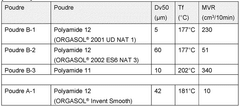
Figure IMGF000017_0001 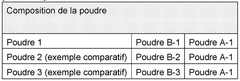
Figure IMGF000018_0001 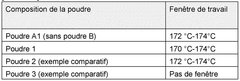
Figure IMGF000018_0002
Abstract
Description
[0001] DESCRIPTION
[0002] Title: Polyamide 12-based powder for 3D printing
[0003] Field of invention
[0004] The present invention relates to a composition of polymer powders for the manufacture of articles by 3D printing, in particular by sintering, mainly comprising a polyamide 12 powder, making it possible to improve the processability of the material during printing and to obtain printed parts having satisfactory, or even improved, mechanical properties.
[0005] The invention also relates to a process for preparing this powder composition as well as its use in a sintering manufacturing process, and to the articles manufactured from said powder composition.
[0006] Technical background
[0007] Additive manufacturing on thermoplastic polymer powder beds (SLS, M JF, HSS, etc.) allows the construction of parts with complex geometry, including in series production. It allows the production of a large number of parts simultaneously, with excellent resolution and very good mechanical properties, which gives them an advantage over other additive manufacturing processes such as fused deposition.
[0008] However, few thermoplastic polymer materials are commercially available because a very specific temperature behavior is required for the material to be processable on polymer powder bed additive manufacturing machines. Indeed, if the construction temperature is too low, we encounter "curling" phenomena, i.e. a deformation of the constructed part under the effect of internal stresses appearing in particular when the polymer layers crystallize too quickly. The appearance of "curling" most often compromises all the parts constructed in the enclosure. In addition, we can observe problems of cohesion of the powder bath, necessary for the support of the part under construction, and also fusion defects which affect the mechanical properties of the printed part.Conversely, when the construction temperature is too high, we observe "caking" phenomena, that is to say an agglomeration of all or part of the polymer powder bath under the effect of partial fusion of the grains.
[0009] The processability of the material, i.e. its ability to be transformed into a final part in additive manufacturing machines, can be defined by the width of the working window. This working window corresponds to the temperature range over which the material can be transformed into a final part while avoiding the "curling" and "caking" problems presented above.
[0010] Polyamide powders, in particular polyamide 12 powder, are particularly interesting for the aforementioned additive manufacturing technology because they offer high mechanical and thermal properties, namely high rigidity and good stress resistance.
[0011] These include commercial products such as Orgasol® from Arkema, Durafom® from 3D-Systems, Vestosint® from Evonik, and PA2200® from EOS.
[0012] However, the narrow working window of polyamide 12, i.e., generally a few degrees, makes printing complicated. Thus, there is a need to improve the temperature behavior of the polyamide 12 used in order to make it more easily processable, i.e. in particular to widen the working window, and / or to make it possible to obtain sintered objects with satisfactory mechanical properties. There also remains a desire to widen it towards low temperatures because the structural changes of the powders are less when the temperature in the printing machine is low. This lesser change will lead to easier reuse of the powder in another print.
[0013] Summary of the invention
[0014] The aim of the present invention is to propose a solution to the problems mentioned above, namely to propose a composition of powders containing polyamide 12, having better processability in 3D printing by laser sintering and making it possible to obtain sintered objects with satisfactory, or even improved, mechanical properties.
[0015] To this end, the present invention is based on the addition of a particular thermoplastic polymer powder (called “auxiliary powder”) in small quantities to the composition of powders containing polyamide 12.
[0016] Thus, according to a first aspect, the invention relates to a composition of polymer powders comprising:
[0017] (i) a polyamide 12 powder A having a Dv50 of 20 to 100 pm, preferably of 30 to 80 pm, even more preferably of 40 to 60 pm; (ii) 0.1 to 3% by mass, preferably 0.5 to 2% by mass, more preferably 0.7 to 1.5% by mass, relative to the total mass of the composition, of a powder B of thermoplastic polymer, preferably a powder B of polyamide or a powder B of polyether block amides, the powder B having a Dv50 lower than the Dv50 of the powder A and from 1 to 30 pm, preferably from 3 to 25 pm, even more preferably from 4 to 20 pm, and a melting temperature (Tf) lower than or equal to the melting temperature of the powder A, the Tf being measured according to standard NF EN ISO 11357-3:2018.
[0018] Dv50 being measured according to ISO 13320:2009 standard.
[0019] The polymer powder composition comprises 0.1 to 3% by mass, preferably 0.1 to 2%, 0.1 to 1.8%, 0.1 to 1.5%, 0.5 to 2%, 0.5 to 1.8%, 0.5 to 1.5%, 0.7 to 1.5%, 0.9 to 1.5%, 1 to 1.5% or 0.9 to 1.4% by mass of powder B, relative to the total mass of the composition.
[0020] According to one embodiment, the melting temperature (Tf) of powder B is at least 1°C lower than that of powder A, preferably at least 3°C lower than that of powder A, or at least 10°C lower than that of powder A.
[0021] According to one embodiment, the difference between the melting temperatures of powders B and A is less than or equal to 10°C.
[0022] According to one embodiment, the Dv50 of powder B is 5 to 80% of the Dv50 of powder A, preferably 10 to 60% of the Dv50 of powder A.
[0023] According to a second aspect, the invention relates to a composition of polymer powders comprising, relative to the total mass of the composition:
[0024] (i) 59.5 to 99.5% by mass of a polyamide 12 powder A as defined above;
[0025] (ii) 0.1 to 3% by mass, preferably 0.5 to 2% by mass, more preferably 0.7 to 1.5% by mass, of a powder B as defined above;
[0026] (iii) 0 to 40%, preferably 0.05 to 40% by mass of one or more additives and / or one or more fillers.
[0027] The thermoplastic polymer powder B that can be used in the context of the present invention can in particular be chosen from polyolefins such as polypropylene and polyethylene (olefin base waxes would not fall outside the scope of the present invention), polycarbonate, polymethylmethacrylate (PMMA), polyamides and thermoplastic elastomers such as polyether block amides (PEBA), polyesters and polyether blocks (COPE), thermoplastic polyurethanes (TPU) and their mixtures, preferably polyamides and polyether block amides, even more preferably a polyamide, preferably a polyamide12.
[0028] The thermoplastic polymer in powder B is typically a semi-crystalline thermoplastic polymer.
[0029] According to one embodiment, the thermoplastic polymer powder B used in the context of the present invention is chosen from polyolefins such as polypropylene and polyethylene (olefin base waxes would not fall outside the scope of the present invention), polyamides and thermoplastic elastomers such as polyether block amides (PEBA), polyesters and polyether blocks (COPE), thermoplastic polyurethanes (TPU) and their mixtures, preferably polyamides and polyether block amides, even more preferably a polyamide, preferably a polyamide12.
[0030] According to one embodiment, the volume flow index (MVR) of powder B is greater than the volume flow index (MVR) of powder A.
[0031] The ratio of MVR of powder B to MVR of powder A may typically be greater than 3, preferably greater than 5, more preferably greater than 10, even more preferably greater than 20.
[0032] Preferably, the MVR of powder B is greater than 50 cm 3 / 10min, preferably greater than 100 cm 3 / 10min, even more preferably greater than 200 cm 3 / 10 min.
[0033] It has been observed in the context of the present invention that the addition of a small quantity of a particular auxiliary powder in a polyamide 12 powder suitable for 3D printing by sintering made it possible, surprisingly, to improve its working window, and / or to obtain sintered objects with satisfactory, or even improved, mechanical properties, in particular in terms of elongation at break, stress at break and tensile modulus.
[0034] For the purposes of the present invention, the term "improving the working window" means an enlargement of the working window, including in particular an enlargement of the working window towards low temperatures. The present invention also relates to a 3D printing method, preferably a sintering method caused by electromagnetic radiation, using the powder composition as defined above.
[0035] Preferably, the electromagnetic radiation is chosen from one or more laser beams, infrared radiation or UV radiation.
[0036] The present invention also relates to an article obtained by the 3D printing process as defined above.
[0037] Preferably, the article obtained using the powder composition as defined above has a tensile modulus greater than 1200 MPa, preferably 1400 Mpa, an elongation at break greater than 8%, preferably greater than 9%, and / or a breaking stress greater than 35 Mpa, preferably greater than 40 Mpa.
[0038] The article can be chosen from prototypes, models and parts, particularly in the automotive, nautical, aeronautical, aerospace, medical (prosthetics, hearing systems, cellular tissues, etc.) fields, textiles, clothing, fashion, decoration, design, cases for electronics, telephony, IT, lighting, sport, industrial tools.
[0039] According to yet another aspect, the invention relates to the use of 0.1 to 3% by mass, preferably 0.5 to 2% by mass, more preferably 0.7 to 1.5% by mass, of a thermoplastic polymer powder B, preferably a polyamide powder B or a polyether block amide powder B, relative to the total mass of the composition, in a composition comprising a polyamide 12 powder A having a Dv50 of 20 to 100 pm, preferably 30 to 80 pm, even more preferably 40 to 60 pm in a 3D printing process, preferably by sintering, the powder B having a Dv50 lower than the Dv50 of the powder A and 1 to 30 pm, preferably 3 to 25 pm, even more preferably 4 to 20 pm, and a melting temperature (Tf) lower or equal to the melting temperature of powder A, the Tf being measured according to the NF EN ISO 11357-3:2018 standard, Dv50 being measured according to the ISO 13320:2009 standard, to improve the working window.For example, it is possible to use 0.1 to 3% by mass, preferably 0.1 to 2%, 0.1 to 1.8%, 0.1 to 1.5%, 0.5 to 2%, 0.5 to 1.8%, 0.5 to 1.5%, 0.7 to 1.5%, 0.9 to 1.5%, 1 to 1.5% or even 0.9 to 1.4% by mass of powder B, relative to the total mass of the composition.
[0040] The invention is now described in detail and in a non-limiting manner in the following description.
[0041] Description of the invention
[0042] Definition
[0043] In the present description of the invention, including in the examples below.
[0044] The term "powder" is understood to mean a solid material in finely divided form, generally in the form of very small particles, generally of the order of a few hundred micrometers or less.
[0045] The polyamides of the present invention may be homopolyamides or copolyamides.
[0046] For the purposes of the invention, homopolyamide means the polymerization products of aminocarboxylic acid, lactam or diacid monomers with diamines.
[0047] By copolyamide in the sense of the invention, is meant a copolymer resulting from the polymerization of at least two different monomers, called "co-monomers", that is to say at least one monomer and at least one co-monomer (monomer different from the first monomer), being chosen from aminocarboxylic acids, lactams, diamine diacid couples. The copolyamide may comprise a so-called majority monomer, that is to say representing at least 80% by mass of the total mass of the mixture of monomers, and at least one so-called minority co-monomer, representing at most 20% by mass of the total mass of the total mixture of monomer(s) and co-monomer(s).
[0048] The term "monomer" in the following description should be taken to mean "repeating unit". The case where a repeating unit is made up of the association of a diacid with a diamine is special. It is considered that it is the association of a diamine and a diacid, that is to say the diamine.diacid pair (in equimolar quantity), which corresponds to the monomer. This is explained by the fact that individually, the diacid or the diamine is only a structural unit, which is not sufficient on its own to form a polymer.
[0049] Examples of amino acid or aminocarboxylic acid monomers include those having 4 to 18 carbon atoms, such as aminocaproic, 7-aminoheptanoic, 11-aminoundecanoic, n-heptyl-11-aminoundecanoic and 12-aminododecanoic acids.
[0050] Examples of lactam monomers include those having 3 to 18 carbon atoms on the main ring and which may be substituted. Examples include p,p-dimethylpropriolactam, a,a-dimethylpropriolactam, amylolactam, caprolactam also known as lactam 6, capryllactam also known as lactam 8, oenantholactam, 2-pyrrolidone and lauryllactam also known as lactam 12.
[0051] Examples of dicarboxylic acids include acids having between 4 and 18 carbon atoms. Examples include adipic acid, sebacic acid, azelaic acid, suberic acid, isophthalic acid, butanedioic acid, 1,4-cyclohexyldicarboxylic acid, terephthalic acid, the sodium or lithium salt of sulphoisophthalic acid, dimerized fatty acids (these dimerized fatty acids have a dimer content of at least 98% and are preferably hydrogenated) and dodecanedioic acid.
[0052] Examples of diamines include aliphatic diamines having 4 to 18 atoms, which may be aryl and / or saturated cyclic. Examples include hexamethylenediamine, piperazine, tetramethylenediamine, octamethylenediamine, decamethylenediamine, 5-dodecamethylenediamine, 1,5-diaminohexane, 2,2,4-trimethyl-1,6-diaminohexane, diamine polyols, isophoronediamine (IPD), methyl pentamethylenediamine (MPDM), bis(aminocyclohexyl)methane (BACM), bis(3-methyl-4-aminocyclohexyl)methane (BMACM), methaxylyenediamine, bis-p-aminocyclohexylmethane, and trimethylhexamethylenediamine.
[0053] The Dv50 also called herein "volume median diameter" corresponds to the value of the particle size which divides the population of particles examined exactly in two, as measured by laser diffraction according to the ISO 13320: 2009 standard, for example on a Malvern diffractometer of the Insitec® type. The "melting temperature (Tf)" designates the temperature at which an at least partially crystalline compound passes into the viscous liquid state as measured according to the NF EN ISO 11357-3: 2018 standard. In the present invention, the value was determined during the heating step at a rate of 20 °C / min during the first heating.
[0054] Unless otherwise stated, this refers more specifically to the peak melting temperature as defined below.
[0055] More specifically, the following terms are understood to mean in relation to melting temperature:
[0056] • a “peak” means the portion of the differential scanning calorimetry (DSC) thermogram that deviates from the specimen baseline to reach a maximum or minimum and then returns to the specimen baseline. Such a peak may indicate a first-order transition;
[0057] • a “baseline” means the part of the recorded thermogram without any transition, in particular here without any first-order transition of the melting type. At a transition zone, a virtual baseline can be determined: it is an imaginary line drawn through the transition zone, assuming that the heat due to the transition is zero. The virtual baseline can be drawn by interpolating the baseline of the specimen by means of a straight line;
[0058] • a “melting peak temperature” means the temperature at which the distance is greatest between the thermogram and the virtual baseline during a peak.
[0059] The melt flow rate (MVR) is measured by a Zwick MFlow measuring device, manufactured by Zwick according to ISO 1133.
[0060] Mechanical properties, including tensile modulus, elongation at break and stress at break, are measured according to ISO 527-1:2019.
[0061] In this description, it is specified that when reference is made to intervals, expressions of the type "between... and..." or "from... to..." include the limits of the interval. Unless otherwise stated, the percentages expressed are mass percentages. Unless otherwise stated, the parameters referred to are measured at atmospheric pressure and ambient temperature (23°C).
[0062] Composition of polymer powders
[0063] Polyamide 12 Powder A
[0064] Polyamide 12 powder can be obtained by any suitable method, for example by anionic polymerization, by dissolution-precipitation process, or by grinding, for example grinding of granules.
[0065] Polyamide 12 powder A is a homopolyamide 12 powder or a copolyamide 12 powder.
[0066] According to one embodiment, powder A is a homopolyamide 12 powder.
[0067] According to one embodiment, powder A is a copolyamide 12 powder containing a monomer of amino-12-dodecanoic acid or a monomer of lactam 12, preferably containing a majority monomer of amino-12-dodecanoic acid or a monomer of lactam 12.
[0068] According to one embodiment, the minority co-monomer represents from 0.1 to 20% by mass, preferably from 0.5 to 15%, from 1% to 10%, from 1 to 7%, from 1 to 5% by mass of the total mass of the monomer(s) and comonomer(s).
[0069] Advantageously, the minority comonomer comprises amino-11-undecanoic acid, caprolactam and / or capryllactam.
[0070] The Dv50 of the powder is 20 to 100 pm, preferably 30 to 80 pm, even more preferably 40 to 60 pm.
[0071] These include commercial products such as Orgasol® from Arkema, Durafom® from 3D-Systems, Vestosint® from Evonik, and PA2200® from EOS.
[0072] Preferably, powder A has a melting temperature (Tm) of between 150 and 190°C, preferably between 160 and 187°C. Powder B of thermoplastic polymer
[0073] The Dv50 of powder B is lower than the Dv50 of powder A.
[0074] The Dv50 is 1 to 30 pm, preferably 3 to 25 pm, even more preferably 4 to 20 pm.
[0075] According to one embodiment, powder B is chosen from PA 6, PA 11, PA 12, PA 66, PA 610, PA 613, PA 611, PA 612, PA 614, PA 618, PA 1010, PA 1012, PA 1014 or PA 1018.
[0076] According to one embodiment, powder B is chosen from PA 6 / 12, PA 6 / 66, PA 1010 / 12, PA 1010 / 11, PA 6 / 12 / 66, PA 6 / 69 / 11 / 12, PA 6 / 66 / 11 / 12, PA 69 / 12, PA 4 / 6, PA 4 / 12, PA 6 / 11, PA 12 / 8, PA11 / 4, PA 11 / 12, PA 8 / 6, PA 8 / 4, PA 12 / 8, PA 12 / 11.
[0077] Preferably, the thermoplastic polymer powder B is a polyamide 12 powder, which is a homopolyamide 12 or a copolyamide 12.
[0078] According to one embodiment, powder B is a homopolyamide 12 powder, as defined above.
[0079] According to one embodiment, powder B is a copolyamide 12 powder as defined above.
[0080] Preferably, the thermoplastic polymer powder B has a melting temperature (Tf) less than or equal to 180°C, preferably between 80 and 180°C, preferably between 100 and 180°C.
[0081] According to one embodiment, the volume melt flow index (MVR) of powder B is greater than the volume melt flow index (MVR) of powder A.
[0082] According to one embodiment, the MVR of powder B is greater than 50 cm 3 / 10min, preferably greater than 100 cm 3 / 10min, even more preferably greater than 200 cm 3 / 10 min.
[0083] The ratio of MVR of powder B to MVR of powder A may typically be greater than 3, preferably greater than 5, more preferably greater than 10, even more preferably greater than 20. Additives
[0084] The additives generally represent less than 5% by mass relative to the total mass of the composition. Preferably, the additives represent less than 3%, preferably less than 2% by mass of the total mass of the composition.
[0085] Additives include flow agents, stabilizers (light, especially UV, and heat), optical brighteners, dyes, pigments, energy-absorbing additives (including UV absorbers), a wax (e.g., polyethylene and polypropylene wax, polytetrafluoroethylene wax, ketone wax, acid wax, partially esterified acid wax, acid anhydride wax, ester wax, aldehyde wax, amide wax, derivatives thereof, and mixtures thereof) and / or surfactants.
[0086] Among the flow agents, mention may be made, for example, of a hydrophilic or hydrophobic silica. Advantageously, the flow agent represents from 0.01 to 0.4% by mass relative to the total mass of the composition. In other embodiments, the powdery composition does not comprise a flow agent.
[0087] The pigment may be, for example for HSS or MJ F technology, a pigment having an absorbance of light with a wavelength of 1000 nm, as measured according to ASTM E1790, of less than 40%.
[0088] Charges
[0089] The polymer powder composition may also comprise one or more fillers. The fillers generally represent less than 40% by mass, in particular less than 30% by mass, and preferably less than 25% by mass relative to the total mass of the final powder composition. Among the fillers, reinforcing fillers may be mentioned, in particular mineral fillers such as carbon black, talc, nanotubes, carbon or not, and fibers, in particular glass or carbon fibers, ground or not, or glass in another form, for example in the form of flakes or beads, hollow or not. Other fillers providing an additional property may be used without departing from the scope of the invention, for example flame-retardant fillers, fillers providing electrical or thermal conductivity.
[0090] Process for preparing the composition of powders
[0091] According to one aspect, the invention relates to a method for manufacturing the powder composition as described above, by mixing: i. a polyamide 12 powder A having a Dv50 of 20 to 100 pm, preferably of 30 to 80 pm, even more preferably of 40 to 60 pm; ii. 0.1 to 3% by mass, preferably 0.5 to 2% by mass, more preferably 0.7 to 1.5% by mass, relative to the total mass of the composition, of a powder B of thermoplastic polymer, preferably a powder B of polyamide or a powder B of polyether block amides, the powder B having a Dv50 lower than the Dv50 of the powder A and from 1 to 30 pm, preferably from 3 to 25 pm, even more preferably from 4 to 20 pm, and a melting temperature (Tf) lower than or equal to the melting temperature of the powder A, the Tf being measured according to standard NF EN ISO 11357-3:2018.
[0092] Dv50 being measured according to ISO 13320:2009 iii. possibly, one or more additives and / or one or more fillers.
[0093] Mixing can typically be achieved by dry mixing.
[0094] According to one embodiment, the method for manufacturing the powder composition as described above is carried out by mixing:
[0095] (i) 59.5 to 99.5% by mass of the polyamide 12 powder A as defined above;
[0096] (ii) 0.1 to 3% by mass, preferably 0.5 to 2% by mass, more preferably 0.7 to 1.5% by mass, relative to the total mass of the composition, of thermoplastic polymer powder B, preferably polyamide powder B, as defined above;
[0097] (iii) 0 to 40%, preferably 0.05 to 40% by mass of one or more additives and / or one or more fillers, relative to the total mass of the composition.
[0098] Polymer A and B powders can be manufactured using standard processes.
[0099] Typically, the powder A and / or B contained in the composition can be obtained by grinding polymers in the form of extruded granules or flakes, according to conventional techniques.
[0100] Grinding can be room temperature grinding.
[0101] Grinding may be cryogenic grinding. In this process, the material to be ground is cooled, for example by means of liquid nitrogen, liquid carbon dioxide or liquid helium, to make the material easier to grind. Grinding may be carried out on equipment known for this purpose, for example by means of a counter-rotating pin mill, a hammer mill or in a whirl mill.
[0102] The polyamide powder can also be manufactured by other methods known in the art, for example the preparation of a polyamide 12 powder by anionic precipitating polymerization as described for example in EP 1 814 931 B1 or FR 06.56024 B1 or by dissolution precipitation method as described in US patent 4334056.
[0103] The powder can be sieved or subjected to a selection step to obtain the desired particle size profile.
[0104] Depending on a certain method of preparation, the polymer powder may be subjected to different treatments, in particular thermal or hydraulic treatments. Reference may be made in particular to patent application EP 1413595 A1.
[0105] When the powder contains, in addition to the polymer powders, one or more additives and / or one or more fillers, preferably reinforcing or flame-retardant fillers, these additives and / or fillers may be incorporated by melt mixing, for example by extrusion (compounding) and granulation followed by grinding of the granules.
[0106] Preferably, the additives and / or fillers are added to the powder by dry blending.
[0107] According to one embodiment, the step of introducing the additives and / or fillers can be carried out during the synthesis of powder A and / or B.
[0108] For example, it is possible to mix polyamide A or polymer B by means of co-precipitation of the polymer from a solution in the presence of certain additives and / or fillers (dissolution / precipitation). The conditions can be easily adapted by those skilled in the art. For example, reference may be made to document EP 0863174 B1.
[0109] It is also possible to use several of these processes, depending on the additives, for their introduction into the polymer powder.
[0110] The additives and / or fillers may be used in any form suitable for the preparation method. According to one embodiment, one or more additives / fillers are used in powder form. The shape and size of the particles forming the powder are not particularly limited, except by the application of 3D printing by sintering. The particles most often have a spherical shape. However, their use in other forms such as rod-shaped or lamellar forms is not excluded.
[0111] When the additives / fillers are added to the polymer in dry-blend, they advantageously have a volume median diameter Dv50 substantially equal to or less than that of the powder with which it will be mixed.
[0112] 3D printing process by sintering
[0113] The process which is the subject of the invention may in particular be a selective laser sintering (SLS) process, a sintering process of the MJF (Multi Jet Fusion) type or a sintering process of the HSS (High Speed Sintering) type.
[0114] The SLS process is widely known. In this context, reference may be made in particular to documents US 6,136,948 and WO 96 / 06881.
[0115] In this type of process, a thin layer of powder is deposited on a horizontal plate held in an enclosure heated to a temperature called the build temperature. Most commonly, heating to the build temperature is achieved by means of IR radiation lamps, for example halogen lamps, which generally have an emission maximum at a wavelength between 750 nm and 1250 nm. The build temperature refers to the temperature to which the powder bed, of a constituent layer of a three-dimensional article under construction, is heated during the layer-by-layer sintering process of the powder.Electromagnetic radiation, for example in the form of a laser, then provides the energy necessary to sinter the powder particles at different points in the powder layer according to a geometry corresponding to an object, for example using a computer that stores the shape of an object and reproduces it in the form of slices. Then, the horizontal plate is lowered by a height corresponding to the thickness of a powder layer, and a new layer of powder is spread, heated and then sintered in the same way. The procedure is repeated until the object has been manufactured.
[0116] The powder layer deposited on a horizontal plate may have, before sintering, for example a thickness of 20 to 200 μm, and preferably 50 to 150 μm. After sintering, the thickness of the agglomerated material layer is somewhat smaller, and may have, for example, a thickness of 10 to 150 μm, and preferably 30 to 120 μm. For the MJ F and HSS process, the entire layer of the building material is exposed to radiation, but only a portion covered with a melting agent is melted to become a layer of a 3D part. The melting agent is a compound capable of absorbing radiation and converting it into thermal energy, for example, a black ink. It is selectively applied to the selected region of the building material. The melting agent is able to penetrate the layer of the building material and transmits the absorbed energy to the neighboring building material, thus causing it to melt or be sintered.By melting, bonding and subsequent hardening of each layer of the building material, the object is formed.
[0117] In the particular case of MJ F, a detailing agent is additionally added to the edges of the area to be melted to allow the pieces to have better definition.
[0118] Advantageously, the use of the polyamide powder composition described below in these processes does not require any particular modification. However, it makes it possible to obtain parts with a good surface appearance, in particular lower roughness and better definition.
[0119] Advantageously, the process allows the polyamide powder composition to be used in several successive constructions. In this case, it can be reused alone or mixed with other powders, recycled or not.
[0120] Examples
[0121] The examples below illustrate the present invention without limiting its scope. In the examples, unless otherwise indicated, all percentages and parts are expressed by mass.
[0122] Granulometry
[0123] The powders were characterized in terms of particle size using a Malvern Insitec laser diffractometer with RT Sizer software, according to ISO 13320:2009.
[0124] A laser beam is shone on the particles moving in the air. The measurement is carried out on 30 g of powder.
[0125] Measurement of melting temperature (Tf)
[0126] The melting temperature of the powders was measured by DSC on a TA Instruments Q2000 calorimeter, in accordance with NF EN ISO 11357-3:2018. The value was determined during the heating step at a rate of 20 °C / min during the first heating. MVR measurement
[0127] MVR is measured by a Zwick MFlow device, manufactured by Zwick, at 235°C under a load of 2.16 kg according to ISO 1133.
[0128] Measurement of mechanical properties
[0129] Tensile modulus, elongation at break and stress at break are measured according to ISO 527-1:2019.
[0130] Powder compositions
[0131] Powders B-1, B-2 and A-1 are polyamide 12 powders marketed by Arkema. Their trade names are shown in Table 1.
[0132] B-3 powder was obtained from a polyamide 11 powder marketed by ARKEMA under the name Rilsan® Invent Natural. The Rilsan® Invent Natural powder was ground in a mini hammer mill with an internal selector until a powder with a Dv50 of 10 μm was obtained.
[0133] The properties of the powders used in the examples are shown in the table below.
[0134] Table 1]
[0135] 1% by mass of Powder B was added to Powder A-1 in a dry-blend in a Henschel mixer at a rotation speed of 900 rpm for 100 seconds. The compositions of the powders tested are shown in the table below. Table 2]
[0136] Measurement of working window and mechanical properties
[0137] The compositions of Powder A-1 and Powders 1 to 3 were used to manufacture by 3D printing by laser sintering 1 B XY specimens (1 B specimen according to ISO 527-1:2019, called “XY” because it is printed in the plane of the printer, i.e. horizontally) on a P1000 machine (marketed by the company Prodways) by setting the thickness of the powder layer to 100 μm. The printing parameters used are as follows:
[0138] Laser power: 24W
[0139] Laser speed: 3000mm / s
[0140] Distance between two laser passes: 0.25mm
[0141] Their working windows were measured and presented in the table below.
[0142] Table 3]
[0143] It was observed that Powder 1, containing 1% of Powder B1, namely an auxiliary powder whose Dv50 is lower than the Dv50 of Powder A-1 and whose melting temperature is lower than that of Powder A-1, has a working window of 5°C instead of 3°C, thus making it possible to significantly widen the working window.
[0144] On the other hand, the working window is widened towards low temperatures, which brings a benefit on a lesser evolution of the powder, which will favor its reuse in another printing test. Whereas in the cases where powder A-1 is mixed with powder B-2 (whose Dv50 is higher than that of powder A-1) or with powder B-3 (whose melting temperature is higher than that of powder A-1), no improvement of the working window was observed, or even the powder was not transformed (case of Powder 3).
[0145] The mechanical properties of Powder 1 were measured and compared with Powder A-1.
[0146] The results are collected in the table below (average of 10 specimens tested).
[0147] [Table 4]
[0148] It was observed, at different build temperatures, that Powder 1 of the invention exhibits an improved tensile modulus, an improved elongation at break and an improved stress at break, compared to the powder without the auxiliary powder.
Claims
Claims 1. Composition of polymer powders comprising: (i) a polyamide 12 powder A having a Dv50 of 20 to 100 pm, preferably of 30 to 80 pm, even more preferably of 40 to 60 pm; (ii) 0.1 to 3% by mass, preferably 0.5 to 2% by mass, more preferably 0.7 to 1.5% by mass, relative to the total mass of the composition, of a powder B of thermoplastic polymer, preferably a powder B of polyamide or a powder B of polyether block amides, the powder B having a Dv50 lower than the Dv50 of the powder A and from 1 to 30 pm, preferably from 3 to 25 pm, even more preferably from 4 to 20 pm, and a melting temperature (Tf) lower than or equal to the melting temperature of the powder A, the Tf being measured according to standard NF EN ISO 11357-3:2018. Dv50 being measured according to ISO 13320:2009 standard.
2. Composition according to claim 1, in which the Dv50 of powder B is from 5 to 80% of the Dv50 of powder A, preferably from 10 to 60% of the Dv50 of powder A.
3. Composition according to claim 1 or 2 comprising, relative to the total mass of the composition: (i) 59.5 to 99.5% by mass of polyamide 12 powder A; (ii) 0.1 to 3% by mass, preferably 0.5 to 2% by mass, more preferably 0.7 to 1.5% by mass, of powder B; (iii) 0 to 40%, preferably 0.05 to 40% by mass of additives and / or fillers.
4. Composition according to one of the preceding claims, in which the polyamide 12 powder A is a homopolyamide 12 powder or a copolyamide 12 powder.
5. Composition according to one of the preceding claims, in which the melting temperature (Tf) of powder A is between 150 and 190°C, preferably between 160 and 187°C.
6. Composition according to one of the preceding claims, in which the thermoplastic polymer powder B is chosen from polyolefins such as polypropylene and polyethylene (olefinic base waxes would not fall outside the scope of the present invention), polycarbonate, polymethylmethacrylate (PMMA), polyamides and thermoplastic elastomers such as polyether block amides (PEBA), polyesters and polyether blocks (COPE), thermoplastic polyurethanes (TPU) and their mixtures, preferably polyamides and polyether block amides, even more preferably a polyamide, preferably a polyamide12.
7. Composition according to one of the preceding claims, in which the melting temperature (Tf) of powder B is less than or equal to 180°C, preferably between 80°C and 180°C, preferably between 100 and 180°C.
8. Composition according to one of the preceding claims, in which the volume flow index (MVR) of powder B is greater than the volume flow index (MVR) of powder A, preferably the ratio of MVR of powder B to MVR of powder A is greater than 3, preferably greater than 5, even more preferably greater than 10.
9. Composition according to one of the preceding claims, in which the MVR of powder B is greater than 50 cm 3 / 10min, preferably greater than 100 cm 3 / 10min, even more preferably greater than 200 cm 3 / 10 min.
10. Process for manufacturing the powder composition, by mixing: (i) a polyamide 12 powder A having a Dv50 of 20 to 100 pm, preferably of 30 to 80 pm, even more preferably of 40 to 60 pm; (ii) 0.1 to 3% by mass, preferably 0.5 to 2% by mass, more preferably 0.7 to 1.5% by mass, relative to the total mass of the composition, of a powder B of thermoplastic polymer, preferably a powder B of polyamide or a powder B of polyether block amides, the powder B having a Dv50 lower than the Dv50 of the powder A and from 1 to 30 pm, preferably from 3 to 25 pm, even more preferably from 4 to 20 pm, and a melting temperature (Tf) lower than or equal to the melting temperature of the powder A, the Tf being measured according to standard NF EN ISO 11357-3:2018. Dv50 being measured according to ISO 13320:2009 standard (iii) optionally, one or more additives and / or one or more fillers.
11. Method according to claim 10, being carried out by mixing: (i) 59.5 to 99.5% by mass of polyamide 12 powder A; (ii) 0.1 to 3% by mass, preferably 0.5 to 2% by mass, more preferably 0.7 to 1.5% by mass, relative to the total mass of the composition, of thermoplastic polymer powder B, preferably polyamide powder B; (iii) 0 to 40%, preferably 0.05 to 40% by mass of one or more additives and / or one or more fillers, relative to the total mass of the composition.
12. Method according to claim 10 or 11, the mixing being carried out by dry mixing.
13. 3D printing method, preferably a sintering method caused by electromagnetic radiation, using at least in part a powder composition according to one of the preceding claims.
14. Manufactured article obtained by the 3D printing process of claim 13.
15. Use of 0.1 to 3% by mass, preferably 0.5 to 2% by mass, more preferably 0.7 to 1.5% by mass, of a thermoplastic polymer powder B, preferably a polyamide powder B or a polyether block amide powder B, relative to the total mass of the composition, in a composition comprising a polyamide 12 powder A having a Dv50 of 20 to 100 pm, preferably 30 to 80 pm, even more preferably 40 to 60 pm in a 3D printing process, preferably by sintering, the powder B having a Dv50 lower than the Dv50 of the powder A and 1 to 30 pm, preferably 3 to 25 pm, even more preferably 4 to 20 pm, and a melting temperature (Tf) lower than or equal to the melting temperature of powder A, Tf being measured according to standard NF EN ISO 11357-3:2018, Dv50 being measured according to standard ISO 13320:2009, to improve the working window.
Citation Information
Patent Citations
Preparation of precipitated polyamide powders with a narrow grain size distribution and low porosity
EP0863174B1
Process for increasing the melting point and the melting enthalpy of polyamides by water treatment
EP1413595A1
Process for obtaining polyamide or copolyesteramide particles
EP1814931B1
metal spoke wheel
FR656024A
Method for polytropically precipitating polyamide powder coating compositions where the polyamides have at least 10 aliphatically bound carbon atoms per carbonamide group
US4334056A