

Carbon Capture Technologies: Integration with Industrial Processes
OCT 27, 20259 MIN READ
Generate Your Research Report Instantly with AI Agent
PatSnap Eureka helps you evaluate technical feasibility & market potential.
Carbon Capture Evolution and Objectives
Carbon capture technologies have evolved significantly over the past several decades, transitioning from theoretical concepts to practical applications in industrial settings. The journey began in the 1970s with early experiments in post-combustion capture methods, primarily using amine-based solvents to separate CO2 from flue gases. These initial efforts were largely academic and faced substantial efficiency and cost barriers that limited widespread adoption.
The 1990s marked a pivotal shift as climate change concerns gained international recognition, catalyzing increased research investment and technological advancement. This period saw the emergence of pre-combustion and oxy-fuel combustion as alternative capture approaches, expanding the technological portfolio beyond post-combustion methods.
By the early 2000s, the first large-scale demonstration projects were implemented, notably at coal-fired power plants in North America and Europe. These projects provided critical operational data and highlighted integration challenges that would inform subsequent technological iterations. The period from 2010 to 2020 witnessed significant improvements in capture efficiency, with energy penalties decreasing from approximately 30% to below 20% for many applications.
Current technological objectives focus on seamless integration with existing industrial processes while minimizing operational disruptions and energy penalties. The primary goal is to achieve carbon capture costs below $50 per ton of CO2 by 2030, compared to current averages of $70-100 per ton, making implementation economically viable across multiple industries without substantial subsidies.
Technical objectives also include developing modular and scalable capture systems that can be retrofitted to diverse industrial facilities, from power generation to cement production and steel manufacturing. These systems must accommodate varying CO2 concentrations in process streams, from the relatively high concentrations in natural gas processing (>20%) to the dilute streams in cement kilns (approximately 5%).
Another critical objective is improving the integration of capture technologies with downstream utilization and storage pathways, creating complete carbon management systems rather than isolated capture solutions. This includes optimizing compression and transportation systems, as well as developing versatile capture technologies that produce CO2 streams suitable for various utilization applications.
Looking forward, the field aims to advance direct air capture technologies to complement point-source capture, creating comprehensive carbon management strategies that address both new emissions and the existing atmospheric carbon burden. The ultimate objective remains developing economically viable, energy-efficient capture systems that can be deployed at sufficient scale to meaningfully impact global carbon reduction targets while maintaining industrial productivity and competitiveness.
The 1990s marked a pivotal shift as climate change concerns gained international recognition, catalyzing increased research investment and technological advancement. This period saw the emergence of pre-combustion and oxy-fuel combustion as alternative capture approaches, expanding the technological portfolio beyond post-combustion methods.
By the early 2000s, the first large-scale demonstration projects were implemented, notably at coal-fired power plants in North America and Europe. These projects provided critical operational data and highlighted integration challenges that would inform subsequent technological iterations. The period from 2010 to 2020 witnessed significant improvements in capture efficiency, with energy penalties decreasing from approximately 30% to below 20% for many applications.
Current technological objectives focus on seamless integration with existing industrial processes while minimizing operational disruptions and energy penalties. The primary goal is to achieve carbon capture costs below $50 per ton of CO2 by 2030, compared to current averages of $70-100 per ton, making implementation economically viable across multiple industries without substantial subsidies.
Technical objectives also include developing modular and scalable capture systems that can be retrofitted to diverse industrial facilities, from power generation to cement production and steel manufacturing. These systems must accommodate varying CO2 concentrations in process streams, from the relatively high concentrations in natural gas processing (>20%) to the dilute streams in cement kilns (approximately 5%).
Another critical objective is improving the integration of capture technologies with downstream utilization and storage pathways, creating complete carbon management systems rather than isolated capture solutions. This includes optimizing compression and transportation systems, as well as developing versatile capture technologies that produce CO2 streams suitable for various utilization applications.
Looking forward, the field aims to advance direct air capture technologies to complement point-source capture, creating comprehensive carbon management strategies that address both new emissions and the existing atmospheric carbon burden. The ultimate objective remains developing economically viable, energy-efficient capture systems that can be deployed at sufficient scale to meaningfully impact global carbon reduction targets while maintaining industrial productivity and competitiveness.
Industrial Integration Market Analysis
The carbon capture technology integration market is experiencing significant growth as industries face increasing pressure to reduce emissions. Currently, the global carbon capture and storage (CCS) market is valued at approximately 3 billion USD, with projections indicating growth to reach 7 billion USD by 2030. This expansion is primarily driven by stringent environmental regulations, carbon pricing mechanisms, and corporate sustainability commitments across major industrial sectors.
Heavy industries represent the most promising market segment for carbon capture integration, with cement, steel, and chemical manufacturing collectively accounting for nearly 40% of global industrial CO2 emissions. The cement industry alone contributes about 8% of global carbon emissions, making it a critical target for carbon capture solutions. Post-combustion capture technologies currently dominate the industrial integration landscape, representing over 60% of implemented projects due to their retrofitting capabilities with existing infrastructure.
Regional market analysis reveals that Europe leads in carbon capture technology adoption, supported by the EU Emissions Trading System and ambitious climate targets. North America follows closely, with significant growth potential driven by recent policy developments such as the Inflation Reduction Act in the United States, which provides tax credits of up to $85 per ton for captured carbon. The Asia-Pacific region, particularly China and India, represents the fastest-growing market with annual growth rates exceeding 15% as these nations balance industrial expansion with emission reduction commitments.
Customer segmentation within the industrial integration market reveals three primary adopter categories: early innovators (typically large multinational corporations with strong sustainability mandates), compliance-driven adopters (companies operating in jurisdictions with carbon pricing), and cost-sensitive followers (organizations primarily motivated by operational efficiency improvements). The willingness to pay varies significantly across these segments, with early innovators demonstrating tolerance for payback periods of 5-7 years, while cost-sensitive followers typically require ROI within 2-3 years.
Market barriers include high capital expenditure requirements, with average installation costs ranging from $400-$700 per ton of CO2 capture capacity for post-combustion systems. Operational expenditures add approximately $40-$80 per ton of captured CO2, creating significant economic hurdles for widespread adoption. Additional market challenges include limited CO2 transport infrastructure, uncertain regulatory frameworks in developing markets, and competition from alternative emission reduction strategies such as electrification and hydrogen adoption.
The competitive landscape is evolving rapidly, with traditional engineering firms increasingly competing with specialized carbon capture technology providers and energy majors diversifying into this space. Strategic partnerships between technology providers and industrial end-users have increased by 35% over the past three years, indicating a shift toward collaborative market development approaches.
Heavy industries represent the most promising market segment for carbon capture integration, with cement, steel, and chemical manufacturing collectively accounting for nearly 40% of global industrial CO2 emissions. The cement industry alone contributes about 8% of global carbon emissions, making it a critical target for carbon capture solutions. Post-combustion capture technologies currently dominate the industrial integration landscape, representing over 60% of implemented projects due to their retrofitting capabilities with existing infrastructure.
Regional market analysis reveals that Europe leads in carbon capture technology adoption, supported by the EU Emissions Trading System and ambitious climate targets. North America follows closely, with significant growth potential driven by recent policy developments such as the Inflation Reduction Act in the United States, which provides tax credits of up to $85 per ton for captured carbon. The Asia-Pacific region, particularly China and India, represents the fastest-growing market with annual growth rates exceeding 15% as these nations balance industrial expansion with emission reduction commitments.
Customer segmentation within the industrial integration market reveals three primary adopter categories: early innovators (typically large multinational corporations with strong sustainability mandates), compliance-driven adopters (companies operating in jurisdictions with carbon pricing), and cost-sensitive followers (organizations primarily motivated by operational efficiency improvements). The willingness to pay varies significantly across these segments, with early innovators demonstrating tolerance for payback periods of 5-7 years, while cost-sensitive followers typically require ROI within 2-3 years.
Market barriers include high capital expenditure requirements, with average installation costs ranging from $400-$700 per ton of CO2 capture capacity for post-combustion systems. Operational expenditures add approximately $40-$80 per ton of captured CO2, creating significant economic hurdles for widespread adoption. Additional market challenges include limited CO2 transport infrastructure, uncertain regulatory frameworks in developing markets, and competition from alternative emission reduction strategies such as electrification and hydrogen adoption.
The competitive landscape is evolving rapidly, with traditional engineering firms increasingly competing with specialized carbon capture technology providers and energy majors diversifying into this space. Strategic partnerships between technology providers and industrial end-users have increased by 35% over the past three years, indicating a shift toward collaborative market development approaches.
Global CCUS Technology Landscape
Carbon Capture, Utilization, and Storage (CCUS) technologies have evolved significantly over the past decades, with global deployment accelerating in response to climate change imperatives. Currently, there are approximately 35 commercial-scale CCUS facilities in operation worldwide, with capacity to capture about 45 million tonnes of CO2 annually. This represents less than 0.1% of global emissions, highlighting the vast potential for expansion.
The global landscape of CCUS technologies shows distinct regional patterns. North America leads in deployment, hosting over 60% of operational facilities, primarily due to favorable policy environments and the established use of CO2 for enhanced oil recovery. The European Union follows with ambitious plans to expand capacity to 50 million tonnes annually by 2030, focusing on industrial clusters and offshore storage in the North Sea.
Asia-Pacific represents the fastest-growing region for CCUS development, with China announcing plans for 100 million tonnes of annual capacity by 2030. Japan and South Korea are focusing on innovative capture technologies and international collaboration for storage solutions.
Technology distribution shows post-combustion capture as the dominant approach globally (65% of projects), followed by pre-combustion (20%) and oxy-fuel combustion (10%). Emerging direct air capture technologies, while representing only 5% of current projects, are experiencing the fastest growth rate at approximately 300% over the past five years.
Investment patterns reveal a shift from primarily government-funded demonstration projects to increasing private sector participation. Global investment in CCUS reached approximately $4.5 billion in 2022, a 50% increase from 2020, with projections suggesting this could reach $15 billion annually by 2025.
International collaboration frameworks are expanding, with initiatives like the Carbon Sequestration Leadership Forum and the Oil and Gas Climate Initiative facilitating knowledge sharing and standardization efforts. These collaborations are particularly important for developing nations seeking to implement CCUS technologies with limited domestic expertise.
Regulatory landscapes vary significantly by region, with the United States' 45Q tax credits providing the most substantial financial incentives globally. The EU's Emissions Trading System and Innovation Fund are driving European deployment, while Asian countries are developing dedicated CCUS policy frameworks, often integrated with broader industrial decarbonization strategies.
The global CCUS landscape is characterized by accelerating deployment, increasing commercial viability, and growing recognition of its essential role in achieving net-zero emissions, particularly for hard-to-abate industrial sectors where electrification and other alternatives face significant limitations.
The global landscape of CCUS technologies shows distinct regional patterns. North America leads in deployment, hosting over 60% of operational facilities, primarily due to favorable policy environments and the established use of CO2 for enhanced oil recovery. The European Union follows with ambitious plans to expand capacity to 50 million tonnes annually by 2030, focusing on industrial clusters and offshore storage in the North Sea.
Asia-Pacific represents the fastest-growing region for CCUS development, with China announcing plans for 100 million tonnes of annual capacity by 2030. Japan and South Korea are focusing on innovative capture technologies and international collaboration for storage solutions.
Technology distribution shows post-combustion capture as the dominant approach globally (65% of projects), followed by pre-combustion (20%) and oxy-fuel combustion (10%). Emerging direct air capture technologies, while representing only 5% of current projects, are experiencing the fastest growth rate at approximately 300% over the past five years.
Investment patterns reveal a shift from primarily government-funded demonstration projects to increasing private sector participation. Global investment in CCUS reached approximately $4.5 billion in 2022, a 50% increase from 2020, with projections suggesting this could reach $15 billion annually by 2025.
International collaboration frameworks are expanding, with initiatives like the Carbon Sequestration Leadership Forum and the Oil and Gas Climate Initiative facilitating knowledge sharing and standardization efforts. These collaborations are particularly important for developing nations seeking to implement CCUS technologies with limited domestic expertise.
Regulatory landscapes vary significantly by region, with the United States' 45Q tax credits providing the most substantial financial incentives globally. The EU's Emissions Trading System and Innovation Fund are driving European deployment, while Asian countries are developing dedicated CCUS policy frameworks, often integrated with broader industrial decarbonization strategies.
The global CCUS landscape is characterized by accelerating deployment, increasing commercial viability, and growing recognition of its essential role in achieving net-zero emissions, particularly for hard-to-abate industrial sectors where electrification and other alternatives face significant limitations.
Current Industrial Integration Solutions
01 Direct Air Capture (DAC) Technologies
Direct Air Capture technologies involve systems that extract carbon dioxide directly from the atmosphere. These systems typically use sorbent materials or chemical solutions to selectively capture CO2 from ambient air. After capture, the CO2 can be concentrated and either stored underground or utilized in various applications. DAC technologies are particularly valuable for addressing distributed emissions and can be deployed in various locations regardless of emission sources.- Chemical absorption methods for carbon capture: Chemical absorption is a widely used method for capturing carbon dioxide from various emission sources. This approach involves the use of solvents, typically amine-based compounds, that selectively bind with CO2. The process generally consists of an absorption phase where CO2 is captured by the solvent and a regeneration phase where the CO2 is released and the solvent is recycled. These systems can be integrated with existing industrial facilities to reduce carbon emissions effectively.
- Direct air capture technologies: Direct air capture (DAC) technologies are designed to extract carbon dioxide directly from the ambient air rather than from point sources like industrial emissions. These systems typically use specialized sorbents or solutions that can selectively capture CO2 even at the low concentrations found in atmospheric air. Once captured, the CO2 can be concentrated, purified, and either stored permanently or utilized in various applications. DAC technologies represent an important approach for addressing historical emissions and achieving negative emissions targets.
- Membrane-based carbon separation systems: Membrane-based carbon capture technologies utilize selective membranes that allow CO2 to pass through while blocking other gases. These systems operate based on differences in gas permeability and can be designed with various materials including polymers, ceramics, or hybrid materials. Membrane separation offers advantages such as lower energy requirements, compact design, and continuous operation capability. Recent innovations have focused on improving membrane selectivity, durability, and performance under various operating conditions.
- Biological carbon capture methods: Biological carbon capture methods leverage natural biological processes to remove CO2 from the atmosphere or flue gases. These approaches include engineered microalgae systems, enhanced forest management, biochar production, and microbial carbon fixation. Biological systems can offer cost-effective and environmentally friendly alternatives to more energy-intensive technological solutions. These methods often provide co-benefits such as biomass production, soil improvement, or ecosystem services while sequestering carbon.
- Carbon utilization and storage technologies: After carbon dioxide is captured, it must be either stored permanently or converted into useful products. Carbon storage technologies include geological sequestration in depleted oil and gas reservoirs, saline aquifers, or basalt formations. Carbon utilization approaches convert captured CO2 into valuable products such as building materials, fuels, chemicals, or polymers. These technologies aim to create economic value from captured carbon while ensuring its long-term removal from the atmosphere, potentially creating circular carbon economies.
02 Post-Combustion Carbon Capture
Post-combustion carbon capture technologies focus on removing CO2 from flue gases after the combustion process in power plants and industrial facilities. These systems typically employ chemical absorption using amine-based solvents or other capture media to selectively remove CO2 from exhaust streams. The captured CO2 is then separated from the capture medium, compressed, and prepared for transport and storage. This approach allows retrofitting existing facilities without major modifications to the primary process.Expand Specific Solutions03 Biological Carbon Sequestration Methods
Biological carbon sequestration leverages natural processes to capture and store carbon dioxide. These methods include enhanced forestry practices, algae cultivation systems, and engineered biological systems that accelerate carbon uptake. Microorganisms and plants are utilized to absorb CO2 through photosynthesis, converting it into biomass or stable carbon compounds. Some approaches enhance natural carbon sinks, while others develop engineered biological systems specifically designed for maximizing carbon capture efficiency.Expand Specific Solutions04 Carbon Mineralization and Geological Storage
Carbon mineralization technologies convert CO2 into stable mineral carbonates through reactions with calcium or magnesium-rich materials. These processes accelerate natural weathering reactions to permanently store carbon in solid form. Geological storage involves injecting captured CO2 into suitable underground formations such as depleted oil and gas reservoirs or saline aquifers. These approaches focus on long-term, secure carbon storage with minimal risk of leakage, providing permanent removal of CO2 from the atmosphere.Expand Specific Solutions05 Carbon Capture Utilization and Storage (CCUS) Systems
CCUS systems integrate carbon capture with utilization pathways that convert CO2 into valuable products. These technologies transform captured carbon dioxide into fuels, chemicals, building materials, and other commercial products. The approach includes converting CO2 into synthetic fuels through catalytic processes, using CO2 as a feedstock for chemical production, or incorporating it into construction materials like concrete. CCUS creates economic incentives for carbon capture by generating revenue streams from captured carbon.Expand Specific Solutions
Leading CCUS Industry Players
Carbon capture technology integration with industrial processes is currently in a growth phase, with the market expected to expand significantly due to increasing climate change concerns. The global carbon capture market is projected to reach $7-10 billion by 2030, growing at approximately 20% annually. Technologically, the field shows varying maturity levels across different capture methods. Leading players like Sinopec, Saudi Aramco, and 8 Rivers Capital are advancing post-combustion technologies, while companies such as NuScale Power and Mantel Capture focus on innovative integration approaches. Academic institutions including Tianjin University and Nanyang Technological University are contributing fundamental research, while industrial giants like Schlumberger and State Grid Corp. of China are developing practical implementation strategies. The ecosystem demonstrates a collaborative approach between energy incumbents and specialized technology providers to overcome cost and efficiency barriers.
China Petroleum & Chemical Corp.
Technical Solution: China Petroleum & Chemical Corp. (Sinopec) has developed an integrated carbon capture technology suite specifically designed for industrial processes. Their approach combines pre-combustion, post-combustion, and oxy-fuel combustion technologies tailored to different industrial applications. Sinopec's flagship CCUS project at Qilu Petrochemical captures over 1 million tons of CO2 annually from industrial processes, which is then transported via pipeline for enhanced oil recovery operations. The company has pioneered solvent-based carbon capture systems optimized for high-concentration industrial emissions sources, achieving capture rates exceeding 90% while reducing energy penalties to approximately 2.5 GJ/ton CO2 captured[1]. Their technology integrates seamlessly with existing industrial infrastructure, requiring minimal modifications to core production processes while effectively capturing carbon from flue gases. Sinopec has also developed specialized heat integration systems that recover waste heat from industrial processes to power the carbon capture operations, significantly improving overall energy efficiency.
Strengths: Extensive industrial integration experience across petrochemical facilities; proprietary solvent formulations with lower regeneration energy requirements; proven at commercial scale with multiple operational projects. Weaknesses: Technology still faces challenges with high capital costs; energy penalties remain significant despite improvements; primarily focused on applications within oil and gas sector rather than broader industrial processes.
8 Rivers Capital LLC
Technical Solution: 8 Rivers Capital has developed the Allam-Fetvedt Cycle, a revolutionary approach to carbon capture that fundamentally reimagines power generation and industrial processes. Unlike conventional post-combustion capture systems, this technology uses supercritical CO2 as the working fluid in a high-pressure, high-temperature power cycle that inherently produces pipeline-ready CO2 without additional capture equipment. The system combusts fossil fuels with pure oxygen in a high-pressure environment (approximately 300 bar), creating a working fluid that is approximately 95% CO2[2]. This fluid drives a turbine for power generation and is then cooled, with a portion recycled and the remainder captured at nearly 100% purity. The NET Power demonstration plant in La Porte, Texas has validated this technology at the 50 MWth scale, achieving first-fire in 2018. For industrial integration, 8 Rivers has adapted this technology to create the 8RH2 system, which produces both clean hydrogen and captured CO2 from natural gas, enabling decarbonization of various industrial processes including steel manufacturing, cement production, and chemical synthesis.
Strengths: Near-100% carbon capture with virtually no efficiency penalty; produces pipeline-ready CO2 without separate capture systems; eliminates traditional stack emissions entirely; can be integrated with various industrial processes beyond power generation. Weaknesses: Requires significant modifications to existing industrial infrastructure; high capital costs for initial deployment; technology still scaling up from demonstration to full commercial implementation; requires pure oxygen input, necessitating an air separation unit.
Key Carbon Capture Patents
System and method for carbon capture
PatentWO2020225689A1
Innovation
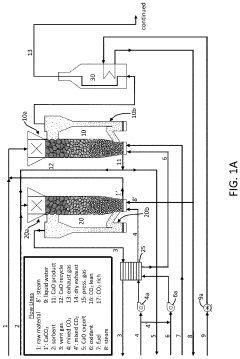
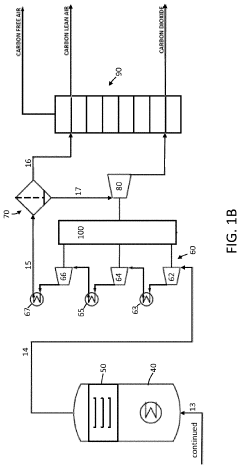
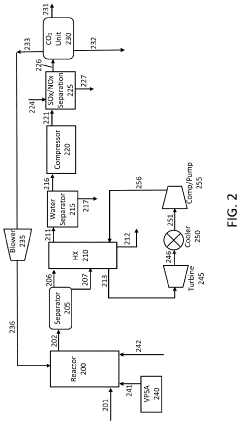
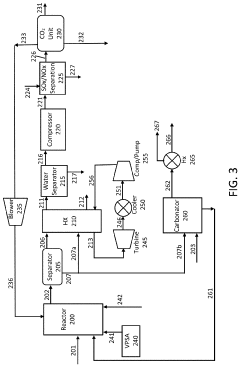
- A system and method that integrates carbon capture with calcination processes, utilizing a reactor, separator, heat exchange unit, and CO2 separation unit to capture and purify CO2, while also producing industrially useful products like cement and steel, using a carbonator to recycle calcium oxide and integrate with power generation cycles.


Systems and methods for carbon capture
PatentInactiveUS20220203297A1
Innovation
- A system and method for capturing CO2 during calcination processes, integrating carbon capture with cement, steel, and power production, utilizing a reactor, separator, heat exchange unit, and CO2 separation unit, including oxygen provision and membrane separation, to produce 'carbon dioxide-free' industrial products and integrate with power plants for efficient CO2 utilization.
Regulatory Framework for CCUS
The regulatory landscape for Carbon Capture, Utilization, and Storage (CCUS) technologies varies significantly across regions, creating a complex framework that industry participants must navigate. In the United States, the EPA regulates CCUS primarily through the Underground Injection Control (UIC) program under the Safe Drinking Water Act, with Class VI wells specifically designated for CO2 storage. The 45Q tax credit has emerged as a critical financial incentive, offering up to $50 per metric ton of CO2 permanently sequestered, significantly improving project economics for industrial integration.
The European Union has established a comprehensive regulatory framework through the CCS Directive (2009/31/EC), which outlines requirements for site selection, permitting, monitoring, and long-term liability. The EU Emissions Trading System (EU ETS) provides market-based incentives by recognizing captured carbon as "not emitted," effectively creating financial value for carbon reduction. Recent amendments to the EU ETS have strengthened these incentives, particularly for industrial applications.
In Asia, regulatory approaches show considerable variation. China has incorporated CCUS into its climate strategy through the 14th Five-Year Plan, offering subsidies and preferential policies for demonstration projects in key industrial sectors. Japan focuses on offshore storage regulations through its Act on Prevention of Marine Pollution, while developing specific frameworks for industrial CCUS applications.
Liability frameworks represent a significant regulatory challenge across jurisdictions. Most frameworks transition long-term liability to government entities after a monitoring period (typically 10-30 years), but requirements for financial assurance during operational phases remain substantial barriers to widespread industrial adoption.
Permitting processes present another critical regulatory hurdle, with timelines ranging from 2-7 years depending on jurisdiction. This regulatory uncertainty affects investment decisions and project timelines for industrial integration. Recent regulatory innovations include the development of carbon accounting standards specific to industrial processes and streamlined permitting for integrated industrial CCUS projects.
International frameworks are evolving through mechanisms like the London Protocol amendment allowing cross-border CO2 transport for storage purposes. The development of ISO standards for quantification and verification of industrial carbon capture is advancing global harmonization efforts, though significant regional differences persist.
For successful industrial integration, regulatory frameworks must balance environmental protection with practical implementation pathways. Recent trends indicate movement toward performance-based regulations rather than prescriptive approaches, potentially accelerating industrial adoption while maintaining safety standards.
The European Union has established a comprehensive regulatory framework through the CCS Directive (2009/31/EC), which outlines requirements for site selection, permitting, monitoring, and long-term liability. The EU Emissions Trading System (EU ETS) provides market-based incentives by recognizing captured carbon as "not emitted," effectively creating financial value for carbon reduction. Recent amendments to the EU ETS have strengthened these incentives, particularly for industrial applications.
In Asia, regulatory approaches show considerable variation. China has incorporated CCUS into its climate strategy through the 14th Five-Year Plan, offering subsidies and preferential policies for demonstration projects in key industrial sectors. Japan focuses on offshore storage regulations through its Act on Prevention of Marine Pollution, while developing specific frameworks for industrial CCUS applications.
Liability frameworks represent a significant regulatory challenge across jurisdictions. Most frameworks transition long-term liability to government entities after a monitoring period (typically 10-30 years), but requirements for financial assurance during operational phases remain substantial barriers to widespread industrial adoption.
Permitting processes present another critical regulatory hurdle, with timelines ranging from 2-7 years depending on jurisdiction. This regulatory uncertainty affects investment decisions and project timelines for industrial integration. Recent regulatory innovations include the development of carbon accounting standards specific to industrial processes and streamlined permitting for integrated industrial CCUS projects.
International frameworks are evolving through mechanisms like the London Protocol amendment allowing cross-border CO2 transport for storage purposes. The development of ISO standards for quantification and verification of industrial carbon capture is advancing global harmonization efforts, though significant regional differences persist.
For successful industrial integration, regulatory frameworks must balance environmental protection with practical implementation pathways. Recent trends indicate movement toward performance-based regulations rather than prescriptive approaches, potentially accelerating industrial adoption while maintaining safety standards.
Economic Viability Assessment
The economic viability of carbon capture technologies in industrial integration remains a critical factor determining widespread adoption. Current cost estimates for carbon capture range from $40 to $120 per ton of CO2 captured, with significant variations based on industry type, capture method, and facility scale. These costs encompass capital expenditures for equipment installation, operational expenses including energy requirements, and maintenance considerations throughout the system lifecycle.
Energy penalties represent a substantial economic challenge, as most carbon capture systems require 15-30% additional energy input, directly impacting operational costs. This energy requirement creates a paradoxical situation where carbon capture technologies designed to reduce emissions may indirectly increase them through heightened energy consumption unless powered by renewable sources.
Financial incentives significantly influence economic feasibility. Carbon pricing mechanisms, tax credits like the 45Q in the United States (offering up to $50 per ton for geological storage), and emissions trading schemes provide crucial economic support. The EU Emissions Trading System has demonstrated how market-based approaches can gradually shift industrial priorities toward decarbonization when properly structured.
Return on investment timelines typically extend beyond traditional industrial project horizons, with most carbon capture installations requiring 7-15 years to achieve financial breakeven. This extended payback period presents challenges for securing investment, particularly in industries with tight profit margins or volatile market conditions.
Scale economies play a decisive role in viability assessments. Large-scale implementations generally achieve lower per-ton capture costs, creating advantages for major industrial facilities. Analysis of existing projects indicates that facilities capturing over 500,000 tons of CO2 annually can reduce costs by 20-40% compared to smaller installations.
Integration with existing value chains offers promising economic opportunities. Industries that can utilize captured carbon (enhanced oil recovery, concrete curing, chemical feedstock) demonstrate improved economic models. The cement industry, for example, has shown potential for cost reductions of 15-25% when captured carbon is incorporated into concrete products, creating circular economy benefits.
Future economic viability will likely improve through technological learning curves, with projected cost reductions of 5-8% annually as deployment scales. Policy stability remains essential for investment security, as fluctuating regulatory frameworks significantly impact risk assessments and capital allocation decisions across industrial sectors considering carbon capture implementation.
Energy penalties represent a substantial economic challenge, as most carbon capture systems require 15-30% additional energy input, directly impacting operational costs. This energy requirement creates a paradoxical situation where carbon capture technologies designed to reduce emissions may indirectly increase them through heightened energy consumption unless powered by renewable sources.
Financial incentives significantly influence economic feasibility. Carbon pricing mechanisms, tax credits like the 45Q in the United States (offering up to $50 per ton for geological storage), and emissions trading schemes provide crucial economic support. The EU Emissions Trading System has demonstrated how market-based approaches can gradually shift industrial priorities toward decarbonization when properly structured.
Return on investment timelines typically extend beyond traditional industrial project horizons, with most carbon capture installations requiring 7-15 years to achieve financial breakeven. This extended payback period presents challenges for securing investment, particularly in industries with tight profit margins or volatile market conditions.
Scale economies play a decisive role in viability assessments. Large-scale implementations generally achieve lower per-ton capture costs, creating advantages for major industrial facilities. Analysis of existing projects indicates that facilities capturing over 500,000 tons of CO2 annually can reduce costs by 20-40% compared to smaller installations.
Integration with existing value chains offers promising economic opportunities. Industries that can utilize captured carbon (enhanced oil recovery, concrete curing, chemical feedstock) demonstrate improved economic models. The cement industry, for example, has shown potential for cost reductions of 15-25% when captured carbon is incorporated into concrete products, creating circular economy benefits.
Future economic viability will likely improve through technological learning curves, with projected cost reductions of 5-8% annually as deployment scales. Policy stability remains essential for investment security, as fluctuating regulatory frameworks significantly impact risk assessments and capital allocation decisions across industrial sectors considering carbon capture implementation.
Unlock deeper insights with PatSnap Eureka Quick Research — get a full tech report to explore trends and direct your research. Try now!
Generate Your Research Report Instantly with AI Agent
Supercharge your innovation with PatSnap Eureka AI Agent Platform!