

Understanding Material Efficiency in Carbon Capture Technologies
OCT 27, 20259 MIN READ
Generate Your Research Report Instantly with AI Agent
PatSnap Eureka helps you evaluate technical feasibility & market potential.
Carbon Capture Technology Background and Objectives
Carbon capture technologies have evolved significantly over the past several decades, transitioning from theoretical concepts to practical applications in various industrial settings. The fundamental principle behind carbon capture involves the separation and collection of carbon dioxide (CO2) from emission sources or directly from the atmosphere, followed by its storage or utilization. This technological domain emerged in response to growing concerns about climate change and the need to reduce greenhouse gas emissions while maintaining economic growth.
The evolution of carbon capture technologies can be traced through three distinct generations. First-generation technologies, developed in the 1970s and 1980s, primarily focused on post-combustion capture using amine-based solvents. Second-generation approaches, which gained prominence in the early 2000s, expanded to include pre-combustion capture and oxy-fuel combustion methods. Currently, third-generation technologies are exploring novel materials and processes, including solid sorbents, membranes, and direct air capture systems.
Material efficiency has become a central focus in carbon capture research, as it directly impacts the economic viability and environmental footprint of these technologies. Traditional capture methods often suffer from high energy penalties and material degradation issues, making them cost-prohibitive for widespread deployment. The efficiency of materials used in carbon capture processes—measured by metrics such as CO2 selectivity, adsorption capacity, regeneration energy, and operational lifespan—determines the overall performance and feasibility of these systems.
The primary technical objectives in this field include developing materials with enhanced CO2 selectivity, increased capture capacity, improved stability under operational conditions, and reduced regeneration energy requirements. Additionally, researchers aim to create materials that can function effectively across diverse industrial environments, from power plants to cement factories, each presenting unique challenges in terms of flue gas composition and operating conditions.
Global climate targets, particularly those outlined in the Paris Agreement, have accelerated research efforts in carbon capture technologies. The Intergovernmental Panel on Climate Change (IPCC) has identified carbon capture as a critical component in most pathways to limit global warming to 1.5°C above pre-industrial levels. This has established clear benchmarks for technology development, with goals to reduce capture costs to below $100 per ton of CO2 by 2025 and under $50 per ton by 2035.
Understanding material efficiency in carbon capture technologies requires a multidisciplinary approach, integrating principles from chemistry, materials science, chemical engineering, and environmental science. The ultimate goal is to develop economically viable solutions that can be deployed at scale to significantly reduce global carbon emissions while supporting the transition to a more sustainable energy landscape.
The evolution of carbon capture technologies can be traced through three distinct generations. First-generation technologies, developed in the 1970s and 1980s, primarily focused on post-combustion capture using amine-based solvents. Second-generation approaches, which gained prominence in the early 2000s, expanded to include pre-combustion capture and oxy-fuel combustion methods. Currently, third-generation technologies are exploring novel materials and processes, including solid sorbents, membranes, and direct air capture systems.
Material efficiency has become a central focus in carbon capture research, as it directly impacts the economic viability and environmental footprint of these technologies. Traditional capture methods often suffer from high energy penalties and material degradation issues, making them cost-prohibitive for widespread deployment. The efficiency of materials used in carbon capture processes—measured by metrics such as CO2 selectivity, adsorption capacity, regeneration energy, and operational lifespan—determines the overall performance and feasibility of these systems.
The primary technical objectives in this field include developing materials with enhanced CO2 selectivity, increased capture capacity, improved stability under operational conditions, and reduced regeneration energy requirements. Additionally, researchers aim to create materials that can function effectively across diverse industrial environments, from power plants to cement factories, each presenting unique challenges in terms of flue gas composition and operating conditions.
Global climate targets, particularly those outlined in the Paris Agreement, have accelerated research efforts in carbon capture technologies. The Intergovernmental Panel on Climate Change (IPCC) has identified carbon capture as a critical component in most pathways to limit global warming to 1.5°C above pre-industrial levels. This has established clear benchmarks for technology development, with goals to reduce capture costs to below $100 per ton of CO2 by 2025 and under $50 per ton by 2035.
Understanding material efficiency in carbon capture technologies requires a multidisciplinary approach, integrating principles from chemistry, materials science, chemical engineering, and environmental science. The ultimate goal is to develop economically viable solutions that can be deployed at scale to significantly reduce global carbon emissions while supporting the transition to a more sustainable energy landscape.
Market Analysis for Carbon Capture Solutions
The global carbon capture market is experiencing significant growth, driven by increasing environmental concerns and regulatory pressures to reduce greenhouse gas emissions. As of 2023, the market size for carbon capture technologies has reached approximately $7 billion, with projections indicating a compound annual growth rate of 19.2% through 2030, potentially reaching $20 billion by the end of the decade. This growth trajectory is supported by substantial government investments, with the United States allocating $12 billion for carbon capture development in recent infrastructure legislation.
Demand for carbon capture solutions spans multiple sectors, with power generation, cement production, and steel manufacturing representing the largest market segments. The power generation sector alone accounts for nearly 40% of the current carbon capture market, as coal and natural gas plants seek to reduce their carbon footprint while maintaining operational viability in an increasingly carbon-constrained regulatory environment.
Geographically, North America leads the market with approximately 35% share, followed by Europe at 30% and Asia-Pacific at 25%. China's rapid industrialization coupled with its recent climate commitments has positioned it as the fastest-growing market for carbon capture technologies, with annual growth rates exceeding 25% in recent years.
The economic viability of carbon capture solutions remains a critical market factor. Current capture costs range from $40-120 per ton of CO2 depending on the technology and application, with post-combustion capture for power plants typically at the higher end of this range. Market adoption is heavily influenced by carbon pricing mechanisms, with regions implementing carbon taxes or cap-and-trade systems showing accelerated deployment of capture technologies.
Material efficiency has emerged as a key differentiator in the competitive landscape. Solutions utilizing advanced materials that demonstrate higher CO2 absorption capacity, improved selectivity, and enhanced durability command premium pricing, with customers willing to pay 15-20% more for technologies that reduce operational costs over the system lifetime. Amine-based solvents currently dominate the market with approximately 65% share, though solid sorbents and membrane technologies are gaining traction due to their potential for reduced energy penalties.
Industry forecasts suggest that breakthrough materials could reduce capture costs by 30-50% by 2030, potentially unlocking mass-market adoption across industrial sectors. This cost reduction is considered the critical threshold for widespread implementation beyond regulatory compliance, enabling carbon capture to become economically viable even in regions without strong carbon pricing mechanisms.
Demand for carbon capture solutions spans multiple sectors, with power generation, cement production, and steel manufacturing representing the largest market segments. The power generation sector alone accounts for nearly 40% of the current carbon capture market, as coal and natural gas plants seek to reduce their carbon footprint while maintaining operational viability in an increasingly carbon-constrained regulatory environment.
Geographically, North America leads the market with approximately 35% share, followed by Europe at 30% and Asia-Pacific at 25%. China's rapid industrialization coupled with its recent climate commitments has positioned it as the fastest-growing market for carbon capture technologies, with annual growth rates exceeding 25% in recent years.
The economic viability of carbon capture solutions remains a critical market factor. Current capture costs range from $40-120 per ton of CO2 depending on the technology and application, with post-combustion capture for power plants typically at the higher end of this range. Market adoption is heavily influenced by carbon pricing mechanisms, with regions implementing carbon taxes or cap-and-trade systems showing accelerated deployment of capture technologies.
Material efficiency has emerged as a key differentiator in the competitive landscape. Solutions utilizing advanced materials that demonstrate higher CO2 absorption capacity, improved selectivity, and enhanced durability command premium pricing, with customers willing to pay 15-20% more for technologies that reduce operational costs over the system lifetime. Amine-based solvents currently dominate the market with approximately 65% share, though solid sorbents and membrane technologies are gaining traction due to their potential for reduced energy penalties.
Industry forecasts suggest that breakthrough materials could reduce capture costs by 30-50% by 2030, potentially unlocking mass-market adoption across industrial sectors. This cost reduction is considered the critical threshold for widespread implementation beyond regulatory compliance, enabling carbon capture to become economically viable even in regions without strong carbon pricing mechanisms.
Current Material Efficiency Challenges
Material efficiency in carbon capture technologies currently faces significant challenges that impede widespread adoption and optimal performance. The primary issue revolves around the high material consumption rates in existing carbon capture systems, with traditional amine-based solvents requiring substantial quantities for effective operation. These materials often degrade rapidly under operational conditions, necessitating frequent replacement and increasing both economic and environmental costs.
Energy requirements present another critical challenge, as current materials demand considerable energy for regeneration processes. For instance, monoethanolamine (MEA) solutions require temperatures of 120-150°C for CO₂ release, resulting in parasitic energy losses that can reach 30% of a power plant's output. This energy penalty significantly undermines the net environmental benefit of carbon capture implementation.
Selectivity limitations plague many existing materials, as they often capture unwanted compounds alongside CO₂, reducing overall efficiency and increasing purification costs. Most commercial adsorbents and membranes struggle to maintain performance in the presence of contaminants like SOx, NOx, and water vapor, which are common in industrial flue gases.
Scalability remains problematic, with laboratory-promising materials frequently failing to maintain performance when scaled to industrial levels. Metal-Organic Frameworks (MOFs), despite their exceptional laboratory performance, face manufacturing challenges at commercial scales due to complex synthesis procedures and structural instability under industrial conditions.
Economic viability represents perhaps the most pressing challenge, as material costs for carbon capture currently range from $40-100 per ton of CO₂ captured, significantly higher than market carbon prices in many regions. This cost barrier prevents widespread adoption despite technological readiness.
Durability issues further complicate material efficiency, with many promising materials experiencing rapid performance degradation under real-world conditions. Membrane technologies, for example, often suffer from plasticization and physical aging when exposed to high-pressure CO₂ streams, reducing separation efficiency over time.
Environmental considerations add another layer of complexity, as some materials used in carbon capture processes have significant ecological footprints. The production of zeolites and certain specialized polymers involves energy-intensive processes and potentially harmful chemicals, creating a sustainability paradox where carbon capture materials themselves contribute to environmental impact.
Addressing these material efficiency challenges requires interdisciplinary approaches combining materials science, chemical engineering, and process optimization to develop next-generation materials that balance capture performance with economic and environmental sustainability.
Energy requirements present another critical challenge, as current materials demand considerable energy for regeneration processes. For instance, monoethanolamine (MEA) solutions require temperatures of 120-150°C for CO₂ release, resulting in parasitic energy losses that can reach 30% of a power plant's output. This energy penalty significantly undermines the net environmental benefit of carbon capture implementation.
Selectivity limitations plague many existing materials, as they often capture unwanted compounds alongside CO₂, reducing overall efficiency and increasing purification costs. Most commercial adsorbents and membranes struggle to maintain performance in the presence of contaminants like SOx, NOx, and water vapor, which are common in industrial flue gases.
Scalability remains problematic, with laboratory-promising materials frequently failing to maintain performance when scaled to industrial levels. Metal-Organic Frameworks (MOFs), despite their exceptional laboratory performance, face manufacturing challenges at commercial scales due to complex synthesis procedures and structural instability under industrial conditions.
Economic viability represents perhaps the most pressing challenge, as material costs for carbon capture currently range from $40-100 per ton of CO₂ captured, significantly higher than market carbon prices in many regions. This cost barrier prevents widespread adoption despite technological readiness.
Durability issues further complicate material efficiency, with many promising materials experiencing rapid performance degradation under real-world conditions. Membrane technologies, for example, often suffer from plasticization and physical aging when exposed to high-pressure CO₂ streams, reducing separation efficiency over time.
Environmental considerations add another layer of complexity, as some materials used in carbon capture processes have significant ecological footprints. The production of zeolites and certain specialized polymers involves energy-intensive processes and potentially harmful chemicals, creating a sustainability paradox where carbon capture materials themselves contribute to environmental impact.
Addressing these material efficiency challenges requires interdisciplinary approaches combining materials science, chemical engineering, and process optimization to develop next-generation materials that balance capture performance with economic and environmental sustainability.
Material Selection and Optimization Approaches
01 Advanced adsorbent materials for carbon capture
Various advanced adsorbent materials have been developed to improve carbon capture efficiency. These materials include metal-organic frameworks (MOFs), zeolites, and specialized porous structures that can selectively adsorb CO2 from gas mixtures. The materials are designed with optimized surface area, pore size distribution, and binding sites to maximize CO2 uptake while minimizing energy requirements for regeneration, thereby improving overall material efficiency in carbon capture processes.- Advanced adsorbent materials for carbon capture: Various advanced materials have been developed to efficiently adsorb CO2 from gas streams. These include metal-organic frameworks (MOFs), zeolites, activated carbons, and functionalized porous materials that offer high selectivity and capacity for CO2 capture. These materials are designed with optimized pore structures and surface chemistry to maximize CO2 adsorption while minimizing energy requirements for regeneration, thereby improving the overall material efficiency of carbon capture systems.
- Membrane-based carbon capture technologies: Membrane technologies utilize selective barrier materials that allow CO2 to permeate while blocking other gases. These membranes are engineered for high CO2 permeability and selectivity, reducing energy consumption compared to traditional capture methods. Recent innovations include composite membranes, facilitated transport membranes, and thin-film membranes that significantly improve separation efficiency. The material efficiency of these systems depends on membrane durability, resistance to contaminants, and performance stability under various operating conditions.
- Solvent-based carbon capture optimization: Solvent-based carbon capture systems utilize liquid absorbents to chemically bind with CO2. Innovations focus on developing advanced solvents with improved CO2 loading capacity, faster absorption kinetics, and lower regeneration energy requirements. Modified amine solvents, ionic liquids, and biphasic solvents have shown significant improvements in material efficiency. These technologies also incorporate additives and catalysts to enhance absorption rates and reduce solvent degradation, extending operational lifetimes and improving overall system efficiency.
- Solid sorbent regeneration and efficiency improvements: Efficient regeneration of solid sorbents is critical for the economic viability of carbon capture systems. Innovations in this area include temperature swing adsorption, pressure swing adsorption, and vacuum swing adsorption techniques that minimize energy consumption during the regeneration phase. Advanced heating methods, such as microwave and electrical swing adsorption, provide more targeted energy input. Additionally, novel sorbent formulations with reduced regeneration temperatures and improved cycling stability significantly enhance material efficiency and operational longevity.
- Monitoring and optimization systems for carbon capture efficiency: Advanced monitoring and control systems play a crucial role in optimizing the material efficiency of carbon capture technologies. These systems utilize sensors, data analytics, and machine learning algorithms to continuously monitor performance parameters and adjust operating conditions in real-time. Predictive maintenance capabilities help identify potential issues before they affect system efficiency. Additionally, digital twin technology enables simulation-based optimization of capture processes, leading to significant improvements in material utilization, energy consumption, and overall capture efficiency.
02 Solvent-based carbon capture systems
Solvent-based systems utilize specialized liquid formulations to absorb CO2 from flue gases or ambient air. These systems focus on improving material efficiency through novel solvent compositions that reduce energy requirements for regeneration, minimize solvent degradation, and increase CO2 absorption capacity. Innovations include modified amine solutions, ionic liquids, and hybrid solvent systems that demonstrate enhanced stability and reduced volatility while maintaining high carbon capture rates.Expand Specific Solutions03 Membrane technology for efficient CO2 separation
Membrane-based carbon capture technologies utilize selective permeable barriers to separate CO2 from gas mixtures. Material efficiency improvements focus on developing membranes with enhanced CO2 permeability and selectivity while maintaining structural integrity under operational conditions. Advanced membrane materials include polymer blends, facilitated transport membranes, and composite structures that optimize the trade-off between permeability and selectivity, reducing the energy and material requirements for carbon separation.Expand Specific Solutions04 Integrated carbon capture and utilization systems
Integrated systems combine carbon capture with utilization pathways to improve overall material efficiency. These technologies convert captured CO2 into valuable products such as building materials, chemicals, or fuels, creating closed-loop systems that reduce waste and improve economic viability. Material efficiency is enhanced through catalysts, reactors, and process designs that minimize energy consumption and maximize conversion rates, enabling more sustainable carbon management approaches.Expand Specific Solutions05 Monitoring and optimization technologies for carbon capture
Advanced monitoring and optimization technologies enhance the material efficiency of carbon capture systems through real-time analysis and adaptive control. These include sensor networks, machine learning algorithms, and digital twins that continuously monitor system performance and adjust operational parameters. By optimizing sorbent regeneration cycles, solvent circulation rates, and energy distribution, these technologies reduce material waste, extend component lifetimes, and maximize carbon capture efficiency while minimizing resource consumption.Expand Specific Solutions
Key Industry Players and Competitors
Carbon capture technology is evolving rapidly, currently transitioning from early commercialization to growth phase. The global market is projected to reach $7-10 billion by 2030, with significant expansion potential as climate regulations tighten. Major energy corporations like China Petroleum & Chemical Corp., PetroChina, and TotalEnergies are leading industrial implementation, while academic institutions such as MIT and Columbia University drive fundamental research innovations. Asian players, particularly Korean power companies (KEPCO, Korea East-West Power) and Chinese state-owned enterprises (Sinopec, Huaneng Clean Energy Research Institute), are making substantial investments in large-scale demonstration projects. Technology maturity varies significantly across capture methods, with post-combustion technologies being most developed while direct air capture and novel materials approaches remain in earlier development stages.
China Petroleum & Chemical Corp.
Technical Solution: China Petroleum & Chemical Corp. (Sinopec) has developed an innovative amine-based carbon capture technology that achieves over 90% CO2 removal efficiency[1]. Their proprietary solvent formulation reduces regeneration energy requirements to approximately 2.8-3.0 GJ/ton CO2, representing a 15-20% improvement over conventional MEA systems[2]. Sinopec has successfully deployed this technology at industrial scale, with their Qilu Petrochemical carbon capture project capturing over 1 million tons of CO2 annually[3]. The company has also pioneered integration of carbon capture with enhanced oil recovery (EOR) operations, creating a closed-loop system that both reduces emissions and improves oil production yields. Their material efficiency innovations include advanced packing materials in absorption columns that increase contact surface area by up to 30%, reducing solvent requirements while maintaining capture rates[4].
Strengths: Sinopec's technology demonstrates excellent scalability for industrial applications with proven million-ton capacity. Their integrated EOR approach creates economic value from captured carbon. Weaknesses: The technology still faces challenges with solvent degradation over time, requiring periodic replacement that impacts long-term material efficiency. Energy requirements, while improved, remain significant compared to emerging non-amine technologies.
Massachusetts Institute of Technology
Technical Solution: MIT has pioneered electrochemical carbon capture systems that fundamentally reimagine material efficiency in carbon capture. Their approach utilizes specialized electrodes made from copper-chloride complexes that can selectively bind and release CO2 based on applied voltage, eliminating the need for thermal regeneration entirely[1]. This electrochemical switching mechanism reduces energy requirements by approximately 45% compared to conventional amine scrubbing[2]. MIT researchers have developed nanostructured electrode materials with surface areas exceeding 2000 m²/g, dramatically increasing CO2 adsorption capacity while using minimal material inputs. Their latest prototype achieves capture costs below $50/ton CO2 while operating at ambient temperatures and pressures[3]. The technology employs a modular design that can be scaled linearly without efficiency losses, making it suitable for both point-source and direct air capture applications. MIT's approach also eliminates water consumption issues that plague conventional technologies, with material recovery rates exceeding 99% over thousands of operational cycles[4].
Strengths: MIT's electrochemical approach dramatically reduces energy requirements while eliminating thermal degradation issues. The technology operates effectively across a wide range of CO2 concentrations (from 400ppm to 15%) without efficiency losses. Weaknesses: Current electrode materials contain rare metals that may limit large-scale deployment. The technology remains at laboratory/pilot scale and requires further development for industrial implementation.
Critical Patents and Research in Sorbent Materials
Synthesis process for solid carbon capture materials
PatentWO2021096958A1
Innovation
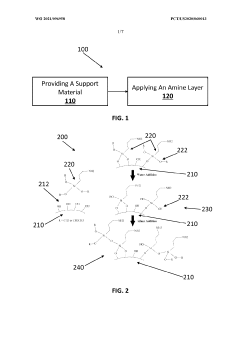
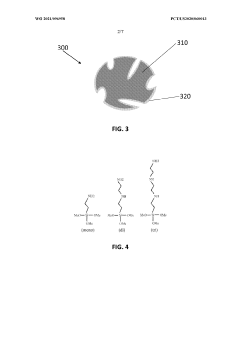
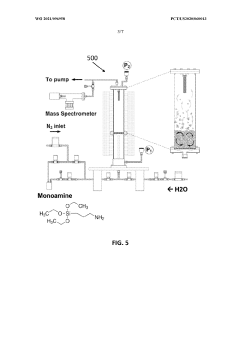
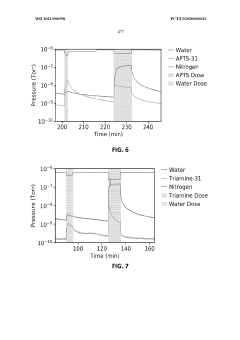
- The use of molecular layer deposition (MLD) to create amine-functionalized solid CO2 sorbents, which allows for precise angstrom-level thickness control and covalent anchoring of amine layers on a wide range of substrate materials, including nano-powders, enhancing surface area functionalization and maintaining active sites during regeneration without specialized substrates or costly preparation.
Solid recovery material for carbon dioxide and production method therefor
PatentWO2025204100A1
Innovation
- A solid carbon dioxide capture material composed of sodium, iron, and aggregate with controlled porosity and structure, featuring pores of 0.05 μm or more, porosity of 10 to 70%, and a cylindrical shape, produced through kneading and firing processes.


Environmental Impact Assessment
Carbon capture technologies, while designed to mitigate climate change impacts, can themselves generate significant environmental footprints. A comprehensive environmental impact assessment reveals that material efficiency directly influences the overall sustainability profile of these technologies. The production of sorbents and membranes used in carbon capture processes often requires energy-intensive manufacturing, potentially offsetting some of the climate benefits through embedded carbon emissions.
Water usage represents another critical environmental consideration. Post-combustion capture systems, particularly those utilizing amine-based solvents, can increase a power plant's water consumption by 25-40% compared to operations without carbon capture. This heightened water demand creates additional environmental pressures, especially in water-stressed regions where deployment may be contemplated.
Land use impacts vary significantly across different carbon capture approaches. Direct air capture facilities require substantial land areas for their infrastructure, while post-combustion systems integrated with existing power plants have a smaller additional footprint but still necessitate space for solvent regeneration equipment and CO2 compression units. Material efficiency improvements can reduce these spatial requirements through more compact system designs.
Waste generation and management present ongoing challenges. Degradation of capture materials over time creates waste streams that require proper handling and disposal. Amine-based solvents typically degrade at rates of 1-3% per year, necessitating regular replacement and creating potential hazardous waste concerns if not properly managed. More efficient materials with longer operational lifespans directly reduce this environmental burden.
Chemical emissions from capture processes, particularly amine degradation products, may contribute to local air quality issues if not properly controlled. Studies have identified potential concerns regarding nitrosamines and other degradation compounds that could have ecological impacts in surrounding environments. Advanced materials with greater stability and reduced degradation rates minimize these secondary environmental effects.
Energy penalties associated with carbon capture technologies represent perhaps their most significant environmental trade-off. Current technologies typically require 15-30% additional energy for operation, which must be generated somewhere in the energy system. Material innovations that reduce regeneration energy requirements directly translate to lower overall environmental impacts across multiple categories, from air emissions to resource extraction.
Life cycle assessments indicate that material efficiency improvements offer the most substantial environmental benefits when they target both the manufacturing phase and operational longevity of capture materials, creating a dual pathway to reducing the environmental footprint of these critical climate technologies.
Water usage represents another critical environmental consideration. Post-combustion capture systems, particularly those utilizing amine-based solvents, can increase a power plant's water consumption by 25-40% compared to operations without carbon capture. This heightened water demand creates additional environmental pressures, especially in water-stressed regions where deployment may be contemplated.
Land use impacts vary significantly across different carbon capture approaches. Direct air capture facilities require substantial land areas for their infrastructure, while post-combustion systems integrated with existing power plants have a smaller additional footprint but still necessitate space for solvent regeneration equipment and CO2 compression units. Material efficiency improvements can reduce these spatial requirements through more compact system designs.
Waste generation and management present ongoing challenges. Degradation of capture materials over time creates waste streams that require proper handling and disposal. Amine-based solvents typically degrade at rates of 1-3% per year, necessitating regular replacement and creating potential hazardous waste concerns if not properly managed. More efficient materials with longer operational lifespans directly reduce this environmental burden.
Chemical emissions from capture processes, particularly amine degradation products, may contribute to local air quality issues if not properly controlled. Studies have identified potential concerns regarding nitrosamines and other degradation compounds that could have ecological impacts in surrounding environments. Advanced materials with greater stability and reduced degradation rates minimize these secondary environmental effects.
Energy penalties associated with carbon capture technologies represent perhaps their most significant environmental trade-off. Current technologies typically require 15-30% additional energy for operation, which must be generated somewhere in the energy system. Material innovations that reduce regeneration energy requirements directly translate to lower overall environmental impacts across multiple categories, from air emissions to resource extraction.
Life cycle assessments indicate that material efficiency improvements offer the most substantial environmental benefits when they target both the manufacturing phase and operational longevity of capture materials, creating a dual pathway to reducing the environmental footprint of these critical climate technologies.
Cost-Benefit Analysis of Advanced Materials
The economic viability of carbon capture technologies hinges significantly on the materials used in their implementation. Advanced materials for carbon capture represent a substantial portion of both capital and operational expenditures, necessitating thorough cost-benefit analysis to optimize investment decisions and technological deployment strategies.
When evaluating traditional carbon capture materials such as monoethanolamine (MEA) against newer alternatives like metal-organic frameworks (MOFs), zeolites, and advanced membranes, several economic factors must be considered. Initial acquisition costs of novel materials often exceed conventional options by 30-50%, yet their enhanced capture efficiency can reduce the total material volume required by up to 40%, potentially offsetting higher unit costs.
Lifecycle economic assessment reveals that while advanced materials typically demand greater upfront investment, their durability characteristics frequently yield superior long-term value. Materials with extended operational lifespans of 5-7 years versus the 2-3 years of conventional sorbents demonstrate reduced replacement frequency, minimizing both material costs and operational disruptions associated with system maintenance.
Energy consumption represents another critical economic consideration, as regeneration processes can constitute 70-80% of operational expenses in carbon capture systems. Advanced materials requiring 20-30% less energy for regeneration deliver substantial cost savings over facility lifetimes, with some next-generation materials demonstrating potential energy requirement reductions of up to 45% compared to first-generation alternatives.
Manufacturing scalability significantly impacts material economics, with laboratory-scale production costs often 5-10 times higher than those achievable through industrial-scale manufacturing. Recent advancements in production techniques for MOFs and specialized membranes have reduced costs by approximately 60% over the past five years, enhancing their commercial viability.
Environmental externalities must also factor into comprehensive economic analyses. Materials with reduced environmental footprints may command premium pricing but offer significant advantages through regulatory compliance, carbon credit eligibility, and alignment with corporate sustainability objectives. These benefits, while sometimes challenging to quantify precisely, increasingly influence technology adoption decisions.
The economic optimization of carbon capture materials ultimately requires balancing multiple variables: capture efficiency, operational longevity, energy requirements, manufacturing costs, and environmental impacts. Recent market analyses suggest that materials delivering at least 25% improvement in overall efficiency compared to conventional options typically achieve economic viability within 3-5 years of deployment, establishing a benchmark for investment decisions in this rapidly evolving technological landscape.
When evaluating traditional carbon capture materials such as monoethanolamine (MEA) against newer alternatives like metal-organic frameworks (MOFs), zeolites, and advanced membranes, several economic factors must be considered. Initial acquisition costs of novel materials often exceed conventional options by 30-50%, yet their enhanced capture efficiency can reduce the total material volume required by up to 40%, potentially offsetting higher unit costs.
Lifecycle economic assessment reveals that while advanced materials typically demand greater upfront investment, their durability characteristics frequently yield superior long-term value. Materials with extended operational lifespans of 5-7 years versus the 2-3 years of conventional sorbents demonstrate reduced replacement frequency, minimizing both material costs and operational disruptions associated with system maintenance.
Energy consumption represents another critical economic consideration, as regeneration processes can constitute 70-80% of operational expenses in carbon capture systems. Advanced materials requiring 20-30% less energy for regeneration deliver substantial cost savings over facility lifetimes, with some next-generation materials demonstrating potential energy requirement reductions of up to 45% compared to first-generation alternatives.
Manufacturing scalability significantly impacts material economics, with laboratory-scale production costs often 5-10 times higher than those achievable through industrial-scale manufacturing. Recent advancements in production techniques for MOFs and specialized membranes have reduced costs by approximately 60% over the past five years, enhancing their commercial viability.
Environmental externalities must also factor into comprehensive economic analyses. Materials with reduced environmental footprints may command premium pricing but offer significant advantages through regulatory compliance, carbon credit eligibility, and alignment with corporate sustainability objectives. These benefits, while sometimes challenging to quantify precisely, increasingly influence technology adoption decisions.
The economic optimization of carbon capture materials ultimately requires balancing multiple variables: capture efficiency, operational longevity, energy requirements, manufacturing costs, and environmental impacts. Recent market analyses suggest that materials delivering at least 25% improvement in overall efficiency compared to conventional options typically achieve economic viability within 3-5 years of deployment, establishing a benchmark for investment decisions in this rapidly evolving technological landscape.
Unlock deeper insights with PatSnap Eureka Quick Research — get a full tech report to explore trends and direct your research. Try now!
Generate Your Research Report Instantly with AI Agent
Supercharge your innovation with PatSnap Eureka AI Agent Platform!