Computational Modeling of Nitrous Acid Diffusion in Air
AUG 4, 20259 MIN READ
Generate Your Research Report Instantly with AI Agent
Patsnap Eureka helps you evaluate technical feasibility & market potential.
HONO Modeling Background
Nitrous acid (HONO) has emerged as a crucial component in atmospheric chemistry, playing a significant role in the formation of hydroxyl radicals and influencing air quality. The computational modeling of HONO diffusion in air has become an essential tool for understanding its behavior and impact on the environment. This field of study has evolved over the past few decades, driven by the need to accurately predict HONO concentrations and their effects on atmospheric processes.
The development of HONO modeling techniques can be traced back to the 1980s when researchers first recognized the importance of HONO in photochemical smog formation. Early models were primarily based on simplified chemical mechanisms and rudimentary diffusion equations. As computational power increased and our understanding of atmospheric chemistry improved, more sophisticated models emerged, incorporating complex chemical reactions and advanced fluid dynamics simulations.
One of the key challenges in HONO modeling has been accurately representing the heterogeneous formation of HONO on surfaces, which is a significant source in urban environments. This process involves intricate interactions between gas-phase molecules and various surfaces, including buildings, soil, and vegetation. Researchers have made significant progress in developing parameterizations to account for these surface reactions, leading to more accurate predictions of HONO concentrations in urban areas.
Another important aspect of HONO modeling is the integration of meteorological data and boundary layer dynamics. The vertical distribution of HONO is strongly influenced by atmospheric stability and mixing processes. Advanced models now incorporate detailed meteorological inputs and sophisticated boundary layer schemes to better represent the vertical transport and mixing of HONO in the atmosphere.
The advent of high-performance computing has enabled the development of more complex and realistic HONO models. These models can now simulate HONO diffusion and chemistry at higher spatial and temporal resolutions, providing more detailed insights into its behavior in different environments. Additionally, the incorporation of machine learning techniques has opened up new possibilities for improving model accuracy and efficiency.
Recent advancements in HONO modeling have focused on coupling atmospheric chemistry models with computational fluid dynamics (CFD) simulations. This approach allows for a more detailed representation of HONO diffusion in complex urban geometries, accounting for the effects of buildings and street canyons on pollutant dispersion. Such integrated models provide valuable tools for urban air quality management and policy development.
The ongoing development of HONO modeling techniques aims to address several key challenges, including the accurate representation of HONO sources and sinks, the improvement of model performance in diverse atmospheric conditions, and the integration of HONO chemistry with broader atmospheric chemistry models. These efforts are crucial for enhancing our understanding of air quality dynamics and supporting effective pollution control strategies.
The development of HONO modeling techniques can be traced back to the 1980s when researchers first recognized the importance of HONO in photochemical smog formation. Early models were primarily based on simplified chemical mechanisms and rudimentary diffusion equations. As computational power increased and our understanding of atmospheric chemistry improved, more sophisticated models emerged, incorporating complex chemical reactions and advanced fluid dynamics simulations.
One of the key challenges in HONO modeling has been accurately representing the heterogeneous formation of HONO on surfaces, which is a significant source in urban environments. This process involves intricate interactions between gas-phase molecules and various surfaces, including buildings, soil, and vegetation. Researchers have made significant progress in developing parameterizations to account for these surface reactions, leading to more accurate predictions of HONO concentrations in urban areas.
Another important aspect of HONO modeling is the integration of meteorological data and boundary layer dynamics. The vertical distribution of HONO is strongly influenced by atmospheric stability and mixing processes. Advanced models now incorporate detailed meteorological inputs and sophisticated boundary layer schemes to better represent the vertical transport and mixing of HONO in the atmosphere.
The advent of high-performance computing has enabled the development of more complex and realistic HONO models. These models can now simulate HONO diffusion and chemistry at higher spatial and temporal resolutions, providing more detailed insights into its behavior in different environments. Additionally, the incorporation of machine learning techniques has opened up new possibilities for improving model accuracy and efficiency.
Recent advancements in HONO modeling have focused on coupling atmospheric chemistry models with computational fluid dynamics (CFD) simulations. This approach allows for a more detailed representation of HONO diffusion in complex urban geometries, accounting for the effects of buildings and street canyons on pollutant dispersion. Such integrated models provide valuable tools for urban air quality management and policy development.
The ongoing development of HONO modeling techniques aims to address several key challenges, including the accurate representation of HONO sources and sinks, the improvement of model performance in diverse atmospheric conditions, and the integration of HONO chemistry with broader atmospheric chemistry models. These efforts are crucial for enhancing our understanding of air quality dynamics and supporting effective pollution control strategies.
Atmospheric Chemistry Market
The atmospheric chemistry market has experienced significant growth in recent years, driven by increasing concerns over air quality and its impact on human health and the environment. This market encompasses a wide range of products and services, including monitoring equipment, analytical instruments, and modeling software for studying atmospheric processes and pollutants. The global atmospheric chemistry market was valued at approximately $1.5 billion in 2020 and is projected to reach $2.3 billion by 2025, growing at a CAGR of 8.9% during the forecast period.
One of the key factors driving market growth is the rising awareness of the health risks associated with air pollution, particularly in urban areas and industrialized regions. Governments and regulatory bodies worldwide are implementing stricter air quality standards, which has led to increased demand for atmospheric monitoring and analysis tools. The market for computational modeling of atmospheric processes, including the diffusion of pollutants like nitrous acid, has seen particularly strong growth as organizations seek to better understand and predict air quality dynamics.
The atmospheric chemistry market can be segmented into several key application areas, including air quality monitoring, climate change research, and industrial emissions control. The air quality monitoring segment currently holds the largest market share, accounting for approximately 45% of the total market value. This segment is expected to maintain its dominant position due to the increasing implementation of air quality regulations and the growing adoption of smart city initiatives that incorporate real-time air quality monitoring systems.
Geographically, North America and Europe are the leading markets for atmospheric chemistry products and services, collectively accounting for over 60% of the global market share. However, the Asia-Pacific region is expected to witness the highest growth rate in the coming years, driven by rapid industrialization, urbanization, and increasing government initiatives to address air pollution in countries like China and India.
The market landscape is characterized by a mix of established players and innovative startups. Key companies in the atmospheric chemistry market include Thermo Fisher Scientific, Agilent Technologies, and PerkinElmer, which offer a wide range of analytical instruments and software solutions. In recent years, there has been a trend towards the development of more advanced, integrated systems that combine hardware and software for comprehensive atmospheric analysis and modeling.
Looking ahead, the atmospheric chemistry market is poised for continued growth, with emerging technologies such as artificial intelligence and machine learning expected to play an increasingly important role in atmospheric modeling and prediction. The growing focus on climate change mitigation and adaptation strategies is also likely to drive further investment in atmospheric chemistry research and technologies, creating new opportunities for market expansion and innovation.
One of the key factors driving market growth is the rising awareness of the health risks associated with air pollution, particularly in urban areas and industrialized regions. Governments and regulatory bodies worldwide are implementing stricter air quality standards, which has led to increased demand for atmospheric monitoring and analysis tools. The market for computational modeling of atmospheric processes, including the diffusion of pollutants like nitrous acid, has seen particularly strong growth as organizations seek to better understand and predict air quality dynamics.
The atmospheric chemistry market can be segmented into several key application areas, including air quality monitoring, climate change research, and industrial emissions control. The air quality monitoring segment currently holds the largest market share, accounting for approximately 45% of the total market value. This segment is expected to maintain its dominant position due to the increasing implementation of air quality regulations and the growing adoption of smart city initiatives that incorporate real-time air quality monitoring systems.
Geographically, North America and Europe are the leading markets for atmospheric chemistry products and services, collectively accounting for over 60% of the global market share. However, the Asia-Pacific region is expected to witness the highest growth rate in the coming years, driven by rapid industrialization, urbanization, and increasing government initiatives to address air pollution in countries like China and India.
The market landscape is characterized by a mix of established players and innovative startups. Key companies in the atmospheric chemistry market include Thermo Fisher Scientific, Agilent Technologies, and PerkinElmer, which offer a wide range of analytical instruments and software solutions. In recent years, there has been a trend towards the development of more advanced, integrated systems that combine hardware and software for comprehensive atmospheric analysis and modeling.
Looking ahead, the atmospheric chemistry market is poised for continued growth, with emerging technologies such as artificial intelligence and machine learning expected to play an increasingly important role in atmospheric modeling and prediction. The growing focus on climate change mitigation and adaptation strategies is also likely to drive further investment in atmospheric chemistry research and technologies, creating new opportunities for market expansion and innovation.
HONO Diffusion Challenges
The computational modeling of nitrous acid (HONO) diffusion in air presents several significant challenges that researchers and environmental scientists must address. One of the primary difficulties lies in accurately representing the complex chemical reactions and physical processes involved in HONO formation and transport. HONO is a highly reactive compound that can be produced through various pathways, including direct emissions, heterogeneous reactions on surfaces, and gas-phase reactions. Modeling these diverse sources and their relative contributions to ambient HONO concentrations requires sophisticated algorithms and extensive computational resources.
Another major challenge is the need to account for the spatial and temporal variability of HONO concentrations. HONO levels can fluctuate rapidly due to changes in meteorological conditions, such as temperature, humidity, and solar radiation. These factors influence both the production and loss rates of HONO, making it difficult to develop models that can accurately predict HONO concentrations across different environments and time scales. Additionally, the vertical distribution of HONO in the atmosphere is often non-uniform, with higher concentrations typically observed near the ground. Capturing this vertical gradient in computational models adds another layer of complexity to the diffusion calculations.
The interaction between HONO and other atmospheric constituents poses yet another challenge for computational modeling. HONO can participate in various chemical reactions, acting as both a source and sink for other important atmospheric species, such as hydroxyl radicals (OH). These intricate chemical relationships must be accurately represented in the model to ensure reliable predictions of HONO diffusion and its impact on overall air quality. Furthermore, the presence of aerosols and other particulate matter can significantly affect HONO chemistry and transport, necessitating the incorporation of multiphase processes into the modeling framework.
Scale considerations also present a significant hurdle in HONO diffusion modeling. Researchers must balance the need for high-resolution simulations that capture local-scale phenomena with the computational limitations that restrict the spatial and temporal extent of the models. This trade-off between resolution and coverage is particularly challenging when attempting to model HONO diffusion across urban areas or complex terrains, where local emission sources and surface characteristics can greatly influence HONO dynamics.
Lastly, the validation of HONO diffusion models remains a persistent challenge due to the limited availability of comprehensive observational data. While advances in measurement techniques have improved our ability to monitor HONO concentrations, obtaining spatially and temporally resolved datasets that can adequately test and refine computational models is still difficult. This lack of validation data can lead to uncertainties in model performance and hinder the development of more accurate predictive tools for HONO diffusion in air.
Another major challenge is the need to account for the spatial and temporal variability of HONO concentrations. HONO levels can fluctuate rapidly due to changes in meteorological conditions, such as temperature, humidity, and solar radiation. These factors influence both the production and loss rates of HONO, making it difficult to develop models that can accurately predict HONO concentrations across different environments and time scales. Additionally, the vertical distribution of HONO in the atmosphere is often non-uniform, with higher concentrations typically observed near the ground. Capturing this vertical gradient in computational models adds another layer of complexity to the diffusion calculations.
The interaction between HONO and other atmospheric constituents poses yet another challenge for computational modeling. HONO can participate in various chemical reactions, acting as both a source and sink for other important atmospheric species, such as hydroxyl radicals (OH). These intricate chemical relationships must be accurately represented in the model to ensure reliable predictions of HONO diffusion and its impact on overall air quality. Furthermore, the presence of aerosols and other particulate matter can significantly affect HONO chemistry and transport, necessitating the incorporation of multiphase processes into the modeling framework.
Scale considerations also present a significant hurdle in HONO diffusion modeling. Researchers must balance the need for high-resolution simulations that capture local-scale phenomena with the computational limitations that restrict the spatial and temporal extent of the models. This trade-off between resolution and coverage is particularly challenging when attempting to model HONO diffusion across urban areas or complex terrains, where local emission sources and surface characteristics can greatly influence HONO dynamics.
Lastly, the validation of HONO diffusion models remains a persistent challenge due to the limited availability of comprehensive observational data. While advances in measurement techniques have improved our ability to monitor HONO concentrations, obtaining spatially and temporally resolved datasets that can adequately test and refine computational models is still difficult. This lack of validation data can lead to uncertainties in model performance and hinder the development of more accurate predictive tools for HONO diffusion in air.
Current HONO Modeling Methods
01 Nitrous acid diffusion in semiconductor manufacturing
Nitrous acid diffusion is utilized in semiconductor manufacturing processes, particularly for doping and surface modification of silicon wafers. This technique involves the controlled diffusion of nitrous acid into the semiconductor material to alter its electrical properties or create specific structures.- Nitrous acid diffusion in gas separation processes: Nitrous acid diffusion plays a role in gas separation processes, particularly in the removal of nitrogen oxides from gas streams. This involves the controlled diffusion of nitrous acid through membranes or other separation media to achieve selective removal of nitrogen-containing compounds.
- Nitrous acid diffusion in soil and agricultural applications: The diffusion of nitrous acid in soil is important for understanding nitrogen cycling in agricultural systems. This process affects nutrient availability, soil pH, and microbial activity, which are crucial factors in crop growth and soil health management.
- Nitrous acid diffusion in atmospheric chemistry: Nitrous acid diffusion in the atmosphere is a key process in tropospheric chemistry. It influences the formation of secondary pollutants, affects the oxidative capacity of the atmosphere, and plays a role in the nitrogen oxide cycle, impacting air quality and climate.
- Nitrous acid diffusion in material science and corrosion studies: The diffusion of nitrous acid through various materials is studied in the context of corrosion resistance and material degradation. This is particularly important in the development of protective coatings and the selection of materials for specific industrial applications exposed to nitrous acid.
- Nitrous acid diffusion in water treatment and environmental remediation: Nitrous acid diffusion is relevant in water treatment processes and environmental remediation efforts. It affects the removal of nitrogen compounds from wastewater and contaminated groundwater, and plays a role in the natural attenuation of pollutants in aquatic ecosystems.
02 Nitrous acid diffusion in chemical reactions and synthesis
The diffusion of nitrous acid plays a crucial role in various chemical reactions and synthesis processes. It is used as a reagent or catalyst in organic synthesis, particularly in nitrosation reactions and the production of certain dyes and pharmaceuticals.Expand Specific Solutions03 Environmental applications of nitrous acid diffusion
Nitrous acid diffusion is studied and applied in environmental science, particularly in atmospheric chemistry. It is involved in the formation of acid rain and plays a role in the nitrogen cycle. Understanding its diffusion patterns is crucial for air quality monitoring and pollution control strategies.Expand Specific Solutions04 Nitrous acid diffusion in materials science and engineering
The diffusion of nitrous acid is utilized in materials science for surface treatment and modification of various materials. This includes processes such as etching, passivation, and the creation of porous structures in metals, ceramics, and polymers.Expand Specific Solutions05 Measurement and control of nitrous acid diffusion
Techniques and apparatus for measuring and controlling nitrous acid diffusion are essential in various industrial and research applications. This includes the development of sensors, analytical methods, and process control systems to monitor and regulate nitrous acid concentrations and diffusion rates in different environments.Expand Specific Solutions
Key Players in HONO Research
The computational modeling of nitrous acid diffusion in air represents an emerging field at the intersection of atmospheric chemistry and computational science. This technology is in its early development stage, with growing interest from both academic institutions and industry players. The market size is relatively small but expanding as environmental concerns drive demand for accurate air quality modeling.
Technologically, the field is still maturing, with ongoing research to improve model accuracy and computational efficiency. Key players like Nanjing University of Aeronautics & Astronautics, NTT Inc., and Zhejiang University of Technology are leading academic efforts, while companies such as Mitsubishi Heavy Industries and Furukawa Electric are exploring industrial applications. The collaboration between academia and industry is crucial for advancing this technology towards practical implementation in air quality management and environmental protection.
Technologically, the field is still maturing, with ongoing research to improve model accuracy and computational efficiency. Key players like Nanjing University of Aeronautics & Astronautics, NTT Inc., and Zhejiang University of Technology are leading academic efforts, while companies such as Mitsubishi Heavy Industries and Furukawa Electric are exploring industrial applications. The collaboration between academia and industry is crucial for advancing this technology towards practical implementation in air quality management and environmental protection.
Tsinghua University
Technical Solution: Tsinghua University has developed advanced computational models for simulating nitrous acid (HONO) diffusion in air. Their approach combines Computational Fluid Dynamics (CFD) with chemical kinetics to accurately predict HONO concentrations in various atmospheric conditions. The model incorporates factors such as temperature, humidity, and surface reactions to provide a comprehensive understanding of HONO behavior. Tsinghua's researchers have implemented a multi-scale modeling technique that can simulate HONO diffusion from street-level to regional scales[1]. Their model has been validated against field measurements, showing high accuracy in predicting HONO spatial and temporal distributions[2]. The university has also developed machine learning algorithms to enhance the computational efficiency of their models, allowing for real-time predictions of HONO concentrations in urban environments[3].
Strengths: High accuracy in predicting HONO concentrations across multiple scales; integration of chemical kinetics with CFD; validated against real-world data. Weaknesses: Computationally intensive for large-scale simulations; may require significant input data for accurate predictions.
University of Science & Technology of China
Technical Solution: The University of Science & Technology of China (USTC) has developed a sophisticated computational model for nitrous acid diffusion in air, focusing on the heterogeneous formation of HONO on aerosol surfaces. Their model incorporates a detailed representation of aerosol microphysics and chemistry, allowing for accurate predictions of HONO formation and diffusion in complex urban environments. USTC researchers have implemented a novel approach that combines box models with 3D chemical transport models to simulate HONO behavior across different spatial scales[4]. The model accounts for various HONO sources, including direct emissions, heterogeneous reactions on ground and aerosol surfaces, and gas-phase formation. USTC's approach has been particularly successful in explaining the "missing" daytime HONO source observed in many field studies[5]. Their model has been extensively validated using data from multiple field campaigns in Chinese megacities, demonstrating its robustness and applicability to diverse urban conditions[6].
Strengths: Comprehensive treatment of HONO formation mechanisms; successful in explaining observed HONO phenomena; validated in diverse urban environments. Weaknesses: May be computationally expensive for large-scale applications; requires detailed input data on aerosol properties and urban surface characteristics.
HONO Diffusion Innovations
Atmospheric aerosol inorganic and organic nitrogen quantification method and system
PatentPendingUS20230107753A1
Innovation
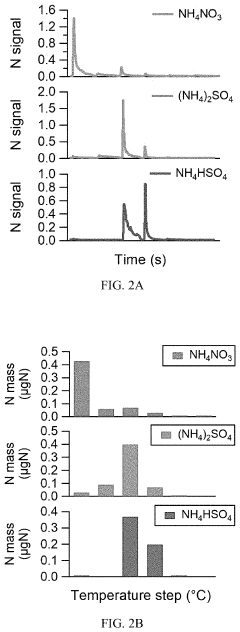
- A method involving ambient air sampling, thermal desorption, oxidation, and chemiluminescent reaction to quantify total nitrogen, using a stepwise temperature program and multivariate curve resolution to differentiate inorganic and organic nitrogen signals, allowing for simultaneous measurement of both water-soluble and water-insoluble fractions.



Method for measuring concentration of nitrogen dioxide in air by single-wavelength laser induced fluorescence method, and apparatus for measuring concentration of nitrogen dioxide by the method
PatentInactiveUS20040262501A1
Innovation
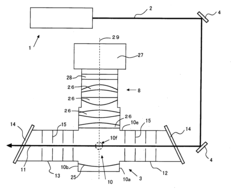
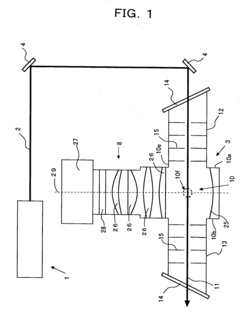
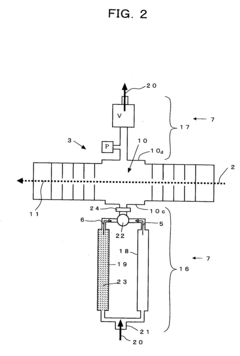
- A single-wavelength laser induced fluorescence technique is used, where a test atmosphere and a reference atmosphere with nitrogen dioxide removed are irradiated with a laser, allowing for the subtraction of background signals to accurately determine nitrogen dioxide concentration, utilizing a diffusion scrubber with powdery titanium oxide to create the reference atmosphere and optimizing fluorescence intensity in a vacuum.
Environmental Policy Impact
The computational modeling of nitrous acid diffusion in air has significant implications for environmental policy development and implementation. As our understanding of atmospheric chemistry and pollutant behavior improves, policymakers are better equipped to craft targeted regulations and mitigation strategies. The accurate modeling of nitrous acid diffusion provides crucial data for assessing air quality, predicting pollution hotspots, and evaluating the effectiveness of emission control measures.
Environmental policies informed by these models can lead to more precise and cost-effective interventions. For instance, urban planning decisions may be influenced by the predicted distribution of nitrous acid in different city zones, potentially leading to changes in zoning laws or building codes to minimize exposure to harmful concentrations. Additionally, transportation policies might be adjusted based on the modeled impact of vehicle emissions on nitrous acid levels in urban areas.
The impact extends to industrial regulations as well. Computational models can help in setting appropriate emission standards for factories and power plants, taking into account the complex interactions between nitrous acid and other pollutants in the atmosphere. This can result in more nuanced and effective pollution control strategies, potentially reducing compliance costs for industries while still achieving environmental goals.
Furthermore, these models contribute to the development of early warning systems for air quality. By accurately predicting the diffusion of nitrous acid, authorities can issue timely alerts to vulnerable populations, such as those with respiratory conditions, enhancing public health protection measures. This proactive approach can significantly reduce the health impacts and associated economic costs of air pollution.
International environmental agreements also benefit from improved modeling capabilities. Negotiators can use these models to assess the transboundary effects of nitrous acid pollution, leading to more informed discussions on shared responsibilities and collaborative mitigation efforts. This scientific basis can facilitate the creation of more effective and equitable global environmental policies.
Lastly, the integration of nitrous acid diffusion models into broader environmental impact assessments can lead to more comprehensive and accurate evaluations of proposed projects or policies. This holistic approach ensures that decision-makers have a fuller picture of potential environmental consequences, leading to more sustainable and environmentally responsible policy choices.
Environmental policies informed by these models can lead to more precise and cost-effective interventions. For instance, urban planning decisions may be influenced by the predicted distribution of nitrous acid in different city zones, potentially leading to changes in zoning laws or building codes to minimize exposure to harmful concentrations. Additionally, transportation policies might be adjusted based on the modeled impact of vehicle emissions on nitrous acid levels in urban areas.
The impact extends to industrial regulations as well. Computational models can help in setting appropriate emission standards for factories and power plants, taking into account the complex interactions between nitrous acid and other pollutants in the atmosphere. This can result in more nuanced and effective pollution control strategies, potentially reducing compliance costs for industries while still achieving environmental goals.
Furthermore, these models contribute to the development of early warning systems for air quality. By accurately predicting the diffusion of nitrous acid, authorities can issue timely alerts to vulnerable populations, such as those with respiratory conditions, enhancing public health protection measures. This proactive approach can significantly reduce the health impacts and associated economic costs of air pollution.
International environmental agreements also benefit from improved modeling capabilities. Negotiators can use these models to assess the transboundary effects of nitrous acid pollution, leading to more informed discussions on shared responsibilities and collaborative mitigation efforts. This scientific basis can facilitate the creation of more effective and equitable global environmental policies.
Lastly, the integration of nitrous acid diffusion models into broader environmental impact assessments can lead to more comprehensive and accurate evaluations of proposed projects or policies. This holistic approach ensures that decision-makers have a fuller picture of potential environmental consequences, leading to more sustainable and environmentally responsible policy choices.
HONO Health Implications
The health implications of nitrous acid (HONO) are significant and multifaceted, primarily due to its role in atmospheric chemistry and its potential direct effects on human health. HONO is a key precursor to hydroxyl radicals, which play a crucial role in the formation of photochemical smog and ground-level ozone. These secondary pollutants are known to cause respiratory issues and exacerbate existing conditions such as asthma and chronic obstructive pulmonary disease (COPD).
Exposure to HONO itself can lead to various health effects, particularly in sensitive populations. Short-term exposure may cause irritation of the eyes, nose, and throat, while long-term exposure has been associated with more severe respiratory problems. Studies have shown that HONO can react with amines in the human body to form potentially carcinogenic nitrosamines, raising concerns about its long-term health impacts.
In indoor environments, HONO concentrations can be significantly higher than outdoor levels due to various sources such as gas stoves, tobacco smoke, and surface reactions. This is particularly concerning as people spend a majority of their time indoors, potentially leading to prolonged exposure. The health risks associated with indoor HONO exposure are compounded by poor ventilation and the presence of other indoor air pollutants.
Children, elderly individuals, and those with pre-existing respiratory conditions are particularly vulnerable to the health effects of HONO. Epidemiological studies have linked increased HONO levels to higher rates of hospital admissions for respiratory ailments, especially during periods of elevated air pollution. Furthermore, HONO's role in the formation of particulate matter contributes to cardiovascular health risks, as fine particles can penetrate deep into the lungs and enter the bloodstream.
The computational modeling of HONO diffusion in air is crucial for understanding its distribution and concentration in various environments. Accurate models can help predict exposure levels, inform air quality management strategies, and guide the development of mitigation measures. By improving our ability to forecast HONO concentrations, we can better protect public health through targeted interventions and policy decisions.
Given the significant health implications of HONO, there is a growing need for comprehensive research into its long-term effects and the development of more effective monitoring and control strategies. This includes improving indoor air quality standards, enhancing ventilation systems, and developing technologies to reduce HONO formation and accumulation in both indoor and outdoor environments.
Exposure to HONO itself can lead to various health effects, particularly in sensitive populations. Short-term exposure may cause irritation of the eyes, nose, and throat, while long-term exposure has been associated with more severe respiratory problems. Studies have shown that HONO can react with amines in the human body to form potentially carcinogenic nitrosamines, raising concerns about its long-term health impacts.
In indoor environments, HONO concentrations can be significantly higher than outdoor levels due to various sources such as gas stoves, tobacco smoke, and surface reactions. This is particularly concerning as people spend a majority of their time indoors, potentially leading to prolonged exposure. The health risks associated with indoor HONO exposure are compounded by poor ventilation and the presence of other indoor air pollutants.
Children, elderly individuals, and those with pre-existing respiratory conditions are particularly vulnerable to the health effects of HONO. Epidemiological studies have linked increased HONO levels to higher rates of hospital admissions for respiratory ailments, especially during periods of elevated air pollution. Furthermore, HONO's role in the formation of particulate matter contributes to cardiovascular health risks, as fine particles can penetrate deep into the lungs and enter the bloodstream.
The computational modeling of HONO diffusion in air is crucial for understanding its distribution and concentration in various environments. Accurate models can help predict exposure levels, inform air quality management strategies, and guide the development of mitigation measures. By improving our ability to forecast HONO concentrations, we can better protect public health through targeted interventions and policy decisions.
Given the significant health implications of HONO, there is a growing need for comprehensive research into its long-term effects and the development of more effective monitoring and control strategies. This includes improving indoor air quality standards, enhancing ventilation systems, and developing technologies to reduce HONO formation and accumulation in both indoor and outdoor environments.
Unlock deeper insights with Patsnap Eureka Quick Research — get a full tech report to explore trends and direct your research. Try now!
Generate Your Research Report Instantly with AI Agent
Supercharge your innovation with Patsnap Eureka AI Agent Platform!