Evaluate CDI's Response to Fluctuating Water Quality
APR 21, 20268 MIN READ
Generate Your Research Report Instantly with AI Agent
PatSnap Eureka helps you evaluate technical feasibility & market potential.
CDI Water Treatment Background and Objectives
Capacitive Deionization (CDI) represents a revolutionary electrochemical water treatment technology that has emerged as a promising alternative to conventional desalination methods. This innovative approach leverages the principles of electrical double-layer capacitance to remove ionic contaminants from water sources through reversible electrosorption processes. Unlike traditional methods such as reverse osmosis or thermal distillation, CDI operates at relatively low voltages and ambient temperatures, making it particularly attractive for energy-efficient water purification applications.
The fundamental mechanism of CDI involves applying a low voltage across porous carbon electrodes, creating an electric field that attracts and captures ions from the feed water. When the voltage is applied, cations migrate toward the negatively charged electrode while anions move toward the positively charged electrode, effectively removing dissolved salts and other ionic species from the water stream. The process is inherently reversible, allowing for electrode regeneration and concentrate recovery through voltage reversal or disconnection.
The primary objective of evaluating CDI's response to fluctuating water quality centers on understanding how this technology adapts to dynamic input conditions commonly encountered in real-world applications. Water sources rarely maintain consistent ionic compositions, pH levels, or contaminant concentrations, presenting significant operational challenges for any treatment system. These variations can stem from seasonal changes, industrial discharge patterns, agricultural runoff cycles, or natural geological processes that alter groundwater chemistry.
Current research objectives focus on characterizing CDI performance across diverse water quality scenarios, including variations in total dissolved solids concentrations, ionic species distribution, organic matter content, and pH fluctuations. Understanding these relationships is crucial for developing robust control strategies and optimizing system design parameters to maintain consistent treatment efficiency regardless of input variability.
The strategic importance of this evaluation extends beyond technical performance metrics to encompass economic viability and operational reliability. Successful adaptation to fluctuating conditions would position CDI as a versatile solution for decentralized water treatment applications, particularly in regions where water quality varies significantly or where conventional treatment infrastructure proves economically unfeasible.
The fundamental mechanism of CDI involves applying a low voltage across porous carbon electrodes, creating an electric field that attracts and captures ions from the feed water. When the voltage is applied, cations migrate toward the negatively charged electrode while anions move toward the positively charged electrode, effectively removing dissolved salts and other ionic species from the water stream. The process is inherently reversible, allowing for electrode regeneration and concentrate recovery through voltage reversal or disconnection.
The primary objective of evaluating CDI's response to fluctuating water quality centers on understanding how this technology adapts to dynamic input conditions commonly encountered in real-world applications. Water sources rarely maintain consistent ionic compositions, pH levels, or contaminant concentrations, presenting significant operational challenges for any treatment system. These variations can stem from seasonal changes, industrial discharge patterns, agricultural runoff cycles, or natural geological processes that alter groundwater chemistry.
Current research objectives focus on characterizing CDI performance across diverse water quality scenarios, including variations in total dissolved solids concentrations, ionic species distribution, organic matter content, and pH fluctuations. Understanding these relationships is crucial for developing robust control strategies and optimizing system design parameters to maintain consistent treatment efficiency regardless of input variability.
The strategic importance of this evaluation extends beyond technical performance metrics to encompass economic viability and operational reliability. Successful adaptation to fluctuating conditions would position CDI as a versatile solution for decentralized water treatment applications, particularly in regions where water quality varies significantly or where conventional treatment infrastructure proves economically unfeasible.
Market Demand for Adaptive Water Treatment Solutions
The global water treatment market is experiencing unprecedented growth driven by increasing water scarcity, stringent environmental regulations, and rising industrial demand for high-quality water. Traditional water treatment systems often struggle with varying input water quality, creating substantial market opportunities for adaptive solutions that can respond dynamically to fluctuating conditions.
Industrial sectors represent the largest demand segment for adaptive water treatment technologies. Manufacturing facilities, particularly in pharmaceuticals, electronics, and food processing, require consistent water quality despite seasonal variations and upstream contamination events. These industries face significant operational disruptions when conventional treatment systems cannot adapt to changing feed water characteristics, driving demand for intelligent treatment solutions.
Municipal water utilities constitute another critical market segment experiencing growing pressure to maintain service quality amid climate change impacts. Extreme weather events, aging infrastructure, and population growth create highly variable source water conditions that challenge traditional treatment approaches. Utilities increasingly seek technologies capable of real-time adjustment to maintain regulatory compliance while optimizing operational costs.
The desalination market presents substantial opportunities for adaptive treatment technologies, particularly as membrane-based processes like Capacitive Deionization gain prominence. Seawater composition varies significantly due to seasonal changes, industrial discharge, and environmental factors. Treatment systems capable of adjusting to these variations can achieve superior energy efficiency and membrane longevity compared to static operational approaches.
Emerging markets in developing regions show accelerating adoption of advanced water treatment solutions. Rapid industrialization and urbanization create complex water quality challenges that exceed the capabilities of conventional treatment infrastructure. These markets demonstrate strong preference for technologies offering operational flexibility and reduced maintenance requirements.
The agricultural sector increasingly demands adaptive irrigation water treatment as precision farming practices expand. Variable source water quality from different wells, surface water bodies, and recycled sources requires treatment systems capable of real-time optimization to protect crops and irrigation equipment while minimizing chemical consumption and energy costs.
Industrial sectors represent the largest demand segment for adaptive water treatment technologies. Manufacturing facilities, particularly in pharmaceuticals, electronics, and food processing, require consistent water quality despite seasonal variations and upstream contamination events. These industries face significant operational disruptions when conventional treatment systems cannot adapt to changing feed water characteristics, driving demand for intelligent treatment solutions.
Municipal water utilities constitute another critical market segment experiencing growing pressure to maintain service quality amid climate change impacts. Extreme weather events, aging infrastructure, and population growth create highly variable source water conditions that challenge traditional treatment approaches. Utilities increasingly seek technologies capable of real-time adjustment to maintain regulatory compliance while optimizing operational costs.
The desalination market presents substantial opportunities for adaptive treatment technologies, particularly as membrane-based processes like Capacitive Deionization gain prominence. Seawater composition varies significantly due to seasonal changes, industrial discharge, and environmental factors. Treatment systems capable of adjusting to these variations can achieve superior energy efficiency and membrane longevity compared to static operational approaches.
Emerging markets in developing regions show accelerating adoption of advanced water treatment solutions. Rapid industrialization and urbanization create complex water quality challenges that exceed the capabilities of conventional treatment infrastructure. These markets demonstrate strong preference for technologies offering operational flexibility and reduced maintenance requirements.
The agricultural sector increasingly demands adaptive irrigation water treatment as precision farming practices expand. Variable source water quality from different wells, surface water bodies, and recycled sources requires treatment systems capable of real-time optimization to protect crops and irrigation equipment while minimizing chemical consumption and energy costs.
Current CDI Limitations with Variable Water Quality
Capacitive Deionization technology faces significant operational challenges when confronted with variable water quality conditions. The most prominent limitation stems from the technology's sensitivity to ionic strength fluctuations, which directly impact the electric double layer formation at electrode surfaces. When feed water salinity varies substantially, CDI systems experience inconsistent desalination performance, leading to unpredictable effluent quality and reduced operational reliability.
Electrode fouling represents another critical constraint under fluctuating water conditions. Variable concentrations of organic matter, suspended solids, and multivalent ions create unpredictable fouling patterns that compromise electrode accessibility and charge storage capacity. This fouling accumulation becomes particularly problematic when water quality parameters shift rapidly, as conventional cleaning protocols may not adequately address the diverse fouling mechanisms occurring simultaneously.
The fixed voltage operation mode commonly employed in CDI systems proves inadequate for handling dynamic water quality scenarios. Traditional control strategies fail to adapt to real-time changes in conductivity, pH, and ionic composition, resulting in suboptimal energy efficiency and incomplete ion removal. This limitation becomes especially pronounced when treating water sources with seasonal variations or industrial discharge fluctuations.
Membrane degradation accelerates under variable water quality conditions due to inconsistent chemical exposure and mechanical stress. Ion exchange membranes used in membrane CDI configurations experience reduced selectivity and increased resistance when subjected to varying pH levels and ionic compositions. The membrane's structural integrity deteriorates more rapidly under these conditions compared to stable water quality scenarios.
Current CDI architectures lack sophisticated monitoring and feedback mechanisms necessary for real-time adaptation to changing water parameters. The absence of integrated sensors and adaptive control algorithms prevents systems from automatically adjusting operational parameters such as applied voltage, flow rates, and regeneration cycles based on incoming water characteristics.
Energy consumption optimization remains challenging under variable conditions as existing systems cannot predict or compensate for efficiency losses caused by water quality fluctuations. The inability to maintain consistent specific energy consumption across different water compositions limits the technology's economic viability for applications with highly variable feed streams, ultimately restricting CDI deployment in dynamic water treatment scenarios.
Electrode fouling represents another critical constraint under fluctuating water conditions. Variable concentrations of organic matter, suspended solids, and multivalent ions create unpredictable fouling patterns that compromise electrode accessibility and charge storage capacity. This fouling accumulation becomes particularly problematic when water quality parameters shift rapidly, as conventional cleaning protocols may not adequately address the diverse fouling mechanisms occurring simultaneously.
The fixed voltage operation mode commonly employed in CDI systems proves inadequate for handling dynamic water quality scenarios. Traditional control strategies fail to adapt to real-time changes in conductivity, pH, and ionic composition, resulting in suboptimal energy efficiency and incomplete ion removal. This limitation becomes especially pronounced when treating water sources with seasonal variations or industrial discharge fluctuations.
Membrane degradation accelerates under variable water quality conditions due to inconsistent chemical exposure and mechanical stress. Ion exchange membranes used in membrane CDI configurations experience reduced selectivity and increased resistance when subjected to varying pH levels and ionic compositions. The membrane's structural integrity deteriorates more rapidly under these conditions compared to stable water quality scenarios.
Current CDI architectures lack sophisticated monitoring and feedback mechanisms necessary for real-time adaptation to changing water parameters. The absence of integrated sensors and adaptive control algorithms prevents systems from automatically adjusting operational parameters such as applied voltage, flow rates, and regeneration cycles based on incoming water characteristics.
Energy consumption optimization remains challenging under variable conditions as existing systems cannot predict or compensate for efficiency losses caused by water quality fluctuations. The inability to maintain consistent specific energy consumption across different water compositions limits the technology's economic viability for applications with highly variable feed streams, ultimately restricting CDI deployment in dynamic water treatment scenarios.
Existing CDI Solutions for Water Quality Fluctuations
01 CDI-based polymerization and polymer synthesis methods
Carbonyldiimidazole (CDI) is utilized as an activating agent in polymer synthesis and polymerization reactions. CDI facilitates the formation of reactive intermediates that enable coupling reactions and chain extension processes. This approach is particularly useful in creating functionalized polymers and copolymers with controlled molecular weights and specific properties for various applications.- CDI-based polymerization and polymer synthesis methods: Carbonyldiimidazole (CDI) is utilized as an activating agent in polymer synthesis and polymerization reactions. This approach enables the formation of various polymer structures through controlled activation of carboxylic acid groups, facilitating coupling reactions and chain extension processes. The method provides advantages in terms of reaction efficiency and product purity in polymer chemistry applications.
- CDI activation for bioconjugation and drug delivery systems: The use of carbonyldiimidazole as a coupling agent enables the attachment of therapeutic molecules, proteins, or other bioactive compounds to carrier systems. This activation method facilitates the formation of stable linkages between different molecular entities, which is particularly useful in developing targeted drug delivery platforms and bioconjugate therapeutics with improved pharmacological properties.
- CDI-mediated surface modification and functionalization: Carbonyldiimidazole serves as an effective reagent for modifying surfaces of materials and substrates. This technique allows for the introduction of functional groups onto various surfaces, enabling subsequent attachment of biomolecules or other chemical entities. The method is applicable to medical devices, biosensors, and other materials requiring specific surface properties for enhanced performance.
- CDI application in peptide and protein chemistry: The reagent is employed in peptide synthesis and protein modification procedures where selective activation of carboxyl groups is required. This application enables efficient coupling reactions in the preparation of peptide bonds and protein conjugates. The methodology offers advantages in terms of selectivity and mild reaction conditions suitable for sensitive biological molecules.
- CDI utilization in pharmaceutical formulation and manufacturing processes: Carbonyldiimidazole finds application in pharmaceutical manufacturing as a coupling agent and intermediate in the synthesis of active pharmaceutical ingredients. The compound facilitates various chemical transformations necessary for drug substance preparation and formulation development. This includes its role in creating prodrugs, improving drug stability, and enabling controlled release formulations.
02 CDI activation for bioconjugation and drug delivery systems
CDI serves as a coupling agent for bioconjugation reactions, enabling the attachment of therapeutic agents to carrier molecules or surfaces. This activation method is employed in developing drug delivery systems where controlled release and targeted delivery are required. The technique allows for stable linkage formation between biomolecules and pharmaceutical compounds.Expand Specific Solutions03 CDI-mediated surface modification and coating technologies
CDI is applied in surface modification processes to introduce functional groups onto substrates. This technology enables the creation of modified surfaces with enhanced properties such as improved adhesion, biocompatibility, or chemical resistance. The method is particularly valuable in medical device manufacturing and materials engineering applications.Expand Specific Solutions04 CDI application in crosslinking and network formation
CDI functions as a crosslinking agent to create three-dimensional polymer networks and hydrogels. This application involves the formation of covalent bonds between polymer chains, resulting in materials with enhanced mechanical properties and stability. The crosslinking process is utilized in producing materials for biomedical, pharmaceutical, and industrial applications.Expand Specific Solutions05 CDI utilization in peptide and protein modification
CDI is employed as a reagent for modifying peptides and proteins through selective activation of carboxyl groups. This technique enables the conjugation of various functional moieties to biomolecules while maintaining their biological activity. The method is widely used in biochemical research and therapeutic protein development.Expand Specific Solutions
Key Players in CDI and Water Treatment Industry
The CDI (Capacitive Deionization) water treatment technology market is experiencing rapid growth driven by increasing demand for adaptive water purification solutions. The industry is in an expansion phase with significant market potential, as fluctuating water quality challenges require advanced, responsive treatment systems. Technology maturity varies considerably across market participants. Established electronics giants like Samsung Electronics, LG Electronics, Mitsubishi Electric, and Toshiba bring sophisticated sensor and control technologies, while specialized water treatment companies such as COWAY and EcoWater Systems contribute domain expertise. Research institutions including China Agricultural University, Tongji University, and Technion Research Foundation are advancing core CDI technologies. Infrastructure specialists like China Three Gorges Corp. and engineering firms provide large-scale implementation capabilities. This diverse ecosystem indicates a maturing technology landscape where traditional water treatment approaches are being enhanced with smart, adaptive capabilities to handle dynamic water quality conditions effectively.
COWAY Co., Ltd.
Technical Solution: COWAY has developed advanced water purification systems with real-time water quality monitoring capabilities that automatically adjust filtration processes based on incoming water conditions. Their technology incorporates multi-stage filtration with smart sensors that detect changes in turbidity, pH, chlorine levels, and total dissolved solids. The system uses adaptive algorithms to modify filtration intensity and activate specific treatment modules when water quality parameters deviate from optimal ranges. Their CDI (Capacitive Deionization) technology integrates with IoT connectivity for remote monitoring and predictive maintenance, ensuring consistent water quality output regardless of source water fluctuations.
Strengths: Advanced sensor integration, real-time adaptive control, consumer-friendly design. Weaknesses: Limited to residential scale applications, higher cost compared to basic filtration systems.
Samsung Electronics Co., Ltd.
Technical Solution: Samsung has developed smart water management solutions incorporating CDI technology with AI-powered water quality assessment systems. Their approach utilizes machine learning algorithms to predict water quality changes and preemptively adjust treatment parameters. The system features advanced electrode materials and automated regeneration cycles that respond to varying ionic concentrations in source water. Samsung's technology includes cloud-based analytics for pattern recognition in water quality fluctuations, enabling proactive system adjustments. The integration of semiconductor manufacturing expertise allows for precise control of electrical parameters in CDI processes, optimizing energy efficiency while maintaining treatment effectiveness across diverse water quality conditions.
Strengths: AI integration, cloud analytics, semiconductor precision control. Weaknesses: Complex system requiring technical expertise, potential over-engineering for simple applications.
Core Innovations in Adaptive CDI Systems
Capacitive deionization system for water treatment
PatentInactiveTW200942495A
Innovation
- The use of bipolar electrodes with embedded sealing members and supercapacitors for rapid electrode regeneration, combined with a staggered electrode arrangement and optimized electrical connections, ensures even voltage distribution and minimizes cross-contamination, enhancing ion adsorption capacity and reducing energy consumption.
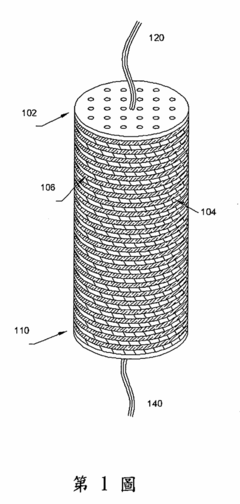
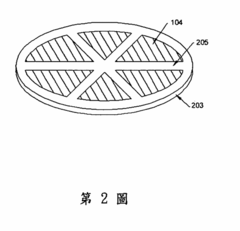
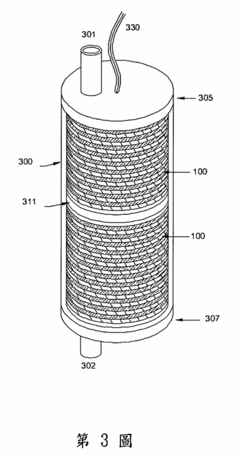
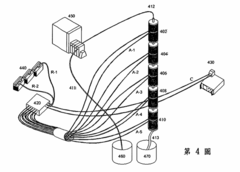
Apparatus and method for enhanced capacitive deionization of contaminated water
PatentInactiveUS20220017388A1
Innovation
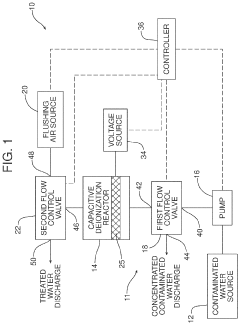
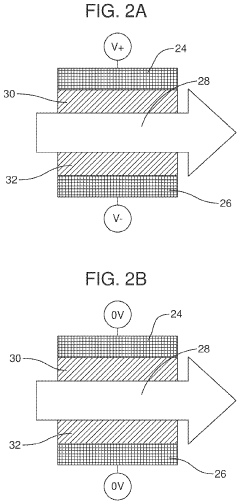
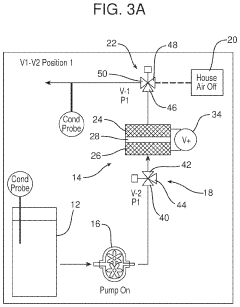
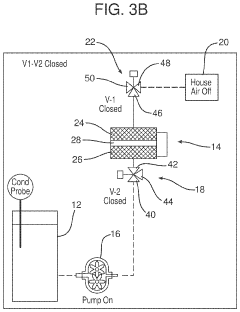
- The introduction of a flushing fluid, such as inert gas or air, is used to isolate and flush out concentrated contaminants from the CDI reactor, separating the cleaning process from the main water treatment process, thereby conserving contaminated water and enhancing the efficiency of capacitive deionization by maximizing water recovery.
Water Quality Regulations and Compliance Standards
Water quality regulations governing Capacitive Deionization (CDI) systems operate within a complex framework of international, national, and regional standards that directly impact system design and operational parameters. The World Health Organization establishes baseline drinking water quality guidelines, while regional authorities such as the US Environmental Protection Agency, European Union Water Framework Directive, and national regulatory bodies implement specific compliance requirements for desalination technologies including CDI systems.
Primary regulatory frameworks focus on output water quality parameters including total dissolved solids, conductivity levels, pH ranges, and specific ion concentrations. CDI systems must demonstrate consistent compliance with maximum contaminant levels for various dissolved species, particularly sodium, chloride, fluoride, and heavy metals. These standards typically require output water to maintain TDS levels below 500-1000 mg/L depending on jurisdiction, with conductivity thresholds ranging from 400-2500 μS/cm for potable water applications.
Fluctuating input water quality presents significant compliance challenges as CDI systems must maintain consistent output standards regardless of feed water variability. Regulatory frameworks increasingly emphasize real-time monitoring capabilities and adaptive control systems to ensure continuous compliance during dynamic operating conditions. This includes requirements for automated shutdown mechanisms when output quality approaches regulatory limits and comprehensive data logging for regulatory reporting.
Emerging regulations specifically address energy efficiency and environmental impact metrics for desalination technologies. CDI systems benefit from favorable regulatory positioning due to their lower energy consumption compared to reverse osmosis, with some jurisdictions offering incentives for energy-efficient water treatment technologies. However, compliance requirements for electrode materials, particularly regarding potential heavy metal leaching, are becoming increasingly stringent.
Industrial applications face additional sector-specific regulations, particularly in pharmaceutical, food processing, and semiconductor manufacturing where ultra-pure water standards apply. These applications require CDI systems to meet more restrictive compliance thresholds, often necessitating multi-stage treatment configurations and enhanced monitoring protocols to address fluctuating input conditions while maintaining regulatory compliance.
Primary regulatory frameworks focus on output water quality parameters including total dissolved solids, conductivity levels, pH ranges, and specific ion concentrations. CDI systems must demonstrate consistent compliance with maximum contaminant levels for various dissolved species, particularly sodium, chloride, fluoride, and heavy metals. These standards typically require output water to maintain TDS levels below 500-1000 mg/L depending on jurisdiction, with conductivity thresholds ranging from 400-2500 μS/cm for potable water applications.
Fluctuating input water quality presents significant compliance challenges as CDI systems must maintain consistent output standards regardless of feed water variability. Regulatory frameworks increasingly emphasize real-time monitoring capabilities and adaptive control systems to ensure continuous compliance during dynamic operating conditions. This includes requirements for automated shutdown mechanisms when output quality approaches regulatory limits and comprehensive data logging for regulatory reporting.
Emerging regulations specifically address energy efficiency and environmental impact metrics for desalination technologies. CDI systems benefit from favorable regulatory positioning due to their lower energy consumption compared to reverse osmosis, with some jurisdictions offering incentives for energy-efficient water treatment technologies. However, compliance requirements for electrode materials, particularly regarding potential heavy metal leaching, are becoming increasingly stringent.
Industrial applications face additional sector-specific regulations, particularly in pharmaceutical, food processing, and semiconductor manufacturing where ultra-pure water standards apply. These applications require CDI systems to meet more restrictive compliance thresholds, often necessitating multi-stage treatment configurations and enhanced monitoring protocols to address fluctuating input conditions while maintaining regulatory compliance.
Environmental Impact of CDI Water Treatment Systems
Capacitive Deionization (CDI) water treatment systems demonstrate significant environmental advantages compared to conventional desalination technologies, particularly in their response to fluctuating water quality conditions. The environmental footprint of CDI systems is inherently lower due to their energy-efficient operation and reduced chemical consumption requirements. Unlike reverse osmosis or thermal desalination processes, CDI operates at low voltages and ambient temperatures, resulting in substantially reduced carbon emissions and energy consumption patterns.
The modular design of CDI systems enables adaptive environmental performance when confronting variable water quality parameters. During periods of high total dissolved solids concentration, CDI systems can adjust their operational cycles without requiring additional chemical pretreatment or generating excessive waste streams. This flexibility translates to reduced environmental stress compared to fixed-capacity treatment systems that must maintain consistent chemical dosing regardless of input water conditions.
CDI technology exhibits minimal secondary pollution generation, as the desalination process relies primarily on electrochemical ion removal rather than chemical precipitation or membrane rejection. The absence of concentrated brine discharge, which typically characterizes conventional desalination methods, significantly reduces the environmental impact on receiving water bodies. Instead, CDI systems produce a controlled regeneration stream with manageable salt concentrations that can be further processed or safely disposed.
The carbon electrode materials used in CDI systems present both opportunities and challenges for environmental sustainability. While activated carbon electrodes are generally derived from renewable sources, the manufacturing process and eventual disposal require careful environmental consideration. However, emerging research into bio-based electrode materials and electrode regeneration techniques promises to further reduce the environmental footprint of CDI systems.
Energy recovery capabilities in advanced CDI configurations contribute to overall environmental benefits by reducing net energy consumption during fluctuating operational conditions. The ability to store and release energy during charge-discharge cycles enhances system efficiency while maintaining consistent treatment performance across varying water quality scenarios, ultimately supporting sustainable water treatment objectives.
The modular design of CDI systems enables adaptive environmental performance when confronting variable water quality parameters. During periods of high total dissolved solids concentration, CDI systems can adjust their operational cycles without requiring additional chemical pretreatment or generating excessive waste streams. This flexibility translates to reduced environmental stress compared to fixed-capacity treatment systems that must maintain consistent chemical dosing regardless of input water conditions.
CDI technology exhibits minimal secondary pollution generation, as the desalination process relies primarily on electrochemical ion removal rather than chemical precipitation or membrane rejection. The absence of concentrated brine discharge, which typically characterizes conventional desalination methods, significantly reduces the environmental impact on receiving water bodies. Instead, CDI systems produce a controlled regeneration stream with manageable salt concentrations that can be further processed or safely disposed.
The carbon electrode materials used in CDI systems present both opportunities and challenges for environmental sustainability. While activated carbon electrodes are generally derived from renewable sources, the manufacturing process and eventual disposal require careful environmental consideration. However, emerging research into bio-based electrode materials and electrode regeneration techniques promises to further reduce the environmental footprint of CDI systems.
Energy recovery capabilities in advanced CDI configurations contribute to overall environmental benefits by reducing net energy consumption during fluctuating operational conditions. The ability to store and release energy during charge-discharge cycles enhances system efficiency while maintaining consistent treatment performance across varying water quality scenarios, ultimately supporting sustainable water treatment objectives.
Unlock deeper insights with PatSnap Eureka Quick Research — get a full tech report to explore trends and direct your research. Try now!
Generate Your Research Report Instantly with AI Agent
Supercharge your innovation with PatSnap Eureka AI Agent Platform!