

Exploring the Limits of Downsizing in V12 Engine Design
AUG 5, 20259 MIN READ
Generate Your Research Report Instantly with AI Agent
PatSnap Eureka helps you evaluate technical feasibility & market potential.
V12 Engine Evolution and Downsizing Objectives
The V12 engine has long been synonymous with luxury, power, and prestige in the automotive world. Its evolution spans over a century, from early aviation applications to high-performance sports cars and luxury vehicles. The V12's unique configuration, with two banks of six cylinders arranged in a V-shape, offers exceptional smoothness and power delivery, making it a preferred choice for premium automotive brands.
In recent years, however, the automotive industry has faced increasing pressure to improve fuel efficiency and reduce emissions. This has led to a significant trend towards engine downsizing, even in the luxury and high-performance segments. The challenge now lies in maintaining the characteristics that make V12 engines desirable while reducing their environmental impact.
The objectives of downsizing V12 engines are multifaceted. Primarily, manufacturers aim to reduce fuel consumption and CO2 emissions to meet stringent regulatory standards. This involves decreasing engine displacement while maintaining or even improving power output through advanced technologies such as turbocharging, direct injection, and variable valve timing.
Another key objective is to reduce the overall weight and size of the engine, which can contribute to improved vehicle dynamics and packaging efficiency. This is particularly crucial in modern vehicle designs where space is at a premium, and weight reduction is a constant goal for enhancing performance and efficiency.
Maintaining the distinctive sound and character of V12 engines presents a significant challenge in downsizing efforts. Engineers must find innovative ways to preserve the smooth power delivery and unique exhaust note that V12 enthusiasts cherish, even as they reduce engine size and cylinder count.
The pursuit of downsizing also aims to future-proof V12 engines in an increasingly electrified automotive landscape. By making these engines more efficient and environmentally friendly, manufacturers hope to extend their viability in the face of tightening regulations and shifting consumer preferences.
As the industry explores the limits of downsizing in V12 engine design, the ultimate goal is to strike a balance between performance, efficiency, and the emotional appeal that has long been associated with these powerplants. This endeavor pushes the boundaries of engineering and challenges designers to reimagine the future of high-end propulsion systems.
In recent years, however, the automotive industry has faced increasing pressure to improve fuel efficiency and reduce emissions. This has led to a significant trend towards engine downsizing, even in the luxury and high-performance segments. The challenge now lies in maintaining the characteristics that make V12 engines desirable while reducing their environmental impact.
The objectives of downsizing V12 engines are multifaceted. Primarily, manufacturers aim to reduce fuel consumption and CO2 emissions to meet stringent regulatory standards. This involves decreasing engine displacement while maintaining or even improving power output through advanced technologies such as turbocharging, direct injection, and variable valve timing.
Another key objective is to reduce the overall weight and size of the engine, which can contribute to improved vehicle dynamics and packaging efficiency. This is particularly crucial in modern vehicle designs where space is at a premium, and weight reduction is a constant goal for enhancing performance and efficiency.
Maintaining the distinctive sound and character of V12 engines presents a significant challenge in downsizing efforts. Engineers must find innovative ways to preserve the smooth power delivery and unique exhaust note that V12 enthusiasts cherish, even as they reduce engine size and cylinder count.
The pursuit of downsizing also aims to future-proof V12 engines in an increasingly electrified automotive landscape. By making these engines more efficient and environmentally friendly, manufacturers hope to extend their viability in the face of tightening regulations and shifting consumer preferences.
As the industry explores the limits of downsizing in V12 engine design, the ultimate goal is to strike a balance between performance, efficiency, and the emotional appeal that has long been associated with these powerplants. This endeavor pushes the boundaries of engineering and challenges designers to reimagine the future of high-end propulsion systems.
Market Analysis for Compact V12 Engines
The market for compact V12 engines represents a niche but potentially lucrative segment within the automotive industry. Traditionally associated with high-performance luxury vehicles and supercars, V12 engines have long been synonymous with power, prestige, and exclusivity. However, the trend towards engine downsizing and increased efficiency has created a new demand for more compact V12 designs that can deliver the same level of performance while meeting stricter emissions regulations.
Recent market research indicates that the global market for V12 engines is expected to grow steadily over the next five years, driven primarily by the luxury and sports car segments. The demand for compact V12 engines is particularly strong in regions such as Europe and North America, where stringent emissions standards are pushing manufacturers to innovate in engine design.
The primary market for compact V12 engines remains the ultra-luxury and high-performance vehicle sector. Brands such as Ferrari, Lamborghini, and Aston Martin continue to invest in V12 technology, recognizing its appeal to discerning customers who value the unique characteristics of these engines. Additionally, there is growing interest from boutique supercar manufacturers and specialized tuning companies looking to differentiate their offerings in a crowded market.
One significant trend shaping the market is the integration of hybrid technology with compact V12 engines. This approach allows manufacturers to maintain the prestige and performance associated with V12 powerplants while improving fuel efficiency and reducing emissions. Several luxury automakers have already introduced or announced plans for hybrid V12 models, indicating a shift in market demand towards more environmentally conscious high-performance vehicles.
The market analysis also reveals a potential expansion of compact V12 engines into new vehicle categories. Some manufacturers are exploring the use of downsized V12 engines in luxury SUVs and high-end sedans, aiming to capture a broader customer base while maintaining the exclusivity associated with V12 power.
Despite the positive growth outlook, the market for compact V12 engines faces challenges. Increasing pressure from environmental regulations and the shift towards electric vehicles pose significant threats to the long-term viability of V12 technology. Manufacturers must balance the desire for performance and prestige with the need for improved efficiency and reduced emissions to ensure the continued relevance of V12 engines in the automotive landscape.
In conclusion, the market for compact V12 engines remains robust, driven by demand from luxury and performance vehicle segments. The trend towards downsizing and hybridization presents both challenges and opportunities for manufacturers, with the potential to expand the application of V12 technology while meeting evolving regulatory and consumer expectations.
Recent market research indicates that the global market for V12 engines is expected to grow steadily over the next five years, driven primarily by the luxury and sports car segments. The demand for compact V12 engines is particularly strong in regions such as Europe and North America, where stringent emissions standards are pushing manufacturers to innovate in engine design.
The primary market for compact V12 engines remains the ultra-luxury and high-performance vehicle sector. Brands such as Ferrari, Lamborghini, and Aston Martin continue to invest in V12 technology, recognizing its appeal to discerning customers who value the unique characteristics of these engines. Additionally, there is growing interest from boutique supercar manufacturers and specialized tuning companies looking to differentiate their offerings in a crowded market.
One significant trend shaping the market is the integration of hybrid technology with compact V12 engines. This approach allows manufacturers to maintain the prestige and performance associated with V12 powerplants while improving fuel efficiency and reducing emissions. Several luxury automakers have already introduced or announced plans for hybrid V12 models, indicating a shift in market demand towards more environmentally conscious high-performance vehicles.
The market analysis also reveals a potential expansion of compact V12 engines into new vehicle categories. Some manufacturers are exploring the use of downsized V12 engines in luxury SUVs and high-end sedans, aiming to capture a broader customer base while maintaining the exclusivity associated with V12 power.
Despite the positive growth outlook, the market for compact V12 engines faces challenges. Increasing pressure from environmental regulations and the shift towards electric vehicles pose significant threats to the long-term viability of V12 technology. Manufacturers must balance the desire for performance and prestige with the need for improved efficiency and reduced emissions to ensure the continued relevance of V12 engines in the automotive landscape.
In conclusion, the market for compact V12 engines remains robust, driven by demand from luxury and performance vehicle segments. The trend towards downsizing and hybridization presents both challenges and opportunities for manufacturers, with the potential to expand the application of V12 technology while meeting evolving regulatory and consumer expectations.
Current Challenges in V12 Miniaturization
The miniaturization of V12 engines presents significant challenges in modern automotive engineering. As manufacturers strive to meet increasingly stringent emissions regulations and fuel efficiency standards, downsizing these powerful engines becomes a complex balancing act between performance and environmental considerations.
One of the primary challenges in V12 miniaturization is maintaining the engine's characteristic smooth operation and power delivery while reducing its overall size and weight. The V12 configuration is renowned for its inherent balance and low vibration, attributes that become more difficult to preserve as the engine's dimensions decrease. Engineers must employ advanced materials and innovative design techniques to ensure that smaller components can withstand the high stresses and temperatures associated with V12 operation.
Thermal management poses another significant hurdle in downsizing V12 engines. As the engine becomes more compact, dissipating heat efficiently becomes increasingly challenging. The reduced surface area and tighter packaging make it harder to implement effective cooling systems, potentially leading to performance limitations or reduced reliability. Overcoming this challenge requires sophisticated cooling strategies and the integration of advanced thermal management technologies.
Fuel efficiency and emissions control present additional complexities in V12 miniaturization. Smaller engines typically struggle to match the fuel economy of their larger counterparts when operating at high loads, a common scenario for performance-oriented V12s. Engineers must develop innovative solutions, such as advanced fuel injection systems, variable valve timing, and cylinder deactivation technologies, to optimize efficiency across a wide range of operating conditions.
The integration of forced induction systems, particularly turbochargers, into downsized V12 engines introduces its own set of challenges. While turbocharging can help maintain power output in smaller engines, packaging multiple turbochargers in a compact V12 layout requires intricate design solutions. Additionally, managing turbo lag and ensuring responsive power delivery across the entire rev range becomes more demanding as engine size decreases.
Maintaining the distinctive V12 sound signature in downsized engines is another challenge that engineers face. The unique exhaust note of a V12 is a crucial part of its appeal, and preserving this characteristic in a smaller package requires careful attention to exhaust system design and tuning. Balancing acoustic performance with increasingly strict noise regulations adds another layer of complexity to the miniaturization process.
As V12 engines become smaller, the precision required in manufacturing and assembly increases significantly. Tighter tolerances and more complex component designs demand advanced production techniques and quality control measures. This challenge extends to the entire powertrain, as transmissions and drivelines must also be optimized to work efficiently with the downsized engine while maintaining durability and performance.
One of the primary challenges in V12 miniaturization is maintaining the engine's characteristic smooth operation and power delivery while reducing its overall size and weight. The V12 configuration is renowned for its inherent balance and low vibration, attributes that become more difficult to preserve as the engine's dimensions decrease. Engineers must employ advanced materials and innovative design techniques to ensure that smaller components can withstand the high stresses and temperatures associated with V12 operation.
Thermal management poses another significant hurdle in downsizing V12 engines. As the engine becomes more compact, dissipating heat efficiently becomes increasingly challenging. The reduced surface area and tighter packaging make it harder to implement effective cooling systems, potentially leading to performance limitations or reduced reliability. Overcoming this challenge requires sophisticated cooling strategies and the integration of advanced thermal management technologies.
Fuel efficiency and emissions control present additional complexities in V12 miniaturization. Smaller engines typically struggle to match the fuel economy of their larger counterparts when operating at high loads, a common scenario for performance-oriented V12s. Engineers must develop innovative solutions, such as advanced fuel injection systems, variable valve timing, and cylinder deactivation technologies, to optimize efficiency across a wide range of operating conditions.
The integration of forced induction systems, particularly turbochargers, into downsized V12 engines introduces its own set of challenges. While turbocharging can help maintain power output in smaller engines, packaging multiple turbochargers in a compact V12 layout requires intricate design solutions. Additionally, managing turbo lag and ensuring responsive power delivery across the entire rev range becomes more demanding as engine size decreases.
Maintaining the distinctive V12 sound signature in downsized engines is another challenge that engineers face. The unique exhaust note of a V12 is a crucial part of its appeal, and preserving this characteristic in a smaller package requires careful attention to exhaust system design and tuning. Balancing acoustic performance with increasingly strict noise regulations adds another layer of complexity to the miniaturization process.
As V12 engines become smaller, the precision required in manufacturing and assembly increases significantly. Tighter tolerances and more complex component designs demand advanced production techniques and quality control measures. This challenge extends to the entire powertrain, as transmissions and drivelines must also be optimized to work efficiently with the downsized engine while maintaining durability and performance.
Existing V12 Downsizing Techniques
01 V12 Engine Configuration and Design
V12 engines are typically designed with two banks of six cylinders arranged in a V-shape. This configuration allows for a compact design while providing high power output and smooth operation. The size of V12 engines can vary depending on the specific application, but they are generally larger than V8 or inline-six engines due to the increased number of cylinders.- V12 Engine Configuration and Design: V12 engines are typically designed with two banks of six cylinders arranged in a V-shape. This configuration allows for a compact design while providing high power output and smooth operation. The size of V12 engines can vary depending on the specific application, but they are generally larger than V8 or V6 engines due to the increased number of cylinders.
- Displacement and Performance: The size of a V12 engine is often measured by its displacement, which can range from around 5.0 to 7.0 liters for high-performance automotive applications, and even larger for marine or industrial use. Larger displacements generally correlate with higher power output, but advancements in technology have allowed for increased efficiency and power from smaller displacements.
- Cooling and Lubrication Systems: Due to their size and power output, V12 engines require sophisticated cooling and lubrication systems. These systems are designed to manage the heat generated by the engine and ensure proper lubrication of all moving parts. The size and complexity of these systems contribute to the overall dimensions of the engine package.
- Fuel Efficiency and Emissions Control: Modern V12 engines incorporate advanced technologies to improve fuel efficiency and reduce emissions, despite their large size. These may include direct fuel injection, variable valve timing, and cylinder deactivation systems. The integration of these technologies can impact the overall size and complexity of the engine.
- Application-Specific Sizing: The size of V12 engines can vary significantly based on their intended application. Automotive V12 engines are typically designed to fit within the constraints of a vehicle's engine bay, while marine or stationary V12 engines may be considerably larger. The specific dimensions are often tailored to meet the power, torque, and packaging requirements of the application.
02 Displacement and Bore/Stroke Ratio
The size of a V12 engine is often measured by its displacement, which is the total volume of all cylinders. This can range from around 3.0 liters in smaller applications to over 12.0 liters in large luxury or performance vehicles. The bore and stroke dimensions of each cylinder also play a crucial role in determining the overall engine size and performance characteristics.Expand Specific Solutions03 Compact V12 Engine Designs
Advancements in engine technology have led to the development of more compact V12 engines. These designs aim to reduce the overall size and weight of the engine while maintaining high performance. Techniques such as optimized cylinder spacing, integrated components, and advanced materials contribute to achieving a smaller engine footprint.Expand Specific Solutions04 V12 Engine Applications and Size Variations
V12 engines are used in a variety of applications, including high-performance sports cars, luxury vehicles, marine vessels, and even some aircraft. The size of the engine can vary significantly depending on its intended use. For example, a V12 engine in a sports car may be more compact and lightweight compared to one designed for a large luxury sedan or a marine application.Expand Specific Solutions05 Cooling and Lubrication Systems for V12 Engines
The size of a V12 engine is also influenced by its cooling and lubrication systems. These engines typically require more extensive cooling arrangements due to their higher heat output. Advanced cooling technologies and efficient oil circulation systems are crucial for maintaining optimal performance while keeping the overall engine size as compact as possible.Expand Specific Solutions
Key Manufacturers in V12 Engine Industry
The competition landscape for V12 engine downsizing is evolving as the automotive industry enters a mature phase, with a market size estimated in the billions. Major players like GM, Ford, Mercedes-Benz, and BMW are at the forefront of this technology, leveraging their extensive R&D capabilities. Japanese manufacturers such as Toyota, Honda, and Mitsubishi are also making significant strides. The technology's maturity varies, with luxury brands like Mercedes-Benz and BMW leading in implementation, while others like Hyundai and Chery are catching up. As environmental regulations tighten, companies are focusing on balancing performance with efficiency, driving innovation in this niche but crucial segment of the automotive market.
GM Global Technology Operations LLC
Technical Solution: General Motors, while not currently producing V12 engines for production vehicles, has explored V12 concepts in the past, particularly for luxury brands like Cadillac. GM's approach to engine downsizing has primarily focused on their V8 and V6 engines, but the technologies developed could potentially be applied to a V12 configuration. The company has made significant advancements in cylinder deactivation technology, variable valve timing, and direct injection, which are crucial for downsizing high-cylinder count engines[13]. GM's research into lightweight materials and advanced manufacturing techniques, such as 3D-printed components, could contribute to reducing the overall weight and size of a V12 engine[14]. Additionally, GM's experience with electrification, particularly in hybrid powertrains, could lead to innovative solutions for integrating electric assistance with a downsized V12, potentially improving both performance and efficiency[15].
Strengths: Extensive experience in engine technology development and manufacturing capabilities that could be applied to V12 downsizing. Weaknesses: Lack of recent production V12 engines may require significant investment to catch up with competitors already producing downsized V12s.
Ford Global Technologies LLC
Technical Solution: While Ford is not currently producing V12 engines for production vehicles, the company has a history of exploring V12 designs, particularly in racing applications. Ford's approach to engine downsizing has focused more on their EcoBoost technology, which applies turbocharging and direct injection to smaller displacement engines. However, these principles could potentially be applied to a V12 configuration. Ford's research into advanced materials, such as graphene-enhanced components, could lead to lighter and stronger engine parts, enabling further downsizing of large engines like V12s[11]. The company's work on cylinder deactivation technology in their V8 engines could also be adapted for a V12 platform, allowing for improved efficiency under varying load conditions[12].
Strengths: Extensive experience with turbocharging and direct injection technologies that could be applied to V12 downsizing. Weaknesses: Lack of recent direct experience with V12 engines in production vehicles may put Ford at a disadvantage compared to luxury brands actively developing V12s.
Innovative V12 Miniaturization Patents
Even fire 90a°v12 IC engines, fueling and firing sequence controllers, and methods of operation by PS/p technology and IFR compensation by fuel feed control
PatentInactiveUS20090099755A1
Innovation
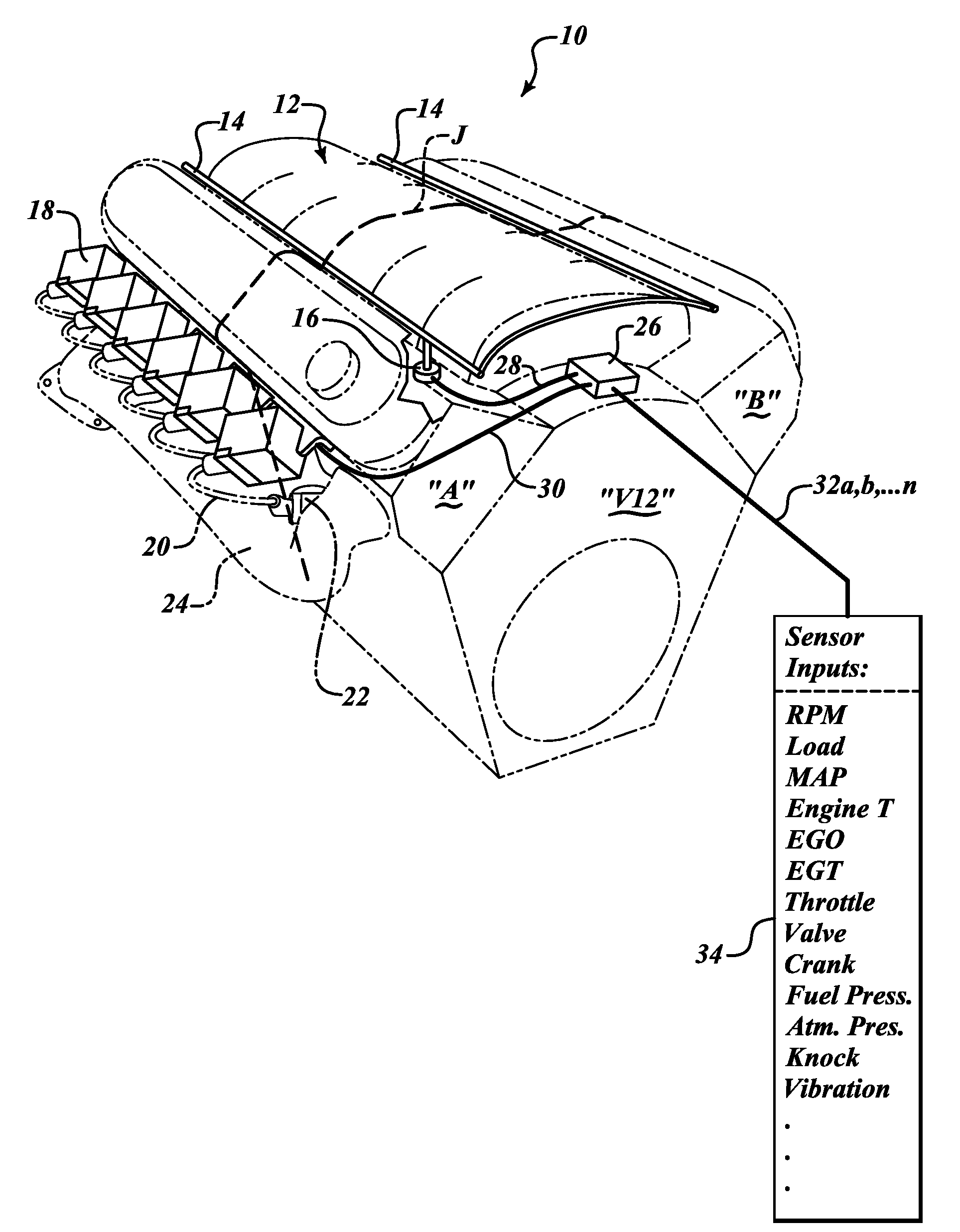
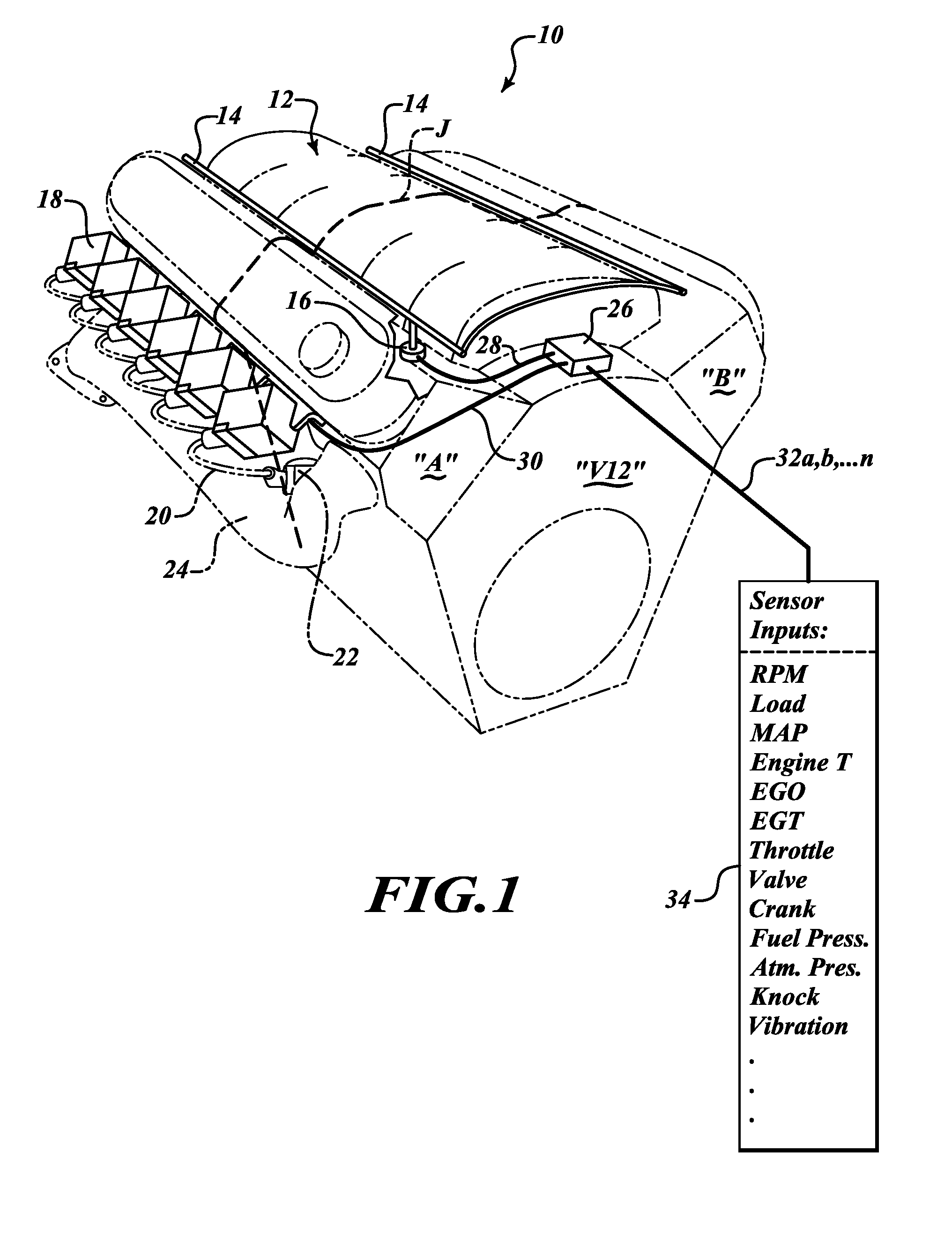
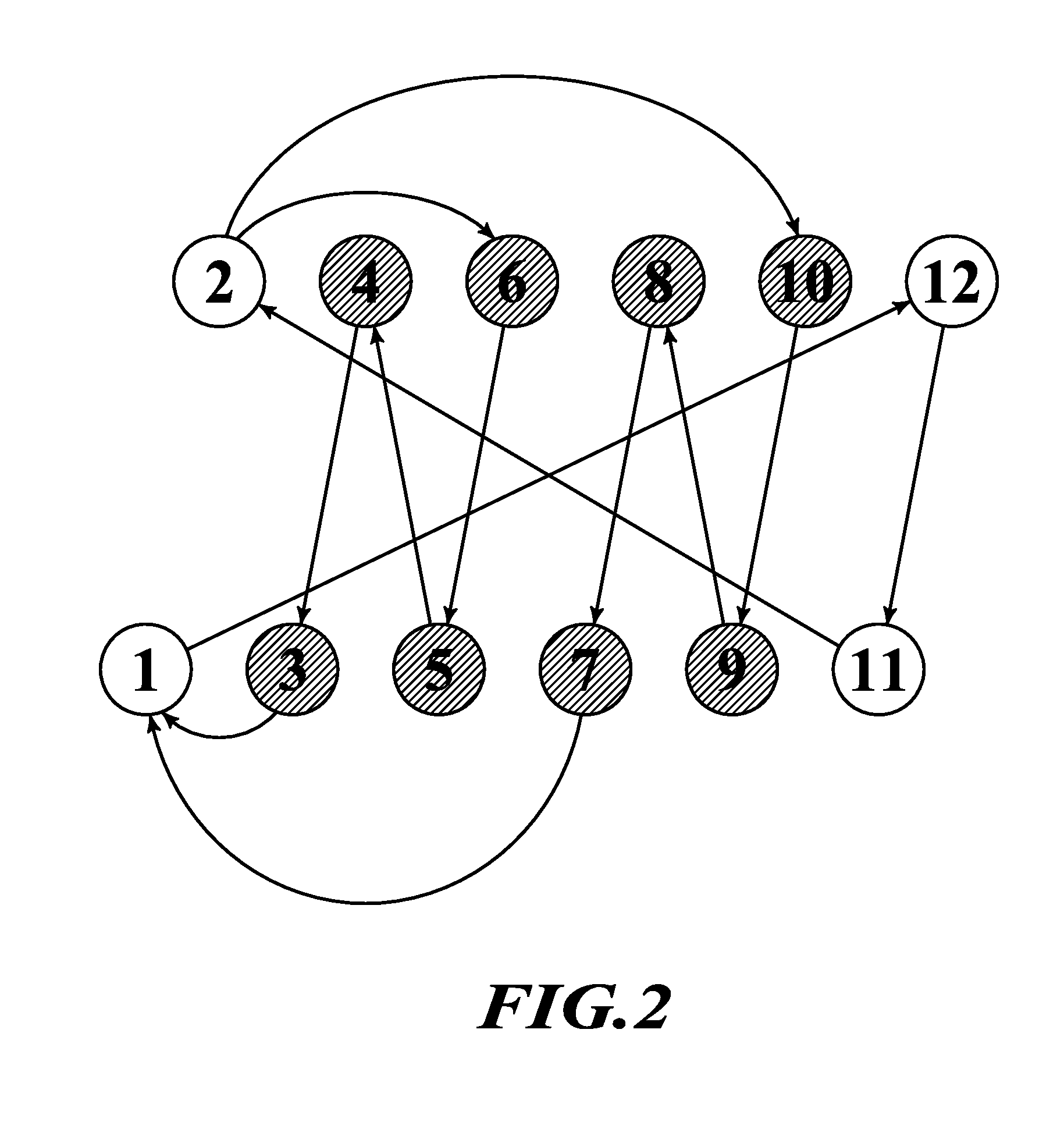
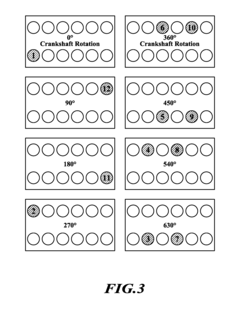
- Implementing a Progressive Single/Pair (PS/P) fueling and firing sequence in a 90° V12 engine, controlled by a Powertrain Control Module (PCM), which allows for Even Fire operation by selectively reducing fuel feed to specific cylinders during imbalance frequency ranges, effectively converting the engine to a balanced V8 operation during peak vibrations.
Environmental Regulations Impact
Environmental regulations have become a significant driving force in shaping the future of V12 engine design, particularly in the context of downsizing efforts. As governments worldwide implement increasingly stringent emissions standards, automakers are compelled to adapt their high-performance engines to meet these requirements while maintaining their iconic status and performance characteristics.
The impact of environmental regulations on V12 engine downsizing is multifaceted. Firstly, carbon dioxide (CO2) emission limits have forced manufacturers to explore ways to reduce fuel consumption without compromising power output. This has led to the integration of advanced technologies such as direct fuel injection, variable valve timing, and cylinder deactivation systems in V12 engines.
Secondly, regulations targeting nitrogen oxides (NOx) and particulate matter emissions have necessitated the development of more sophisticated exhaust after-treatment systems. These systems, including selective catalytic reduction (SCR) and gasoline particulate filters (GPF), add complexity and weight to V12 engines, further challenging designers to find innovative downsizing solutions.
The European Union's Euro 7 standards, set to be implemented in the coming years, will impose even more stringent limits on emissions from passenger vehicles. This regulatory pressure is pushing V12 engine manufacturers to explore hybrid and electrification technologies as a means of compliance while preserving the unique characteristics of these powerplants.
In response to these challenges, some automakers are investigating the potential of synthetic fuels (e-fuels) as a way to extend the lifespan of V12 engines. These carbon-neutral fuels could potentially allow V12 engines to meet emissions targets without extensive redesign, though their widespread adoption faces significant hurdles in terms of production scale and infrastructure.
The impact of environmental regulations is not limited to technical aspects alone. It also affects the market positioning and brand image of V12-powered vehicles. As consumers become more environmentally conscious, manufacturers must balance the prestige and performance associated with V12 engines against the growing demand for sustainable mobility solutions.
In conclusion, environmental regulations are reshaping the landscape of V12 engine design, driving innovation in downsizing techniques and alternative technologies. The future of these iconic powerplants will depend on the industry's ability to adapt to evolving regulatory frameworks while preserving the unique appeal that has made V12 engines a symbol of automotive excellence.
The impact of environmental regulations on V12 engine downsizing is multifaceted. Firstly, carbon dioxide (CO2) emission limits have forced manufacturers to explore ways to reduce fuel consumption without compromising power output. This has led to the integration of advanced technologies such as direct fuel injection, variable valve timing, and cylinder deactivation systems in V12 engines.
Secondly, regulations targeting nitrogen oxides (NOx) and particulate matter emissions have necessitated the development of more sophisticated exhaust after-treatment systems. These systems, including selective catalytic reduction (SCR) and gasoline particulate filters (GPF), add complexity and weight to V12 engines, further challenging designers to find innovative downsizing solutions.
The European Union's Euro 7 standards, set to be implemented in the coming years, will impose even more stringent limits on emissions from passenger vehicles. This regulatory pressure is pushing V12 engine manufacturers to explore hybrid and electrification technologies as a means of compliance while preserving the unique characteristics of these powerplants.
In response to these challenges, some automakers are investigating the potential of synthetic fuels (e-fuels) as a way to extend the lifespan of V12 engines. These carbon-neutral fuels could potentially allow V12 engines to meet emissions targets without extensive redesign, though their widespread adoption faces significant hurdles in terms of production scale and infrastructure.
The impact of environmental regulations is not limited to technical aspects alone. It also affects the market positioning and brand image of V12-powered vehicles. As consumers become more environmentally conscious, manufacturers must balance the prestige and performance associated with V12 engines against the growing demand for sustainable mobility solutions.
In conclusion, environmental regulations are reshaping the landscape of V12 engine design, driving innovation in downsizing techniques and alternative technologies. The future of these iconic powerplants will depend on the industry's ability to adapt to evolving regulatory frameworks while preserving the unique appeal that has made V12 engines a symbol of automotive excellence.
Materials Advancements for V12 Engines
The advancement of materials technology plays a crucial role in pushing the boundaries of V12 engine downsizing. As manufacturers strive to reduce engine size while maintaining or improving performance, innovative materials are at the forefront of this evolution. High-strength alloys, such as advanced aluminum and magnesium alloys, are being developed to create lighter yet more durable engine components. These materials offer superior strength-to-weight ratios, allowing for thinner walls and reduced overall mass without compromising structural integrity.
Ceramic matrix composites (CMCs) are emerging as a game-changing material for V12 engines. Their exceptional heat resistance and low density make them ideal for components exposed to extreme temperatures, such as cylinder liners and exhaust manifolds. By incorporating CMCs, engineers can design more compact combustion chambers that operate at higher temperatures, improving thermal efficiency and power output.
Nanomaterials are also making significant contributions to V12 engine downsizing efforts. Carbon nanotubes and graphene-enhanced polymers are being explored for use in various engine components, offering unprecedented strength and lightweight properties. These materials can potentially reduce friction, improve heat dissipation, and enhance overall engine efficiency.
Coatings technology has seen remarkable progress, with diamond-like carbon (DLC) coatings and thermal barrier coatings (TBCs) leading the way. DLC coatings significantly reduce friction between moving parts, allowing for tighter tolerances and more compact designs. TBCs, on the other hand, enable higher operating temperatures and improved thermal management, crucial for downsized V12 engines that generate more heat per unit volume.
Advanced manufacturing techniques, such as 3D printing and additive manufacturing, are revolutionizing the production of complex engine components. These methods allow for the creation of intricate internal structures and optimized geometries that were previously impossible to manufacture. This capability enables engineers to design more compact and efficient V12 engines with improved cooling channels and reduced material waste.
The integration of smart materials and shape memory alloys into V12 engine design is an exciting frontier. These materials can adapt to changing operating conditions, potentially allowing for variable compression ratios or adaptive valve timing without the need for complex mechanical systems. This adaptability could lead to further engine downsizing while maintaining a wide performance envelope.
As research in materials science continues to advance, the potential for even more radical downsizing of V12 engines grows. The synergy between new materials, innovative design approaches, and cutting-edge manufacturing techniques is paving the way for the next generation of compact, high-performance V12 engines that push the limits of what was previously thought possible.
Ceramic matrix composites (CMCs) are emerging as a game-changing material for V12 engines. Their exceptional heat resistance and low density make them ideal for components exposed to extreme temperatures, such as cylinder liners and exhaust manifolds. By incorporating CMCs, engineers can design more compact combustion chambers that operate at higher temperatures, improving thermal efficiency and power output.
Nanomaterials are also making significant contributions to V12 engine downsizing efforts. Carbon nanotubes and graphene-enhanced polymers are being explored for use in various engine components, offering unprecedented strength and lightweight properties. These materials can potentially reduce friction, improve heat dissipation, and enhance overall engine efficiency.
Coatings technology has seen remarkable progress, with diamond-like carbon (DLC) coatings and thermal barrier coatings (TBCs) leading the way. DLC coatings significantly reduce friction between moving parts, allowing for tighter tolerances and more compact designs. TBCs, on the other hand, enable higher operating temperatures and improved thermal management, crucial for downsized V12 engines that generate more heat per unit volume.
Advanced manufacturing techniques, such as 3D printing and additive manufacturing, are revolutionizing the production of complex engine components. These methods allow for the creation of intricate internal structures and optimized geometries that were previously impossible to manufacture. This capability enables engineers to design more compact and efficient V12 engines with improved cooling channels and reduced material waste.
The integration of smart materials and shape memory alloys into V12 engine design is an exciting frontier. These materials can adapt to changing operating conditions, potentially allowing for variable compression ratios or adaptive valve timing without the need for complex mechanical systems. This adaptability could lead to further engine downsizing while maintaining a wide performance envelope.
As research in materials science continues to advance, the potential for even more radical downsizing of V12 engines grows. The synergy between new materials, innovative design approaches, and cutting-edge manufacturing techniques is paving the way for the next generation of compact, high-performance V12 engines that push the limits of what was previously thought possible.
Unlock deeper insights with PatSnap Eureka Quick Research — get a full tech report to explore trends and direct your research. Try now!
Generate Your Research Report Instantly with AI Agent
Supercharge your innovation with PatSnap Eureka AI Agent Platform!