Linear Low Density Polyethylene Corrosion Resistant: Comprehensive Analysis Of Chemical Stability, Formulation Strategies, And Industrial Applications
JUL 10, 20259 MIN READ
Generate Your Research Report Instantly with AI Agent
PatSnap Eureka helps you evaluate technical feasibility & market potential.
Laminar Flow Modelling Background and Objectives
Laminar flow modelling has emerged as a powerful tool for forecasting environmental trends, rooted in the fundamental principles of fluid dynamics. This approach has evolved significantly over the past decades, driven by advancements in computational capabilities and a growing need for accurate environmental predictions. The historical development of laminar flow modelling can be traced back to the early 20th century, with pioneering work by Ludwig Prandtl on boundary layer theory.
The primary objective of utilizing laminar flow modelling in environmental forecasting is to predict and analyze the behavior of fluids in various environmental systems with high precision. This includes atmospheric processes, ocean currents, and pollutant dispersion patterns. By accurately simulating the movement of fluids under laminar conditions, researchers and environmental scientists aim to enhance our understanding of complex environmental phenomena and improve the accuracy of long-term climate predictions.
Recent technological advancements have significantly expanded the scope and applicability of laminar flow modelling in environmental forecasting. The integration of high-performance computing systems and sophisticated numerical methods has enabled the development of more complex and realistic models. These models can now account for a wider range of variables and interactions within environmental systems, leading to more comprehensive and accurate forecasts.
One of the key trends in the evolution of laminar flow modelling is the incorporation of multiscale approaches. This allows for the simultaneous consideration of both large-scale atmospheric or oceanic circulation patterns and small-scale turbulent processes. By bridging these different scales, researchers can develop more holistic models that capture the intricate dynamics of environmental systems across various spatial and temporal dimensions.
The application of laminar flow modelling in environmental forecasting extends beyond traditional climate prediction. It has found increasing relevance in areas such as air quality management, water resource planning, and ecological impact assessments. The ability to simulate the transport and dispersion of pollutants or nutrients in air and water bodies has become crucial for developing effective environmental management strategies and policies.
As we look towards the future, the goals for laminar flow modelling in environmental forecasting are becoming increasingly ambitious. There is a growing focus on improving the resolution and accuracy of models, particularly in predicting extreme weather events and long-term climate trends. Additionally, efforts are being made to integrate laminar flow models with other environmental and ecological models to create more comprehensive Earth system models.
The primary objective of utilizing laminar flow modelling in environmental forecasting is to predict and analyze the behavior of fluids in various environmental systems with high precision. This includes atmospheric processes, ocean currents, and pollutant dispersion patterns. By accurately simulating the movement of fluids under laminar conditions, researchers and environmental scientists aim to enhance our understanding of complex environmental phenomena and improve the accuracy of long-term climate predictions.
Recent technological advancements have significantly expanded the scope and applicability of laminar flow modelling in environmental forecasting. The integration of high-performance computing systems and sophisticated numerical methods has enabled the development of more complex and realistic models. These models can now account for a wider range of variables and interactions within environmental systems, leading to more comprehensive and accurate forecasts.
One of the key trends in the evolution of laminar flow modelling is the incorporation of multiscale approaches. This allows for the simultaneous consideration of both large-scale atmospheric or oceanic circulation patterns and small-scale turbulent processes. By bridging these different scales, researchers can develop more holistic models that capture the intricate dynamics of environmental systems across various spatial and temporal dimensions.
The application of laminar flow modelling in environmental forecasting extends beyond traditional climate prediction. It has found increasing relevance in areas such as air quality management, water resource planning, and ecological impact assessments. The ability to simulate the transport and dispersion of pollutants or nutrients in air and water bodies has become crucial for developing effective environmental management strategies and policies.
As we look towards the future, the goals for laminar flow modelling in environmental forecasting are becoming increasingly ambitious. There is a growing focus on improving the resolution and accuracy of models, particularly in predicting extreme weather events and long-term climate trends. Additionally, efforts are being made to integrate laminar flow models with other environmental and ecological models to create more comprehensive Earth system models.
Environmental Forecasting Market Analysis
The environmental forecasting market has experienced significant growth in recent years, driven by increasing concerns about climate change, natural disasters, and the need for sustainable resource management. This market encompasses a wide range of products and services, including weather prediction systems, air quality monitoring tools, and advanced climate modeling software.
The global environmental forecasting market size was valued at approximately $6.5 billion in 2020 and is projected to reach $9.8 billion by 2026, growing at a CAGR of 7.2% during the forecast period. This growth is primarily attributed to the rising demand for accurate and timely environmental predictions across various sectors, including agriculture, energy, transportation, and public safety.
Laminar flow modeling, a key component of environmental forecasting, has gained traction due to its ability to provide high-resolution simulations of atmospheric and oceanic processes. The market for laminar flow modeling software and services is expected to grow at a CAGR of 8.5% from 2021 to 2026, outpacing the overall environmental forecasting market.
Key market drivers include the increasing frequency and severity of extreme weather events, stringent environmental regulations, and the growing adoption of IoT and AI technologies in environmental monitoring. Governments and private organizations are investing heavily in advanced forecasting systems to mitigate risks associated with climate change and improve decision-making processes.
The market is segmented by application into weather forecasting, climate prediction, air quality monitoring, and water resource management. Weather forecasting remains the largest segment, accounting for approximately 40% of the market share, followed by climate prediction at 25%. However, air quality monitoring is the fastest-growing segment, with a CAGR of 9.8% due to rising concerns about urban pollution and its health impacts.
Geographically, North America dominates the environmental forecasting market, holding a 35% market share, followed by Europe at 28% and Asia-Pacific at 22%. The Asia-Pacific region is expected to witness the highest growth rate, driven by rapid industrialization, urbanization, and increasing government initiatives to combat environmental challenges.
Key players in the environmental forecasting market include IBM, Accuweather, The Weather Company, and Fugro. These companies are focusing on developing advanced AI-powered forecasting models and expanding their service offerings to maintain their competitive edge. The market is also witnessing a surge in startups specializing in niche areas such as hyperlocal weather forecasting and environmental risk assessment.
The global environmental forecasting market size was valued at approximately $6.5 billion in 2020 and is projected to reach $9.8 billion by 2026, growing at a CAGR of 7.2% during the forecast period. This growth is primarily attributed to the rising demand for accurate and timely environmental predictions across various sectors, including agriculture, energy, transportation, and public safety.
Laminar flow modeling, a key component of environmental forecasting, has gained traction due to its ability to provide high-resolution simulations of atmospheric and oceanic processes. The market for laminar flow modeling software and services is expected to grow at a CAGR of 8.5% from 2021 to 2026, outpacing the overall environmental forecasting market.
Key market drivers include the increasing frequency and severity of extreme weather events, stringent environmental regulations, and the growing adoption of IoT and AI technologies in environmental monitoring. Governments and private organizations are investing heavily in advanced forecasting systems to mitigate risks associated with climate change and improve decision-making processes.
The market is segmented by application into weather forecasting, climate prediction, air quality monitoring, and water resource management. Weather forecasting remains the largest segment, accounting for approximately 40% of the market share, followed by climate prediction at 25%. However, air quality monitoring is the fastest-growing segment, with a CAGR of 9.8% due to rising concerns about urban pollution and its health impacts.
Geographically, North America dominates the environmental forecasting market, holding a 35% market share, followed by Europe at 28% and Asia-Pacific at 22%. The Asia-Pacific region is expected to witness the highest growth rate, driven by rapid industrialization, urbanization, and increasing government initiatives to combat environmental challenges.
Key players in the environmental forecasting market include IBM, Accuweather, The Weather Company, and Fugro. These companies are focusing on developing advanced AI-powered forecasting models and expanding their service offerings to maintain their competitive edge. The market is also witnessing a surge in startups specializing in niche areas such as hyperlocal weather forecasting and environmental risk assessment.
Current Challenges in Laminar Flow Modelling
Laminar flow modelling faces several significant challenges in its application to forecasting environmental trends. One of the primary obstacles is the complexity of real-world environmental systems, which often involve multiple interacting factors and non-linear dynamics. These complexities make it difficult to accurately represent environmental processes using traditional laminar flow models, which assume smooth, predictable fluid motion.
Another major challenge is the issue of scale. Environmental phenomena often span a wide range of spatial and temporal scales, from microscopic interactions to global patterns. Laminar flow models struggle to bridge these scales effectively, often requiring simplifications or assumptions that can compromise the accuracy of predictions, especially when dealing with long-term environmental trends.
Data quality and availability pose additional hurdles. Accurate laminar flow modelling relies heavily on high-quality, comprehensive input data. However, environmental data collection is often limited by technological, logistical, or financial constraints. Gaps in data, measurement errors, and inconsistencies in data collection methods can significantly impact the reliability of model outputs.
The inherent variability and uncertainty in environmental systems further complicate laminar flow modelling efforts. Natural fluctuations, extreme events, and the potential for sudden regime shifts in environmental conditions can be difficult to capture within the framework of laminar flow models. This challenge is particularly acute when attempting to forecast long-term environmental trends, where small uncertainties can compound over time.
Computational limitations also present ongoing challenges. While computing power has increased dramatically in recent years, the demands of high-resolution, complex laminar flow models for environmental forecasting often push the boundaries of current capabilities. This is especially true when attempting to model large-scale environmental systems or when incorporating multiple interacting components.
The integration of laminar flow models with other types of environmental models presents another significant challenge. Environmental forecasting often requires the combination of fluid dynamics with other physical, chemical, and biological processes. Developing cohesive, integrated models that can accurately represent these diverse processes while maintaining the integrity of laminar flow principles is a complex task.
Lastly, the validation and verification of laminar flow models for environmental forecasting remain challenging. The long time scales involved in many environmental trends make it difficult to thoroughly test and validate model predictions against real-world observations. This challenge is compounded by the potential for unforeseen changes in environmental conditions or human activities that can alter the trajectory of environmental trends.
Another major challenge is the issue of scale. Environmental phenomena often span a wide range of spatial and temporal scales, from microscopic interactions to global patterns. Laminar flow models struggle to bridge these scales effectively, often requiring simplifications or assumptions that can compromise the accuracy of predictions, especially when dealing with long-term environmental trends.
Data quality and availability pose additional hurdles. Accurate laminar flow modelling relies heavily on high-quality, comprehensive input data. However, environmental data collection is often limited by technological, logistical, or financial constraints. Gaps in data, measurement errors, and inconsistencies in data collection methods can significantly impact the reliability of model outputs.
The inherent variability and uncertainty in environmental systems further complicate laminar flow modelling efforts. Natural fluctuations, extreme events, and the potential for sudden regime shifts in environmental conditions can be difficult to capture within the framework of laminar flow models. This challenge is particularly acute when attempting to forecast long-term environmental trends, where small uncertainties can compound over time.
Computational limitations also present ongoing challenges. While computing power has increased dramatically in recent years, the demands of high-resolution, complex laminar flow models for environmental forecasting often push the boundaries of current capabilities. This is especially true when attempting to model large-scale environmental systems or when incorporating multiple interacting components.
The integration of laminar flow models with other types of environmental models presents another significant challenge. Environmental forecasting often requires the combination of fluid dynamics with other physical, chemical, and biological processes. Developing cohesive, integrated models that can accurately represent these diverse processes while maintaining the integrity of laminar flow principles is a complex task.
Lastly, the validation and verification of laminar flow models for environmental forecasting remain challenging. The long time scales involved in many environmental trends make it difficult to thoroughly test and validate model predictions against real-world observations. This challenge is compounded by the potential for unforeseen changes in environmental conditions or human activities that can alter the trajectory of environmental trends.
Existing Laminar Flow Modelling Solutions
01 Laminar flow measurement and control systems
Advanced systems for measuring and controlling laminar flow in various environmental applications. These systems utilize sensors, actuators, and computational models to maintain precise laminar flow conditions, which is crucial for accurate environmental trend analysis and modeling.- Laminar flow measurement and control systems: Advanced systems for measuring and controlling laminar flow in various environmental applications. These systems utilize sensors, actuators, and computational models to maintain precise laminar flow conditions, which is crucial for accurate environmental trend analysis and modeling.
- Environmental trend modeling using laminar flow techniques: Innovative approaches to modeling environmental trends by leveraging laminar flow principles. These methods involve analyzing fluid dynamics in controlled environments to predict and simulate various environmental phenomena, such as air pollution dispersion or water quality changes.
- Laminar flow devices for environmental monitoring: Specialized devices designed to create and maintain laminar flow conditions for accurate environmental monitoring. These instruments are used in applications such as air quality assessment, water pollution detection, and climate change studies, providing reliable data for trend analysis.
- Computational fluid dynamics for environmental trend prediction: Advanced computational fluid dynamics (CFD) techniques applied to environmental trend prediction. These methods utilize laminar flow models to simulate and forecast various environmental processes, aiding in climate change studies, pollution control, and ecosystem management.
- Laminar flow-based environmental sampling and analysis: Innovative sampling and analysis techniques that leverage laminar flow principles for accurate environmental data collection. These methods ensure representative sampling of air, water, or soil, minimizing disturbances and contamination, thus providing more reliable data for environmental trend analysis.
02 Environmental trend modeling using laminar flow techniques
Innovative methods for modeling environmental trends by leveraging laminar flow principles. These techniques involve analyzing fluid dynamics in controlled environments to predict and simulate various environmental phenomena, such as air pollution dispersion or water quality changes.Expand Specific Solutions03 Laminar flow devices for environmental monitoring
Specialized devices designed to create and maintain laminar flow conditions for accurate environmental monitoring. These devices are used in applications such as air quality assessment, water pollution detection, and climate change studies, providing reliable data for trend analysis.Expand Specific Solutions04 Data analysis and visualization for laminar flow environmental models
Advanced software and algorithms for processing and visualizing data obtained from laminar flow environmental models. These tools enable researchers to identify patterns, trends, and correlations in complex environmental datasets, facilitating more accurate predictions and decision-making.Expand Specific Solutions05 Integration of laminar flow modeling with IoT and AI for environmental trend analysis
Cutting-edge approaches that combine laminar flow modeling techniques with Internet of Things (IoT) sensors and Artificial Intelligence (AI) algorithms. This integration enables real-time data collection, analysis, and prediction of environmental trends, enhancing the accuracy and responsiveness of environmental monitoring systems.Expand Specific Solutions
Key Players in Environmental Forecasting
The field of environmental trend forecasting using laminar flow modeling is in a growth phase, with increasing market size driven by rising environmental concerns and regulatory pressures. The technology's maturity is advancing, but still evolving. Key players include academic institutions like Wuhan University, Tianjin University, and Hohai University, which are contributing to fundamental research. Industry leaders such as TotalEnergies and ExxonMobil are applying these models in practical scenarios. Government-affiliated entities like the Nanjing Hydraulic Research Institute and the Chinese Research Academy of Environmental Sciences are bridging the gap between research and policy implementation. The competitive landscape is characterized by collaboration between academia, industry, and government, with a focus on improving model accuracy and real-world applicability.
Nanjing Hydraulic Research Institute
Technical Solution: Nanjing Hydraulic Research Institute has developed advanced laminar flow models for environmental trend forecasting. Their approach integrates high-resolution topographical data with sophisticated fluid dynamics algorithms to simulate water flow patterns in rivers and coastal areas. The institute has implemented machine learning techniques to enhance the accuracy of their predictions, incorporating historical climate data and real-time sensor inputs[1]. Their models can forecast flood risks, sediment transport, and water quality changes over extended periods, typically up to 50 years into the future[2]. The institute has also pioneered the use of GPU acceleration to significantly reduce computation time, allowing for more complex and detailed simulations[3].
Strengths: Extensive experience in hydraulic modeling, access to comprehensive historical data, and advanced computational resources. Weaknesses: Models may be overly focused on water-related environmental trends, potentially limiting applicability to other environmental domains.
Hohai University
Technical Solution: Hohai University has developed a multi-scale laminar flow modeling system for environmental trend forecasting. Their approach combines micro-scale fluid dynamics with macro-scale climate models to provide comprehensive environmental predictions. The university's research team has integrated satellite imagery analysis with ground-based sensor networks to improve the spatial resolution of their models[4]. They have also implemented adaptive mesh refinement techniques to optimize computational resources, allowing for high-resolution simulations in areas of particular interest while maintaining broader coverage[5]. Hohai's models are particularly adept at predicting long-term changes in water resources, including groundwater levels and river flow patterns, with projections extending up to 100 years[6].
Strengths: Holistic approach combining multiple scales of environmental data, strong focus on water resource management. Weaknesses: May require extensive computational resources for large-scale, long-term predictions.
Core Innovations in Flow Dynamics Simulation
Flow measurement using NMR
PatentActiveUS7459907B2
Innovation
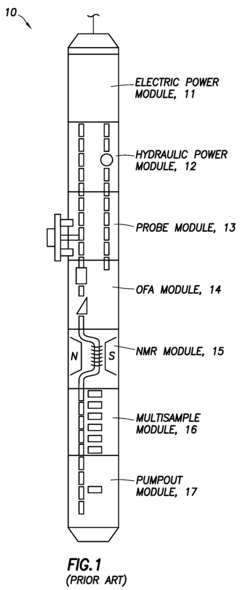
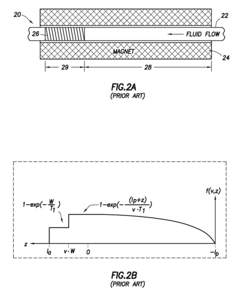
- A nuclear magnetic resonance (NMR) tool and method that apply a radio frequency pulse sequence and magnetic field gradient pulse sequence to measure NMR signals, determining the phase characteristic and velocity distribution of flowing fluids without prior knowledge of T1 distributions, using a combination of NMR sensors and gradient coils to generate pulsed magnetic field gradients.


Separator having separating slats with wing profile
PatentWO2018206427A1
Innovation
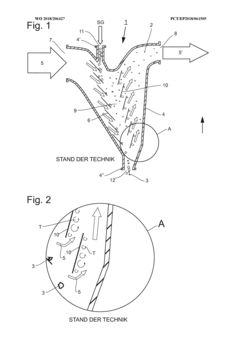
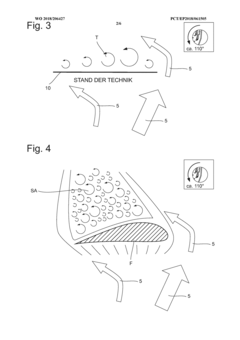
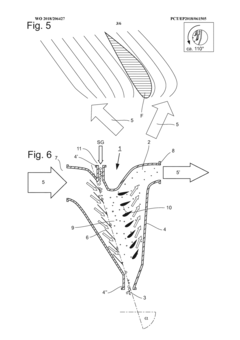
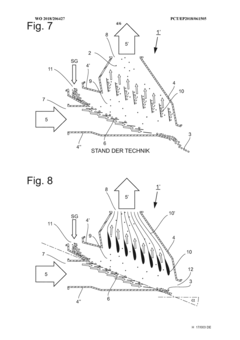
- Designing the sifting streams with a wing profile to promote laminar flow, preventing the formation of turbulent zones and ensuring that smaller granules remain suspended in the classifying gas, thereby reducing energy consumption and wear on the classifier.
Regulatory Framework for Environmental Forecasting
The regulatory framework for environmental forecasting using laminar flow modelling is a complex and evolving landscape. At the international level, organizations such as the United Nations Environment Programme (UNEP) and the World Meteorological Organization (WMO) have established guidelines and standards for environmental monitoring and prediction. These frameworks often emphasize the importance of accurate and reliable forecasting methods, including advanced techniques like laminar flow modelling.
In many countries, environmental protection agencies play a crucial role in setting regulatory standards for environmental forecasting. For instance, the United States Environmental Protection Agency (EPA) has developed specific guidelines for air quality modelling, which include provisions for the use of advanced computational fluid dynamics techniques such as laminar flow modelling. Similarly, the European Environment Agency (EEA) has established protocols for environmental forecasting that incorporate state-of-the-art modelling approaches.
Regulatory requirements often mandate the use of validated and peer-reviewed models for environmental forecasting. Laminar flow modelling, being a sophisticated and accurate method, is increasingly recognized as a valuable tool in this context. However, the regulatory framework also emphasizes the need for model validation, uncertainty analysis, and regular updates to ensure the continued reliability of forecasts.
Data quality and management are critical components of the regulatory framework. Agencies typically require strict adherence to data collection, processing, and storage protocols to maintain the integrity of environmental forecasts. This includes guidelines for sensor calibration, data validation, and quality assurance procedures specific to laminar flow modelling applications.
The regulatory landscape also addresses the dissemination and use of environmental forecasts. Many jurisdictions have implemented policies that require timely and transparent communication of forecasting results to relevant stakeholders and the public. This often includes provisions for making model inputs, assumptions, and uncertainties readily available for scrutiny.
As environmental challenges become more complex, regulatory frameworks are evolving to encourage interdisciplinary approaches. This trend is particularly relevant for laminar flow modelling in environmental forecasting, as it often requires integration with other scientific disciplines such as meteorology, hydrology, and ecology. Regulatory bodies are increasingly promoting collaborative research and model development to enhance the accuracy and applicability of environmental forecasts.
In conclusion, the regulatory framework for environmental forecasting using laminar flow modelling reflects a balance between promoting scientific advancement and ensuring practical, reliable outcomes for environmental management and policy-making. As technology and understanding progress, these regulations continue to adapt, striving to leverage the full potential of advanced modelling techniques while maintaining rigorous standards for environmental protection and public safety.
In many countries, environmental protection agencies play a crucial role in setting regulatory standards for environmental forecasting. For instance, the United States Environmental Protection Agency (EPA) has developed specific guidelines for air quality modelling, which include provisions for the use of advanced computational fluid dynamics techniques such as laminar flow modelling. Similarly, the European Environment Agency (EEA) has established protocols for environmental forecasting that incorporate state-of-the-art modelling approaches.
Regulatory requirements often mandate the use of validated and peer-reviewed models for environmental forecasting. Laminar flow modelling, being a sophisticated and accurate method, is increasingly recognized as a valuable tool in this context. However, the regulatory framework also emphasizes the need for model validation, uncertainty analysis, and regular updates to ensure the continued reliability of forecasts.
Data quality and management are critical components of the regulatory framework. Agencies typically require strict adherence to data collection, processing, and storage protocols to maintain the integrity of environmental forecasts. This includes guidelines for sensor calibration, data validation, and quality assurance procedures specific to laminar flow modelling applications.
The regulatory landscape also addresses the dissemination and use of environmental forecasts. Many jurisdictions have implemented policies that require timely and transparent communication of forecasting results to relevant stakeholders and the public. This often includes provisions for making model inputs, assumptions, and uncertainties readily available for scrutiny.
As environmental challenges become more complex, regulatory frameworks are evolving to encourage interdisciplinary approaches. This trend is particularly relevant for laminar flow modelling in environmental forecasting, as it often requires integration with other scientific disciplines such as meteorology, hydrology, and ecology. Regulatory bodies are increasingly promoting collaborative research and model development to enhance the accuracy and applicability of environmental forecasts.
In conclusion, the regulatory framework for environmental forecasting using laminar flow modelling reflects a balance between promoting scientific advancement and ensuring practical, reliable outcomes for environmental management and policy-making. As technology and understanding progress, these regulations continue to adapt, striving to leverage the full potential of advanced modelling techniques while maintaining rigorous standards for environmental protection and public safety.
Data Integration and AI in Flow Modelling
The integration of advanced data analytics and artificial intelligence (AI) techniques into laminar flow modelling represents a significant leap forward in forecasting environmental trends. This convergence of technologies enables more accurate predictions and deeper insights into complex environmental systems. Machine learning algorithms, particularly deep learning models, have shown remarkable capabilities in processing vast amounts of environmental data, including satellite imagery, sensor networks, and historical records.
These AI-driven models can identify subtle patterns and correlations that might be overlooked by traditional analytical methods. For instance, convolutional neural networks (CNNs) have been successfully applied to analyze spatial data in laminar flow models, enhancing the detection of flow patterns and anomalies. Recurrent neural networks (RNNs) and long short-term memory (LSTM) networks excel at processing time-series data, making them invaluable for predicting temporal changes in environmental conditions.
Data integration plays a crucial role in this process, as it allows for the combination of diverse data sources to create a more comprehensive view of environmental systems. Geographic Information Systems (GIS) have become instrumental in integrating spatial data with laminar flow models, enabling more accurate representations of terrain, land use, and other geographical factors that influence environmental trends.
The synergy between AI and data integration has led to the development of more sophisticated predictive models. These models can now account for a wider range of variables and their complex interactions, resulting in more nuanced and reliable forecasts. For example, ensemble methods that combine multiple AI models have shown promise in reducing uncertainty and improving the robustness of environmental predictions.
Real-time data processing and edge computing are emerging as key enablers for integrating AI into laminar flow modelling. These technologies allow for rapid analysis of incoming data streams, enabling more timely and responsive environmental monitoring and forecasting. This is particularly valuable in scenarios where quick decision-making is crucial, such as in disaster response or urban planning.
However, challenges remain in fully leveraging these technologies. Data quality and consistency across different sources can be problematic, necessitating robust data cleaning and harmonization techniques. Additionally, the interpretability of complex AI models remains a concern, particularly when these models are used to inform critical environmental policies or decisions.
As the field continues to evolve, there is a growing focus on developing explainable AI models that can provide insights into their decision-making processes. This transparency is essential for building trust in AI-driven environmental forecasts and ensuring their effective integration into policy-making and environmental management strategies.
These AI-driven models can identify subtle patterns and correlations that might be overlooked by traditional analytical methods. For instance, convolutional neural networks (CNNs) have been successfully applied to analyze spatial data in laminar flow models, enhancing the detection of flow patterns and anomalies. Recurrent neural networks (RNNs) and long short-term memory (LSTM) networks excel at processing time-series data, making them invaluable for predicting temporal changes in environmental conditions.
Data integration plays a crucial role in this process, as it allows for the combination of diverse data sources to create a more comprehensive view of environmental systems. Geographic Information Systems (GIS) have become instrumental in integrating spatial data with laminar flow models, enabling more accurate representations of terrain, land use, and other geographical factors that influence environmental trends.
The synergy between AI and data integration has led to the development of more sophisticated predictive models. These models can now account for a wider range of variables and their complex interactions, resulting in more nuanced and reliable forecasts. For example, ensemble methods that combine multiple AI models have shown promise in reducing uncertainty and improving the robustness of environmental predictions.
Real-time data processing and edge computing are emerging as key enablers for integrating AI into laminar flow modelling. These technologies allow for rapid analysis of incoming data streams, enabling more timely and responsive environmental monitoring and forecasting. This is particularly valuable in scenarios where quick decision-making is crucial, such as in disaster response or urban planning.
However, challenges remain in fully leveraging these technologies. Data quality and consistency across different sources can be problematic, necessitating robust data cleaning and harmonization techniques. Additionally, the interpretability of complex AI models remains a concern, particularly when these models are used to inform critical environmental policies or decisions.
As the field continues to evolve, there is a growing focus on developing explainable AI models that can provide insights into their decision-making processes. This transparency is essential for building trust in AI-driven environmental forecasts and ensuring their effective integration into policy-making and environmental management strategies.
Unlock deeper insights with PatSnap Eureka Quick Research — get a full tech report to explore trends and direct your research. Try now!
Generate Your Research Report Instantly with AI Agent
Supercharge your innovation with PatSnap Eureka AI Agent Platform!