

Linear Low Density Polyethylene High Toughness: Advanced Material Engineering For Superior Impact Performance
JUL 10, 20259 MIN READ
Generate Your Research Report Instantly with AI Agent
PatSnap Eureka helps you evaluate technical feasibility & market potential.
Laminar Flow in Aerospace: Background and Objectives
Laminar flow, a concept that has been known in fluid dynamics for decades, is experiencing a renaissance in aerospace engineering. This phenomenon, characterized by smooth and predictable fluid motion, has become a focal point for innovation in aircraft design and performance optimization. The evolution of laminar flow technology in aerospace can be traced back to the mid-20th century, with significant advancements occurring in recent years due to improved computational capabilities and materials science.
The primary objective of implementing laminar flow in aerospace is to reduce drag, which in turn leads to improved fuel efficiency and reduced emissions. As the aviation industry faces increasing pressure to minimize its environmental impact, the pursuit of laminar flow has gained renewed importance. This technology holds the promise of revolutionizing aircraft design, potentially reducing fuel consumption by up to 15% compared to conventional designs.
The development of laminar flow technology has been marked by several key milestones. Early research focused on natural laminar flow, which relies on airfoil shape to maintain smooth airflow. However, the limitations of this approach in real-world conditions led to the exploration of active laminar flow control systems. These systems use various methods, such as suction or blowing, to manipulate the boundary layer and maintain laminar flow over larger portions of the aircraft surface.
Recent technological advancements have enabled more sophisticated approaches to laminar flow control. The integration of smart materials, micro-electromechanical systems (MEMS), and advanced sensors has opened new possibilities for dynamic and adaptive laminar flow systems. These innovations allow for real-time adjustment of surface properties to maintain optimal flow conditions across a wide range of flight regimes.
The aerospace industry's current focus on laminar flow technology is driven by a convergence of factors. Stricter environmental regulations, rising fuel costs, and the need for more efficient long-haul aircraft have all contributed to the renewed interest in this field. Additionally, the advent of electric and hybrid-electric propulsion systems has created new opportunities for integrating laminar flow technologies into novel aircraft configurations.
As research in this area progresses, the goal is not only to improve the performance of conventional aircraft but also to enable new aircraft designs that were previously impractical. The successful implementation of laminar flow technology could lead to radical changes in aircraft geometry, propulsion integration, and overall system architecture. This, in turn, could redefine aerospace standards, pushing the boundaries of what is possible in terms of efficiency, range, and environmental impact.
The primary objective of implementing laminar flow in aerospace is to reduce drag, which in turn leads to improved fuel efficiency and reduced emissions. As the aviation industry faces increasing pressure to minimize its environmental impact, the pursuit of laminar flow has gained renewed importance. This technology holds the promise of revolutionizing aircraft design, potentially reducing fuel consumption by up to 15% compared to conventional designs.
The development of laminar flow technology has been marked by several key milestones. Early research focused on natural laminar flow, which relies on airfoil shape to maintain smooth airflow. However, the limitations of this approach in real-world conditions led to the exploration of active laminar flow control systems. These systems use various methods, such as suction or blowing, to manipulate the boundary layer and maintain laminar flow over larger portions of the aircraft surface.
Recent technological advancements have enabled more sophisticated approaches to laminar flow control. The integration of smart materials, micro-electromechanical systems (MEMS), and advanced sensors has opened new possibilities for dynamic and adaptive laminar flow systems. These innovations allow for real-time adjustment of surface properties to maintain optimal flow conditions across a wide range of flight regimes.
The aerospace industry's current focus on laminar flow technology is driven by a convergence of factors. Stricter environmental regulations, rising fuel costs, and the need for more efficient long-haul aircraft have all contributed to the renewed interest in this field. Additionally, the advent of electric and hybrid-electric propulsion systems has created new opportunities for integrating laminar flow technologies into novel aircraft configurations.
As research in this area progresses, the goal is not only to improve the performance of conventional aircraft but also to enable new aircraft designs that were previously impractical. The successful implementation of laminar flow technology could lead to radical changes in aircraft geometry, propulsion integration, and overall system architecture. This, in turn, could redefine aerospace standards, pushing the boundaries of what is possible in terms of efficiency, range, and environmental impact.
Market Demand for Efficient Aircraft Design
The aerospace industry is experiencing a growing demand for more efficient aircraft designs, driven by economic and environmental pressures. Airlines and aircraft operators are seeking ways to reduce fuel consumption, lower operating costs, and minimize their carbon footprint. This market demand has led to increased interest in laminar flow technology, which promises significant improvements in aerodynamic efficiency.
Laminar flow, characterized by smooth and predictable air movement over aircraft surfaces, offers substantial benefits in terms of drag reduction. By maintaining laminar flow over larger portions of an aircraft's wings and fuselage, manufacturers can achieve remarkable fuel savings, estimated to be up to 15% compared to conventional designs. This translates to reduced operating costs for airlines and lower emissions, aligning with global sustainability goals.
The market for more efficient aircraft is further propelled by stringent environmental regulations and industry commitments to reduce carbon emissions. The International Civil Aviation Organization (ICAO) has set ambitious targets for the aviation sector to achieve carbon-neutral growth from 2020 onwards and to halve CO2 emissions by 2050 compared to 2005 levels. These targets create a strong incentive for airlines to invest in next-generation aircraft incorporating laminar flow technology.
Moreover, the competitive landscape in the commercial aviation sector is driving manufacturers to innovate and differentiate their products. Airlines are increasingly looking for aircraft that offer better fuel efficiency and lower maintenance costs. Laminar flow technology provides a compelling selling point for manufacturers, as it addresses these key customer requirements.
The potential market for laminar flow technology extends beyond commercial aviation. Military aircraft operators are also showing interest in the technology for its potential to enhance range, endurance, and overall mission capabilities. Additionally, the business jet sector, where performance and efficiency are crucial selling points, represents another promising market for laminar flow applications.
As the aviation industry recovers from the impact of the COVID-19 pandemic, there is a renewed focus on fleet modernization and efficiency improvements. Airlines are looking to replace older, less efficient aircraft with newer models that incorporate advanced technologies like laminar flow. This trend is expected to drive demand for aircraft featuring laminar flow designs in the coming years.
The market demand for efficient aircraft design is not limited to new aircraft production. There is also growing interest in retrofit solutions that can bring some of the benefits of laminar flow technology to existing aircraft. This opens up additional market opportunities for aerospace suppliers and maintenance, repair, and overhaul (MRO) providers.
Laminar flow, characterized by smooth and predictable air movement over aircraft surfaces, offers substantial benefits in terms of drag reduction. By maintaining laminar flow over larger portions of an aircraft's wings and fuselage, manufacturers can achieve remarkable fuel savings, estimated to be up to 15% compared to conventional designs. This translates to reduced operating costs for airlines and lower emissions, aligning with global sustainability goals.
The market for more efficient aircraft is further propelled by stringent environmental regulations and industry commitments to reduce carbon emissions. The International Civil Aviation Organization (ICAO) has set ambitious targets for the aviation sector to achieve carbon-neutral growth from 2020 onwards and to halve CO2 emissions by 2050 compared to 2005 levels. These targets create a strong incentive for airlines to invest in next-generation aircraft incorporating laminar flow technology.
Moreover, the competitive landscape in the commercial aviation sector is driving manufacturers to innovate and differentiate their products. Airlines are increasingly looking for aircraft that offer better fuel efficiency and lower maintenance costs. Laminar flow technology provides a compelling selling point for manufacturers, as it addresses these key customer requirements.
The potential market for laminar flow technology extends beyond commercial aviation. Military aircraft operators are also showing interest in the technology for its potential to enhance range, endurance, and overall mission capabilities. Additionally, the business jet sector, where performance and efficiency are crucial selling points, represents another promising market for laminar flow applications.
As the aviation industry recovers from the impact of the COVID-19 pandemic, there is a renewed focus on fleet modernization and efficiency improvements. Airlines are looking to replace older, less efficient aircraft with newer models that incorporate advanced technologies like laminar flow. This trend is expected to drive demand for aircraft featuring laminar flow designs in the coming years.
The market demand for efficient aircraft design is not limited to new aircraft production. There is also growing interest in retrofit solutions that can bring some of the benefits of laminar flow technology to existing aircraft. This opens up additional market opportunities for aerospace suppliers and maintenance, repair, and overhaul (MRO) providers.
Current State and Challenges in Laminar Flow Technology
Laminar flow technology has made significant strides in recent years, revolutionizing aerospace standards and pushing the boundaries of aircraft efficiency. Currently, the state of laminar flow technology is characterized by a blend of promising advancements and persistent challenges.
One of the primary areas of focus is Natural Laminar Flow (NLF), which has shown remarkable progress in reducing drag on aircraft surfaces. Advanced computational fluid dynamics (CFD) simulations and wind tunnel testing have enabled engineers to optimize airfoil designs, achieving extended regions of laminar flow over wings and other aerodynamic surfaces. This has resulted in drag reductions of up to 15% in some cases, translating to substantial fuel savings and improved range for aircraft.
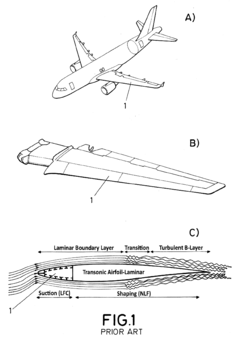
Hybrid Laminar Flow Control (HLFC) systems represent another frontier in laminar flow technology. These systems combine passive NLF techniques with active suction or blowing mechanisms to maintain laminar flow over larger portions of the aircraft. HLFC has demonstrated the potential to reduce overall aircraft drag by up to 10-20%, depending on the specific application and flight conditions.
Despite these advancements, several challenges persist in the widespread adoption of laminar flow technology. Surface contamination remains a significant hurdle, as even minor imperfections or debris on aircraft surfaces can trigger premature transition to turbulent flow, negating the benefits of laminar flow designs. Researchers are exploring innovative surface coatings and self-cleaning materials to mitigate this issue, but practical, long-term solutions are still in development.
Another major challenge lies in the integration of laminar flow technology with other aircraft systems. For instance, the incorporation of anti-icing systems and noise reduction technologies can conflict with the smooth surface requirements for laminar flow. Balancing these competing demands while maintaining structural integrity and manufacturability presents a complex engineering problem.
The aerospace industry also faces challenges in scaling laminar flow technology from small, experimental aircraft to larger commercial and military platforms. As the Reynolds number increases with aircraft size, maintaining laminar flow becomes increasingly difficult. This has led to a focus on developing hybrid systems and localized laminar flow solutions for specific high-impact areas of larger aircraft.
Manufacturing precision and quality control pose additional challenges. The tolerances required for effective laminar flow surfaces are extremely tight, often pushing the limits of current manufacturing capabilities. This not only affects initial production but also raises concerns about maintaining these precise surfaces over the operational life of an aircraft.
Lastly, the certification and regulatory landscape for laminar flow technology is still evolving. As new designs and systems emerge, aviation authorities must develop appropriate standards and testing procedures to ensure safety and performance. This process can be time-consuming and may slow the adoption of innovative laminar flow solutions in commercial aviation.
One of the primary areas of focus is Natural Laminar Flow (NLF), which has shown remarkable progress in reducing drag on aircraft surfaces. Advanced computational fluid dynamics (CFD) simulations and wind tunnel testing have enabled engineers to optimize airfoil designs, achieving extended regions of laminar flow over wings and other aerodynamic surfaces. This has resulted in drag reductions of up to 15% in some cases, translating to substantial fuel savings and improved range for aircraft.
Hybrid Laminar Flow Control (HLFC) systems represent another frontier in laminar flow technology. These systems combine passive NLF techniques with active suction or blowing mechanisms to maintain laminar flow over larger portions of the aircraft. HLFC has demonstrated the potential to reduce overall aircraft drag by up to 10-20%, depending on the specific application and flight conditions.
Despite these advancements, several challenges persist in the widespread adoption of laminar flow technology. Surface contamination remains a significant hurdle, as even minor imperfections or debris on aircraft surfaces can trigger premature transition to turbulent flow, negating the benefits of laminar flow designs. Researchers are exploring innovative surface coatings and self-cleaning materials to mitigate this issue, but practical, long-term solutions are still in development.
Another major challenge lies in the integration of laminar flow technology with other aircraft systems. For instance, the incorporation of anti-icing systems and noise reduction technologies can conflict with the smooth surface requirements for laminar flow. Balancing these competing demands while maintaining structural integrity and manufacturability presents a complex engineering problem.
The aerospace industry also faces challenges in scaling laminar flow technology from small, experimental aircraft to larger commercial and military platforms. As the Reynolds number increases with aircraft size, maintaining laminar flow becomes increasingly difficult. This has led to a focus on developing hybrid systems and localized laminar flow solutions for specific high-impact areas of larger aircraft.
Manufacturing precision and quality control pose additional challenges. The tolerances required for effective laminar flow surfaces are extremely tight, often pushing the limits of current manufacturing capabilities. This not only affects initial production but also raises concerns about maintaining these precise surfaces over the operational life of an aircraft.
Lastly, the certification and regulatory landscape for laminar flow technology is still evolving. As new designs and systems emerge, aviation authorities must develop appropriate standards and testing procedures to ensure safety and performance. This process can be time-consuming and may slow the adoption of innovative laminar flow solutions in commercial aviation.
Existing Laminar Flow Solutions in Aircraft Design
01 Laminar flow measurement and control systems
Various systems and methods for measuring and controlling laminar flow in different applications. These include optical systems for detecting flow characteristics, flow control devices for maintaining laminar flow conditions, and sensors for monitoring flow parameters in real-time.- Laminar flow measurement and control systems: Various systems and methods for measuring and controlling laminar flow in different applications. These include optical systems for detecting flow characteristics, flow control devices for maintaining laminar flow conditions, and sensors for monitoring flow parameters.
- Laminar flow in fluid handling devices: Innovations in fluid handling devices that utilize or promote laminar flow. This includes designs for nozzles, valves, and other components that help maintain laminar flow conditions in various industrial and scientific applications.
- Laminar flow in air purification and ventilation: Applications of laminar flow principles in air purification and ventilation systems. This includes designs for clean rooms, air filtration units, and HVAC systems that use laminar flow to improve air quality and reduce contamination.
- Laminar flow in manufacturing and material processing: Utilization of laminar flow in various manufacturing and material processing applications. This includes systems for coating, drying, and treating materials using laminar flow techniques to ensure uniform and controlled processing.
- Laminar flow in microfluidic and analytical devices: Implementation of laminar flow principles in microfluidic and analytical devices. This includes designs for lab-on-a-chip systems, flow cytometers, and other analytical instruments that rely on laminar flow for precise sample handling and analysis.
02 Laminar flow in fluid handling devices
Innovations in fluid handling devices that utilize laminar flow principles. This includes designs for nozzles, valves, and other components that promote laminar flow conditions to improve efficiency, reduce turbulence, and enhance overall performance in fluid systems.Expand Specific Solutions03 Laminar flow applications in medical and laboratory settings
Utilization of laminar flow technology in medical and laboratory environments. This encompasses clean room designs, sterile air flow systems, and specialized equipment that relies on laminar flow to maintain controlled conditions for sensitive procedures or experiments.Expand Specific Solutions04 Laminar flow in aerodynamics and vehicle design
Applications of laminar flow principles in aerodynamics and vehicle design. This includes innovations in aircraft wing design, automotive body shaping, and other transportation-related technologies that aim to reduce drag and improve fuel efficiency through laminar flow optimization.Expand Specific Solutions05 Laminar flow in industrial processes and manufacturing
Implementation of laminar flow concepts in various industrial processes and manufacturing applications. This covers areas such as coating technologies, material processing, and production line designs that leverage laminar flow to enhance product quality, increase efficiency, or improve process control.Expand Specific Solutions
Key Players in Aerospace Laminar Flow Research
The aerospace industry's laminar flow technology is in a transitional phase, moving from research to practical implementation. The market for this technology is expanding, driven by the increasing demand for fuel-efficient aircraft. While the technology is maturing, it's not yet fully commercialized. Major players like Boeing, Airbus, and NASA are at the forefront of laminar flow research and development. Boeing and Airbus are integrating laminar flow concepts into their latest aircraft designs, while NASA continues to conduct advanced aerodynamics research. Smaller companies and research institutions are also contributing to the field, focusing on specific components or applications of laminar flow technology.
The Boeing Co.
Technical Solution: Boeing has been at the forefront of laminar flow technology in aerospace. Their Hybrid Laminar Flow Control (HLFC) system, implemented on the Boeing 787-9 Dreamliner, uses a combination of passive and active flow control techniques to maintain laminar flow over a larger portion of the wing surface. This system involves suction through tiny perforations on the leading edge of the wing, reducing drag by up to 10% compared to conventional designs[1]. Boeing has also developed the Transonic Truss-Braced Wing (TTBW) concept, which utilizes an innovative ultra-thin wing design to maximize laminar flow, potentially reducing fuel consumption by 9% over conventional tube-and-wing designs[2]. Additionally, Boeing's ecoDemonstrator program has been testing various laminar flow technologies, including natural laminar flow nacelles and coatings, to further improve aerodynamic efficiency[3].
Strengths: Extensive experience in implementing laminar flow technologies in commercial aircraft; proven fuel efficiency gains. Weaknesses: High development and implementation costs; potential maintenance challenges for active systems.
Airbus Operations Ltd.
Technical Solution: Airbus has been actively developing and implementing laminar flow technologies to redefine aerospace standards. Their BLADE (Breakthrough Laminar Aircraft Demonstrator in Europe) project, tested on an A340 aircraft, showcases Natural Laminar Flow (NLF) technology. This involves redesigning the wing's leading edge and surface to maintain laminar airflow over a larger area, potentially reducing wing friction by 50% and overall aircraft drag by up to 5%[4]. Airbus has also been working on Hybrid Laminar Flow Control (HLFC) technology, which combines passive shaping with active suction systems. The HLFC system, tested on the vertical tail plane of an A350, has demonstrated the potential to reduce drag by up to 10%[5]. Furthermore, Airbus is exploring the use of smart sensors and actuators for real-time laminar flow monitoring and control, aiming to optimize aerodynamic performance across various flight conditions[6].
Strengths: Proven results in large-scale laminar flow demonstrations; integration of advanced materials and smart technologies. Weaknesses: Complexity in scaling up technologies for full aircraft implementation; potential weight increases from additional systems.
Core Innovations in Laminar Flow Aerodynamics
Synthesis and development of polyurethane coatings containing flourine groups for abhesive applications
PatentWO2017116612A2
Innovation
- Development of epoxy modified fluorinated urethane compositions with amino-terminated random urethane oligomers that migrate to the surface, providing low surface energy and reducing adhesion of insect residue, dirt, and other contaminants while maintaining mechanical and thermal properties.


Leading edge with laminar flow control
PatentActiveEP3173328A1
Innovation
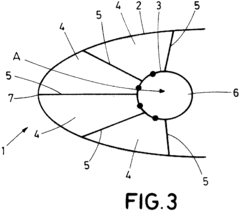
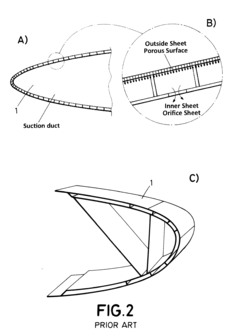
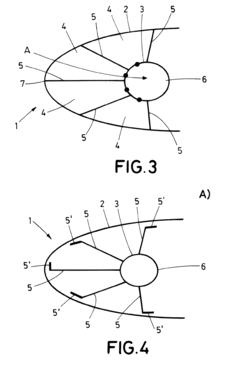
- A leading edge section made from composite materials with a micro-drilled outer skin and perforated inner surface, featuring radial structural elements that form suction chambers for laminar flow control, allowing for integrated and optimized structural support and easier maintenance, using materials like Carbon Fiber Reinforced Plastic (CFRP) and metals.
Environmental Impact of Laminar Flow Implementation
The implementation of laminar flow technology in aerospace engineering has significant environmental implications, primarily through its potential to reduce fuel consumption and emissions. By maintaining smooth airflow over aircraft surfaces, laminar flow designs minimize drag, leading to improved fuel efficiency. This reduction in fuel burn directly translates to decreased greenhouse gas emissions, particularly carbon dioxide, which is a major contributor to global warming.
Studies have shown that laminar flow technology can potentially reduce aircraft fuel consumption by 5-10%, depending on the extent of implementation and flight conditions. For long-haul flights, this translates to substantial reductions in carbon emissions. Given the aviation industry's commitment to reducing its environmental footprint, laminar flow technology represents a crucial step towards more sustainable air travel.
The environmental benefits extend beyond just reduced emissions. Lower fuel consumption means less demand for fossil fuels, potentially slowing the rate of resource depletion and reducing the environmental impacts associated with oil extraction and refining. Additionally, the improved efficiency could lead to reduced noise pollution, as engines operating at lower power settings tend to produce less noise.
However, the environmental impact of laminar flow technology is not solely positive. The manufacturing and maintenance of laminar flow surfaces may require specialized materials and processes, which could have their own environmental footprints. For instance, the production of advanced composites or surface coatings used in laminar flow designs might involve energy-intensive processes or the use of chemicals with potential environmental risks.
Furthermore, the disposal or recycling of aircraft components with laminar flow features at the end of their lifecycle presents new challenges. The aerospace industry will need to develop appropriate recycling and disposal methods to ensure that the environmental benefits gained during operation are not offset by end-of-life issues.
It's also worth considering the potential indirect environmental impacts. If laminar flow technology significantly reduces operating costs for airlines, it could lead to increased air travel demand, potentially offsetting some of the environmental gains through a rebound effect. This underscores the need for holistic approaches to environmental sustainability in aviation, combining technological advancements with policy measures and consumer awareness.
In conclusion, while laminar flow technology offers substantial environmental benefits through reduced fuel consumption and emissions, a comprehensive assessment of its environmental impact must consider the entire lifecycle of aircraft and the broader implications for the aviation industry. As the technology matures and becomes more widely adopted, ongoing research and monitoring will be crucial to fully understand and optimize its environmental performance.
Studies have shown that laminar flow technology can potentially reduce aircraft fuel consumption by 5-10%, depending on the extent of implementation and flight conditions. For long-haul flights, this translates to substantial reductions in carbon emissions. Given the aviation industry's commitment to reducing its environmental footprint, laminar flow technology represents a crucial step towards more sustainable air travel.
The environmental benefits extend beyond just reduced emissions. Lower fuel consumption means less demand for fossil fuels, potentially slowing the rate of resource depletion and reducing the environmental impacts associated with oil extraction and refining. Additionally, the improved efficiency could lead to reduced noise pollution, as engines operating at lower power settings tend to produce less noise.
However, the environmental impact of laminar flow technology is not solely positive. The manufacturing and maintenance of laminar flow surfaces may require specialized materials and processes, which could have their own environmental footprints. For instance, the production of advanced composites or surface coatings used in laminar flow designs might involve energy-intensive processes or the use of chemicals with potential environmental risks.
Furthermore, the disposal or recycling of aircraft components with laminar flow features at the end of their lifecycle presents new challenges. The aerospace industry will need to develop appropriate recycling and disposal methods to ensure that the environmental benefits gained during operation are not offset by end-of-life issues.
It's also worth considering the potential indirect environmental impacts. If laminar flow technology significantly reduces operating costs for airlines, it could lead to increased air travel demand, potentially offsetting some of the environmental gains through a rebound effect. This underscores the need for holistic approaches to environmental sustainability in aviation, combining technological advancements with policy measures and consumer awareness.
In conclusion, while laminar flow technology offers substantial environmental benefits through reduced fuel consumption and emissions, a comprehensive assessment of its environmental impact must consider the entire lifecycle of aircraft and the broader implications for the aviation industry. As the technology matures and becomes more widely adopted, ongoing research and monitoring will be crucial to fully understand and optimize its environmental performance.
Regulatory Framework for Laminar Flow Aircraft
The regulatory framework for laminar flow aircraft is evolving to accommodate the advancements in aerodynamic technology. As laminar flow designs push the boundaries of traditional aircraft configurations, aviation authorities worldwide are adapting their certification processes and standards to ensure safety while fostering innovation.
The Federal Aviation Administration (FAA) in the United States has been at the forefront of developing new guidelines for laminar flow aircraft. They have introduced special conditions and amended existing regulations to address the unique characteristics of these advanced designs. These modifications include updated requirements for stability and control, ice protection systems, and structural integrity under various flight conditions.
Similarly, the European Union Aviation Safety Agency (EASA) has been working on revising its certification specifications to incorporate laminar flow technologies. Their efforts focus on establishing performance-based standards that allow for flexibility in design while maintaining rigorous safety levels. This approach enables manufacturers to explore innovative solutions without being constrained by prescriptive regulations.
One of the key challenges in developing regulatory frameworks for laminar flow aircraft is the need for extensive flight testing and data collection. Regulatory bodies are collaborating with industry partners to gather real-world performance data, which informs the development of new standards and test procedures. This collaborative approach ensures that regulations are grounded in practical experience and scientific evidence.
The International Civil Aviation Organization (ICAO) is playing a crucial role in harmonizing global standards for laminar flow aircraft. They are working to establish common guidelines that can be adopted by national aviation authorities worldwide, promoting consistency in certification processes and facilitating international operations of these advanced aircraft.
As laminar flow technology continues to mature, regulatory bodies are also addressing environmental considerations. New standards are being developed to assess and certify the reduced fuel consumption and emissions associated with laminar flow designs, aligning with global efforts to mitigate the environmental impact of aviation.
The regulatory framework is also evolving to encompass the manufacturing processes and quality control measures specific to laminar flow aircraft. This includes new standards for surface finish tolerances, material selection, and assembly techniques that are critical to achieving and maintaining laminar flow conditions in real-world operations.
In conclusion, the regulatory landscape for laminar flow aircraft is undergoing significant transformation. Aviation authorities are striving to create a balanced framework that ensures safety, promotes innovation, and addresses the unique challenges posed by this revolutionary technology. As the industry continues to push the boundaries of aerodynamic efficiency, the regulatory environment will undoubtedly continue to evolve, shaping the future of aerospace standards.
The Federal Aviation Administration (FAA) in the United States has been at the forefront of developing new guidelines for laminar flow aircraft. They have introduced special conditions and amended existing regulations to address the unique characteristics of these advanced designs. These modifications include updated requirements for stability and control, ice protection systems, and structural integrity under various flight conditions.
Similarly, the European Union Aviation Safety Agency (EASA) has been working on revising its certification specifications to incorporate laminar flow technologies. Their efforts focus on establishing performance-based standards that allow for flexibility in design while maintaining rigorous safety levels. This approach enables manufacturers to explore innovative solutions without being constrained by prescriptive regulations.
One of the key challenges in developing regulatory frameworks for laminar flow aircraft is the need for extensive flight testing and data collection. Regulatory bodies are collaborating with industry partners to gather real-world performance data, which informs the development of new standards and test procedures. This collaborative approach ensures that regulations are grounded in practical experience and scientific evidence.
The International Civil Aviation Organization (ICAO) is playing a crucial role in harmonizing global standards for laminar flow aircraft. They are working to establish common guidelines that can be adopted by national aviation authorities worldwide, promoting consistency in certification processes and facilitating international operations of these advanced aircraft.
As laminar flow technology continues to mature, regulatory bodies are also addressing environmental considerations. New standards are being developed to assess and certify the reduced fuel consumption and emissions associated with laminar flow designs, aligning with global efforts to mitigate the environmental impact of aviation.
The regulatory framework is also evolving to encompass the manufacturing processes and quality control measures specific to laminar flow aircraft. This includes new standards for surface finish tolerances, material selection, and assembly techniques that are critical to achieving and maintaining laminar flow conditions in real-world operations.
In conclusion, the regulatory landscape for laminar flow aircraft is undergoing significant transformation. Aviation authorities are striving to create a balanced framework that ensures safety, promotes innovation, and addresses the unique challenges posed by this revolutionary technology. As the industry continues to push the boundaries of aerodynamic efficiency, the regulatory environment will undoubtedly continue to evolve, shaping the future of aerospace standards.
Unlock deeper insights with PatSnap Eureka Quick Research — get a full tech report to explore trends and direct your research. Try now!
Generate Your Research Report Instantly with AI Agent
Supercharge your innovation with PatSnap Eureka AI Agent Platform!