
Titanium Matrix Composite Gas Turbine Material: Advanced Engineering Solutions For High-Temperature Aerospace Applications
JUL 21, 20259 MIN READ
Generate Your Research Report Instantly with AI Agent
Patsnap Eureka helps you evaluate technical feasibility & market potential.
PP Separator Evolution
The evolution of polypropylene (PP) separators in battery technology represents a significant advancement in the field of energy storage. Initially developed in the 1970s, PP separators have undergone continuous improvements to meet the increasing demands of high-performance batteries.
In the early stages, PP separators were primarily used in lead-acid batteries due to their chemical stability and low cost. However, their potential in lithium-ion batteries was quickly recognized, leading to extensive research and development efforts to enhance their properties for this application.
The 1990s marked a turning point in PP separator technology with the introduction of microporous membranes. These membranes featured a highly porous structure that allowed for improved ion transport while maintaining mechanical strength. This development significantly enhanced battery performance and safety, paving the way for widespread adoption in consumer electronics.
As the demand for higher energy density batteries grew in the 2000s, researchers focused on optimizing the pore structure and distribution of PP separators. Advanced manufacturing techniques, such as biaxial stretching and phase inversion, were employed to create separators with uniform pore size and increased porosity. These improvements resulted in better electrolyte uptake and ionic conductivity, crucial factors for high-performance batteries.
The late 2000s and early 2010s saw the emergence of composite PP separators. By incorporating inorganic particles or coating the PP membrane with ceramic materials, researchers were able to enhance the thermal stability and mechanical strength of the separators. This innovation addressed the safety concerns associated with lithium-ion batteries, particularly in high-temperature environments.
Recent years have witnessed the development of ultra-thin PP separators, some as thin as 10 micrometers. These separators offer reduced internal resistance and improved energy density, making them ideal for use in electric vehicles and portable electronic devices. Additionally, surface modification techniques have been employed to improve the wettability and electrolyte retention of PP separators, further enhancing their performance.
The ongoing evolution of PP separators continues to focus on addressing the challenges of next-generation batteries. Research efforts are directed towards developing separators that can withstand high-voltage operations, support fast-charging capabilities, and maintain long-term stability. As battery technology advances, PP separators are expected to play a crucial role in enabling safer, more efficient, and higher-capacity energy storage solutions.
In the early stages, PP separators were primarily used in lead-acid batteries due to their chemical stability and low cost. However, their potential in lithium-ion batteries was quickly recognized, leading to extensive research and development efforts to enhance their properties for this application.
The 1990s marked a turning point in PP separator technology with the introduction of microporous membranes. These membranes featured a highly porous structure that allowed for improved ion transport while maintaining mechanical strength. This development significantly enhanced battery performance and safety, paving the way for widespread adoption in consumer electronics.
As the demand for higher energy density batteries grew in the 2000s, researchers focused on optimizing the pore structure and distribution of PP separators. Advanced manufacturing techniques, such as biaxial stretching and phase inversion, were employed to create separators with uniform pore size and increased porosity. These improvements resulted in better electrolyte uptake and ionic conductivity, crucial factors for high-performance batteries.
The late 2000s and early 2010s saw the emergence of composite PP separators. By incorporating inorganic particles or coating the PP membrane with ceramic materials, researchers were able to enhance the thermal stability and mechanical strength of the separators. This innovation addressed the safety concerns associated with lithium-ion batteries, particularly in high-temperature environments.
Recent years have witnessed the development of ultra-thin PP separators, some as thin as 10 micrometers. These separators offer reduced internal resistance and improved energy density, making them ideal for use in electric vehicles and portable electronic devices. Additionally, surface modification techniques have been employed to improve the wettability and electrolyte retention of PP separators, further enhancing their performance.
The ongoing evolution of PP separators continues to focus on addressing the challenges of next-generation batteries. Research efforts are directed towards developing separators that can withstand high-voltage operations, support fast-charging capabilities, and maintain long-term stability. As battery technology advances, PP separators are expected to play a crucial role in enabling safer, more efficient, and higher-capacity energy storage solutions.
Battery Market Demand
The global battery market has experienced significant growth in recent years, driven by the increasing demand for energy storage solutions across various sectors. This surge is particularly evident in the electric vehicle (EV) industry, portable electronics, and renewable energy storage systems. As these applications continue to expand, the demand for high-performance battery separators, a critical component in battery manufacturing, has also risen substantially.
The EV market has been a major catalyst for battery demand growth. With governments worldwide implementing stricter emissions regulations and offering incentives for electric vehicle adoption, automakers are rapidly transitioning their product lines to include more electric and hybrid models. This shift has led to a substantial increase in the demand for lithium-ion batteries, which in turn drives the need for advanced battery separators.
In the consumer electronics sector, the proliferation of smartphones, tablets, laptops, and wearable devices has contributed to a steady rise in battery demand. As these devices become more powerful and feature-rich, they require batteries with higher energy density and improved safety features, further emphasizing the importance of high-performance separators.
The renewable energy sector has also played a significant role in boosting battery market demand. As solar and wind power generation becomes more widespread, the need for efficient energy storage solutions has grown. Large-scale battery systems are increasingly being deployed to store excess energy during peak production periods and distribute it during times of high demand or low renewable energy generation.
The industrial and aerospace sectors are emerging as additional drivers of battery market growth. Industrial applications, such as forklifts and other material handling equipment, are transitioning from lead-acid to lithium-ion batteries, while the aerospace industry is exploring advanced battery technologies for electric and hybrid aircraft propulsion systems.
As the battery market expands, there is a growing emphasis on improving battery performance, safety, and longevity. This has led to increased focus on the development of advanced battery components, including high-performance separators. Polypropylene-based separators have gained significant attention due to their ability to enhance battery safety, thermal stability, and overall performance.
The demand for batteries with higher energy density, faster charging capabilities, and longer cycle life has further intensified the need for innovative separator technologies. Manufacturers are investing in research and development to create separators that can meet these evolving requirements while maintaining or improving safety standards. This trend is expected to continue as the battery market grows and diversifies, with new applications and technologies emerging across various industries.
The EV market has been a major catalyst for battery demand growth. With governments worldwide implementing stricter emissions regulations and offering incentives for electric vehicle adoption, automakers are rapidly transitioning their product lines to include more electric and hybrid models. This shift has led to a substantial increase in the demand for lithium-ion batteries, which in turn drives the need for advanced battery separators.
In the consumer electronics sector, the proliferation of smartphones, tablets, laptops, and wearable devices has contributed to a steady rise in battery demand. As these devices become more powerful and feature-rich, they require batteries with higher energy density and improved safety features, further emphasizing the importance of high-performance separators.
The renewable energy sector has also played a significant role in boosting battery market demand. As solar and wind power generation becomes more widespread, the need for efficient energy storage solutions has grown. Large-scale battery systems are increasingly being deployed to store excess energy during peak production periods and distribute it during times of high demand or low renewable energy generation.
The industrial and aerospace sectors are emerging as additional drivers of battery market growth. Industrial applications, such as forklifts and other material handling equipment, are transitioning from lead-acid to lithium-ion batteries, while the aerospace industry is exploring advanced battery technologies for electric and hybrid aircraft propulsion systems.
As the battery market expands, there is a growing emphasis on improving battery performance, safety, and longevity. This has led to increased focus on the development of advanced battery components, including high-performance separators. Polypropylene-based separators have gained significant attention due to their ability to enhance battery safety, thermal stability, and overall performance.
The demand for batteries with higher energy density, faster charging capabilities, and longer cycle life has further intensified the need for innovative separator technologies. Manufacturers are investing in research and development to create separators that can meet these evolving requirements while maintaining or improving safety standards. This trend is expected to continue as the battery market grows and diversifies, with new applications and technologies emerging across various industries.
PP Separator Challenges
Polypropylene (PP) separators have become a critical component in high-performance batteries, but they face several challenges that limit their effectiveness and widespread adoption. One of the primary issues is the inherent thermal instability of PP at elevated temperatures. As batteries generate heat during operation, PP separators can shrink or melt, potentially leading to short circuits and safety hazards. This thermal vulnerability necessitates the development of more heat-resistant PP formulations or the incorporation of additional thermal stabilizers.
Another significant challenge is the relatively low porosity of PP separators. While porosity is essential for ion transport between electrodes, increasing it often comes at the cost of mechanical strength. Striking the right balance between porosity and structural integrity remains a key area of research and development. Additionally, the hydrophobic nature of PP can hinder electrolyte wetting, potentially reducing battery performance and increasing manufacturing complexity.
The mechanical strength of PP separators also presents challenges, particularly in high-energy-density batteries where thinner separators are desirable. As separator thickness decreases, the risk of puncture or tearing increases, which could lead to catastrophic battery failure. Enhancing the mechanical properties of PP separators without compromising other essential characteristics is an ongoing challenge for material scientists and engineers.
Furthermore, PP separators face limitations in their ability to prevent dendrite growth, especially in lithium-metal batteries. Dendrites can penetrate the separator, causing short circuits and potentially dangerous thermal runaway events. Developing PP separators with improved dendrite resistance is crucial for advancing next-generation battery technologies.
The manufacturing process of PP separators also presents challenges. Achieving consistent quality, uniform thickness, and optimal pore structure across large-scale production can be difficult. Variations in these parameters can lead to inconsistent battery performance and reliability issues. Additionally, the environmental impact of PP separator production and disposal is a growing concern, prompting research into more sustainable manufacturing methods and recyclable materials.
Lastly, as battery technologies evolve, PP separators must adapt to new electrolyte chemistries and electrode materials. Ensuring compatibility with advanced electrolytes, such as those used in solid-state batteries, while maintaining the desired mechanical and electrochemical properties, remains a significant challenge in the ongoing development of high-performance battery separators.
Another significant challenge is the relatively low porosity of PP separators. While porosity is essential for ion transport between electrodes, increasing it often comes at the cost of mechanical strength. Striking the right balance between porosity and structural integrity remains a key area of research and development. Additionally, the hydrophobic nature of PP can hinder electrolyte wetting, potentially reducing battery performance and increasing manufacturing complexity.
The mechanical strength of PP separators also presents challenges, particularly in high-energy-density batteries where thinner separators are desirable. As separator thickness decreases, the risk of puncture or tearing increases, which could lead to catastrophic battery failure. Enhancing the mechanical properties of PP separators without compromising other essential characteristics is an ongoing challenge for material scientists and engineers.
Furthermore, PP separators face limitations in their ability to prevent dendrite growth, especially in lithium-metal batteries. Dendrites can penetrate the separator, causing short circuits and potentially dangerous thermal runaway events. Developing PP separators with improved dendrite resistance is crucial for advancing next-generation battery technologies.
The manufacturing process of PP separators also presents challenges. Achieving consistent quality, uniform thickness, and optimal pore structure across large-scale production can be difficult. Variations in these parameters can lead to inconsistent battery performance and reliability issues. Additionally, the environmental impact of PP separator production and disposal is a growing concern, prompting research into more sustainable manufacturing methods and recyclable materials.
Lastly, as battery technologies evolve, PP separators must adapt to new electrolyte chemistries and electrode materials. Ensuring compatibility with advanced electrolytes, such as those used in solid-state batteries, while maintaining the desired mechanical and electrochemical properties, remains a significant challenge in the ongoing development of high-performance battery separators.
Current PP Technologies
01 Improved thermal stability and safety
Polypropylene battery separators are engineered to enhance thermal stability and safety in lithium-ion batteries. Advanced manufacturing techniques and material compositions are employed to increase the separator's resistance to thermal shrinkage and melting, thereby reducing the risk of short circuits and improving overall battery safety.- Improved thermal stability and safety: Polypropylene battery separators are engineered to enhance thermal stability and safety in batteries. These separators are designed to maintain their structural integrity at high temperatures, preventing short circuits and improving overall battery safety. Advanced manufacturing techniques and material compositions are employed to achieve superior thermal resistance and dimensional stability.
- Enhanced porosity and ion conductivity: The performance of polypropylene battery separators is improved by optimizing their porosity and ion conductivity. Techniques such as stretching, phase separation, or the addition of pore-forming agents are used to create a highly porous structure. This increased porosity facilitates better ion transport between electrodes, leading to improved battery efficiency and power output.
- Surface modification for improved wettability: Surface modification techniques are applied to polypropylene battery separators to enhance their wettability and electrolyte retention. These modifications can include plasma treatment, grafting of hydrophilic groups, or coating with functional materials. Improved wettability ensures better electrolyte distribution and contact with electrodes, resulting in enhanced battery performance and longevity.
- Mechanical strength and dimensional stability: Polypropylene battery separators are designed to provide excellent mechanical strength and dimensional stability. This is achieved through optimized polymer molecular weight, orientation processes, and the incorporation of reinforcing additives. Enhanced mechanical properties ensure the separator maintains its integrity during battery assembly and operation, preventing short circuits and improving overall battery reliability.
- Multi-layer and composite separator structures: Advanced polypropylene battery separators utilize multi-layer or composite structures to combine the benefits of different materials. These designs can incorporate layers with specific functionalities, such as improved mechanical strength, thermal stability, or ion conductivity. The synergistic effect of these layers results in separators with superior overall performance, addressing multiple aspects of battery efficiency and safety simultaneously.
02 Enhanced porosity and ion conductivity
Innovations in polypropylene separator design focus on optimizing porosity and ion conductivity. These improvements facilitate better electrolyte absorption and ion transport between electrodes, leading to improved battery performance, faster charging rates, and increased energy density.Expand Specific Solutions03 Mechanical strength and dimensional stability
Advanced polypropylene separators are developed with improved mechanical strength and dimensional stability. These properties help maintain separator integrity during battery assembly and operation, preventing electrode contact and enhancing overall battery lifespan and reliability.Expand Specific Solutions04 Surface modification and coating technologies
Surface modification and coating techniques are applied to polypropylene separators to enhance their performance. These treatments can improve wettability, reduce internal resistance, and increase the separator's compatibility with various electrolytes, resulting in better overall battery efficiency.Expand Specific Solutions05 Integration of functional additives
Polypropylene separators are enhanced through the integration of functional additives. These additives can include flame retardants, ceramic particles, or other materials that improve the separator's thermal, mechanical, and electrochemical properties, leading to better overall battery performance and safety.Expand Specific Solutions
Key PP Separator Makers
The market for high-performance battery separators utilizing polypropylene is in a growth phase, driven by increasing demand for lithium-ion batteries in electric vehicles and consumer electronics. The global market size is projected to expand significantly in the coming years. Technologically, the field is advancing rapidly, with companies like Toray Industries, Asahi Kasei, and LG Chem leading innovation. These firms are developing advanced separator materials with improved thermal stability, porosity, and mechanical strength. Emerging players such as Celgard and Hebei Gellec are also contributing to technological advancements. The competitive landscape is characterized by a mix of established chemical companies and specialized separator manufacturers, with ongoing research collaborations between industry and academia further accelerating progress in this critical battery component.
Toray Industries, Inc.
Technical Solution: Toray Industries has developed advanced polypropylene-based battery separators using their proprietary nanofiber technology. Their SETELA™ separator combines a polypropylene base with ceramic coating, achieving high porosity (>40%) and thin thickness (<12μm)[1]. The company utilizes a wet process to produce microporous membranes with uniform pore structure and high thermal stability. Toray's separators incorporate a shutdown mechanism that activates at around 130°C, enhancing battery safety[2]. They have also implemented a high-speed production line capable of producing separators at speeds exceeding 100m/min, significantly improving manufacturing efficiency[3].
Strengths: High porosity for improved ion conductivity, excellent thermal stability, and integrated safety features. Weaknesses: Higher production costs compared to standard polyolefin separators, potential challenges in scaling up nanofiber technology.
Celgard LLC
Technical Solution: Celgard, a subsidiary of Asahi Kasei, specializes in dry process polypropylene separators for lithium-ion batteries. Their technology involves a unique stretching process that creates a highly porous membrane with a distinct slit-like pore structure[4]. Celgard's separators feature a tri-layer design (PP/PE/PP) that provides enhanced mechanical strength and thermal shutdown capabilities. The company has developed separators with thicknesses as low as 8μm while maintaining high puncture strength (>300 gf/mil)[5]. Celgard has also introduced ceramic-coated separators that offer improved wettability and thermal stability, with some variants able to withstand temperatures up to 200°C[6].
Strengths: Well-established dry process technology, excellent mechanical properties, and proven safety features. Weaknesses: Limited flexibility in pore structure compared to wet process methods, potential for higher manufacturing costs due to complex tri-layer design.
PP Separator Innovations
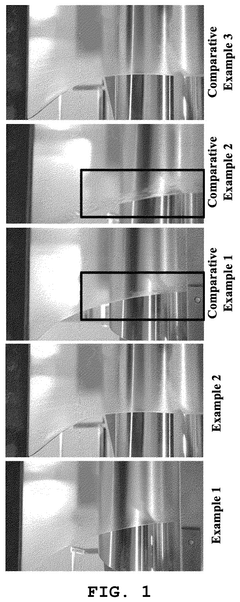
Polypropylene lithium ion battery separator for high wettability of electrolyte
PatentActiveKR1020170033545A
Innovation
- A three-layer polypropylene separator structure is developed, comprising high stereoregular polypropylene layers with a polar structure and a central layer, manufactured through co-extrusion and controlled stretching to enhance pore connectivity and electrolyte affinity.
Method for preparing polypropylene for separator of secondary battery having excellent mechanical and thermal properties
PatentPendingUS20250192361A1
Innovation
- A bimodal process is applied to polymerize propylene monomers in the presence of a Ziegler-Natta catalyst, producing high and low molecular weight polypropylene with a specific co-catalyst and electron donor ratio, optimizing molecular weight distribution and crystallinity.
Environmental Impact
The environmental impact of polypropylene-based battery separators is a critical consideration in the development and adoption of high-performance energy storage solutions. As the demand for lithium-ion batteries continues to grow, particularly in electric vehicles and renewable energy systems, the environmental footprint of battery components becomes increasingly significant.
Polypropylene, as a key material in battery separators, offers several environmental advantages. Its production process is relatively energy-efficient compared to alternative materials, resulting in lower greenhouse gas emissions during manufacturing. Additionally, polypropylene is recyclable, which aligns with circular economy principles and reduces the overall environmental impact of battery production.
However, the environmental benefits of polypropylene separators extend beyond production. Their high thermal stability and excellent mechanical properties contribute to longer battery lifespans, reducing the frequency of battery replacements and associated waste. This longevity directly translates to a decrease in raw material consumption and energy expenditure over the battery's lifecycle.
The lightweight nature of polypropylene also plays a crucial role in enhancing the energy efficiency of batteries. By reducing the overall weight of the battery pack, especially in electric vehicles, polypropylene separators indirectly contribute to lower energy consumption and reduced carbon emissions during operation.
Despite these advantages, there are environmental challenges associated with polypropylene separators. The material is derived from fossil fuels, raising concerns about resource depletion and carbon footprint. Efforts are underway to develop bio-based alternatives that maintain the high-performance characteristics of traditional polypropylene while reducing reliance on non-renewable resources.
End-of-life management of polypropylene separators presents both opportunities and challenges. While the material is recyclable, the complex nature of battery components often makes separation and recycling processes difficult. Advancements in recycling technologies and the development of design-for-recycling strategies are crucial to maximizing the environmental benefits of polypropylene separators.
The use of polypropylene in battery separators also contributes to the overall safety of energy storage systems. Its high melting point and resistance to chemical degradation reduce the risk of thermal runaway and battery fires, potentially preventing environmental contamination from hazardous battery materials in the event of accidents.
In conclusion, while polypropylene enables high-performance battery separators with several environmental benefits, ongoing research and development are essential to address remaining challenges and further improve the sustainability profile of this critical battery component.
Polypropylene, as a key material in battery separators, offers several environmental advantages. Its production process is relatively energy-efficient compared to alternative materials, resulting in lower greenhouse gas emissions during manufacturing. Additionally, polypropylene is recyclable, which aligns with circular economy principles and reduces the overall environmental impact of battery production.
However, the environmental benefits of polypropylene separators extend beyond production. Their high thermal stability and excellent mechanical properties contribute to longer battery lifespans, reducing the frequency of battery replacements and associated waste. This longevity directly translates to a decrease in raw material consumption and energy expenditure over the battery's lifecycle.
The lightweight nature of polypropylene also plays a crucial role in enhancing the energy efficiency of batteries. By reducing the overall weight of the battery pack, especially in electric vehicles, polypropylene separators indirectly contribute to lower energy consumption and reduced carbon emissions during operation.
Despite these advantages, there are environmental challenges associated with polypropylene separators. The material is derived from fossil fuels, raising concerns about resource depletion and carbon footprint. Efforts are underway to develop bio-based alternatives that maintain the high-performance characteristics of traditional polypropylene while reducing reliance on non-renewable resources.
End-of-life management of polypropylene separators presents both opportunities and challenges. While the material is recyclable, the complex nature of battery components often makes separation and recycling processes difficult. Advancements in recycling technologies and the development of design-for-recycling strategies are crucial to maximizing the environmental benefits of polypropylene separators.
The use of polypropylene in battery separators also contributes to the overall safety of energy storage systems. Its high melting point and resistance to chemical degradation reduce the risk of thermal runaway and battery fires, potentially preventing environmental contamination from hazardous battery materials in the event of accidents.
In conclusion, while polypropylene enables high-performance battery separators with several environmental benefits, ongoing research and development are essential to address remaining challenges and further improve the sustainability profile of this critical battery component.
Safety Regulations
Safety regulations play a crucial role in the development and implementation of high-performance battery separators made from polypropylene. These regulations are designed to ensure the safety and reliability of batteries, particularly in applications where failure could lead to significant risks.
The primary focus of safety regulations for battery separators is on thermal stability and resistance to short circuits. Polypropylene-based separators must meet stringent requirements for thermal shutdown properties, which prevent the battery from overheating and potentially causing fires or explosions. Regulatory bodies such as UL (Underwriters Laboratories) and IEC (International Electrotechnical Commission) have established specific standards for battery separator performance under various conditions.
One key aspect of these regulations is the requirement for separators to maintain their integrity at high temperatures. Polypropylene separators are typically expected to withstand temperatures up to 130°C without significant shrinkage or loss of mechanical properties. This is critical for preventing internal short circuits that could lead to thermal runaway.
Additionally, safety regulations often mandate specific testing protocols for battery separators. These may include nail penetration tests, crush tests, and overcharge tests to simulate potential abuse scenarios. Polypropylene separators must demonstrate the ability to maintain their protective function under these extreme conditions.
Chemical stability is another important factor addressed by safety regulations. Polypropylene separators must resist degradation when exposed to the electrolytes and electrode materials used in batteries. This ensures that the separator maintains its protective properties throughout the battery's lifecycle, preventing the formation of conductive paths that could lead to short circuits.
Regulations also often specify minimum thickness requirements for battery separators to ensure adequate insulation between electrodes. For polypropylene separators, this typically ranges from 20 to 25 microns, depending on the specific application and battery chemistry.
Furthermore, safety regulations are continually evolving to address new challenges and technologies in battery design. For instance, recent updates have focused on the safety of high-energy-density batteries used in electric vehicles and portable electronics. These regulations may require additional features in polypropylene separators, such as ceramic coatings or multi-layer designs, to enhance their safety performance.
Compliance with these safety regulations is not only a legal requirement but also a key factor in market acceptance and consumer trust. Manufacturers of polypropylene-based battery separators must invest significantly in research and development to meet and exceed these standards, driving continuous innovation in separator technology.
The primary focus of safety regulations for battery separators is on thermal stability and resistance to short circuits. Polypropylene-based separators must meet stringent requirements for thermal shutdown properties, which prevent the battery from overheating and potentially causing fires or explosions. Regulatory bodies such as UL (Underwriters Laboratories) and IEC (International Electrotechnical Commission) have established specific standards for battery separator performance under various conditions.
One key aspect of these regulations is the requirement for separators to maintain their integrity at high temperatures. Polypropylene separators are typically expected to withstand temperatures up to 130°C without significant shrinkage or loss of mechanical properties. This is critical for preventing internal short circuits that could lead to thermal runaway.
Additionally, safety regulations often mandate specific testing protocols for battery separators. These may include nail penetration tests, crush tests, and overcharge tests to simulate potential abuse scenarios. Polypropylene separators must demonstrate the ability to maintain their protective function under these extreme conditions.
Chemical stability is another important factor addressed by safety regulations. Polypropylene separators must resist degradation when exposed to the electrolytes and electrode materials used in batteries. This ensures that the separator maintains its protective properties throughout the battery's lifecycle, preventing the formation of conductive paths that could lead to short circuits.
Regulations also often specify minimum thickness requirements for battery separators to ensure adequate insulation between electrodes. For polypropylene separators, this typically ranges from 20 to 25 microns, depending on the specific application and battery chemistry.
Furthermore, safety regulations are continually evolving to address new challenges and technologies in battery design. For instance, recent updates have focused on the safety of high-energy-density batteries used in electric vehicles and portable electronics. These regulations may require additional features in polypropylene separators, such as ceramic coatings or multi-layer designs, to enhance their safety performance.
Compliance with these safety regulations is not only a legal requirement but also a key factor in market acceptance and consumer trust. Manufacturers of polypropylene-based battery separators must invest significantly in research and development to meet and exceed these standards, driving continuous innovation in separator technology.
Unlock deeper insights with Patsnap Eureka Quick Research — get a full tech report to explore trends and direct your research. Try now!
Generate Your Research Report Instantly with AI Agent
Supercharge your innovation with Patsnap Eureka AI Agent Platform!