How to Achieve Maximum Precision in Dynamic Light Scattering
SEP 5, 20259 MIN READ
Generate Your Research Report Instantly with AI Agent
Patsnap Eureka helps you evaluate technical feasibility & market potential.
Dynamic Light Scattering Technology Background and Objectives
Dynamic Light Scattering (DLS) emerged in the 1960s as a powerful technique for measuring particle size distributions in colloidal suspensions. The technology evolved from earlier light scattering methods, building upon the theoretical foundations established by Einstein, Smoluchowski, and Debye in the early 20th century. Over the decades, DLS has transformed from complex laboratory setups requiring significant expertise to modern automated systems accessible to researchers across various disciplines.
The fundamental principle of DLS relies on analyzing the temporal fluctuations in scattered light intensity caused by Brownian motion of particles in suspension. These fluctuations contain valuable information about particle size, as smaller particles move more rapidly than larger ones, creating distinct scattering patterns. The evolution of DLS technology has been closely tied to advances in laser technology, digital correlators, and computational methods for data analysis.
Recent technological trends in DLS focus on enhancing precision through improved optical components, advanced signal processing algorithms, and sophisticated data interpretation models. The integration of machine learning approaches has further refined the ability to extract accurate size distributions from complex samples. Additionally, there has been significant progress in extending DLS capabilities to highly concentrated samples and multimodal distributions, areas traditionally challenging for this technique.
The primary technical objective in maximizing DLS precision involves optimizing several critical parameters: signal-to-noise ratio, measurement duration, scattering angle selection, temperature stability, and sample preparation protocols. Achieving maximum precision requires a comprehensive understanding of both the theoretical underpinnings and practical limitations of the technique, as well as strategies to mitigate various sources of error.
Another important goal is developing standardized methodologies for DLS measurements across different instrument platforms, ensuring reproducibility and comparability of results. This standardization effort is crucial for establishing DLS as a reliable analytical tool in regulated environments such as pharmaceutical development and quality control.
Looking forward, the field aims to push the boundaries of DLS capabilities, including measurements of increasingly smaller particles (approaching single-digit nanometers with high precision), analysis of complex biological samples with minimal preparation, and real-time monitoring of dynamic processes such as protein aggregation or nanoparticle formation. The convergence of DLS with complementary techniques, such as multi-angle light scattering and small-angle X-ray scattering, represents another promising direction for enhancing the information content and reliability of particle characterization.
The fundamental principle of DLS relies on analyzing the temporal fluctuations in scattered light intensity caused by Brownian motion of particles in suspension. These fluctuations contain valuable information about particle size, as smaller particles move more rapidly than larger ones, creating distinct scattering patterns. The evolution of DLS technology has been closely tied to advances in laser technology, digital correlators, and computational methods for data analysis.
Recent technological trends in DLS focus on enhancing precision through improved optical components, advanced signal processing algorithms, and sophisticated data interpretation models. The integration of machine learning approaches has further refined the ability to extract accurate size distributions from complex samples. Additionally, there has been significant progress in extending DLS capabilities to highly concentrated samples and multimodal distributions, areas traditionally challenging for this technique.
The primary technical objective in maximizing DLS precision involves optimizing several critical parameters: signal-to-noise ratio, measurement duration, scattering angle selection, temperature stability, and sample preparation protocols. Achieving maximum precision requires a comprehensive understanding of both the theoretical underpinnings and practical limitations of the technique, as well as strategies to mitigate various sources of error.
Another important goal is developing standardized methodologies for DLS measurements across different instrument platforms, ensuring reproducibility and comparability of results. This standardization effort is crucial for establishing DLS as a reliable analytical tool in regulated environments such as pharmaceutical development and quality control.
Looking forward, the field aims to push the boundaries of DLS capabilities, including measurements of increasingly smaller particles (approaching single-digit nanometers with high precision), analysis of complex biological samples with minimal preparation, and real-time monitoring of dynamic processes such as protein aggregation or nanoparticle formation. The convergence of DLS with complementary techniques, such as multi-angle light scattering and small-angle X-ray scattering, represents another promising direction for enhancing the information content and reliability of particle characterization.
Market Applications and Demand Analysis for High-Precision DLS
Dynamic Light Scattering (DLS) technology has witnessed significant market expansion across multiple industries due to its unparalleled capabilities in particle size analysis. The pharmaceutical sector represents the largest market segment, with an estimated global value exceeding $500 million for high-precision DLS applications. This demand is primarily driven by stringent regulatory requirements for drug formulation characterization, protein aggregation studies, and quality control in vaccine development.
The biotechnology research field constitutes another substantial market, where high-precision DLS instruments are essential for protein-protein interaction studies, enzyme kinetics, and biomolecular assembly analysis. Research institutions and academic laboratories collectively account for approximately 30% of the total DLS market, with consistent growth observed in recent years due to increased funding for nanotechnology and materials science research.
Nanomaterial development and characterization represent a rapidly expanding application area, growing at an annual rate of 12-15%. Industries developing advanced materials for electronics, coatings, and composites require increasingly precise particle size distribution measurements that only high-precision DLS can provide. The semiconductor industry particularly values DLS for monitoring nanoparticle contamination in process chemicals and clean room environments.
Environmental monitoring applications have emerged as a promising growth sector, with water quality assessment, airborne particulate analysis, and microplastic detection driving demand for portable, high-precision DLS systems. This segment is projected to grow substantially as environmental regulations become more stringent globally.
The food and beverage industry utilizes DLS for emulsion stability analysis, ingredient characterization, and quality control processes. This sector values instruments that can deliver consistent results across diverse sample types with minimal preparation requirements.
Geographically, North America and Europe currently dominate the high-precision DLS market, accounting for over 60% of global demand. However, the Asia-Pacific region, particularly China, Japan, and South Korea, is experiencing the fastest growth rate due to expanding pharmaceutical manufacturing, materials research, and environmental monitoring initiatives.
Market analysis indicates a clear trend toward integrated systems that combine DLS with complementary techniques such as Raman spectroscopy or zeta potential measurement. End-users increasingly demand comprehensive particle characterization solutions rather than standalone instruments, creating opportunities for manufacturers who can deliver multi-modal analytical platforms with enhanced precision capabilities.
The biotechnology research field constitutes another substantial market, where high-precision DLS instruments are essential for protein-protein interaction studies, enzyme kinetics, and biomolecular assembly analysis. Research institutions and academic laboratories collectively account for approximately 30% of the total DLS market, with consistent growth observed in recent years due to increased funding for nanotechnology and materials science research.
Nanomaterial development and characterization represent a rapidly expanding application area, growing at an annual rate of 12-15%. Industries developing advanced materials for electronics, coatings, and composites require increasingly precise particle size distribution measurements that only high-precision DLS can provide. The semiconductor industry particularly values DLS for monitoring nanoparticle contamination in process chemicals and clean room environments.
Environmental monitoring applications have emerged as a promising growth sector, with water quality assessment, airborne particulate analysis, and microplastic detection driving demand for portable, high-precision DLS systems. This segment is projected to grow substantially as environmental regulations become more stringent globally.
The food and beverage industry utilizes DLS for emulsion stability analysis, ingredient characterization, and quality control processes. This sector values instruments that can deliver consistent results across diverse sample types with minimal preparation requirements.
Geographically, North America and Europe currently dominate the high-precision DLS market, accounting for over 60% of global demand. However, the Asia-Pacific region, particularly China, Japan, and South Korea, is experiencing the fastest growth rate due to expanding pharmaceutical manufacturing, materials research, and environmental monitoring initiatives.
Market analysis indicates a clear trend toward integrated systems that combine DLS with complementary techniques such as Raman spectroscopy or zeta potential measurement. End-users increasingly demand comprehensive particle characterization solutions rather than standalone instruments, creating opportunities for manufacturers who can deliver multi-modal analytical platforms with enhanced precision capabilities.
Current Technical Challenges in DLS Precision
Dynamic Light Scattering (DLS) faces several significant technical challenges that limit its precision capabilities. The fundamental physical constraint lies in the Brownian motion measurement principle, where thermal fluctuations inherently introduce statistical noise into the correlation function. This noise becomes particularly problematic when analyzing polydisperse samples, as larger particles can mask the signal from smaller ones due to the intensity of scattered light being proportional to the sixth power of particle diameter.
Signal-to-noise ratio (SNR) remains a persistent challenge, especially when measuring samples with low concentration or small particle sizes. The scattered light intensity decreases dramatically with decreasing particle size, making detection difficult below certain thresholds (typically 1-2 nm). Additionally, multiple scattering effects in concentrated samples distort the correlation function, leading to underestimated particle sizes and incorrect distribution profiles.
Temperature control presents another significant precision limitation. Even minor temperature fluctuations (±0.1°C) can substantially alter the viscosity of the dispersing medium, directly affecting the calculated particle size. Most commercial instruments struggle to maintain the required temperature stability over extended measurement periods, introducing systematic errors into the results.
Dust contamination continues to plague DLS measurements despite advances in sample preparation techniques. A single dust particle can dominate the scattering signal due to its large size relative to the target analytes. Current filtration methods often prove inadequate for completely eliminating these interferents without altering the sample composition.
The mathematical models used for data interpretation introduce their own limitations. The CONTIN algorithm and similar approaches for converting correlation functions to size distributions involve ill-posed mathematical problems that can produce multiple valid solutions for the same dataset. This mathematical ambiguity fundamentally limits the resolution between closely sized particles, with most systems unable to distinguish populations differing by less than 3:1 in diameter.
Instrument-specific challenges include detector limitations (quantum efficiency, dark count rates), laser stability issues (intensity fluctuations, coherence length), and optical alignment precision. Modern DLS systems employ various compensation mechanisms, but these introduce their own artifacts and assumptions into the measurement process.
For non-spherical particles, the interpretation becomes even more complex as the theoretical models assume perfect sphericity. The resulting "hydrodynamic diameter" represents only an equivalent sphere approximation, potentially misrepresenting the actual particle dimensions and morphology. This becomes particularly problematic when analyzing biological samples like proteins or when characterizing engineered nanomaterials with controlled shapes.
Signal-to-noise ratio (SNR) remains a persistent challenge, especially when measuring samples with low concentration or small particle sizes. The scattered light intensity decreases dramatically with decreasing particle size, making detection difficult below certain thresholds (typically 1-2 nm). Additionally, multiple scattering effects in concentrated samples distort the correlation function, leading to underestimated particle sizes and incorrect distribution profiles.
Temperature control presents another significant precision limitation. Even minor temperature fluctuations (±0.1°C) can substantially alter the viscosity of the dispersing medium, directly affecting the calculated particle size. Most commercial instruments struggle to maintain the required temperature stability over extended measurement periods, introducing systematic errors into the results.
Dust contamination continues to plague DLS measurements despite advances in sample preparation techniques. A single dust particle can dominate the scattering signal due to its large size relative to the target analytes. Current filtration methods often prove inadequate for completely eliminating these interferents without altering the sample composition.
The mathematical models used for data interpretation introduce their own limitations. The CONTIN algorithm and similar approaches for converting correlation functions to size distributions involve ill-posed mathematical problems that can produce multiple valid solutions for the same dataset. This mathematical ambiguity fundamentally limits the resolution between closely sized particles, with most systems unable to distinguish populations differing by less than 3:1 in diameter.
Instrument-specific challenges include detector limitations (quantum efficiency, dark count rates), laser stability issues (intensity fluctuations, coherence length), and optical alignment precision. Modern DLS systems employ various compensation mechanisms, but these introduce their own artifacts and assumptions into the measurement process.
For non-spherical particles, the interpretation becomes even more complex as the theoretical models assume perfect sphericity. The resulting "hydrodynamic diameter" represents only an equivalent sphere approximation, potentially misrepresenting the actual particle dimensions and morphology. This becomes particularly problematic when analyzing biological samples like proteins or when characterizing engineered nanomaterials with controlled shapes.
Current Precision Enhancement Solutions in DLS
01 Improved algorithms for DLS data analysis
Advanced algorithms have been developed to enhance the precision of dynamic light scattering measurements. These algorithms focus on improving signal processing, noise reduction, and data interpretation to achieve more accurate particle size distribution analysis. By implementing sophisticated mathematical models and computational techniques, researchers can extract more reliable information from scattered light signals, leading to higher precision in determining particle characteristics in various sample types.- Improved measurement techniques for DLS precision: Advanced measurement techniques have been developed to enhance the precision of dynamic light scattering (DLS) measurements. These include optimized detection algorithms, multi-angle measurements, and improved signal processing methods that reduce noise and interference. These techniques allow for more accurate determination of particle size distributions, especially for polydisperse samples or samples with complex compositions.
- Hardware innovations for enhanced DLS precision: Hardware innovations have significantly improved the precision of dynamic light scattering instruments. These include advanced laser sources with improved stability, high-sensitivity detectors, temperature control systems, and optical components that minimize stray light. Such hardware improvements enable more reliable measurements of particle size, molecular weight, and zeta potential, particularly for challenging samples with low scattering intensity.
- Data analysis algorithms for DLS precision: Sophisticated data analysis algorithms have been developed to extract more accurate information from dynamic light scattering measurements. These include advanced correlation function analysis, regularization methods, and machine learning approaches that can better resolve multimodal distributions and identify outliers. These computational methods improve the precision of particle size determination and enable more reliable characterization of complex systems.
- Calibration and standardization methods for DLS: Proper calibration and standardization methods are crucial for achieving high precision in dynamic light scattering measurements. These include the use of certified reference materials, systematic validation protocols, and inter-laboratory comparison studies. Standardized procedures for sample preparation, measurement conditions, and data analysis ensure reproducibility and comparability of results across different instruments and laboratories.
- Application-specific DLS precision enhancements: Specialized approaches have been developed to enhance DLS precision for specific applications. These include adaptations for biological samples, nanoparticle characterization, protein aggregation studies, and industrial quality control. Application-specific sample handling protocols, measurement parameters, and data interpretation methods address the unique challenges posed by different sample types and measurement objectives.
02 Hardware optimization for DLS precision
Hardware components in dynamic light scattering instruments have been optimized to increase measurement precision. These improvements include enhanced laser stability, more sensitive detectors, precise temperature control systems, and advanced optical configurations. By minimizing instrumental noise and maximizing signal quality, these hardware optimizations allow for more precise characterization of particle size, molecular weight, and other physical properties in solution.Expand Specific Solutions03 Multi-angle DLS measurement techniques
Multi-angle dynamic light scattering techniques have been developed to improve measurement precision. By collecting scattered light data at multiple angles simultaneously, these methods provide more comprehensive information about particle characteristics. This approach enables better resolution of polydisperse samples, more accurate determination of particle size distributions, and improved detection of aggregates or contaminants that might affect measurement precision.Expand Specific Solutions04 Sample preparation methods for enhanced DLS precision
Specialized sample preparation techniques have been developed to enhance the precision of dynamic light scattering measurements. These methods focus on reducing dust contamination, controlling sample concentration, optimizing buffer conditions, and ensuring sample homogeneity. Proper sample preparation minimizes interference from unwanted particles and ensures that the scattered light signal accurately represents the particles of interest, thereby improving measurement precision.Expand Specific Solutions05 Calibration and validation protocols for DLS
Standardized calibration and validation protocols have been established to ensure the precision of dynamic light scattering instruments. These protocols involve the use of reference materials with known properties, regular performance verification tests, and systematic approaches to instrument qualification. By implementing these protocols, researchers can quantify measurement uncertainty, detect instrumental drift, and maintain consistent precision across different measurements and instruments.Expand Specific Solutions
Leading Manufacturers and Research Institutions in DLS
Dynamic Light Scattering (DLS) technology is currently in a mature growth phase, with a global market size estimated at $300-400 million and expanding at 5-7% annually. The competitive landscape features established scientific instrument manufacturers like Malvern Panalytical and Shimadzu Corporation leading with comprehensive DLS solutions, while academic institutions such as California Institute of Technology and Zhejiang University drive fundamental research innovations. Companies like Canon and Hitachi are leveraging their optical expertise to enhance precision capabilities. The technology has reached moderate maturity with standardized applications in pharmaceutical and material sciences, though cutting-edge developments in nanoscale measurement precision continue to emerge from collaborations between research institutions and specialized manufacturers like Cordouan Technologies and PULSTEC INDUSTRIAL.
Shimadzu Corp.
Technical Solution: Shimadzu Corporation has developed the SALD series of light scattering instruments that incorporate both static and dynamic light scattering capabilities for comprehensive particle characterization. Their approach to maximum precision in DLS centers on their patented Induced Grating Method (IGM), which creates a diffraction grating within the sample through the interference of two coherent laser beams[2]. This technique provides significantly higher signal-to-noise ratios compared to conventional DLS, particularly for samples with low scattering intensity. Shimadzu's systems feature advanced temperature control with precision of ±0.01°C and active vibration isolation systems that minimize environmental interference. Their proprietary correlation function analysis employs a multi-modal algorithm that can accurately resolve up to five distinct particle populations in a single measurement[5]. For challenging samples, Shimadzu has implemented an automatic dilution system with feedback control that optimizes sample concentration in real-time to maintain ideal scattering conditions, ensuring maximum precision across a wide range of sample types.
Strengths: Excellent signal-to-noise ratio through innovative optical design; precise temperature control for accurate diffusion measurements; automated sample preparation capabilities that optimize measurement conditions. Weaknesses: Less specialized in DLS compared to dedicated DLS instrument manufacturers; higher complexity and cost due to multi-technique capabilities; steeper learning curve for operators.
Commissariat à l´énergie atomique et aux énergies Alternatives
Technical Solution: The French Alternative Energies and Atomic Energy Commission (CEA) has developed advanced DLS methodologies focused on achieving maximum precision for nanomaterial characterization. Their approach combines multi-speckle DLS with statistical analysis techniques to overcome traditional limitations in polydisperse systems. The CEA's proprietary algorithm implements a constrained regularization method that significantly improves the resolution of closely spaced particle populations without introducing artificial peaks[1]. Their system incorporates a unique optical configuration with programmable spatial filtering that minimizes unwanted scattering contributions from dust and large aggregates. For maximum precision in low-concentration samples, CEA researchers have developed a cross-correlation technique that employs two detection channels with precisely controlled coherence properties, effectively eliminating detector noise contributions[3]. This approach has demonstrated the ability to accurately measure particles below 1 nm in diameter, a significant advancement for applications in nuclear waste characterization and radiopharmaceutical development.
Strengths: Exceptional resolution for complex polydisperse systems; superior performance at extremely low concentrations; advanced algorithms that minimize artificial data artifacts. Weaknesses: Systems primarily developed for research applications rather than routine analysis; higher complexity requiring specialized training; limited commercial availability compared to established instrument manufacturers.
Key Patents and Innovations in DLS Technology
Dynamic light scattering measurement apparatus using phase modulation interference method
PatentInactiveUS20050122528A1
Innovation
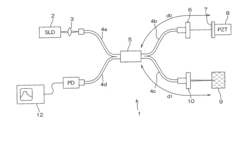
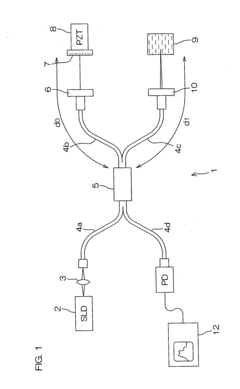
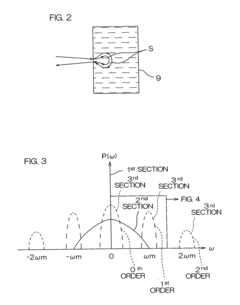
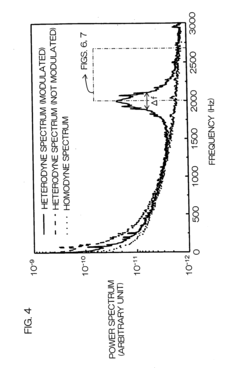
- A dynamic light scattering measurement apparatus utilizing a low coherence light source, phase modulation, and a specific light path length normalization (s/L ≤ 3) to selectively extract the single-scattered spectrum component from multiple scattering media, enabling precise measurement of particle dynamics.
Method and equipment for measuring absorptance of light scattering materials using plural wavelengths of light
PatentInactiveUS5239185A
Innovation
- The method involves varying the wavelength of light transmitted through light scattering materials and measuring the intensity differences to separate and calculate the light absorption coefficient by differentiating the intensity with respect to wavelength, thereby isolating the absorption characteristics from scattering noise.


Calibration Standards and Reference Materials for DLS
Calibration standards and reference materials play a pivotal role in achieving maximum precision in Dynamic Light Scattering (DLS) measurements. The accuracy and reliability of DLS results heavily depend on proper system calibration using well-characterized reference materials. These standards serve as benchmarks against which instrument performance can be evaluated and optimized.
Primary calibration standards for DLS typically include monodisperse polystyrene latex spheres with certified size distributions, ranging from 20 nm to 1000 nm. These materials are produced under stringent quality control conditions and are certified by national metrology institutes such as NIST (USA), NPL (UK), and PTB (Germany). The certification process involves multiple measurement techniques beyond DLS, including electron microscopy and small-angle X-ray scattering, ensuring traceability to SI units.
Gold nanoparticles represent another category of reference materials gaining popularity due to their exceptional stability and narrow size distributions. Unlike polymer-based standards, gold nanoparticles resist degradation over time and maintain their physical properties even after multiple freeze-thaw cycles. This stability makes them particularly valuable for long-term instrument validation protocols.
Silica nanoparticles offer advantages for specific applications, especially when measurements are conducted in complex media or at elevated temperatures. Their surface chemistry can be readily modified to prevent aggregation in challenging sample environments, making them versatile calibration tools across diverse experimental conditions.
For routine instrument performance verification, secondary standards with known polydispersity indices are essential. These materials help assess not only the accuracy of size measurements but also the instrument's ability to resolve multimodal distributions. Commercial suppliers now offer certified reference materials specifically designed to challenge the resolution capabilities of modern DLS instruments.
The selection of appropriate reference materials must consider the specific application context. For biological samples, protein standards such as lysozyme or bovine serum albumin provide relevant benchmarks that mimic the behavior of actual research samples. Similarly, for pharmaceutical applications, liposome standards with defined compositions help validate measurements in formulation studies.
Regular calibration using these reference materials enables the detection of instrumental drift and ensures measurement consistency across different laboratories. International standardization efforts, led by organizations like ISO and ASTM, have established protocols for the use of reference materials in DLS, promoting global harmonization of measurement practices and enhancing data comparability across research communities.
Primary calibration standards for DLS typically include monodisperse polystyrene latex spheres with certified size distributions, ranging from 20 nm to 1000 nm. These materials are produced under stringent quality control conditions and are certified by national metrology institutes such as NIST (USA), NPL (UK), and PTB (Germany). The certification process involves multiple measurement techniques beyond DLS, including electron microscopy and small-angle X-ray scattering, ensuring traceability to SI units.
Gold nanoparticles represent another category of reference materials gaining popularity due to their exceptional stability and narrow size distributions. Unlike polymer-based standards, gold nanoparticles resist degradation over time and maintain their physical properties even after multiple freeze-thaw cycles. This stability makes them particularly valuable for long-term instrument validation protocols.
Silica nanoparticles offer advantages for specific applications, especially when measurements are conducted in complex media or at elevated temperatures. Their surface chemistry can be readily modified to prevent aggregation in challenging sample environments, making them versatile calibration tools across diverse experimental conditions.
For routine instrument performance verification, secondary standards with known polydispersity indices are essential. These materials help assess not only the accuracy of size measurements but also the instrument's ability to resolve multimodal distributions. Commercial suppliers now offer certified reference materials specifically designed to challenge the resolution capabilities of modern DLS instruments.
The selection of appropriate reference materials must consider the specific application context. For biological samples, protein standards such as lysozyme or bovine serum albumin provide relevant benchmarks that mimic the behavior of actual research samples. Similarly, for pharmaceutical applications, liposome standards with defined compositions help validate measurements in formulation studies.
Regular calibration using these reference materials enables the detection of instrumental drift and ensures measurement consistency across different laboratories. International standardization efforts, led by organizations like ISO and ASTM, have established protocols for the use of reference materials in DLS, promoting global harmonization of measurement practices and enhancing data comparability across research communities.
Data Processing Algorithms and Software Solutions
Data processing algorithms represent the cornerstone of achieving maximum precision in Dynamic Light Scattering (DLS) measurements. The transformation of raw correlation data into meaningful size distributions requires sophisticated mathematical approaches. Current state-of-the-art algorithms include the CONTIN method, which employs regularization techniques to solve ill-posed inversion problems, and Maximum Entropy methods that optimize information content while minimizing artifacts. These algorithms differ significantly in their handling of noise, resolution capabilities, and computational requirements.
Machine learning approaches have recently emerged as powerful tools for DLS data processing. Neural networks trained on extensive datasets can identify patterns in correlation functions that traditional algorithms might miss, particularly in complex polydisperse samples. Deep learning models have demonstrated superior performance in distinguishing closely spaced particle populations and reducing the impact of dust or aggregates on measurements.
Real-time processing capabilities have become increasingly important in modern DLS systems. Advanced software solutions now incorporate parallel computing architectures and GPU acceleration to perform complex calculations within milliseconds. This enables immediate feedback during experiments and facilitates adaptive measurement protocols that can automatically adjust acquisition parameters based on initial results.
Signal filtering techniques play a crucial role in precision enhancement. Wavelet transforms offer advantages over traditional Fourier methods by providing both frequency and time localization of signal features. Adaptive filters that respond to changing noise characteristics during measurement have shown particular promise for samples with time-dependent properties or when measuring at the detection limits of the instrument.
Commercial software packages have evolved significantly, with leading solutions like Malvern's DTS software, Wyatt's DYNAMICS, and Brookhaven's Particle Solutions offering comprehensive analysis suites. Open-source alternatives such as ALV-NonLinFit and DLSanalysis provide flexibility for researchers requiring customized processing approaches. The integration of these software solutions with laboratory information management systems (LIMS) enables seamless data handling workflows and improves reproducibility through standardized processing protocols.
Error estimation and uncertainty quantification have become standard features in advanced DLS software. Monte Carlo methods and bootstrap resampling techniques provide robust confidence intervals for derived parameters, allowing researchers to make statistically sound conclusions about particle size distributions and their changes under varying experimental conditions.
Machine learning approaches have recently emerged as powerful tools for DLS data processing. Neural networks trained on extensive datasets can identify patterns in correlation functions that traditional algorithms might miss, particularly in complex polydisperse samples. Deep learning models have demonstrated superior performance in distinguishing closely spaced particle populations and reducing the impact of dust or aggregates on measurements.
Real-time processing capabilities have become increasingly important in modern DLS systems. Advanced software solutions now incorporate parallel computing architectures and GPU acceleration to perform complex calculations within milliseconds. This enables immediate feedback during experiments and facilitates adaptive measurement protocols that can automatically adjust acquisition parameters based on initial results.
Signal filtering techniques play a crucial role in precision enhancement. Wavelet transforms offer advantages over traditional Fourier methods by providing both frequency and time localization of signal features. Adaptive filters that respond to changing noise characteristics during measurement have shown particular promise for samples with time-dependent properties or when measuring at the detection limits of the instrument.
Commercial software packages have evolved significantly, with leading solutions like Malvern's DTS software, Wyatt's DYNAMICS, and Brookhaven's Particle Solutions offering comprehensive analysis suites. Open-source alternatives such as ALV-NonLinFit and DLSanalysis provide flexibility for researchers requiring customized processing approaches. The integration of these software solutions with laboratory information management systems (LIMS) enables seamless data handling workflows and improves reproducibility through standardized processing protocols.
Error estimation and uncertainty quantification have become standard features in advanced DLS software. Monte Carlo methods and bootstrap resampling techniques provide robust confidence intervals for derived parameters, allowing researchers to make statistically sound conclusions about particle size distributions and their changes under varying experimental conditions.
Unlock deeper insights with Patsnap Eureka Quick Research — get a full tech report to explore trends and direct your research. Try now!
Generate Your Research Report Instantly with AI Agent
Supercharge your innovation with Patsnap Eureka AI Agent Platform!