How to Assess Dynamic Light Scattering System Capabilities
SEP 5, 20259 MIN READ
Generate Your Research Report Instantly with AI Agent
PatSnap Eureka helps you evaluate technical feasibility & market potential.
DLS Technology Background and Objectives
Dynamic Light Scattering (DLS) emerged in the 1960s as a powerful analytical technique for characterizing particles in suspension. Initially developed for polymer science applications, DLS has evolved significantly over the past six decades to become an essential tool across multiple industries including pharmaceuticals, biotechnology, nanotechnology, and materials science. The fundamental principle of DLS relies on measuring the Brownian motion of particles and correlating this movement to particle size through the Stokes-Einstein relationship.
The technological evolution of DLS systems has been marked by significant improvements in laser technology, detection sensitivity, data processing algorithms, and overall system integration. Early systems were limited by bulky equipment, low sensitivity, and manual analysis requirements. Modern DLS instruments feature compact designs, automated measurement protocols, and sophisticated software for data interpretation and quality control.
The primary objective of DLS technology assessment is to evaluate system capabilities for accurately measuring particle size distributions, particularly in the nanometer to micrometer range (typically 0.3nm to 10μm). This assessment must consider the system's ability to handle diverse sample types, concentration ranges, and environmental conditions while maintaining measurement accuracy and reproducibility.
Key performance parameters that define DLS system capabilities include size measurement range, resolution, sensitivity, measurement speed, temperature control precision, and data analysis sophistication. The assessment of these capabilities requires standardized methodologies and reference materials to ensure reliable comparison between different systems and manufacturers.
Recent technological advancements have expanded DLS applications beyond simple size measurements to include zeta potential determination, molecular weight estimation, and protein aggregation studies. These expanded capabilities have driven the need for more comprehensive assessment frameworks that evaluate not only basic performance metrics but also application-specific functionalities.
The global trend toward miniaturization and integration has influenced DLS technology development, with newer systems incorporating multiple measurement techniques (such as static light scattering or Raman spectroscopy) into single platforms. This integration presents additional assessment challenges, as system capabilities must be evaluated across multiple measurement modalities and their potential interactions.
Industry standards for DLS assessment have evolved through organizations like ISO, ASTM, and NIST, which have developed reference materials and methodologies for system validation. However, the rapid pace of technological innovation often outstrips standardization efforts, creating gaps in assessment protocols for cutting-edge capabilities and applications.
The technological evolution of DLS systems has been marked by significant improvements in laser technology, detection sensitivity, data processing algorithms, and overall system integration. Early systems were limited by bulky equipment, low sensitivity, and manual analysis requirements. Modern DLS instruments feature compact designs, automated measurement protocols, and sophisticated software for data interpretation and quality control.
The primary objective of DLS technology assessment is to evaluate system capabilities for accurately measuring particle size distributions, particularly in the nanometer to micrometer range (typically 0.3nm to 10μm). This assessment must consider the system's ability to handle diverse sample types, concentration ranges, and environmental conditions while maintaining measurement accuracy and reproducibility.
Key performance parameters that define DLS system capabilities include size measurement range, resolution, sensitivity, measurement speed, temperature control precision, and data analysis sophistication. The assessment of these capabilities requires standardized methodologies and reference materials to ensure reliable comparison between different systems and manufacturers.
Recent technological advancements have expanded DLS applications beyond simple size measurements to include zeta potential determination, molecular weight estimation, and protein aggregation studies. These expanded capabilities have driven the need for more comprehensive assessment frameworks that evaluate not only basic performance metrics but also application-specific functionalities.
The global trend toward miniaturization and integration has influenced DLS technology development, with newer systems incorporating multiple measurement techniques (such as static light scattering or Raman spectroscopy) into single platforms. This integration presents additional assessment challenges, as system capabilities must be evaluated across multiple measurement modalities and their potential interactions.
Industry standards for DLS assessment have evolved through organizations like ISO, ASTM, and NIST, which have developed reference materials and methodologies for system validation. However, the rapid pace of technological innovation often outstrips standardization efforts, creating gaps in assessment protocols for cutting-edge capabilities and applications.
Market Applications and Demand Analysis
Dynamic Light Scattering (DLS) technology has witnessed significant market growth across multiple industries, driven by increasing demand for nanoparticle characterization and quality control in various applications. The global market for DLS systems is currently experiencing robust expansion, primarily fueled by advancements in pharmaceutical research, biotechnology, and materials science.
In the pharmaceutical sector, DLS systems have become essential tools for drug formulation and stability testing. The rising development of complex biologics, protein-based therapeutics, and nanomedicines has created substantial demand for precise particle size analysis capabilities. Pharmaceutical companies increasingly rely on DLS technology to ensure product quality, batch consistency, and regulatory compliance throughout the drug development lifecycle.
The biotechnology field represents another significant market segment, where researchers utilize DLS for protein characterization, aggregation studies, and biomolecular interaction analysis. As personalized medicine and gene therapy research accelerate, the need for sophisticated DLS systems capable of analyzing biological samples with high sensitivity continues to grow.
Academic and research institutions constitute a stable market base for DLS technology, with applications spanning fundamental research in colloid science, polymer chemistry, and nanomaterials development. The increasing focus on nanoscience and nanotechnology research has further expanded the application scope of DLS systems in these settings.
Industrial applications of DLS technology have diversified considerably, extending to food and beverage quality control, cosmetics formulation, environmental monitoring, and advanced materials development. Manufacturers in these sectors employ DLS for quality assurance, product optimization, and innovation processes, driving demand for versatile and user-friendly systems.
Regional market analysis reveals strong growth in North America and Europe, where established pharmaceutical and biotechnology sectors dominate DLS system adoption. However, the Asia-Pacific region is emerging as the fastest-growing market, supported by expanding research infrastructure, increasing R&D investments, and growing manufacturing capabilities in countries like China, Japan, and India.
Market trends indicate growing demand for integrated analytical platforms that combine DLS with complementary techniques such as Raman spectroscopy, static light scattering, or zeta potential measurement. End-users increasingly seek comprehensive characterization capabilities within single instruments, driving innovation toward multi-modal systems.
The COVID-19 pandemic has further accelerated market growth, as DLS systems proved valuable in vaccine development, particularly for lipid nanoparticle characterization in mRNA vaccine formulations. This application has highlighted the critical role of DLS technology in addressing global health challenges and expanded awareness of its capabilities among potential users.
In the pharmaceutical sector, DLS systems have become essential tools for drug formulation and stability testing. The rising development of complex biologics, protein-based therapeutics, and nanomedicines has created substantial demand for precise particle size analysis capabilities. Pharmaceutical companies increasingly rely on DLS technology to ensure product quality, batch consistency, and regulatory compliance throughout the drug development lifecycle.
The biotechnology field represents another significant market segment, where researchers utilize DLS for protein characterization, aggregation studies, and biomolecular interaction analysis. As personalized medicine and gene therapy research accelerate, the need for sophisticated DLS systems capable of analyzing biological samples with high sensitivity continues to grow.
Academic and research institutions constitute a stable market base for DLS technology, with applications spanning fundamental research in colloid science, polymer chemistry, and nanomaterials development. The increasing focus on nanoscience and nanotechnology research has further expanded the application scope of DLS systems in these settings.
Industrial applications of DLS technology have diversified considerably, extending to food and beverage quality control, cosmetics formulation, environmental monitoring, and advanced materials development. Manufacturers in these sectors employ DLS for quality assurance, product optimization, and innovation processes, driving demand for versatile and user-friendly systems.
Regional market analysis reveals strong growth in North America and Europe, where established pharmaceutical and biotechnology sectors dominate DLS system adoption. However, the Asia-Pacific region is emerging as the fastest-growing market, supported by expanding research infrastructure, increasing R&D investments, and growing manufacturing capabilities in countries like China, Japan, and India.
Market trends indicate growing demand for integrated analytical platforms that combine DLS with complementary techniques such as Raman spectroscopy, static light scattering, or zeta potential measurement. End-users increasingly seek comprehensive characterization capabilities within single instruments, driving innovation toward multi-modal systems.
The COVID-19 pandemic has further accelerated market growth, as DLS systems proved valuable in vaccine development, particularly for lipid nanoparticle characterization in mRNA vaccine formulations. This application has highlighted the critical role of DLS technology in addressing global health challenges and expanded awareness of its capabilities among potential users.
Current DLS System Limitations and Challenges
Despite significant advancements in Dynamic Light Scattering (DLS) technology, current systems face several notable limitations that impact their measurement capabilities and reliability. One fundamental challenge is the inherent bias toward larger particles in polydisperse samples. When samples contain particles of varying sizes, the scattered light intensity from larger particles can overwhelm signals from smaller ones, leading to skewed size distribution results and potentially masking the presence of smaller components.
Resolution limitations represent another significant constraint in contemporary DLS systems. Most commercial instruments struggle to reliably differentiate particles with size ratios less than 3:1 or 5:1, making it difficult to characterize complex mixtures with closely sized components. This limitation becomes particularly problematic in applications requiring precise characterization of multimodal distributions, such as protein aggregation studies or nanoparticle formulation development.
Concentration dependencies also pose substantial challenges. At low concentrations, insufficient scattering intensity leads to poor signal-to-noise ratios, while high concentrations can introduce multiple scattering effects that violate the fundamental assumptions of DLS theory. This creates a relatively narrow operational concentration window that varies depending on sample properties, requiring careful optimization for each application.
Temperature control and stability issues further complicate DLS measurements. Even minor temperature fluctuations can significantly alter particle Brownian motion and solvent viscosity, introducing measurement artifacts. Many systems struggle to maintain precise temperature control over extended measurement periods, particularly when analyzing temperature-sensitive samples like biological materials.
Sample preparation challenges represent a persistent limitation across DLS platforms. Dust particles, air bubbles, or large contaminants can dramatically skew results, necessitating meticulous sample handling protocols. Additionally, many biological and industrial samples require filtration or other preparation steps that may inadvertently alter the very properties being measured.
Data interpretation complexities constitute a significant challenge for DLS users. The mathematical models used to convert correlation data to size distributions rely on assumptions that may not hold for all sample types. Different algorithms (cumulants, CONTIN, etc.) can produce varying results from identical raw data, requiring expert judgment to select appropriate analysis approaches.
Instrument-to-instrument variability remains problematic for standardization efforts. Different optical configurations, detection systems, and proprietary algorithms can yield different results for identical samples across platforms, complicating cross-laboratory comparisons and method transfers. This variability highlights the need for robust calibration standards and harmonized measurement protocols in the DLS field.
Resolution limitations represent another significant constraint in contemporary DLS systems. Most commercial instruments struggle to reliably differentiate particles with size ratios less than 3:1 or 5:1, making it difficult to characterize complex mixtures with closely sized components. This limitation becomes particularly problematic in applications requiring precise characterization of multimodal distributions, such as protein aggregation studies or nanoparticle formulation development.
Concentration dependencies also pose substantial challenges. At low concentrations, insufficient scattering intensity leads to poor signal-to-noise ratios, while high concentrations can introduce multiple scattering effects that violate the fundamental assumptions of DLS theory. This creates a relatively narrow operational concentration window that varies depending on sample properties, requiring careful optimization for each application.
Temperature control and stability issues further complicate DLS measurements. Even minor temperature fluctuations can significantly alter particle Brownian motion and solvent viscosity, introducing measurement artifacts. Many systems struggle to maintain precise temperature control over extended measurement periods, particularly when analyzing temperature-sensitive samples like biological materials.
Sample preparation challenges represent a persistent limitation across DLS platforms. Dust particles, air bubbles, or large contaminants can dramatically skew results, necessitating meticulous sample handling protocols. Additionally, many biological and industrial samples require filtration or other preparation steps that may inadvertently alter the very properties being measured.
Data interpretation complexities constitute a significant challenge for DLS users. The mathematical models used to convert correlation data to size distributions rely on assumptions that may not hold for all sample types. Different algorithms (cumulants, CONTIN, etc.) can produce varying results from identical raw data, requiring expert judgment to select appropriate analysis approaches.
Instrument-to-instrument variability remains problematic for standardization efforts. Different optical configurations, detection systems, and proprietary algorithms can yield different results for identical samples across platforms, complicating cross-laboratory comparisons and method transfers. This variability highlights the need for robust calibration standards and harmonized measurement protocols in the DLS field.
Established DLS System Assessment Methodologies
01 Advanced particle size measurement capabilities
Dynamic Light Scattering (DLS) systems offer sophisticated capabilities for measuring particle sizes in various suspensions and solutions. These systems can accurately determine the size distribution of particles in the nanometer to micrometer range by analyzing the scattered light patterns. The technology enables high-resolution measurements with minimal sample preparation, making it valuable for applications requiring precise particle characterization in fields such as pharmaceuticals, materials science, and biotechnology.- Advanced measurement capabilities of DLS systems: Dynamic Light Scattering systems offer advanced measurement capabilities for particle size analysis, with high precision and accuracy. These systems can measure particles in the nanometer to micrometer range, providing detailed size distribution data. Modern DLS instruments incorporate sophisticated algorithms for data processing, enabling the characterization of polydisperse samples and complex mixtures. The technology allows for real-time monitoring of particle behavior in various media and under different conditions.
- Multi-angle and multi-wavelength DLS techniques: Multi-angle and multi-wavelength Dynamic Light Scattering techniques enhance the analytical capabilities of DLS systems. By measuring scattered light at multiple angles simultaneously, these systems provide more comprehensive information about particle characteristics. Multi-wavelength capabilities allow for better discrimination between different particle populations and improved accuracy in complex samples. These advanced techniques enable more detailed structural analysis and can reveal information about particle shape and internal structure beyond simple size measurements.
- Integration with complementary technologies: Modern Dynamic Light Scattering systems are increasingly integrated with complementary analytical technologies to provide comprehensive particle characterization. These integrated systems may combine DLS with techniques such as Raman spectroscopy, zeta potential measurement, or microscopy methods. Such integration enhances the analytical capabilities, allowing simultaneous measurement of multiple particle properties. This approach provides more complete characterization of complex samples and enables correlation between different physical and chemical properties of particles.
- Automation and high-throughput capabilities: Advanced Dynamic Light Scattering systems feature automation and high-throughput capabilities that enhance research efficiency. These systems incorporate automated sample handling, measurement protocols, and data analysis workflows. High-throughput configurations allow for rapid screening of multiple samples with minimal user intervention. Such automation improves reproducibility, reduces operator-dependent variations, and enables continuous monitoring applications. These capabilities are particularly valuable in quality control, formulation development, and large-scale research projects.
- Application-specific DLS system adaptations: Dynamic Light Scattering systems are increasingly adapted for specific applications across various fields. Specialized configurations exist for biomedical applications, including protein aggregation studies and nanoparticle drug delivery systems. Environmental monitoring applications benefit from DLS systems optimized for detecting microplastics or colloidal particles in water samples. Industrial applications include adaptations for online process monitoring in manufacturing environments. These application-specific systems feature customized hardware, software, and analysis algorithms tailored to the particular requirements of each field.
02 Multi-angle detection systems
Modern DLS systems incorporate multi-angle detection capabilities that enhance measurement accuracy and provide more comprehensive particle characterization. By collecting scattered light data at multiple angles simultaneously, these systems can better analyze complex mixtures, polydisperse samples, and particles with irregular shapes. This approach improves the resolution of size distribution measurements and enables more detailed analysis of particle interactions and aggregation behavior in various media.Expand Specific Solutions03 Real-time monitoring and analysis features
Advanced DLS systems offer real-time monitoring capabilities that allow researchers to observe dynamic changes in particle characteristics over time. These features enable the study of kinetic processes such as aggregation, dissolution, and reaction dynamics in situ. Integrated software platforms provide automated data processing, statistical analysis, and visualization tools that facilitate interpretation of complex scattering data and support quality control applications in industrial settings.Expand Specific Solutions04 Integration with complementary techniques
Modern DLS systems are increasingly designed to integrate with complementary analytical techniques, creating versatile multi-modal platforms. These integrated systems may combine DLS with techniques such as Raman spectroscopy, static light scattering, zeta potential measurement, or rheological analysis. This integration enables comprehensive characterization of particles, providing information not only about size distribution but also about chemical composition, surface properties, and structural features in a single analytical workflow.Expand Specific Solutions05 Specialized environmental control capabilities
Advanced DLS systems feature sophisticated environmental control capabilities that allow measurements under precisely controlled conditions. These systems can maintain specific temperatures, pressures, and chemical environments during analysis, enabling studies of temperature-dependent phenomena, pressure-induced changes, and chemical reactions. Some systems also incorporate flow cells or specialized sample holders for analyzing samples under dynamic conditions or for automated high-throughput screening applications.Expand Specific Solutions
Leading DLS Instrument Manufacturers and Research Groups
Dynamic Light Scattering (DLS) technology is currently in a mature growth phase, with a global market size estimated at $300-400 million and growing steadily at 5-7% annually. The competitive landscape features established industry leaders like Malvern Panalytical, Wyatt Technology, and Anton Paar dominating with comprehensive solutions, while specialized players such as LS Instruments and Postnova Analytics focus on niche applications. Academic institutions including South China Normal University and Xi'an Jiaotong University are advancing fundamental research. The technology has reached commercial maturity in biopharmaceutical applications, while emerging applications in nanomaterials characterization are driving innovation from companies like FUJIFILM and Otsuka Electronics. Recent technological advancements focus on multi-angle capabilities, automation, and AI-enhanced data analysis.
Malvern Panalytical Ltd.
Technical Solution: Malvern Panalytical has developed comprehensive Dynamic Light Scattering (DLS) systems with advanced capabilities for particle size analysis. Their Zetasizer series incorporates Non-Invasive Back Scatter (NIBS) technology, which positions the detector at 173° to optimize the scattering signal while minimizing multiple scattering effects and reducing the influence of contaminants[1]. The company's systems feature adaptive correlation algorithms that automatically adjust measurement parameters based on sample characteristics, enabling accurate measurements across a wide size range (0.3nm to 10μm). Their Multi-Angle DLS (MADLS) technology allows for measurements at multiple angles simultaneously, providing more comprehensive particle characterization and improved resolution for polydisperse samples[2]. Malvern's systems also integrate with their proprietary software that includes built-in quality control parameters such as count rate stability, correlation function analysis, and cumulants fit error to assess measurement reliability.
Strengths: Industry-leading NIBS technology provides superior sensitivity for small particles and concentrated samples; comprehensive software with extensive quality control metrics enables reliable data interpretation. Weaknesses: Premium pricing may be prohibitive for some laboratories; complex systems may require significant training for optimal use.
Wyatt Technology LLC
Technical Solution: Wyatt Technology has pioneered multi-angle light scattering (MALS) technology integrated with DLS capabilities in their DynaPro® series instruments. Their approach combines DLS with size-exclusion chromatography (SEC-MALS-DLS) to provide absolute molecular weight, size, and conformation analysis without reliance on reference standards[3]. Wyatt's DLS systems employ fiber-optic technology and advanced avalanche photodiode detectors that achieve exceptional signal-to-noise ratios, allowing measurements of samples with concentrations as low as 0.1 mg/mL for proteins. Their proprietary DYNAMICS® software implements regularization algorithms that can resolve multimodal distributions with high accuracy. The company's latest DynaPro® Plate Reader enables high-throughput DLS measurements in standard microwell plates, processing up to 96 or 384 samples automatically with temperature control ranging from 4°C to 85°C[4]. Wyatt's systems incorporate automated quality assessment tools that evaluate data quality based on signal intensity, baseline stability, and autocorrelation function characteristics.
Strengths: Exceptional integration with chromatography systems provides comprehensive macromolecular characterization; high-throughput capabilities enable efficient screening of multiple samples. Weaknesses: Systems are optimized primarily for biomolecular applications rather than general particle analysis; higher complexity in data interpretation compared to single-angle DLS systems.
Key Technical Parameters and Performance Metrics
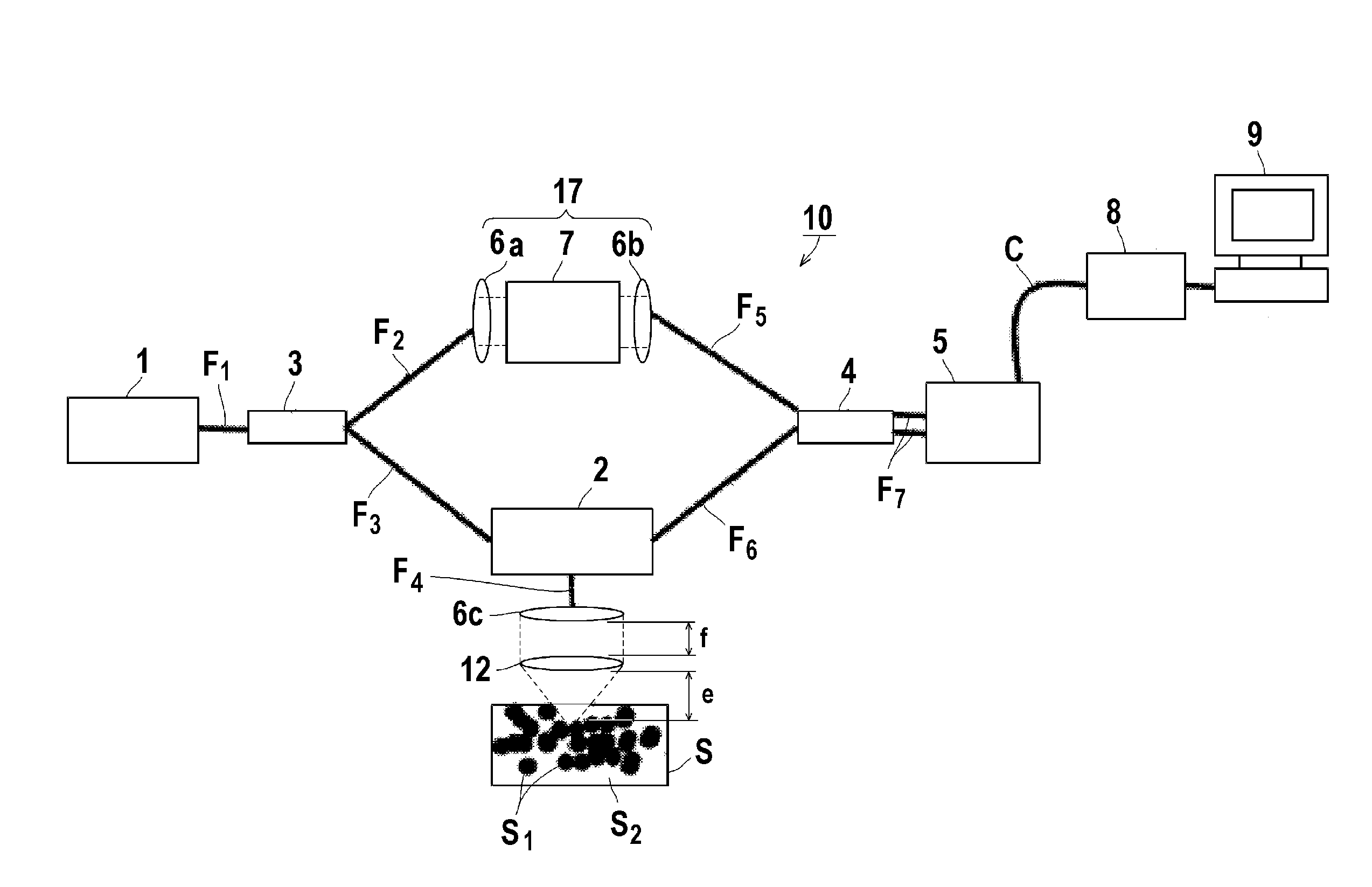
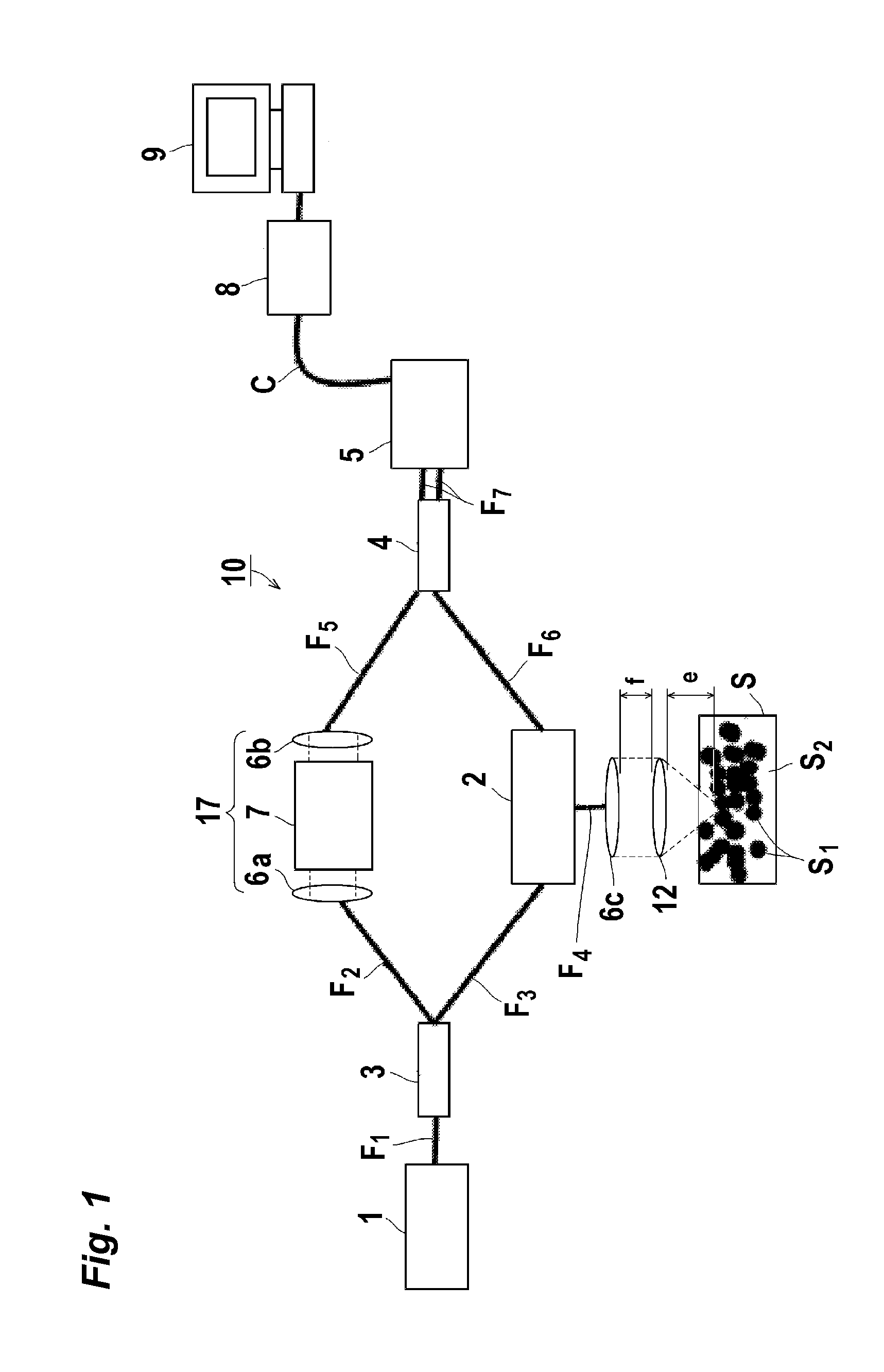
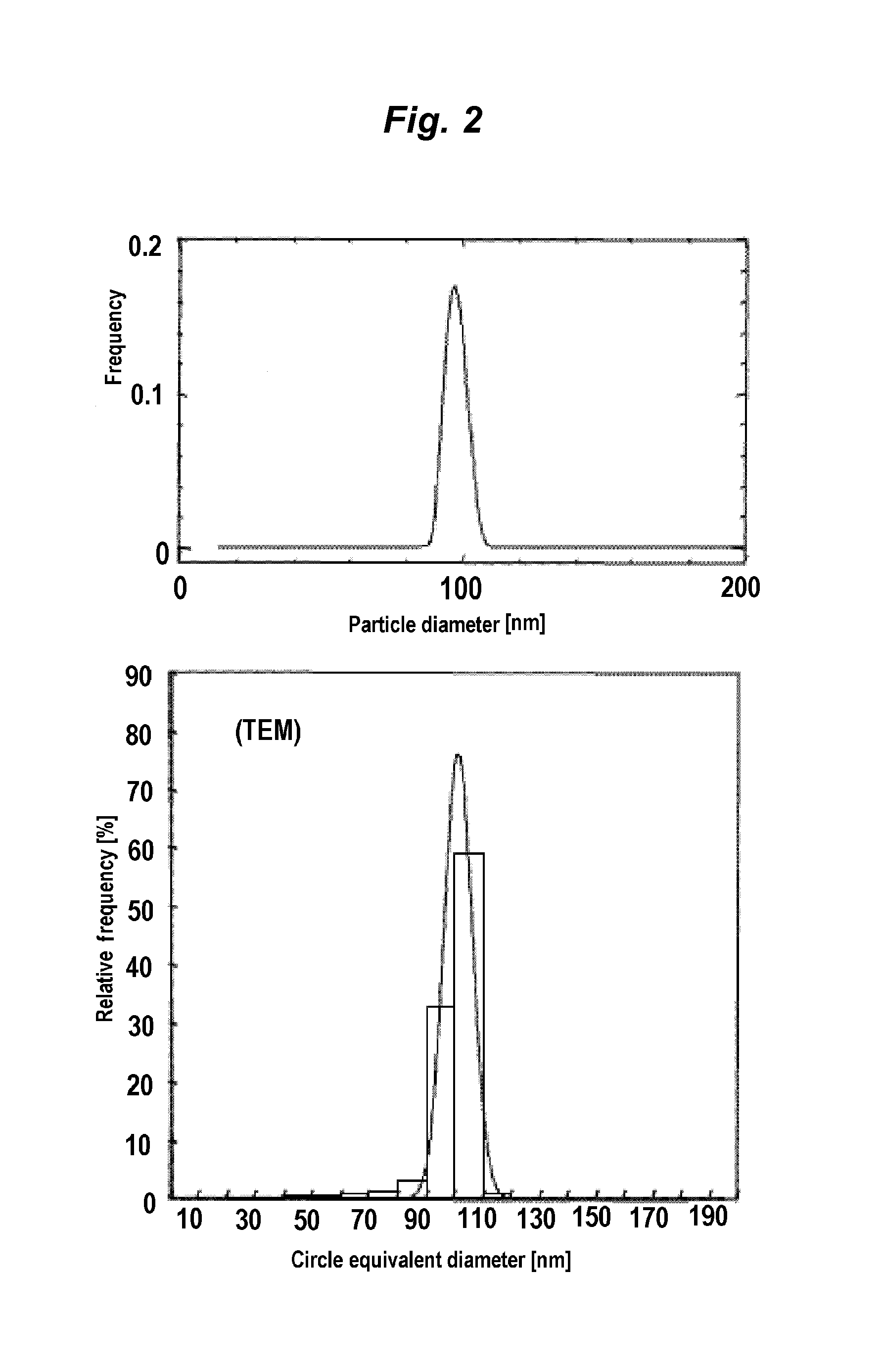
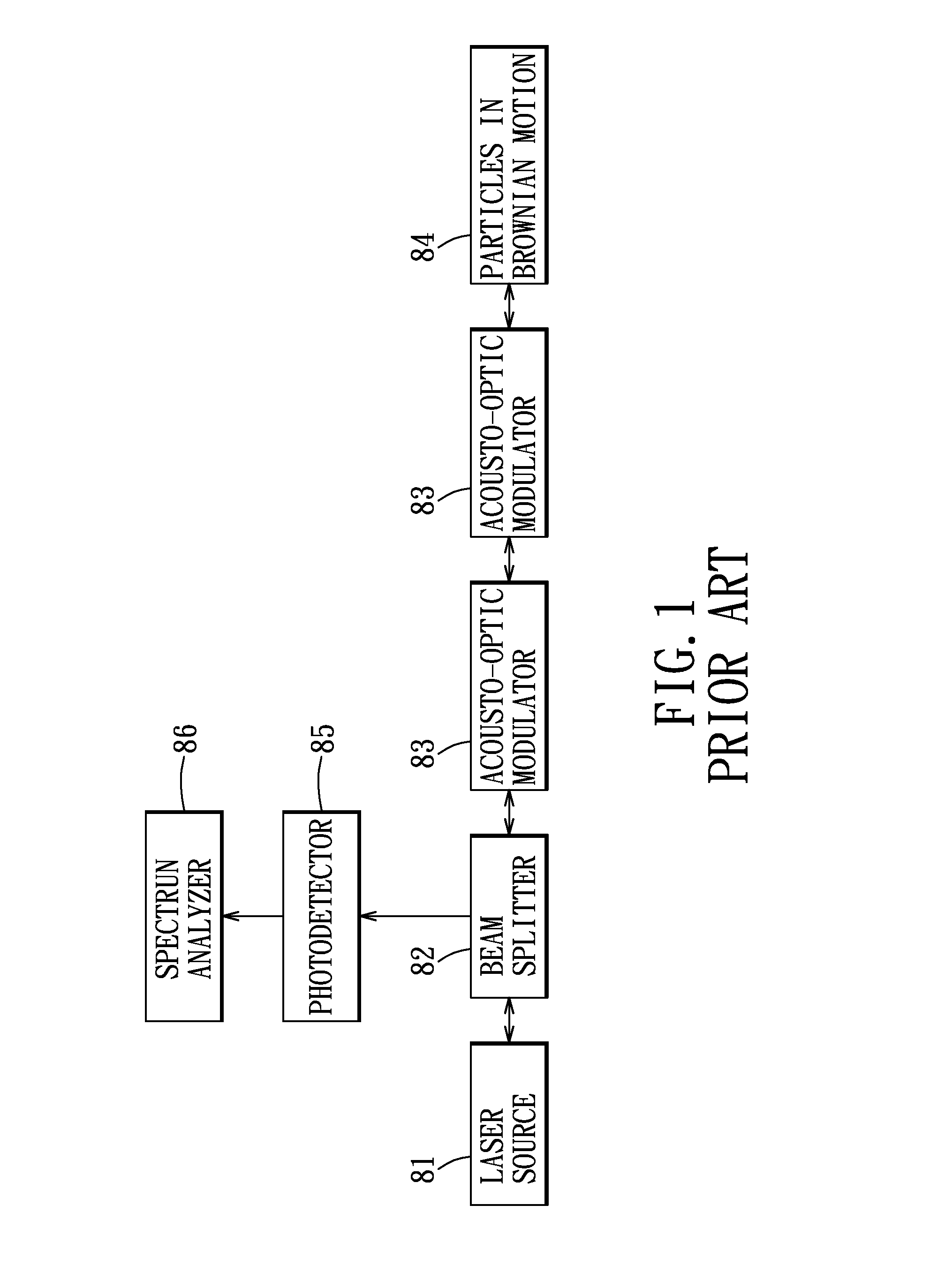
Dynamic light-scattering measuring apparatus using low-coherence light source and light-scattering measuring method of using the apparatus
PatentActiveUS20110001969A1
Innovation
- A dynamic light-scattering measuring apparatus utilizing a Mach-Zehnder interferometer and a low-coherence light source, with adjustable fiber branching ratio and microscope optical system, allows for accurate measurement of particle size in high-concentration samples by selectively detecting single scattering components.

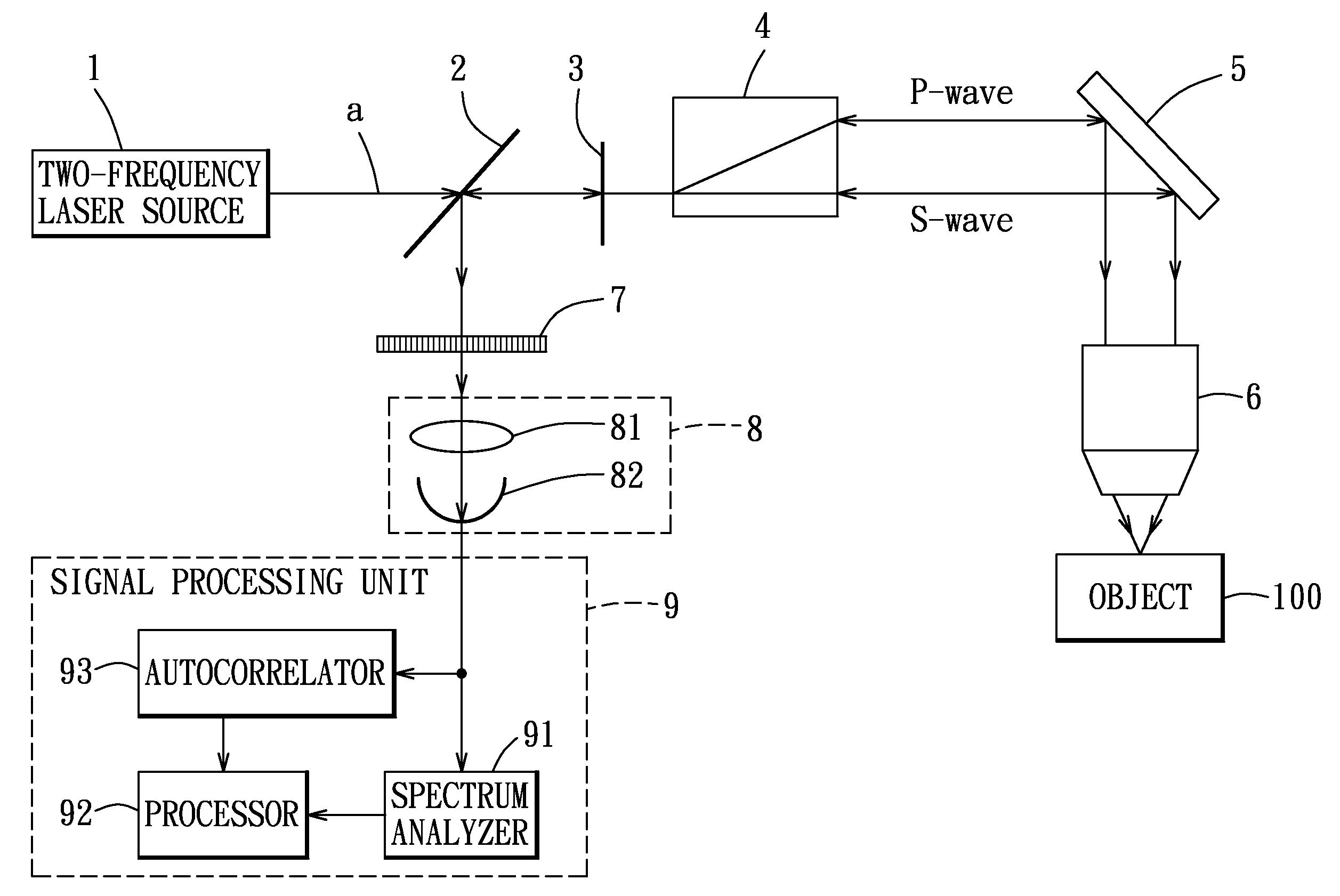
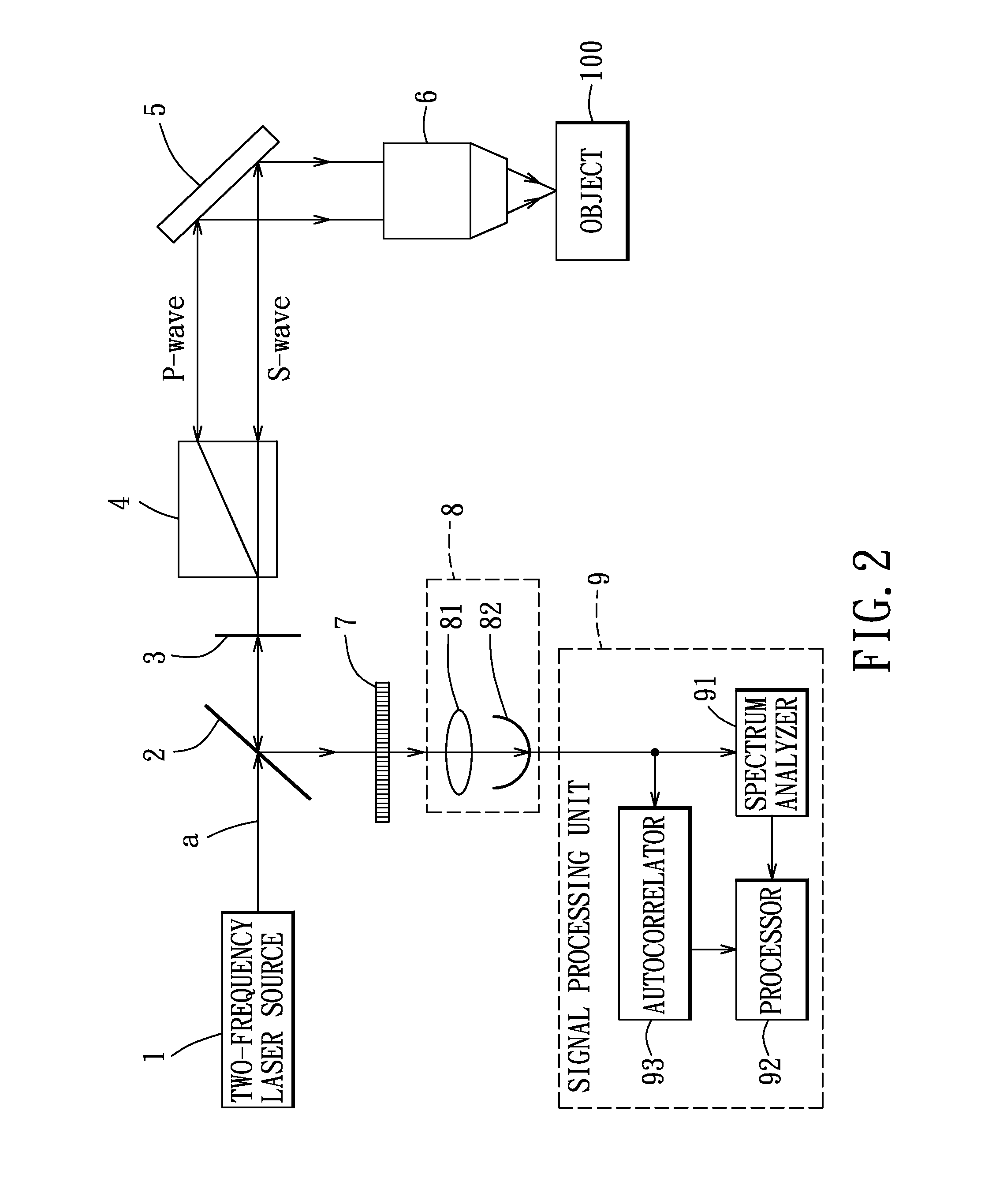
Localized dynamic light scattering system with doppler velocity measuring capability
PatentActiveUS8797514B2
Innovation
- A localized dynamic light scattering measurement system utilizing a two-frequency laser source, beam splitter, iris, beam displacer, focusing lens unit, polarizer, and signal processing unit, which generates a heterodyne interference signal to enhance sensitivity and reduce Doppler broadening by filtering unwanted scattering beams, allowing for more accurate Doppler velocity and particle size measurements.

Standardization and Calibration Protocols
Standardized protocols for calibration and validation are essential for ensuring the reliability and reproducibility of Dynamic Light Scattering (DLS) measurements. These protocols establish a framework for consistent system performance assessment across different laboratories and instruments. The foundation of effective DLS calibration begins with certified reference materials (CRMs) that possess well-characterized size distributions and stability over time. Polystyrene latex spheres, silica nanoparticles, and gold colloids are commonly employed as reference standards due to their uniform properties and commercial availability with certification.
A comprehensive calibration protocol should include verification of multiple system parameters. Size accuracy validation requires measuring reference materials of known dimensions across the instrument's specified range, typically from a few nanometers to several micrometers. Intensity calibration ensures the detector response is linear and consistent across measurements, which is critical for accurate concentration analysis and molecular weight determination. Temperature calibration is equally important as viscosity—a key parameter in DLS calculations—is temperature-dependent, with even small deviations potentially causing significant measurement errors.
Regular performance verification schedules must be established based on usage frequency and environmental conditions. Daily quick checks using stable reference materials can identify immediate issues, while weekly or monthly comprehensive calibrations provide thorough system assessment. Environmental factors such as vibration, electromagnetic interference, and temperature fluctuations should be monitored and controlled as they can significantly impact measurement quality.
Interlaboratory comparison studies represent a valuable approach to validate calibration protocols. By analyzing identical samples across multiple instruments and facilities, systematic biases can be identified and addressed. These collaborative efforts contribute to the development of industry-wide standards and best practices for DLS measurements.
Documentation of calibration procedures and results is crucial for maintaining traceability and demonstrating compliance with quality standards. Records should include calibration dates, reference materials used, environmental conditions, operator information, and any observed deviations. Modern DLS systems often incorporate automated calibration routines and quality control features that streamline this process while ensuring consistency.
For specialized applications such as protein analysis or nanoparticle characterization, application-specific calibration protocols may be necessary. These tailored approaches account for unique sample properties and measurement challenges, providing more relevant performance metrics for specific research or industrial contexts.
A comprehensive calibration protocol should include verification of multiple system parameters. Size accuracy validation requires measuring reference materials of known dimensions across the instrument's specified range, typically from a few nanometers to several micrometers. Intensity calibration ensures the detector response is linear and consistent across measurements, which is critical for accurate concentration analysis and molecular weight determination. Temperature calibration is equally important as viscosity—a key parameter in DLS calculations—is temperature-dependent, with even small deviations potentially causing significant measurement errors.
Regular performance verification schedules must be established based on usage frequency and environmental conditions. Daily quick checks using stable reference materials can identify immediate issues, while weekly or monthly comprehensive calibrations provide thorough system assessment. Environmental factors such as vibration, electromagnetic interference, and temperature fluctuations should be monitored and controlled as they can significantly impact measurement quality.
Interlaboratory comparison studies represent a valuable approach to validate calibration protocols. By analyzing identical samples across multiple instruments and facilities, systematic biases can be identified and addressed. These collaborative efforts contribute to the development of industry-wide standards and best practices for DLS measurements.
Documentation of calibration procedures and results is crucial for maintaining traceability and demonstrating compliance with quality standards. Records should include calibration dates, reference materials used, environmental conditions, operator information, and any observed deviations. Modern DLS systems often incorporate automated calibration routines and quality control features that streamline this process while ensuring consistency.
For specialized applications such as protein analysis or nanoparticle characterization, application-specific calibration protocols may be necessary. These tailored approaches account for unique sample properties and measurement challenges, providing more relevant performance metrics for specific research or industrial contexts.
Data Processing and Analysis Algorithms
Dynamic Light Scattering (DLS) systems rely heavily on sophisticated data processing and analysis algorithms to transform raw scattered light signals into meaningful particle characterization results. The cornerstone of DLS analysis is the autocorrelation function, which measures the similarity between scattering intensities at different time intervals. Modern DLS systems employ various mathematical approaches to extract particle size distributions from these correlation functions, with the most prevalent being cumulants analysis and CONTIN algorithms.
Cumulants analysis provides a robust method for analyzing monodisperse or narrowly distributed samples by fitting the correlation function to a single exponential decay. This approach yields the z-average diameter and polydispersity index (PDI), offering quick assessment of sample quality and stability. For more complex, polydisperse samples, CONTIN and non-negative least squares (NNLS) algorithms apply regularization techniques to solve the inverse Laplace transform problem, producing detailed particle size distributions without assuming specific distribution shapes.
Machine learning algorithms represent the cutting edge of DLS data processing, with neural networks and support vector machines demonstrating superior performance in distinguishing multimodal distributions and handling noisy data. These AI-driven approaches can identify subtle patterns in correlation functions that traditional algorithms might miss, particularly valuable when analyzing complex biological samples or nanoparticle formulations.
Signal filtering techniques play a crucial role in enhancing measurement accuracy by removing dust events and other artifacts that could skew results. Advanced DLS systems implement adaptive filtering algorithms that can distinguish between random noise and genuine scattering events, significantly improving reproducibility for challenging samples like protein solutions or low-concentration nanoparticle dispersions.
Real-time processing capabilities have become increasingly important in modern DLS instruments, allowing for continuous monitoring of dynamic processes such as aggregation, dissolution, or temperature-dependent size changes. These algorithms must balance computational efficiency with accuracy to provide meaningful time-resolved data without introducing processing artifacts.
The validation of DLS algorithms typically involves comparison against reference materials with known size distributions and theoretical models. Robust algorithms should demonstrate consistency across different sample concentrations, refractive indices, and viscosities, with minimal sensitivity to experimental variables. When assessing a DLS system's capabilities, particular attention should be paid to algorithm transparency, with vendors ideally providing detailed documentation of mathematical approaches and assumptions underlying their analysis methods.
Cumulants analysis provides a robust method for analyzing monodisperse or narrowly distributed samples by fitting the correlation function to a single exponential decay. This approach yields the z-average diameter and polydispersity index (PDI), offering quick assessment of sample quality and stability. For more complex, polydisperse samples, CONTIN and non-negative least squares (NNLS) algorithms apply regularization techniques to solve the inverse Laplace transform problem, producing detailed particle size distributions without assuming specific distribution shapes.
Machine learning algorithms represent the cutting edge of DLS data processing, with neural networks and support vector machines demonstrating superior performance in distinguishing multimodal distributions and handling noisy data. These AI-driven approaches can identify subtle patterns in correlation functions that traditional algorithms might miss, particularly valuable when analyzing complex biological samples or nanoparticle formulations.
Signal filtering techniques play a crucial role in enhancing measurement accuracy by removing dust events and other artifacts that could skew results. Advanced DLS systems implement adaptive filtering algorithms that can distinguish between random noise and genuine scattering events, significantly improving reproducibility for challenging samples like protein solutions or low-concentration nanoparticle dispersions.
Real-time processing capabilities have become increasingly important in modern DLS instruments, allowing for continuous monitoring of dynamic processes such as aggregation, dissolution, or temperature-dependent size changes. These algorithms must balance computational efficiency with accuracy to provide meaningful time-resolved data without introducing processing artifacts.
The validation of DLS algorithms typically involves comparison against reference materials with known size distributions and theoretical models. Robust algorithms should demonstrate consistency across different sample concentrations, refractive indices, and viscosities, with minimal sensitivity to experimental variables. When assessing a DLS system's capabilities, particular attention should be paid to algorithm transparency, with vendors ideally providing detailed documentation of mathematical approaches and assumptions underlying their analysis methods.
Unlock deeper insights with PatSnap Eureka Quick Research — get a full tech report to explore trends and direct your research. Try now!
Generate Your Research Report Instantly with AI Agent
Supercharge your innovation with PatSnap Eureka AI Agent Platform!