

How to Optimize Crankshaft Design for Durability
SEP 23, 20259 MIN READ
Generate Your Research Report Instantly with AI Agent
PatSnap Eureka helps you evaluate technical feasibility & market potential.
Crankshaft Design Evolution and Objectives
The crankshaft, a critical component in internal combustion engines, has undergone significant evolution since its inception in the late 19th century. Initially designed with simple geometries and basic materials like cast iron, crankshafts have transformed dramatically to meet the increasing demands of modern engines. The historical progression reveals a continuous pursuit of durability enhancement through material innovation, geometric optimization, and manufacturing process improvements.
Early crankshafts suffered from frequent failures due to material limitations and rudimentary understanding of stress distribution. The transition from cast iron to forged steel in the mid-20th century marked a pivotal advancement, substantially improving fatigue resistance and overall durability. This material evolution continued with the introduction of micro-alloyed steels, nodular cast iron, and specialized heat treatments that further enhanced performance characteristics.
Geometric design evolution has been equally significant, moving from simple offset journals to complex counterweighted configurations that minimize vibration and optimize load distribution. The introduction of fillet rolling in the 1960s represented a breakthrough in addressing stress concentration at journal transitions, dramatically improving fatigue life. Modern computational methods have enabled further refinement of these geometric features, with optimized oil hole placement and journal overlap angles becoming standard practice.
Manufacturing techniques have evolved in parallel, transitioning from sand casting to precision forging, and more recently to advanced processes like isothermal forging and precision machining. These advancements have enabled tighter tolerances, improved surface finishes, and enhanced microstructural properties, all contributing to superior durability performance.
The primary objective in contemporary crankshaft design optimization is to achieve maximum durability while minimizing weight and manufacturing costs. This involves balancing multiple competing factors: fatigue resistance, torsional stiffness, bending strength, and vibration characteristics. Secondary objectives include reducing friction losses, improving oil distribution, and enhancing compatibility with modern engine systems such as start-stop technology and hybrid powertrains.
Current research focuses on several promising directions: computational optimization using finite element analysis and topology optimization algorithms; advanced material solutions including surface treatments like nitriding and induction hardening; and novel manufacturing approaches such as additive manufacturing for prototype development and specialized applications. The integration of sensors for real-time monitoring represents an emerging frontier, potentially enabling predictive maintenance and adaptive performance optimization.
The ultimate goal remains consistent: to develop crankshafts that can withstand increasingly demanding operating conditions while supporting broader trends toward engine downsizing, emissions reduction, and extended service intervals. This requires a holistic approach that considers the entire engine system and anticipates future requirements in terms of performance, reliability, and sustainability.
Early crankshafts suffered from frequent failures due to material limitations and rudimentary understanding of stress distribution. The transition from cast iron to forged steel in the mid-20th century marked a pivotal advancement, substantially improving fatigue resistance and overall durability. This material evolution continued with the introduction of micro-alloyed steels, nodular cast iron, and specialized heat treatments that further enhanced performance characteristics.
Geometric design evolution has been equally significant, moving from simple offset journals to complex counterweighted configurations that minimize vibration and optimize load distribution. The introduction of fillet rolling in the 1960s represented a breakthrough in addressing stress concentration at journal transitions, dramatically improving fatigue life. Modern computational methods have enabled further refinement of these geometric features, with optimized oil hole placement and journal overlap angles becoming standard practice.
Manufacturing techniques have evolved in parallel, transitioning from sand casting to precision forging, and more recently to advanced processes like isothermal forging and precision machining. These advancements have enabled tighter tolerances, improved surface finishes, and enhanced microstructural properties, all contributing to superior durability performance.
The primary objective in contemporary crankshaft design optimization is to achieve maximum durability while minimizing weight and manufacturing costs. This involves balancing multiple competing factors: fatigue resistance, torsional stiffness, bending strength, and vibration characteristics. Secondary objectives include reducing friction losses, improving oil distribution, and enhancing compatibility with modern engine systems such as start-stop technology and hybrid powertrains.
Current research focuses on several promising directions: computational optimization using finite element analysis and topology optimization algorithms; advanced material solutions including surface treatments like nitriding and induction hardening; and novel manufacturing approaches such as additive manufacturing for prototype development and specialized applications. The integration of sensors for real-time monitoring represents an emerging frontier, potentially enabling predictive maintenance and adaptive performance optimization.
The ultimate goal remains consistent: to develop crankshafts that can withstand increasingly demanding operating conditions while supporting broader trends toward engine downsizing, emissions reduction, and extended service intervals. This requires a holistic approach that considers the entire engine system and anticipates future requirements in terms of performance, reliability, and sustainability.
Market Requirements for High-Durability Crankshafts
The global market for high-durability crankshafts is experiencing significant growth driven by increasing demands across multiple industries. Automotive manufacturers, particularly in the premium and heavy-duty segments, require crankshafts that can withstand higher compression ratios, increased power outputs, and extended service intervals while maintaining reliability. Market research indicates that durability has become a primary purchasing factor, with manufacturers willing to invest in superior materials and designs to reduce warranty claims and enhance brand reputation.
Heavy-duty diesel engine manufacturers represent a particularly demanding market segment, requiring crankshafts capable of enduring extreme loads and operating conditions for 1 million+ miles without failure. This segment values fatigue resistance and dimensional stability under thermal cycling conditions as critical performance parameters, often specifying minimum fatigue life requirements that exceed standard automotive applications by 300-400%.
The marine and power generation sectors present unique market requirements, emphasizing corrosion resistance alongside mechanical durability. These applications frequently operate in challenging environments with extended continuous operation periods, creating demand for crankshafts with exceptional resistance to both mechanical fatigue and environmental degradation.
Racing and high-performance applications constitute a specialized market segment with extreme requirements for strength-to-weight ratio. This sector drives innovation in material science and manufacturing techniques, often accepting higher costs for marginal performance improvements. The technologies developed for this segment frequently trickle down to mainstream applications after several development cycles.
Market analysis reveals a growing trend toward lightweight crankshaft designs that maintain or improve durability metrics. This trend is driven by fuel efficiency regulations and emissions standards, creating demand for components that contribute to overall powertrain efficiency while maintaining reliability standards. Manufacturers are increasingly specifying crankshafts that offer 15-20% weight reduction without compromising durability.
Emerging markets show accelerating demand for durable engine components as vehicle ownership expands and infrastructure development increases utilization of heavy equipment. These markets often operate equipment under more severe conditions with less rigorous maintenance schedules, placing additional emphasis on component durability as a key selling feature.
The aftermarket segment demonstrates consistent demand for upgraded crankshafts with enhanced durability specifications, particularly for performance modifications and rebuilds of aging equipment. This market segment values documented performance improvements and compatibility with existing engine architectures, creating opportunities for specialized manufacturers offering enhanced durability solutions.
Heavy-duty diesel engine manufacturers represent a particularly demanding market segment, requiring crankshafts capable of enduring extreme loads and operating conditions for 1 million+ miles without failure. This segment values fatigue resistance and dimensional stability under thermal cycling conditions as critical performance parameters, often specifying minimum fatigue life requirements that exceed standard automotive applications by 300-400%.
The marine and power generation sectors present unique market requirements, emphasizing corrosion resistance alongside mechanical durability. These applications frequently operate in challenging environments with extended continuous operation periods, creating demand for crankshafts with exceptional resistance to both mechanical fatigue and environmental degradation.
Racing and high-performance applications constitute a specialized market segment with extreme requirements for strength-to-weight ratio. This sector drives innovation in material science and manufacturing techniques, often accepting higher costs for marginal performance improvements. The technologies developed for this segment frequently trickle down to mainstream applications after several development cycles.
Market analysis reveals a growing trend toward lightweight crankshaft designs that maintain or improve durability metrics. This trend is driven by fuel efficiency regulations and emissions standards, creating demand for components that contribute to overall powertrain efficiency while maintaining reliability standards. Manufacturers are increasingly specifying crankshafts that offer 15-20% weight reduction without compromising durability.
Emerging markets show accelerating demand for durable engine components as vehicle ownership expands and infrastructure development increases utilization of heavy equipment. These markets often operate equipment under more severe conditions with less rigorous maintenance schedules, placing additional emphasis on component durability as a key selling feature.
The aftermarket segment demonstrates consistent demand for upgraded crankshafts with enhanced durability specifications, particularly for performance modifications and rebuilds of aging equipment. This market segment values documented performance improvements and compatibility with existing engine architectures, creating opportunities for specialized manufacturers offering enhanced durability solutions.
Current Challenges in Crankshaft Engineering
Despite significant advancements in crankshaft engineering, the industry continues to face several critical challenges that impede optimal durability performance. Material selection remains a primary concern, with engineers struggling to balance strength requirements against weight reduction demands. Traditional materials like forged steel offer excellent strength but contribute to excessive vehicle weight, while alternative materials such as nodular cast iron or carbon fiber composites present their own limitations in terms of manufacturing complexity and cost-effectiveness.
Manufacturing inconsistencies represent another significant hurdle. Even minor variations in the production process can lead to microscopic defects that become failure points under operational stress. The industry still lacks standardized quality control protocols that can reliably detect these subtle imperfections without increasing production costs prohibitively.
Fatigue resistance presents perhaps the most persistent challenge in crankshaft engineering. The cyclical loading patterns experienced by crankshafts create complex stress distributions that are difficult to model accurately. Current simulation tools often fail to account for the cumulative effects of these stress cycles over the entire service life, particularly when considering variable operating conditions and environmental factors.
Bearing surface design and lubrication systems continue to present optimization difficulties. The interface between crankshaft journals and bearings experiences extreme pressure and temperature conditions that accelerate wear. Current lubrication technologies struggle to maintain optimal oil film thickness under all operating conditions, particularly during cold starts and high-temperature operations.
Vibration damping represents another persistent engineering challenge. As engines trend toward higher power outputs and lower weights, controlling torsional vibrations becomes increasingly difficult. Current damping technologies add significant weight and complexity to crankshaft designs, often counteracting weight reduction efforts elsewhere in the system.
Balancing requirements further complicate crankshaft design, particularly in multi-cylinder engines with irregular firing orders. Engineers must carefully distribute mass to minimize vibration while maintaining structural integrity, often resulting in complex geometries that are difficult to manufacture consistently.
Finally, the industry faces significant challenges in developing accurate accelerated testing methodologies. The extended service life expected of modern crankshafts (often exceeding 200,000 miles) makes real-world durability testing impractical during development cycles. Current accelerated testing protocols frequently fail to accurately predict long-term failure modes, leading to either over-engineered components or unexpected field failures.
Manufacturing inconsistencies represent another significant hurdle. Even minor variations in the production process can lead to microscopic defects that become failure points under operational stress. The industry still lacks standardized quality control protocols that can reliably detect these subtle imperfections without increasing production costs prohibitively.
Fatigue resistance presents perhaps the most persistent challenge in crankshaft engineering. The cyclical loading patterns experienced by crankshafts create complex stress distributions that are difficult to model accurately. Current simulation tools often fail to account for the cumulative effects of these stress cycles over the entire service life, particularly when considering variable operating conditions and environmental factors.
Bearing surface design and lubrication systems continue to present optimization difficulties. The interface between crankshaft journals and bearings experiences extreme pressure and temperature conditions that accelerate wear. Current lubrication technologies struggle to maintain optimal oil film thickness under all operating conditions, particularly during cold starts and high-temperature operations.
Vibration damping represents another persistent engineering challenge. As engines trend toward higher power outputs and lower weights, controlling torsional vibrations becomes increasingly difficult. Current damping technologies add significant weight and complexity to crankshaft designs, often counteracting weight reduction efforts elsewhere in the system.
Balancing requirements further complicate crankshaft design, particularly in multi-cylinder engines with irregular firing orders. Engineers must carefully distribute mass to minimize vibration while maintaining structural integrity, often resulting in complex geometries that are difficult to manufacture consistently.
Finally, the industry faces significant challenges in developing accurate accelerated testing methodologies. The extended service life expected of modern crankshafts (often exceeding 200,000 miles) makes real-world durability testing impractical during development cycles. Current accelerated testing protocols frequently fail to accurately predict long-term failure modes, leading to either over-engineered components or unexpected field failures.
Modern Crankshaft Design Methodologies
01 Material selection and treatment for crankshaft durability
The selection of appropriate materials and their treatment processes significantly impacts crankshaft durability. High-strength alloys, specialized steel compositions, and surface treatments such as nitriding or induction hardening can enhance wear resistance and fatigue strength. These treatments create a hardened surface layer while maintaining a tough core, resulting in crankshafts that can withstand higher loads and have longer service lives under demanding operating conditions.- Material selection and treatment for crankshaft durability: The choice of materials and subsequent treatments significantly impact crankshaft durability. High-strength alloys, specialized heat treatments, and surface hardening processes can enhance wear resistance and fatigue strength. These treatments create a hardened outer layer while maintaining a tough core, resulting in crankshafts that can withstand higher loads and have longer service lives under demanding operating conditions.
- Structural design improvements for enhanced durability: Innovative structural designs can significantly improve crankshaft durability. Features such as optimized fillet radii, balanced weight distribution, reinforced journals, and improved oil passage configurations help reduce stress concentrations and enhance overall strength. Advanced design methodologies including finite element analysis allow for identification and elimination of potential failure points before manufacturing.
- Manufacturing processes to improve crankshaft integrity: Specialized manufacturing processes significantly impact crankshaft durability. Techniques such as forging (rather than casting), precision machining, shot peening, and advanced grinding methods create more uniform grain structures and superior surface finishes. These processes minimize internal defects and surface irregularities that could otherwise serve as stress concentration points and lead to premature failure under cyclic loading conditions.
- Lubrication system enhancements for crankshaft protection: Enhanced lubrication systems play a crucial role in extending crankshaft life. Optimized oil channels, improved oil filtration, specialized lubricant formulations, and advanced oil delivery mechanisms ensure consistent lubrication to critical bearing surfaces. These improvements reduce friction, minimize wear, prevent overheating, and protect against contaminants that could otherwise accelerate deterioration of crankshaft surfaces under high-load conditions.
- Monitoring and testing methods for crankshaft durability: Advanced monitoring and testing methodologies help ensure crankshaft durability throughout development and service life. Non-destructive testing techniques, real-time condition monitoring systems, accelerated life testing protocols, and precision balancing procedures allow for early detection of potential issues. These approaches enable manufacturers to validate design improvements, identify wear patterns, and implement preventive maintenance before catastrophic failures occur.
02 Innovative crankshaft design and geometry
Advanced design features and optimized geometry can substantially improve crankshaft durability. This includes optimized fillet radii between journals and webs, balanced weight distribution, and strategic placement of counterweights. Computer-aided design and finite element analysis enable engineers to identify and eliminate stress concentration points, resulting in more uniform stress distribution throughout the crankshaft. These design innovations help prevent fatigue failure and extend the operational lifespan of the component.Expand Specific Solutions03 Manufacturing processes for enhanced durability
Specialized manufacturing processes significantly impact crankshaft durability. Techniques such as forging (which aligns grain structure for improved strength), precision machining, and controlled cooling processes all contribute to superior mechanical properties. Advanced manufacturing methods like deep rolling of fillets and journals create beneficial compressive residual stresses that counteract operational tensile stresses, thereby improving fatigue resistance and overall durability under cyclic loading conditions.Expand Specific Solutions04 Lubrication and cooling systems for crankshaft protection
Effective lubrication and cooling systems are critical for maintaining crankshaft durability. Innovations include optimized oil passages within the crankshaft, improved bearing designs, and advanced oil filtration systems. These features ensure consistent lubrication of bearing surfaces, reduce friction, and efficiently dissipate heat generated during operation. Proper lubrication prevents premature wear of journal surfaces and bearings, while effective cooling prevents thermal distortion and maintains dimensional stability under high-load conditions.Expand Specific Solutions05 Monitoring and testing methods for durability assessment
Advanced monitoring and testing methodologies help evaluate and ensure crankshaft durability. These include non-destructive testing techniques, real-time monitoring systems, and accelerated life testing protocols. Sensors can detect early signs of fatigue or abnormal wear patterns, allowing for preventive maintenance before catastrophic failure occurs. Comprehensive testing regimes simulate extreme operating conditions to validate design improvements and material selections, ensuring that crankshafts meet or exceed durability requirements for their intended applications.Expand Specific Solutions
Leading Manufacturers and Industry Competition
The crankshaft durability optimization market is currently in a mature growth phase with increasing demand driven by automotive and industrial applications, valued at approximately $4-5 billion globally. The competitive landscape features established automotive OEMs (Mercedes-Benz, BMW, Toyota, Ford) focusing on lightweight designs and material innovations, while specialized manufacturers (Bharat Forge, Tianrun Industry, thyssenkrupp Gerlach) lead in production technologies. Technical maturity varies across players, with Mercedes-Benz, Toyota, and BMW demonstrating advanced simulation capabilities and material science applications, while NIPPON STEEL and Bharat Forge excel in metallurgical innovations. Chinese manufacturers like BYD and Chery are rapidly advancing their technologies to compete with traditional leaders in this critical powertrain component sector.
Mercedes-Benz Group AG
Technical Solution: Mercedes-Benz has developed a sophisticated approach to crankshaft durability optimization that combines advanced materials science with precision engineering. Their methodology employs a multi-stage design process that begins with detailed finite element analysis to identify critical stress points under various operating conditions. Mercedes utilizes specialized alloy steels with carefully balanced chromium (0.9-1.1%), molybdenum (0.15-0.25%), and nickel (0.4-0.7%) content to enhance fatigue resistance while maintaining machinability. Their crankshafts feature variable cross-section design with optimized counterweights that provide superior balance characteristics while minimizing overall mass. A key innovation in their approach is the implementation of controlled shot peening on fillet areas, which introduces compressive residual stresses to a depth of approximately 0.3-0.5mm, significantly enhancing fatigue resistance at these critical locations. Mercedes employs precision CNC machining with tolerances maintained within ±0.005mm for bearing journals, ensuring optimal oil film formation during operation. Their manufacturing process includes specialized heat treatment protocols with carefully controlled cooling rates to achieve optimal microstructure throughout the component, resulting in a balance of strength and toughness that extends service life beyond 250,000 miles under normal operating conditions.
Strengths: Exceptional dimensional precision and surface finish quality; superior balance characteristics that reduce vibration and associated stress; comprehensive validation methodology including both bench testing and field trials. Weaknesses: Higher manufacturing costs compared to conventional designs; requires specialized equipment and expertise; limited flexibility for aftermarket modifications.
Ford Global Technologies LLC
Technical Solution: Ford has developed an integrated approach to crankshaft durability optimization that combines advanced computational methods with innovative manufacturing techniques. Their design methodology employs multi-objective optimization algorithms that simultaneously consider fatigue life, NVH (Noise, Vibration, Harshness) characteristics, and manufacturing constraints. Ford utilizes a proprietary material specification with carefully controlled carbon (0.37-0.44%), manganese (0.60-0.90%), and chromium (0.15-0.35%) content to achieve an optimal balance of strength and machinability. A distinctive feature of Ford's approach is their "stress-gradient mapping" technique, which identifies areas requiring localized reinforcement while maintaining overall weight targets. Their manufacturing process incorporates precision forging with controlled grain flow orientation to enhance strength in critical areas, followed by induction hardening of bearing journals to achieve surface hardness of 56-60 HRC. Ford has pioneered advanced fillet design methodologies that optimize stress distribution through variable radius transitions, reducing stress concentration factors by up to 25% compared to conventional designs. Their validation protocol includes specialized pulsator testing that simulates over 200 million cycles under varying load conditions, equivalent to approximately 150,000 miles of severe service operation. Ford has also developed proprietary surface treatment processes that enhance oil retention and reduce friction at bearing interfaces.
Strengths: Excellent balance between durability and manufacturing efficiency; robust design methodology that accommodates various engine configurations; comprehensive validation process that accurately predicts field performance. Weaknesses: Requires sophisticated simulation capabilities and specialized testing equipment; higher initial development costs; limited flexibility for significant design changes once production tooling is established.
Critical Patents and Technical Innovations
Crankshaft
PatentInactiveEP2000683A1
Innovation
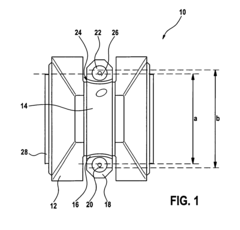
- The crankshaft features main and connecting rod bearings with axial edge areas raised relative to the central area, providing increased rigidity and maintaining the same screw connections, with concave recesses reducing stress and friction, and a convex connecting rod eye shape adapted to the concave bearing for precise fitting and reduced friction.
Crankshaft bearing assembly
PatentInactiveEP1788262B1
Innovation
- A crankshaft bearing assembly with at least one bearing cap made of a wrought or forged aluminum alloy having a tensile strength higher than the engine or crankcase, divided into a first half integral with the crankcase and a second half with a higher tensile strength, typically above 300 MPa, to enhance durability and reduce weight.


Materials Science Advancements for Crankshafts
Recent advancements in materials science have revolutionized crankshaft design and manufacturing, significantly enhancing durability and performance. Traditional materials like carbon steel and cast iron are increasingly being supplemented or replaced by innovative alloys and composites specifically engineered for high-stress automotive applications. Microalloyed steels containing precise amounts of vanadium, niobium, and titanium have demonstrated superior fatigue resistance while maintaining excellent machinability characteristics essential for complex crankshaft geometries.
Forged steel crankshafts have benefited from refined heat treatment processes, including controlled quenching and tempering techniques that create optimized microstructures. These advancements have resulted in up to 25% improvement in fatigue strength compared to conventional treatments. Surface engineering technologies have similarly evolved, with innovations in nitriding, carburizing, and induction hardening allowing for selective reinforcement of high-stress areas without compromising the core ductility necessary for vibration absorption.
Powder metallurgy has emerged as a promising manufacturing approach, enabling the creation of near-net-shape crankshafts with highly controlled material properties. This technology allows for strategic distribution of density and composition throughout the component, addressing specific stress concentrations identified through finite element analysis. The resulting components exhibit exceptional wear resistance at journal surfaces while maintaining appropriate flexibility in web sections.
Carbon fiber reinforced polymers (CFRPs) and metal matrix composites represent the cutting edge of lightweight crankshaft materials. Though primarily limited to high-performance and racing applications, these materials offer weight reductions of 40-60% compared to traditional steel crankshafts. Recent breakthroughs in manufacturing techniques have begun addressing previous limitations regarding cost and scalability, potentially expanding their application to premium production vehicles.
Nanomaterial integration represents another frontier, with nano-precipitate strengthened alloys demonstrating remarkable improvements in both strength and ductility. These materials incorporate precisely engineered nanoparticles that impede dislocation movement within the metal matrix, enhancing fatigue resistance without the brittleness typically associated with high-strength alloys. Early testing indicates potential service life improvements of 30-40% under identical loading conditions.
Computational materials science has accelerated development cycles through predictive modeling of material behavior under complex loading scenarios. Machine learning algorithms now assist in identifying optimal material compositions and processing parameters, reducing the traditional trial-and-error approach to materials development. This data-driven approach has enabled the creation of application-specific material solutions that precisely balance competing requirements of strength, ductility, machinability, and cost-effectiveness.
Forged steel crankshafts have benefited from refined heat treatment processes, including controlled quenching and tempering techniques that create optimized microstructures. These advancements have resulted in up to 25% improvement in fatigue strength compared to conventional treatments. Surface engineering technologies have similarly evolved, with innovations in nitriding, carburizing, and induction hardening allowing for selective reinforcement of high-stress areas without compromising the core ductility necessary for vibration absorption.
Powder metallurgy has emerged as a promising manufacturing approach, enabling the creation of near-net-shape crankshafts with highly controlled material properties. This technology allows for strategic distribution of density and composition throughout the component, addressing specific stress concentrations identified through finite element analysis. The resulting components exhibit exceptional wear resistance at journal surfaces while maintaining appropriate flexibility in web sections.
Carbon fiber reinforced polymers (CFRPs) and metal matrix composites represent the cutting edge of lightweight crankshaft materials. Though primarily limited to high-performance and racing applications, these materials offer weight reductions of 40-60% compared to traditional steel crankshafts. Recent breakthroughs in manufacturing techniques have begun addressing previous limitations regarding cost and scalability, potentially expanding their application to premium production vehicles.
Nanomaterial integration represents another frontier, with nano-precipitate strengthened alloys demonstrating remarkable improvements in both strength and ductility. These materials incorporate precisely engineered nanoparticles that impede dislocation movement within the metal matrix, enhancing fatigue resistance without the brittleness typically associated with high-strength alloys. Early testing indicates potential service life improvements of 30-40% under identical loading conditions.
Computational materials science has accelerated development cycles through predictive modeling of material behavior under complex loading scenarios. Machine learning algorithms now assist in identifying optimal material compositions and processing parameters, reducing the traditional trial-and-error approach to materials development. This data-driven approach has enabled the creation of application-specific material solutions that precisely balance competing requirements of strength, ductility, machinability, and cost-effectiveness.
Simulation and Testing Protocols
Effective simulation and testing protocols are essential for validating crankshaft design optimizations before implementation in production engines. Finite Element Analysis (FEA) serves as the cornerstone of modern crankshaft simulation, allowing engineers to model stress distribution, deformation patterns, and fatigue behavior under various loading conditions. Advanced FEA software packages such as ANSYS, Abaqus, and COMSOL have developed specialized modules for crankshaft analysis that incorporate material nonlinearities, contact mechanics, and dynamic loading scenarios.
Multi-physics simulation approaches have gained significant traction in recent years, enabling simultaneous analysis of structural mechanics, thermal effects, and fluid dynamics interactions. These integrated simulations provide more accurate predictions of crankshaft behavior under real-world operating conditions, particularly in high-performance applications where thermal gradients can significantly impact material properties and dimensional stability.
Physical testing protocols complement simulation efforts through a structured hierarchy of validation methods. Component-level testing typically begins with static load tests to verify basic strength characteristics, followed by dynamic testing on specialized rigs that replicate rotational forces, bending moments, and torsional vibrations. Resonance testing identifies critical frequencies that could lead to premature failure, while impact testing evaluates resistance to sudden load spikes.
Accelerated life testing represents a crucial phase in the validation process, subjecting crankshafts to intensified loading cycles that compress years of operational wear into manageable testing timeframes. These protocols often incorporate stepped-stress methodologies where load levels progressively increase until failure occurs, providing valuable data for Weibull analysis and reliability predictions.
Non-destructive testing (NDT) techniques play a vital role in both development and quality control processes. Ultrasonic testing can detect internal flaws invisible to the naked eye, while magnetic particle inspection identifies surface and near-surface defects. X-ray and CT scanning technologies enable comprehensive three-dimensional inspection of critical areas without compromising the component's integrity.
Correlation between simulation and physical testing results requires sophisticated data acquisition systems and statistical analysis methods. Strain gauges, accelerometers, and high-speed imaging equipment capture real-world performance metrics that can be directly compared to simulation outputs. Discrepancies between predicted and measured values inform iterative refinements to both simulation parameters and physical designs, creating a continuous improvement feedback loop.
Multi-physics simulation approaches have gained significant traction in recent years, enabling simultaneous analysis of structural mechanics, thermal effects, and fluid dynamics interactions. These integrated simulations provide more accurate predictions of crankshaft behavior under real-world operating conditions, particularly in high-performance applications where thermal gradients can significantly impact material properties and dimensional stability.
Physical testing protocols complement simulation efforts through a structured hierarchy of validation methods. Component-level testing typically begins with static load tests to verify basic strength characteristics, followed by dynamic testing on specialized rigs that replicate rotational forces, bending moments, and torsional vibrations. Resonance testing identifies critical frequencies that could lead to premature failure, while impact testing evaluates resistance to sudden load spikes.
Accelerated life testing represents a crucial phase in the validation process, subjecting crankshafts to intensified loading cycles that compress years of operational wear into manageable testing timeframes. These protocols often incorporate stepped-stress methodologies where load levels progressively increase until failure occurs, providing valuable data for Weibull analysis and reliability predictions.
Non-destructive testing (NDT) techniques play a vital role in both development and quality control processes. Ultrasonic testing can detect internal flaws invisible to the naked eye, while magnetic particle inspection identifies surface and near-surface defects. X-ray and CT scanning technologies enable comprehensive three-dimensional inspection of critical areas without compromising the component's integrity.
Correlation between simulation and physical testing results requires sophisticated data acquisition systems and statistical analysis methods. Strain gauges, accelerometers, and high-speed imaging equipment capture real-world performance metrics that can be directly compared to simulation outputs. Discrepancies between predicted and measured values inform iterative refinements to both simulation parameters and physical designs, creating a continuous improvement feedback loop.
Unlock deeper insights with PatSnap Eureka Quick Research — get a full tech report to explore trends and direct your research. Try now!
Generate Your Research Report Instantly with AI Agent
Supercharge your innovation with PatSnap Eureka AI Agent Platform!