

Measure Particle Size Distribution With Atomic Force Microscopy — Accuracy
SEP 19, 20259 MIN READ
Generate Your Research Report Instantly with AI Agent
PatSnap Eureka helps you evaluate technical feasibility & market potential.
AFM Particle Sizing Background and Objectives
Atomic Force Microscopy (AFM) has evolved significantly since its invention in 1986 by Gerd Binnig, Calvin Quate, and Christoph Gerber. Initially developed as an extension of Scanning Tunneling Microscopy (STM), AFM has become a cornerstone technology in nanoscale characterization, offering unprecedented resolution for surface imaging and measurement. The technique's ability to provide three-dimensional topographical information at the nanoscale has positioned it as an essential tool across multiple scientific disciplines.
In recent years, AFM has increasingly been applied to particle size distribution (PSD) analysis, addressing limitations of conventional techniques such as dynamic light scattering (DLS) and electron microscopy. Traditional methods often struggle with heterogeneous samples, aggregation phenomena, or require extensive sample preparation that may alter the native state of particles. AFM offers distinct advantages through direct measurement of individual particles in their near-native state with minimal sample preparation.
The evolution of AFM technology has seen significant improvements in resolution, scanning speed, and automation capabilities. Modern instruments can achieve sub-nanometer resolution in the z-direction and lateral resolution of a few nanometers, making them suitable for measuring particles ranging from a few nanometers to several micrometers. This versatility has expanded AFM's application from academic research to industrial quality control processes.
The primary objective of this technical research is to comprehensively evaluate the accuracy of particle size distribution measurements using AFM. Specifically, we aim to identify the key factors affecting measurement precision, quantify systematic and random errors, and establish optimal protocols for maximizing accuracy across different particle types and size ranges. This includes assessment of tip-sample interactions, scanning parameters, image processing algorithms, and statistical analysis methods.
Additionally, we seek to benchmark AFM-based PSD measurements against established reference methods to determine absolute accuracy and identify scenarios where AFM offers superior performance. The research will address current technical challenges such as tip convolution effects, sample preparation artifacts, and data processing biases that can significantly impact measurement accuracy.
The ultimate goal is to develop standardized methodologies and best practices for AFM-based particle sizing that can be reliably implemented across research and industrial applications. This includes establishing calibration procedures, validation protocols, and uncertainty estimation frameworks to ensure traceable and reproducible measurements. By addressing these objectives, we aim to enhance the adoption of AFM as a trusted technique for particle characterization in fields ranging from pharmaceutical development to nanomaterial manufacturing.
In recent years, AFM has increasingly been applied to particle size distribution (PSD) analysis, addressing limitations of conventional techniques such as dynamic light scattering (DLS) and electron microscopy. Traditional methods often struggle with heterogeneous samples, aggregation phenomena, or require extensive sample preparation that may alter the native state of particles. AFM offers distinct advantages through direct measurement of individual particles in their near-native state with minimal sample preparation.
The evolution of AFM technology has seen significant improvements in resolution, scanning speed, and automation capabilities. Modern instruments can achieve sub-nanometer resolution in the z-direction and lateral resolution of a few nanometers, making them suitable for measuring particles ranging from a few nanometers to several micrometers. This versatility has expanded AFM's application from academic research to industrial quality control processes.
The primary objective of this technical research is to comprehensively evaluate the accuracy of particle size distribution measurements using AFM. Specifically, we aim to identify the key factors affecting measurement precision, quantify systematic and random errors, and establish optimal protocols for maximizing accuracy across different particle types and size ranges. This includes assessment of tip-sample interactions, scanning parameters, image processing algorithms, and statistical analysis methods.
Additionally, we seek to benchmark AFM-based PSD measurements against established reference methods to determine absolute accuracy and identify scenarios where AFM offers superior performance. The research will address current technical challenges such as tip convolution effects, sample preparation artifacts, and data processing biases that can significantly impact measurement accuracy.
The ultimate goal is to develop standardized methodologies and best practices for AFM-based particle sizing that can be reliably implemented across research and industrial applications. This includes establishing calibration procedures, validation protocols, and uncertainty estimation frameworks to ensure traceable and reproducible measurements. By addressing these objectives, we aim to enhance the adoption of AFM as a trusted technique for particle characterization in fields ranging from pharmaceutical development to nanomaterial manufacturing.
Market Applications and Demand Analysis
The market for atomic force microscopy (AFM) particle size distribution measurement technologies has experienced significant growth in recent years, driven by increasing demands for nanoscale characterization across multiple industries. The global AFM market was valued at approximately 570 million USD in 2022 and is projected to reach 762 million USD by 2028, with a compound annual growth rate of 5.9% during this period.
The pharmaceutical and biotechnology sectors represent the largest market segments for AFM particle size distribution analysis. These industries require precise characterization of drug delivery systems, protein aggregates, and nanoparticle-based therapeutics. The ability of AFM to provide accurate size distributions of particles in complex biological matrices offers significant advantages over traditional techniques like dynamic light scattering, particularly for heterogeneous samples.
Materials science and semiconductor industries constitute another major market segment. As device miniaturization continues, the need for accurate characterization of nanoparticles and surface features becomes increasingly critical. AFM's capability to measure particle size distributions with nanometer precision makes it invaluable for quality control in semiconductor manufacturing, where particle contamination can significantly impact yield rates.
Environmental monitoring represents an emerging application area with substantial growth potential. Regulatory agencies worldwide are implementing stricter guidelines for nanoparticle characterization in environmental samples, creating demand for accurate particle size distribution measurements. AFM's ability to analyze particles in their native state without extensive sample preparation provides advantages for environmental scientists studying nanoparticle transport and fate.
Academic and research institutions remain consistent consumers of AFM technology, particularly for particle size distribution studies. The increasing focus on nanoscience and nanotechnology research has expanded this market segment, with many institutions investing in advanced AFM systems capable of automated particle analysis.
Regional market analysis indicates North America holds the largest market share (approximately 38%), followed by Europe (29%) and Asia-Pacific (26%). However, the Asia-Pacific region is experiencing the fastest growth rate, driven by expanding semiconductor manufacturing and increasing research investments in countries like China, Japan, and South Korea.
Key market challenges include the high cost of advanced AFM systems with automated particle analysis capabilities, technical expertise requirements for accurate measurements, and competition from alternative technologies. Despite these challenges, the unique capabilities of AFM for high-resolution particle size distribution analysis ensure continued market growth as nanotechnology applications expand across industries.
The pharmaceutical and biotechnology sectors represent the largest market segments for AFM particle size distribution analysis. These industries require precise characterization of drug delivery systems, protein aggregates, and nanoparticle-based therapeutics. The ability of AFM to provide accurate size distributions of particles in complex biological matrices offers significant advantages over traditional techniques like dynamic light scattering, particularly for heterogeneous samples.
Materials science and semiconductor industries constitute another major market segment. As device miniaturization continues, the need for accurate characterization of nanoparticles and surface features becomes increasingly critical. AFM's capability to measure particle size distributions with nanometer precision makes it invaluable for quality control in semiconductor manufacturing, where particle contamination can significantly impact yield rates.
Environmental monitoring represents an emerging application area with substantial growth potential. Regulatory agencies worldwide are implementing stricter guidelines for nanoparticle characterization in environmental samples, creating demand for accurate particle size distribution measurements. AFM's ability to analyze particles in their native state without extensive sample preparation provides advantages for environmental scientists studying nanoparticle transport and fate.
Academic and research institutions remain consistent consumers of AFM technology, particularly for particle size distribution studies. The increasing focus on nanoscience and nanotechnology research has expanded this market segment, with many institutions investing in advanced AFM systems capable of automated particle analysis.
Regional market analysis indicates North America holds the largest market share (approximately 38%), followed by Europe (29%) and Asia-Pacific (26%). However, the Asia-Pacific region is experiencing the fastest growth rate, driven by expanding semiconductor manufacturing and increasing research investments in countries like China, Japan, and South Korea.
Key market challenges include the high cost of advanced AFM systems with automated particle analysis capabilities, technical expertise requirements for accurate measurements, and competition from alternative technologies. Despite these challenges, the unique capabilities of AFM for high-resolution particle size distribution analysis ensure continued market growth as nanotechnology applications expand across industries.
Current AFM Accuracy Challenges
Despite significant advancements in Atomic Force Microscopy (AFM) technology, several critical challenges persist in achieving high accuracy when measuring particle size distributions. The fundamental limitation stems from tip-sample convolution effects, where the finite size and geometry of the AFM probe tip distort the apparent dimensions of nanoscale particles. This phenomenon becomes particularly problematic when measuring particles with dimensions comparable to or smaller than the tip radius, typically 2-10 nm for standard probes, resulting in systematic overestimation of lateral dimensions.
Thermal drift represents another significant challenge, causing gradual displacement between the tip and sample during measurement. Even minimal drift rates of a few nanometers per minute can substantially impact measurement accuracy when scanning times extend to several minutes, introducing distortions in particle shape and size calculations. This effect becomes more pronounced during high-resolution imaging necessary for precise particle analysis.
Calibration inconsistencies across instruments and laboratories further complicate accurate particle size determination. The lack of universally accepted calibration standards specifically designed for particle size measurements leads to significant variability in reported results. Current calibration grids primarily focus on z-axis calibration but often inadequately address the x-y plane calibration critical for lateral size measurements.
Sample preparation techniques introduce additional variables affecting measurement accuracy. Particle aggregation, substrate interactions, and deposition methods can alter the apparent size distribution. The drying process in particular can cause particle clustering or flattening, while substrate roughness may obscure smaller particles or create imaging artifacts that are difficult to distinguish from actual particles.
Image processing algorithms used for particle identification and measurement add another layer of uncertainty. Threshold selection in particle detection algorithms significantly impacts the calculated particle boundaries, while background subtraction methods can introduce artifacts or remove relevant features. The diversity of proprietary and open-source software solutions, each employing different processing approaches, further complicates standardization efforts.
Environmental factors, including humidity, temperature fluctuations, and acoustic vibrations, contribute to measurement instability. These variables affect not only the physical interaction between tip and sample but also the overall instrument performance. Modern AFMs incorporate vibration isolation systems, but complete elimination of environmental influences remains challenging, particularly for measurements requiring sub-nanometer precision.
Thermal drift represents another significant challenge, causing gradual displacement between the tip and sample during measurement. Even minimal drift rates of a few nanometers per minute can substantially impact measurement accuracy when scanning times extend to several minutes, introducing distortions in particle shape and size calculations. This effect becomes more pronounced during high-resolution imaging necessary for precise particle analysis.
Calibration inconsistencies across instruments and laboratories further complicate accurate particle size determination. The lack of universally accepted calibration standards specifically designed for particle size measurements leads to significant variability in reported results. Current calibration grids primarily focus on z-axis calibration but often inadequately address the x-y plane calibration critical for lateral size measurements.
Sample preparation techniques introduce additional variables affecting measurement accuracy. Particle aggregation, substrate interactions, and deposition methods can alter the apparent size distribution. The drying process in particular can cause particle clustering or flattening, while substrate roughness may obscure smaller particles or create imaging artifacts that are difficult to distinguish from actual particles.
Image processing algorithms used for particle identification and measurement add another layer of uncertainty. Threshold selection in particle detection algorithms significantly impacts the calculated particle boundaries, while background subtraction methods can introduce artifacts or remove relevant features. The diversity of proprietary and open-source software solutions, each employing different processing approaches, further complicates standardization efforts.
Environmental factors, including humidity, temperature fluctuations, and acoustic vibrations, contribute to measurement instability. These variables affect not only the physical interaction between tip and sample but also the overall instrument performance. Modern AFMs incorporate vibration isolation systems, but complete elimination of environmental influences remains challenging, particularly for measurements requiring sub-nanometer precision.
Current AFM Particle Sizing Methodologies
01 Calibration methods for improving AFM accuracy
Various calibration techniques are employed to enhance the accuracy of atomic force microscopy measurements. These methods include using reference standards, implementing algorithmic corrections, and developing specialized calibration protocols that compensate for instrumental drift and environmental factors. Proper calibration ensures reliable dimensional measurements at the nanoscale and improves the reproducibility of results across different operating conditions.- Calibration methods for improving AFM accuracy: Various calibration techniques are employed to enhance the accuracy of atomic force microscopy measurements. These methods include using reference standards, implementing automated calibration procedures, and developing specialized algorithms to correct for instrumental errors. Proper calibration ensures reliable dimensional measurements at the nanoscale and compensates for probe-related artifacts that could affect measurement precision.
- Advanced probe designs for enhanced measurement precision: Innovations in AFM probe design significantly impact measurement accuracy. Specialized probe tips with optimized geometries, novel materials, and improved mechanical properties allow for more precise surface interaction and reduced measurement uncertainty. These advanced probes minimize tip wear and deformation during scanning, resulting in more consistent and accurate topographical data across various sample types.
- Environmental control systems for stability: Environmental factors significantly influence AFM measurement accuracy. Systems that control temperature, humidity, vibration, and electromagnetic interference help maintain stable measurement conditions. Isolation platforms, acoustic enclosures, and temperature regulation systems minimize external disturbances that could compromise measurement accuracy, especially for high-resolution imaging and force measurements at the atomic scale.
- Signal processing and noise reduction techniques: Advanced signal processing algorithms and noise reduction methods substantially improve AFM measurement accuracy. These techniques include digital filtering, statistical analysis of measurement data, and computational methods that separate actual surface features from instrumental artifacts. Real-time data processing and feedback control systems help maintain consistent tip-sample interactions, resulting in more accurate topographical mapping and force measurements.
- Force measurement and control systems: Precise control and measurement of interaction forces between the AFM tip and sample surface are crucial for accurate imaging and mechanical property characterization. Advanced force control systems incorporate feedback mechanisms that maintain consistent tip-sample forces during scanning. These systems can detect and compensate for variations in sample properties, enabling more accurate measurements of surface topography, elasticity, adhesion, and other mechanical properties at the nanoscale.
02 Probe design and optimization for enhanced measurement precision
The design and optimization of AFM probes significantly impacts measurement accuracy. Advanced probe technologies incorporate specialized tip geometries, novel materials, and improved manufacturing techniques to reduce tip-sample interaction artifacts. These innovations minimize measurement distortions, enhance resolution, and provide more accurate topographical data, particularly when measuring complex surface features or soft materials.Expand Specific Solutions03 Environmental control systems for stability improvement
Environmental control systems are implemented to minimize external factors that affect AFM accuracy. These systems regulate temperature, humidity, vibration, and acoustic noise to create stable measurement conditions. Isolation platforms, temperature-controlled enclosures, and active vibration dampening technologies significantly improve measurement stability and reduce drift, allowing for more accurate and reproducible nanoscale measurements.Expand Specific Solutions04 Advanced signal processing and data analysis techniques
Sophisticated signal processing and data analysis methods enhance AFM measurement accuracy. These techniques include noise filtering algorithms, statistical analysis tools, and machine learning approaches that extract meaningful data from raw measurements. Real-time feedback systems and post-processing software correct for instrumental artifacts, tip convolution effects, and thermal drift, resulting in more accurate representation of sample topography and properties.Expand Specific Solutions05 Integration with complementary characterization techniques
Combining AFM with complementary characterization techniques improves overall measurement accuracy through cross-validation. Hybrid systems that integrate optical, spectroscopic, or electrical measurement capabilities with AFM provide multi-dimensional data that enhances interpretation accuracy. These integrated approaches allow for correlation of physical, chemical, and electrical properties at the nanoscale, reducing uncertainties associated with single-technique measurements.Expand Specific Solutions
Leading AFM Manufacturers and Research Institutions
The atomic force microscopy (AFM) particle size distribution measurement market is in a growth phase, characterized by increasing adoption across research and industrial applications. The market is expanding due to the technology's ability to provide high-resolution analysis at the nanoscale level. Key players include established scientific instrument manufacturers like Hitachi, Bruker Nano, and JEOL, who lead with advanced AFM technologies offering superior accuracy. Emerging competitors such as Artidis AG are developing specialized applications in fields like biomedical diagnostics. The technology has reached moderate maturity in research settings but continues to evolve for industrial applications, with companies like Horiba, Shimadzu, and Agilent Technologies integrating AFM capabilities into comprehensive analytical solutions. Academic institutions including Harvard, TUM, and Osaka University contribute significantly to technological advancement through fundamental research.
JEOL Ltd.
Technical Solution: JEOL has pioneered hybrid AFM systems that combine atomic force microscopy with complementary techniques for comprehensive particle size distribution analysis. Their JSPM-5200 platform integrates AFM with optical microscopy and spectroscopic capabilities, allowing for multi-modal particle characterization. JEOL's approach focuses on environmental control during measurement, with temperature-stabilized chambers and vibration isolation systems that achieve sub-nanometer stability over extended measurement periods. Their WinSPM software incorporates advanced particle recognition algorithms that can differentiate between actual particles and surface features based on topographical signatures. JEOL has developed specialized cantilevers with controlled tip geometries that are characterized before measurements to enable mathematical correction of tip-convolution effects. The company's systems also feature automated tip-sample approach protocols that minimize the risk of tip damage, maintaining measurement accuracy throughout extended analysis sessions of heterogeneous particle populations.
Strengths: Excellent integration with complementary techniques (SEM, TEM, optical); superior environmental controls for stable measurements; well-characterized probe tips for accurate measurements. Weaknesses: Systems tend to be bulkier than dedicated AFM instruments; software interface has steeper learning curve; higher maintenance requirements compared to simpler systems.
Bruker Nano, Inc.
Technical Solution: Bruker Nano has developed advanced AFM systems specifically optimized for accurate particle size distribution measurements. Their PeakForce Tapping technology enables high-resolution imaging with minimal sample damage, crucial for precise particle analysis. The company's proprietary algorithms automatically identify and measure particles with nanometer precision, accounting for tip-sample convolution effects that typically distort size measurements. Their NanoScope software suite includes specialized particle analysis modules that can distinguish between agglomerates and primary particles while providing statistical analysis of thousands of particles simultaneously. Bruker's systems incorporate real-time drift correction and calibration protocols using NIST-traceable standards to ensure measurement accuracy within 1-2% for particles ranging from 5nm to several microns. The company has also developed specialized probes with ultra-sharp tips (radius <5nm) specifically designed to improve measurement accuracy of small particles.
Strengths: Industry-leading resolution capabilities with specialized probes and algorithms that correct for tip convolution effects; comprehensive software suite for automated analysis; excellent calibration protocols. Weaknesses: Higher cost compared to competitors; requires significant expertise for optimal operation; some measurement limitations for sub-5nm particles in complex matrices.
Key Technical Innovations in AFM Accuracy
Atomic force microscope, and fine particle imaging method using atomic force microscope
PatentInactiveJP2021173654A
Innovation
- An atomic force microscope with a pool, conductive substrate, cantilever, and electrode member that generates an electric field to attract and image fine particles on the substrate surface, allowing precise scanning and diameter measurement.


System and method for improving the precision of nanoscale force and displacement measurements
PatentActiveUS20100192266A1
Innovation
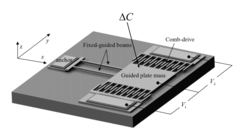
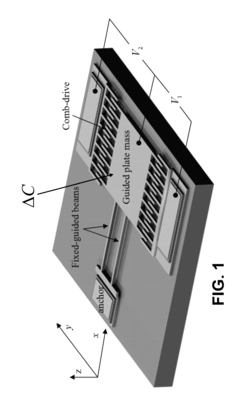
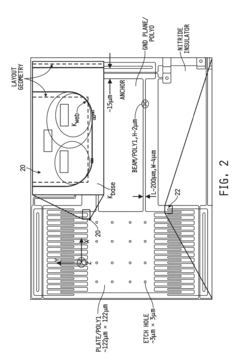
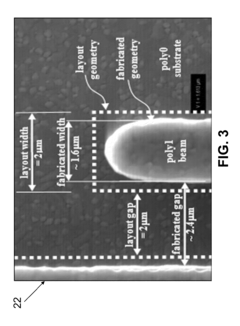
- The use of Electro Micro-Metrology (EMM) techniques, which leverage sensitive electrical-mechanical coupling to precisely measure and characterize geometric, dynamic, and material properties at the micro/nanoscale, allowing for the extraction of multiple properties with high accuracy and reliability, and enabling self-calibration of sensors and actuators.
Calibration Standards and Validation Protocols
Accurate particle size distribution measurement using Atomic Force Microscopy (AFM) requires robust calibration standards and validation protocols to ensure reliability and reproducibility. The National Institute of Standards and Technology (NIST) has developed certified reference materials specifically for AFM calibration, including silicon gratings with precisely defined pitch dimensions and gold nanoparticle standards with narrow size distributions. These standards provide traceability to SI units and serve as benchmarks for instrument performance verification.
Calibration procedures for AFM particle sizing typically follow a multi-step approach. Initially, the XYZ axes must be calibrated using traceable standards to establish dimensional accuracy. This involves scanning reference gratings with known dimensions and adjusting scaling factors to match the certified values. Tip characterization represents another critical calibration step, as tip geometry significantly influences measured particle dimensions through convolution effects. Blind reconstruction algorithms or direct imaging of the tip using specialized tip characterization structures can provide the necessary tip shape information.
Regular validation protocols should include measurement system analysis (MSA) techniques such as repeatability and reproducibility (R&R) studies. These assessments quantify measurement variation attributable to the instrument, operators, and environmental factors. Statistical process control methods help monitor system stability over time, with control charts tracking key performance metrics such as calibration factor drift and resolution parameters.
Interlaboratory comparison studies provide an external validation mechanism for AFM particle sizing capabilities. Participation in round-robin testing, where identical samples are measured across multiple laboratories, helps establish measurement uncertainty budgets and identify systematic errors. The results from such studies inform the development of standardized operating procedures that enhance measurement consistency across different instruments and operators.
Environmental factors significantly impact AFM measurement accuracy and must be controlled through specific protocols. Temperature stability within ±0.5°C is typically required, as thermal drift can introduce dimensional errors. Vibration isolation systems with performance verification procedures ensure mechanical stability during measurement. Humidity control protocols prevent sample-moisture interactions that could alter particle dimensions or adhesion properties.
Documentation requirements for validated AFM particle sizing include comprehensive calibration certificates, uncertainty budgets, and traceability chains. Each measurement should be accompanied by a statement of expanded uncertainty following the guidelines in the Guide to the Expression of Uncertainty in Measurement (GUM). This documentation enables meaningful comparison of results across different measurement campaigns and instruments, supporting reliable particle characterization for research and industrial applications.
Calibration procedures for AFM particle sizing typically follow a multi-step approach. Initially, the XYZ axes must be calibrated using traceable standards to establish dimensional accuracy. This involves scanning reference gratings with known dimensions and adjusting scaling factors to match the certified values. Tip characterization represents another critical calibration step, as tip geometry significantly influences measured particle dimensions through convolution effects. Blind reconstruction algorithms or direct imaging of the tip using specialized tip characterization structures can provide the necessary tip shape information.
Regular validation protocols should include measurement system analysis (MSA) techniques such as repeatability and reproducibility (R&R) studies. These assessments quantify measurement variation attributable to the instrument, operators, and environmental factors. Statistical process control methods help monitor system stability over time, with control charts tracking key performance metrics such as calibration factor drift and resolution parameters.
Interlaboratory comparison studies provide an external validation mechanism for AFM particle sizing capabilities. Participation in round-robin testing, where identical samples are measured across multiple laboratories, helps establish measurement uncertainty budgets and identify systematic errors. The results from such studies inform the development of standardized operating procedures that enhance measurement consistency across different instruments and operators.
Environmental factors significantly impact AFM measurement accuracy and must be controlled through specific protocols. Temperature stability within ±0.5°C is typically required, as thermal drift can introduce dimensional errors. Vibration isolation systems with performance verification procedures ensure mechanical stability during measurement. Humidity control protocols prevent sample-moisture interactions that could alter particle dimensions or adhesion properties.
Documentation requirements for validated AFM particle sizing include comprehensive calibration certificates, uncertainty budgets, and traceability chains. Each measurement should be accompanied by a statement of expanded uncertainty following the guidelines in the Guide to the Expression of Uncertainty in Measurement (GUM). This documentation enables meaningful comparison of results across different measurement campaigns and instruments, supporting reliable particle characterization for research and industrial applications.
Cross-Platform Comparison and Benchmarking
When evaluating the accuracy of particle size distribution measurements using Atomic Force Microscopy (AFM), it is essential to compare its performance against other established analytical techniques. AFM offers unique advantages in nanoscale characterization but must be validated through cross-platform benchmarking to ensure reliability and contextual understanding of its limitations.
Scanning Electron Microscopy (SEM) provides excellent lateral resolution for particle size analysis but lacks the vertical precision of AFM. Comparative studies have shown that while AFM excels at measuring particle heights with sub-nanometer accuracy, SEM typically offers faster acquisition times and larger sampling areas. This trade-off between precision and throughput must be considered when selecting the appropriate technique for specific applications.
Dynamic Light Scattering (DLS) remains the industry standard for rapid particle size distribution measurements in suspension. Benchmark studies comparing AFM and DLS reveal that AFM consistently provides more accurate measurements for polydisperse samples and non-spherical particles, where DLS assumptions about particle shape can introduce significant errors. However, DLS offers statistical advantages through its ability to analyze millions of particles simultaneously.
Transmission Electron Microscopy (TEM) provides complementary data to AFM measurements, particularly for internal structure characterization. Recent comparative analyses demonstrate that AFM and TEM measurements of the same nanoparticle populations typically show 5-15% variation in mean diameter values, with differences attributed to sample preparation artifacts and projection effects in TEM imaging.
Nanoparticle Tracking Analysis (NTA) offers real-time visualization of particles in suspension, providing both size and concentration data. Benchmarking studies indicate that AFM typically yields smaller mean particle sizes compared to NTA, primarily due to the dehydration effects during AFM sample preparation. This systematic difference must be accounted for when correlating measurements across platforms.
Standardized reference materials are crucial for meaningful cross-platform comparison. NIST traceable polystyrene latex spheres and gold nanoparticles have been widely used to establish calibration curves across different analytical platforms. These studies reveal that AFM typically achieves measurement uncertainties of 2-5% for well-defined reference materials, compared to 8-15% for ensemble techniques like DLS.
Multi-technique approaches combining AFM with complementary methods have emerged as best practice for comprehensive particle characterization. Statistical correlation between AFM and secondary validation techniques provides confidence in measurement accuracy and helps identify systematic errors. Integrated data analysis frameworks that combine inputs from multiple platforms offer the most robust approach to particle size distribution determination.
Scanning Electron Microscopy (SEM) provides excellent lateral resolution for particle size analysis but lacks the vertical precision of AFM. Comparative studies have shown that while AFM excels at measuring particle heights with sub-nanometer accuracy, SEM typically offers faster acquisition times and larger sampling areas. This trade-off between precision and throughput must be considered when selecting the appropriate technique for specific applications.
Dynamic Light Scattering (DLS) remains the industry standard for rapid particle size distribution measurements in suspension. Benchmark studies comparing AFM and DLS reveal that AFM consistently provides more accurate measurements for polydisperse samples and non-spherical particles, where DLS assumptions about particle shape can introduce significant errors. However, DLS offers statistical advantages through its ability to analyze millions of particles simultaneously.
Transmission Electron Microscopy (TEM) provides complementary data to AFM measurements, particularly for internal structure characterization. Recent comparative analyses demonstrate that AFM and TEM measurements of the same nanoparticle populations typically show 5-15% variation in mean diameter values, with differences attributed to sample preparation artifacts and projection effects in TEM imaging.
Nanoparticle Tracking Analysis (NTA) offers real-time visualization of particles in suspension, providing both size and concentration data. Benchmarking studies indicate that AFM typically yields smaller mean particle sizes compared to NTA, primarily due to the dehydration effects during AFM sample preparation. This systematic difference must be accounted for when correlating measurements across platforms.
Standardized reference materials are crucial for meaningful cross-platform comparison. NIST traceable polystyrene latex spheres and gold nanoparticles have been widely used to establish calibration curves across different analytical platforms. These studies reveal that AFM typically achieves measurement uncertainties of 2-5% for well-defined reference materials, compared to 8-15% for ensemble techniques like DLS.
Multi-technique approaches combining AFM with complementary methods have emerged as best practice for comprehensive particle characterization. Statistical correlation between AFM and secondary validation techniques provides confidence in measurement accuracy and helps identify systematic errors. Integrated data analysis frameworks that combine inputs from multiple platforms offer the most robust approach to particle size distribution determination.
Unlock deeper insights with PatSnap Eureka Quick Research — get a full tech report to explore trends and direct your research. Try now!
Generate Your Research Report Instantly with AI Agent
Supercharge your innovation with PatSnap Eureka AI Agent Platform!