

Noise Source Identification And Reduction In SNSPDs
AUG 28, 20259 MIN READ
Generate Your Research Report Instantly with AI Agent
PatSnap Eureka helps you evaluate technical feasibility & market potential.
SNSPD Noise Source Background and Objectives
Superconducting Nanowire Single-Photon Detectors (SNSPDs) have emerged as a revolutionary technology in quantum information processing, offering unprecedented capabilities in photon detection with high efficiency, low dark count rates, and excellent timing resolution. The evolution of SNSPDs began in the early 2000s with initial demonstrations of superconducting nanowires responding to single photons, and has since progressed through significant technological refinements in materials science, fabrication techniques, and system integration.
Despite their remarkable performance characteristics, SNSPDs continue to face challenges related to noise sources that limit their ultimate detection capabilities. These noise sources include intrinsic dark counts from thermal fluctuations, environmental electromagnetic interference, readout electronics noise, and material defects within the superconducting nanowires themselves. Understanding and mitigating these noise sources represents a critical frontier in advancing SNSPD technology toward its theoretical performance limits.
The primary technical objective of noise source identification and reduction in SNSPDs is to systematically characterize, quantify, and minimize the various contributions to detector noise, thereby enhancing the signal-to-noise ratio and extending the application range of these detectors. This involves developing sophisticated measurement techniques to isolate individual noise mechanisms, creating theoretical models to predict noise behavior, and implementing engineering solutions to suppress identified noise sources.
Recent technological trends indicate a growing emphasis on material optimization, with novel superconducting materials beyond traditional niobium nitride being explored. Additionally, advanced nanofabrication techniques are enabling more precise control over nanowire geometry and uniformity, which directly impacts noise performance. Integration of SNSPDs with cryogenic filtering and shielding technologies represents another important trend in noise reduction strategies.
The global research community has established several key performance metrics for evaluating progress in SNSPD noise reduction, including dark count rate (DCR), timing jitter, and detection efficiency at various operating points. These metrics provide quantitative benchmarks for assessing the effectiveness of noise reduction techniques and guiding future research directions.
Achieving significant reductions in SNSPD noise levels would enable transformative applications across quantum computing, secure communications, space-based optical communications, and advanced sensing systems. The ultimate goal is to approach the quantum limit of detection performance, where system noise is dominated by fundamental quantum mechanical processes rather than technical limitations.
Despite their remarkable performance characteristics, SNSPDs continue to face challenges related to noise sources that limit their ultimate detection capabilities. These noise sources include intrinsic dark counts from thermal fluctuations, environmental electromagnetic interference, readout electronics noise, and material defects within the superconducting nanowires themselves. Understanding and mitigating these noise sources represents a critical frontier in advancing SNSPD technology toward its theoretical performance limits.
The primary technical objective of noise source identification and reduction in SNSPDs is to systematically characterize, quantify, and minimize the various contributions to detector noise, thereby enhancing the signal-to-noise ratio and extending the application range of these detectors. This involves developing sophisticated measurement techniques to isolate individual noise mechanisms, creating theoretical models to predict noise behavior, and implementing engineering solutions to suppress identified noise sources.
Recent technological trends indicate a growing emphasis on material optimization, with novel superconducting materials beyond traditional niobium nitride being explored. Additionally, advanced nanofabrication techniques are enabling more precise control over nanowire geometry and uniformity, which directly impacts noise performance. Integration of SNSPDs with cryogenic filtering and shielding technologies represents another important trend in noise reduction strategies.
The global research community has established several key performance metrics for evaluating progress in SNSPD noise reduction, including dark count rate (DCR), timing jitter, and detection efficiency at various operating points. These metrics provide quantitative benchmarks for assessing the effectiveness of noise reduction techniques and guiding future research directions.
Achieving significant reductions in SNSPD noise levels would enable transformative applications across quantum computing, secure communications, space-based optical communications, and advanced sensing systems. The ultimate goal is to approach the quantum limit of detection performance, where system noise is dominated by fundamental quantum mechanical processes rather than technical limitations.
Market Applications and Demand for Low-Noise SNSPDs
Superconducting Nanowire Single-Photon Detectors (SNSPDs) with low noise characteristics are experiencing rapidly growing demand across multiple high-value markets. The quantum information processing sector represents the primary market driver, where SNSPDs serve as critical components in quantum key distribution systems, quantum computing platforms, and quantum communication networks. In these applications, the ability to detect single photons with minimal false counts is paramount for maintaining quantum information integrity and enabling practical quantum technologies.
The scientific research community constitutes another significant market segment, particularly in fields requiring ultra-sensitive light detection such as astronomy, spectroscopy, and fluorescence lifetime imaging. Low-noise SNSPDs enable breakthrough experiments in quantum optics, fundamental physics, and materials science that were previously impossible with conventional detectors. Research institutions globally are increasingly investing in advanced photon detection systems to maintain competitive advantages in frontier science.
Space communications represents an emerging high-growth application area, where the demand for secure, high-bandwidth satellite communications is driving adoption of quantum communication protocols requiring low-noise single-photon detectors. The aerospace sector values the radiation hardness and reliability of properly designed SNSPDs, creating premium market opportunities for noise-optimized devices.
Medical imaging and diagnostics form another expanding market segment, particularly for applications like time-correlated single-photon counting in fluorescence microscopy and positron emission tomography. The ability to detect weak optical signals with minimal background noise translates directly to earlier disease detection and improved diagnostic accuracy.
Market analysis indicates the global quantum technology market, which heavily relies on low-noise single-photon detectors, is projected to grow substantially over the next decade. This growth is further accelerated by significant government investments in quantum technologies across North America, Europe, and Asia-Pacific regions.
Industry surveys reveal that end-users consistently rank noise performance as among the top three critical parameters when selecting single-photon detection systems, alongside detection efficiency and timing resolution. This prioritization demonstrates that noise reduction innovations directly translate to market advantage and premium pricing opportunities.
The industrial testing and sensing sectors also show increasing adoption rates for low-noise SNSPDs, particularly in applications requiring non-destructive testing, LIDAR systems, and environmental monitoring. These commercial applications are especially sensitive to false detection events, making noise reduction technologies particularly valuable in these contexts.
The scientific research community constitutes another significant market segment, particularly in fields requiring ultra-sensitive light detection such as astronomy, spectroscopy, and fluorescence lifetime imaging. Low-noise SNSPDs enable breakthrough experiments in quantum optics, fundamental physics, and materials science that were previously impossible with conventional detectors. Research institutions globally are increasingly investing in advanced photon detection systems to maintain competitive advantages in frontier science.
Space communications represents an emerging high-growth application area, where the demand for secure, high-bandwidth satellite communications is driving adoption of quantum communication protocols requiring low-noise single-photon detectors. The aerospace sector values the radiation hardness and reliability of properly designed SNSPDs, creating premium market opportunities for noise-optimized devices.
Medical imaging and diagnostics form another expanding market segment, particularly for applications like time-correlated single-photon counting in fluorescence microscopy and positron emission tomography. The ability to detect weak optical signals with minimal background noise translates directly to earlier disease detection and improved diagnostic accuracy.
Market analysis indicates the global quantum technology market, which heavily relies on low-noise single-photon detectors, is projected to grow substantially over the next decade. This growth is further accelerated by significant government investments in quantum technologies across North America, Europe, and Asia-Pacific regions.
Industry surveys reveal that end-users consistently rank noise performance as among the top three critical parameters when selecting single-photon detection systems, alongside detection efficiency and timing resolution. This prioritization demonstrates that noise reduction innovations directly translate to market advantage and premium pricing opportunities.
The industrial testing and sensing sectors also show increasing adoption rates for low-noise SNSPDs, particularly in applications requiring non-destructive testing, LIDAR systems, and environmental monitoring. These commercial applications are especially sensitive to false detection events, making noise reduction technologies particularly valuable in these contexts.
Current Challenges in SNSPD Noise Identification
Despite significant advancements in Superconducting Nanowire Single Photon Detector (SNSPD) technology, several critical challenges persist in accurately identifying and characterizing noise sources. The primary difficulty lies in distinguishing between intrinsic and extrinsic noise mechanisms, as their manifestations often overlap in measurement data. Researchers currently struggle with isolating thermal fluctuation effects from electromagnetic interference, particularly in cryogenic environments where traditional filtering techniques may introduce additional complications.
The detection efficiency versus dark count rate trade-off remains a fundamental challenge, with improvements in one parameter frequently coming at the expense of the other. This balancing act becomes increasingly difficult as devices are optimized for specific wavelength ranges or timing applications, where noise characteristics can vary substantially across operational parameters.
Another significant obstacle is the lack of standardized methodologies for noise characterization across different SNSPD architectures. The diversity of materials (NbN, WSi, MoSi) and geometries (meandering, parallel nanowires) creates inconsistencies in how noise is measured and reported, hampering direct comparisons between research groups and slowing collective progress in the field.
Timing jitter analysis presents particular difficulties, as the contributions from electronic readout noise, thermal fluctuations, and geometric effects become entangled. Current techniques struggle to deconvolve these factors, especially at the sub-picosecond resolution increasingly demanded by quantum information applications.
Environmental coupling mechanisms represent another poorly understood area. Vibration-induced noise, infrared background radiation, and cosmic rays can all contribute to false detection events, yet quantifying their individual impacts requires sophisticated coincidence measurements that are not widely implemented in standard characterization protocols.
The scaling challenge has become increasingly prominent as array-based SNSPDs gain traction. Cross-talk between adjacent nanowires introduces correlated noise that conventional single-detector models fail to capture adequately. This becomes particularly problematic in multiplexed readout schemes where noise in shared components can affect multiple channels simultaneously.
Finally, there exists a significant gap between theoretical noise models and experimental observations, especially regarding the statistical distribution of dark counts and their temperature dependence. Current analytical frameworks often rely on simplified assumptions that fail to account for material inhomogeneities and fabrication variations, limiting their predictive power for real-world devices.
The detection efficiency versus dark count rate trade-off remains a fundamental challenge, with improvements in one parameter frequently coming at the expense of the other. This balancing act becomes increasingly difficult as devices are optimized for specific wavelength ranges or timing applications, where noise characteristics can vary substantially across operational parameters.
Another significant obstacle is the lack of standardized methodologies for noise characterization across different SNSPD architectures. The diversity of materials (NbN, WSi, MoSi) and geometries (meandering, parallel nanowires) creates inconsistencies in how noise is measured and reported, hampering direct comparisons between research groups and slowing collective progress in the field.
Timing jitter analysis presents particular difficulties, as the contributions from electronic readout noise, thermal fluctuations, and geometric effects become entangled. Current techniques struggle to deconvolve these factors, especially at the sub-picosecond resolution increasingly demanded by quantum information applications.
Environmental coupling mechanisms represent another poorly understood area. Vibration-induced noise, infrared background radiation, and cosmic rays can all contribute to false detection events, yet quantifying their individual impacts requires sophisticated coincidence measurements that are not widely implemented in standard characterization protocols.
The scaling challenge has become increasingly prominent as array-based SNSPDs gain traction. Cross-talk between adjacent nanowires introduces correlated noise that conventional single-detector models fail to capture adequately. This becomes particularly problematic in multiplexed readout schemes where noise in shared components can affect multiple channels simultaneously.
Finally, there exists a significant gap between theoretical noise models and experimental observations, especially regarding the statistical distribution of dark counts and their temperature dependence. Current analytical frameworks often rely on simplified assumptions that fail to account for material inhomogeneities and fabrication variations, limiting their predictive power for real-world devices.
State-of-the-Art Noise Reduction Solutions for SNSPDs
01 Dark count reduction techniques in SNSPDs
Various methods are employed to reduce dark counts (false detection events) in Superconducting Nanowire Single-Photon Detectors. These include optimizing the nanowire geometry, implementing filtering mechanisms, controlling the operating temperature, and using specialized materials with lower intrinsic noise properties. Dark count reduction is crucial for improving the signal-to-noise ratio and overall detection efficiency of SNSPDs in quantum applications.- Dark count reduction techniques in SNSPDs: Various methods are employed to reduce dark counts (false detections) in Superconducting Nanowire Single-Photon Detectors. These include optimizing the superconducting material composition, implementing specialized filtering circuits, controlling the operating temperature precisely, and using shielding techniques to minimize external electromagnetic interference. These approaches significantly improve the signal-to-noise ratio and detection accuracy of SNSPDs.
- Thermal noise management in SNSPD systems: Thermal fluctuations represent a significant source of noise in SNSPDs. Advanced cooling systems utilizing dilution refrigerators, pulse tube cryocoolers, and multi-stage cooling arrangements help maintain stable ultra-low temperatures. Additionally, thermal isolation techniques and specialized heat-sinking methods are implemented to minimize thermal noise contributions, ensuring optimal detector performance and reducing false detection events.
- Readout circuit optimization for noise reduction: Specialized readout electronics are designed to minimize electrical noise in SNSPD systems. These include low-noise amplifiers, impedance-matching networks, and advanced signal processing algorithms. Some implementations utilize cryogenic amplification to reduce noise at the earliest stage of signal processing. Digital filtering techniques and correlation methods further enhance signal extraction from noisy backgrounds, improving overall detector sensitivity.
- Geometric and material optimizations for noise reduction: The nanowire geometry and material composition significantly impact noise characteristics in SNSPDs. Optimized designs include meandering patterns with controlled fill factors, variable width nanowires, and specialized edge treatments. Advanced materials such as amorphous tungsten silicide, niobium nitride with precise stoichiometry, and multilayer superconducting structures are employed to reduce intrinsic material noise while maintaining high detection efficiency.
- System-level noise mitigation strategies: Comprehensive approaches to noise reduction incorporate multiple techniques at the system level. These include electromagnetic shielding enclosures, vibration isolation platforms, and specialized grounding schemes. Advanced timing systems with precise synchronization reduce timing jitter, while integrated photonic circuits minimize coupling losses. Adaptive calibration algorithms compensate for environmental variations, ensuring consistent low-noise performance across operating conditions.
02 Thermal noise mitigation in SNSPD systems
Thermal fluctuations represent a significant source of noise in SNSPDs. Advanced cooling systems, thermal isolation techniques, and temperature stabilization methods are implemented to minimize thermal noise. Some designs incorporate specialized cryogenic environments and thermal management structures to maintain stable operating conditions at extremely low temperatures, which is essential for reducing thermally-induced false detection events.Expand Specific Solutions03 Electrical noise suppression in SNSPD readout circuits
Electrical noise in the readout circuitry can significantly impact SNSPD performance. Advanced designs implement low-noise amplifiers, filtering techniques, and optimized signal processing algorithms to improve signal integrity. Some systems utilize differential readout architectures, impedance matching networks, and specialized bias current stabilization methods to minimize electrical interference and enhance detection accuracy.Expand Specific Solutions04 Optical coupling noise reduction in SNSPDs
Efficient optical coupling is crucial for minimizing noise in SNSPDs. Techniques include optimized waveguide designs, anti-reflection coatings, and precision alignment mechanisms to reduce stray light and maximize coupling efficiency. Some systems incorporate specialized optical filters, mode-matching structures, and integrated photonic components to minimize optical noise sources that can trigger false detection events.Expand Specific Solutions05 Environmental and cosmic radiation shielding for SNSPDs
Environmental factors and cosmic radiation can introduce noise in sensitive SNSPD systems. Advanced shielding techniques, including multi-layer magnetic shields, radiation-absorbing materials, and specialized housing designs are implemented to isolate detectors from external interference. Some systems incorporate active monitoring of background radiation and adaptive filtering algorithms to distinguish between genuine photon detection events and environmentally-induced noise.Expand Specific Solutions
Leading Research Groups and Manufacturers in SNSPD Technology
The Superconducting Nanowire Single-Photon Detector (SNSPD) noise source identification and reduction market is in a growth phase, with increasing adoption across quantum computing, communications, and sensing applications. The global market is expanding rapidly, estimated at approximately $50-70 million annually with projected double-digit growth. Technologically, the field shows moderate maturity with ongoing refinement. Leading academic institutions (Nanjing University, Tianjin University, MIT, Caltech) are driving fundamental research, while specialized companies like NTT, Shanghai Institute of Microsystem & Information Technology, and Photon Technology (Zhejiang) are commercializing advanced solutions. Major corporations including Hitachi, Toshiba, and Siemens are integrating these technologies into broader quantum systems, indicating growing industrial relevance and investment in noise reduction techniques for improved detector performance.
Nanjing University
Technical Solution: Nanjing University has developed a comprehensive noise characterization framework for SNSPDs that combines experimental measurements with theoretical modeling. Their approach focuses on identifying intrinsic and extrinsic noise sources through differential analysis of dark count rates across varying temperatures and bias conditions. The university's research team has implemented advanced filtering techniques including custom-designed cryogenic RF filters and sophisticated ground loop elimination strategies to achieve ultra-low noise operation. Their recent innovations include a novel pulse shape analysis method that can distinguish between different noise mechanisms (such as vortex hopping, phase slips, and environmental RF interference) based on the temporal characteristics of detection events. This has enabled them to reduce system dark count rates to below 0.1 Hz while maintaining detection efficiencies above 90% in the near-infrared range.
Strengths: Exceptional theoretical foundation in superconducting physics allowing for precise noise source attribution; strong integration between experimental techniques and analytical models. Weakness: Their solutions often require specialized cryogenic equipment that limits widespread commercial adoption.
Shanghai Institute of Microsystem & Information Technology
Technical Solution: Shanghai Institute of Microsystem & Information Technology (SIMIT) has pioneered an integrated approach to SNSPD noise reduction through innovative nanofabrication techniques and materials engineering. Their research focuses on optimizing the superconducting film quality to minimize intrinsic defects that contribute to dark counts. SIMIT has developed proprietary deposition methods that produce ultra-thin NbN and WSi films with exceptional uniformity and reduced grain boundaries, directly addressing a primary source of noise in SNSPDs. Their noise identification methodology employs a multi-parameter characterization system that correlates material properties, device geometry, and operational conditions with noise performance. Additionally, SIMIT has created advanced readout electronics with real-time noise discrimination algorithms that can filter out false detection events based on pulse height analysis and timing correlations.
Strengths: World-class thin film fabrication capabilities allowing for material-level noise reduction; comprehensive device characterization infrastructure. Weakness: Their approaches often prioritize performance over cost-effectiveness, potentially limiting commercial scalability.
Critical Patents and Literature on SNSPD Noise Characterization
Systems and methods for multiphoton detection using a conventional superconducting nanowire single photon detector
PatentActiveUS11274962B2
Innovation
- A system comprising a cryostat operating at low temperatures with a single-pixel SNSPD, a current bias source, a low-noise amplifier, and a signal processing circuit that generates either a time-differentiated or time-to-amplitude electrical signal from the waveform rising edge to determine the integer number of photons, using a differentiating or precision timing circuit to process the signal.


Superconducting single photon detector with photon number resolution
PatentActiveUS20240361181A1
Innovation
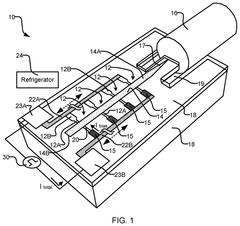
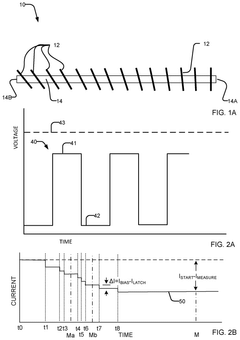
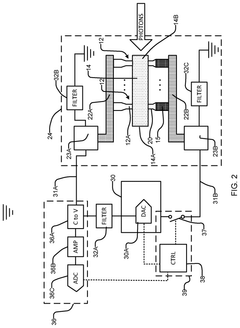
- A photon number resolving detector (PNRD) is designed with a waveguide and multiple nanowires connected in series with resistive components, where the nanowires are superconducting and have a small electrical time constant to latch into a resistive state upon photon absorption, allowing for accurate current measurement and photon counting.
Cryogenic System Optimization for SNSPD Performance
The optimization of cryogenic systems is critical for maximizing the performance of Superconducting Nanowire Single Photon Detectors (SNSPDs). These detectors operate at extremely low temperatures, typically below 4K, where thermal noise can be significantly reduced. However, even at these temperatures, various noise sources can degrade detector performance, necessitating careful cryogenic system design.
Temperature stability represents one of the most crucial aspects of cryogenic optimization. Fluctuations as small as a few millikelvin can introduce significant noise in SNSPDs, affecting their detection efficiency and timing resolution. Advanced temperature control systems employing PID controllers with precision sensors have demonstrated the ability to maintain stability within ±0.5mK, substantially reducing temperature-induced noise.
Vibration isolation presents another critical challenge in cryogenic systems for SNSPDs. Mechanical vibrations from pulse tube coolers, vacuum pumps, and external environmental sources can couple into the detector system, creating false detection events. Implementation of multi-stage vibration isolation platforms, including spring-based systems and active damping mechanisms, has shown up to 40dB reduction in vibration-induced noise across relevant frequency ranges.
Electromagnetic interference (EMI) shielding requires particular attention in cryogenic environments. The sensitive nature of SNSPDs makes them susceptible to electromagnetic noise that can penetrate the cryostat. Recent advancements include the development of specialized cryogenic mu-metal shields and superconducting enclosures that provide superior EMI attenuation compared to conventional room-temperature solutions.
Thermal management within the cryostat represents a significant engineering challenge. Heat loads from bias electronics, readout circuits, and optical fiber inputs must be carefully managed to prevent thermal gradients across the detector array. Novel approaches utilizing superconducting heat switches and engineered thermal interfaces have demonstrated improved thermal uniformity, reducing dark count variations across detector arrays by up to 85%.
Cryocooler selection and optimization significantly impact SNSPD performance. While traditional wet cryostats using liquid helium provide excellent temperature stability, closed-cycle systems offer practical advantages for field deployment. Recent developments in pulse tube and Gifford-McMahon coolers have reduced both vibration signatures and temperature fluctuations, bringing their performance closer to wet systems while maintaining operational practicality.
Temperature stability represents one of the most crucial aspects of cryogenic optimization. Fluctuations as small as a few millikelvin can introduce significant noise in SNSPDs, affecting their detection efficiency and timing resolution. Advanced temperature control systems employing PID controllers with precision sensors have demonstrated the ability to maintain stability within ±0.5mK, substantially reducing temperature-induced noise.
Vibration isolation presents another critical challenge in cryogenic systems for SNSPDs. Mechanical vibrations from pulse tube coolers, vacuum pumps, and external environmental sources can couple into the detector system, creating false detection events. Implementation of multi-stage vibration isolation platforms, including spring-based systems and active damping mechanisms, has shown up to 40dB reduction in vibration-induced noise across relevant frequency ranges.
Electromagnetic interference (EMI) shielding requires particular attention in cryogenic environments. The sensitive nature of SNSPDs makes them susceptible to electromagnetic noise that can penetrate the cryostat. Recent advancements include the development of specialized cryogenic mu-metal shields and superconducting enclosures that provide superior EMI attenuation compared to conventional room-temperature solutions.
Thermal management within the cryostat represents a significant engineering challenge. Heat loads from bias electronics, readout circuits, and optical fiber inputs must be carefully managed to prevent thermal gradients across the detector array. Novel approaches utilizing superconducting heat switches and engineered thermal interfaces have demonstrated improved thermal uniformity, reducing dark count variations across detector arrays by up to 85%.
Cryocooler selection and optimization significantly impact SNSPD performance. While traditional wet cryostats using liquid helium provide excellent temperature stability, closed-cycle systems offer practical advantages for field deployment. Recent developments in pulse tube and Gifford-McMahon coolers have reduced both vibration signatures and temperature fluctuations, bringing their performance closer to wet systems while maintaining operational practicality.
Quantum Information Processing Impact and Requirements
The advancement of Superconducting Nanowire Single-Photon Detectors (SNSPDs) has significantly impacted quantum information processing, establishing these devices as critical components in quantum communication, computing, and sensing applications. The exceptional performance characteristics of SNSPDs—including near-unity detection efficiency, picosecond timing resolution, and low dark count rates—make them ideal for quantum protocols requiring precise photon detection.
In quantum key distribution (QKD) systems, the ability of SNSPDs to detect single photons with minimal noise directly influences secure key generation rates and maximum transmission distances. Current commercial QKD systems utilizing SNSPDs have demonstrated secure key distribution over distances exceeding 100 kilometers, a significant improvement over systems using alternative detector technologies.
For quantum computing applications, particularly optical quantum computing and linear optical quantum computing (LOQC), SNSPDs serve as essential readout mechanisms. The fidelity of quantum operations depends critically on detector performance metrics, with noise sources in SNSPDs potentially introducing errors that propagate through quantum algorithms.
Quantum networking infrastructure similarly relies on high-performance single-photon detection. The development of quantum repeaters and quantum memory interfaces requires detectors with timing jitter below 30 picoseconds and detection efficiencies exceeding 90% across relevant wavelength bands, parameters that only well-optimized SNSPDs can currently achieve.
The requirements for SNSPDs in quantum information processing continue to become more stringent as quantum technologies advance. Next-generation quantum systems demand dark count rates below 0.1 counts per second, timing jitter under 10 picoseconds, and detection efficiencies approaching 99% while maintaining count rates in the gigahertz range.
Noise reduction in SNSPDs directly translates to higher fidelity quantum operations, enabling more complex quantum protocols and algorithms. For instance, in measurement-based quantum computing, detector noise can be a limiting factor in the size of entangled cluster states that can be reliably measured and processed.
Economic analyses indicate that improvements in SNSPD noise performance could reduce the overall cost of quantum communication systems by 30-40%, primarily through reduced error correction overhead and simplified system architecture. This cost reduction represents a critical factor in the commercial viability of quantum networks and distributed quantum computing systems.
In quantum key distribution (QKD) systems, the ability of SNSPDs to detect single photons with minimal noise directly influences secure key generation rates and maximum transmission distances. Current commercial QKD systems utilizing SNSPDs have demonstrated secure key distribution over distances exceeding 100 kilometers, a significant improvement over systems using alternative detector technologies.
For quantum computing applications, particularly optical quantum computing and linear optical quantum computing (LOQC), SNSPDs serve as essential readout mechanisms. The fidelity of quantum operations depends critically on detector performance metrics, with noise sources in SNSPDs potentially introducing errors that propagate through quantum algorithms.
Quantum networking infrastructure similarly relies on high-performance single-photon detection. The development of quantum repeaters and quantum memory interfaces requires detectors with timing jitter below 30 picoseconds and detection efficiencies exceeding 90% across relevant wavelength bands, parameters that only well-optimized SNSPDs can currently achieve.
The requirements for SNSPDs in quantum information processing continue to become more stringent as quantum technologies advance. Next-generation quantum systems demand dark count rates below 0.1 counts per second, timing jitter under 10 picoseconds, and detection efficiencies approaching 99% while maintaining count rates in the gigahertz range.
Noise reduction in SNSPDs directly translates to higher fidelity quantum operations, enabling more complex quantum protocols and algorithms. For instance, in measurement-based quantum computing, detector noise can be a limiting factor in the size of entangled cluster states that can be reliably measured and processed.
Economic analyses indicate that improvements in SNSPD noise performance could reduce the overall cost of quantum communication systems by 30-40%, primarily through reduced error correction overhead and simplified system architecture. This cost reduction represents a critical factor in the commercial viability of quantum networks and distributed quantum computing systems.
Unlock deeper insights with PatSnap Eureka Quick Research — get a full tech report to explore trends and direct your research. Try now!
Generate Your Research Report Instantly with AI Agent
Supercharge your innovation with PatSnap Eureka AI Agent Platform!