SNSPD Photolithography Challenges And Solutions
AUG 28, 202510 MIN READ
Generate Your Research Report Instantly with AI Agent
PatSnap Eureka helps you evaluate technical feasibility & market potential.
SNSPD Technology Background and Objectives
Superconducting Nanowire Single Photon Detectors (SNSPDs) have emerged as revolutionary devices in quantum information processing, quantum communication, and astronomical observation due to their exceptional detection efficiency, low dark count rates, and picosecond-level timing resolution. The evolution of SNSPD technology began in the early 2000s with the pioneering work at Moscow State Pedagogical University, where researchers first demonstrated the potential of superconducting nanowires for single-photon detection.
The fundamental operating principle of SNSPDs relies on the transition of a superconducting nanowire from superconducting to normal state when absorbing a single photon. This transition creates a measurable voltage pulse, enabling photon detection with remarkable sensitivity. Over the past two decades, significant advancements have been made in materials science, fabrication techniques, and system integration, pushing the boundaries of what these detectors can achieve.
The technological trajectory of SNSPDs has been characterized by continuous improvements in detection efficiency, from initial values below 10% to current state-of-the-art devices exceeding 98% efficiency. Concurrently, timing jitter has been reduced from several hundred picoseconds to below 10 picoseconds, enabling unprecedented temporal resolution in photon detection applications.
Photolithography represents a critical fabrication step in SNSPD production, directly impacting device performance and yield. As SNSPDs require nanowires with widths typically between 50-100 nm and thicknesses of only 4-10 nm, the precision of photolithographic processes becomes paramount. The evolution of these processes has been closely tied to advancements in semiconductor manufacturing technologies, though with specific adaptations for superconducting materials.
The primary technical objectives in SNSPD photolithography include achieving consistent sub-100 nm feature sizes, maintaining uniform nanowire widths across large areas, ensuring precise pattern transfer without damaging the ultrathin superconducting films, and developing processes compatible with various substrate materials including silicon, sapphire, and optical fibers.
Current research aims to overcome several key challenges: reducing line edge roughness that can create hotspots and degrade detector performance, developing multi-layer lithography techniques for complex SNSPD architectures, and scaling up fabrication processes to enable larger detector arrays while maintaining uniformity and yield. Additionally, there is growing interest in developing lithography solutions that can accommodate novel superconducting materials beyond the traditional niobium nitride, such as WSi, MoSi, and NbTiN, each presenting unique processing requirements.
The technological roadmap for SNSPD photolithography is increasingly focused on enabling next-generation applications, including integrated photonic circuits, large-scale detector arrays for imaging applications, and specialized geometries optimized for specific wavelength ranges from visible to mid-infrared.
The fundamental operating principle of SNSPDs relies on the transition of a superconducting nanowire from superconducting to normal state when absorbing a single photon. This transition creates a measurable voltage pulse, enabling photon detection with remarkable sensitivity. Over the past two decades, significant advancements have been made in materials science, fabrication techniques, and system integration, pushing the boundaries of what these detectors can achieve.
The technological trajectory of SNSPDs has been characterized by continuous improvements in detection efficiency, from initial values below 10% to current state-of-the-art devices exceeding 98% efficiency. Concurrently, timing jitter has been reduced from several hundred picoseconds to below 10 picoseconds, enabling unprecedented temporal resolution in photon detection applications.
Photolithography represents a critical fabrication step in SNSPD production, directly impacting device performance and yield. As SNSPDs require nanowires with widths typically between 50-100 nm and thicknesses of only 4-10 nm, the precision of photolithographic processes becomes paramount. The evolution of these processes has been closely tied to advancements in semiconductor manufacturing technologies, though with specific adaptations for superconducting materials.
The primary technical objectives in SNSPD photolithography include achieving consistent sub-100 nm feature sizes, maintaining uniform nanowire widths across large areas, ensuring precise pattern transfer without damaging the ultrathin superconducting films, and developing processes compatible with various substrate materials including silicon, sapphire, and optical fibers.
Current research aims to overcome several key challenges: reducing line edge roughness that can create hotspots and degrade detector performance, developing multi-layer lithography techniques for complex SNSPD architectures, and scaling up fabrication processes to enable larger detector arrays while maintaining uniformity and yield. Additionally, there is growing interest in developing lithography solutions that can accommodate novel superconducting materials beyond the traditional niobium nitride, such as WSi, MoSi, and NbTiN, each presenting unique processing requirements.
The technological roadmap for SNSPD photolithography is increasingly focused on enabling next-generation applications, including integrated photonic circuits, large-scale detector arrays for imaging applications, and specialized geometries optimized for specific wavelength ranges from visible to mid-infrared.
Market Applications and Demand Analysis for SNSPD
The market for Superconducting Nanowire Single Photon Detectors (SNSPDs) has experienced significant growth in recent years, driven by increasing demands across multiple high-tech sectors. Quantum information processing represents the most prominent application area, with quantum computing, quantum key distribution (QKD), and quantum communications requiring ultra-sensitive photon detection capabilities that only SNSPDs can reliably provide. The global quantum technology market, where SNSPDs play a critical role, is projected to reach $32 billion by 2030, with an annual growth rate exceeding 25%.
In scientific research applications, SNSPDs have become essential tools for advanced spectroscopy, fluorescence lifetime measurements, and quantum optics experiments. Research institutions worldwide are increasingly adopting these detectors for their superior timing resolution and detection efficiency, creating a steady demand in the academic and R&D sectors.
The telecommunications industry represents another significant market for SNSPDs, particularly in secure communications infrastructure. As cyber threats continue to evolve, quantum-secure communication systems utilizing SNSPDs for photon detection are gaining traction among government agencies, financial institutions, and critical infrastructure operators. This segment is expected to grow at 30% annually over the next five years.
Space and defense applications constitute an emerging but rapidly expanding market for SNSPDs. Space-based quantum communications, deep-space optical communications, and advanced LIDAR systems for defense applications all benefit from the exceptional sensitivity and low noise characteristics of these detectors. Several space agencies have initiated programs incorporating SNSPD technology, with projected investments of $500 million through 2028.
Medical imaging and diagnostics represent a promising future application area, where SNSPDs could enable breakthrough capabilities in non-invasive imaging techniques. Early research suggests potential applications in next-generation PET scanners and advanced microscopy systems, though commercial deployment remains several years away.
Market analysis indicates that while current SNSPD adoption is constrained by manufacturing challenges and high costs, demand consistently exceeds supply. The primary market barrier remains the complex photolithography processes required for fabrication, which directly impacts production yields and final device costs. Industry surveys indicate that a 50% reduction in manufacturing costs could potentially triple the addressable market within three years.
Regional analysis shows North America leading in SNSPD adoption (45% market share), followed by Europe (30%) and Asia-Pacific (20%), with the latter showing the fastest growth rate. This distribution closely follows quantum technology research investment patterns globally.
In scientific research applications, SNSPDs have become essential tools for advanced spectroscopy, fluorescence lifetime measurements, and quantum optics experiments. Research institutions worldwide are increasingly adopting these detectors for their superior timing resolution and detection efficiency, creating a steady demand in the academic and R&D sectors.
The telecommunications industry represents another significant market for SNSPDs, particularly in secure communications infrastructure. As cyber threats continue to evolve, quantum-secure communication systems utilizing SNSPDs for photon detection are gaining traction among government agencies, financial institutions, and critical infrastructure operators. This segment is expected to grow at 30% annually over the next five years.
Space and defense applications constitute an emerging but rapidly expanding market for SNSPDs. Space-based quantum communications, deep-space optical communications, and advanced LIDAR systems for defense applications all benefit from the exceptional sensitivity and low noise characteristics of these detectors. Several space agencies have initiated programs incorporating SNSPD technology, with projected investments of $500 million through 2028.
Medical imaging and diagnostics represent a promising future application area, where SNSPDs could enable breakthrough capabilities in non-invasive imaging techniques. Early research suggests potential applications in next-generation PET scanners and advanced microscopy systems, though commercial deployment remains several years away.
Market analysis indicates that while current SNSPD adoption is constrained by manufacturing challenges and high costs, demand consistently exceeds supply. The primary market barrier remains the complex photolithography processes required for fabrication, which directly impacts production yields and final device costs. Industry surveys indicate that a 50% reduction in manufacturing costs could potentially triple the addressable market within three years.
Regional analysis shows North America leading in SNSPD adoption (45% market share), followed by Europe (30%) and Asia-Pacific (20%), with the latter showing the fastest growth rate. This distribution closely follows quantum technology research investment patterns globally.
Current Photolithography Challenges in SNSPD Fabrication
Superconducting Nanowire Single-Photon Detectors (SNSPDs) fabrication faces significant photolithography challenges due to their nanoscale dimensions and stringent performance requirements. The primary challenge lies in achieving ultra-narrow nanowire widths, typically between 30-100nm, which pushes conventional photolithography techniques to their limits. These narrow dimensions are crucial for optimizing detection efficiency and minimizing dark count rates in SNSPDs.
Resolution limitations represent a fundamental obstacle in SNSPD fabrication. While electron beam lithography (EBL) offers superior resolution compared to optical lithography, it suffers from low throughput and high cost, making it less suitable for large-scale production. Advanced optical lithography techniques such as deep ultraviolet (DUV) and extreme ultraviolet (EUV) lithography can potentially address these limitations but require substantial capital investment and specialized expertise.
Pattern fidelity and line edge roughness (LER) significantly impact SNSPD performance. Even minor variations in nanowire width can lead to localized constrictions that become weak points in the superconducting film, causing premature switching and degraded detector performance. Achieving consistent pattern transfer with minimal LER remains a persistent challenge, particularly for meandering nanowire geometries that maximize the active area while maintaining the required nanowire dimensions.
Material compatibility issues further complicate the photolithography process. The ultrathin superconducting films used in SNSPDs, typically 4-10nm thick NbN, NbTiN, or WSi, are highly sensitive to processing conditions. Resist residues, chemical interactions during development, and plasma etching can degrade the superconducting properties of these materials, necessitating carefully optimized lithography processes that preserve film quality.
Alignment precision presents another critical challenge, especially for multi-layer devices incorporating optical cavities, waveguides, or readout circuits. Sub-micron alignment accuracy is essential to ensure proper coupling between the nanowire and optical structures, requiring sophisticated alignment systems and strategies to compensate for thermal drift and mechanical instabilities during the fabrication process.
Scalability and reproducibility concerns become increasingly prominent as SNSPD technology transitions from laboratory demonstrations to commercial applications. Current fabrication approaches often rely on time-consuming serial processes with limited throughput, creating a bottleneck for wider adoption. Developing parallel processing techniques while maintaining nanometer-scale precision represents a significant challenge for the field.
Environmental control during photolithography is particularly crucial for SNSPDs. Particulate contamination, temperature fluctuations, and humidity variations can all introduce defects in the nanowire pattern, potentially creating hotspots or dead regions in the detector. Class 10 or better cleanroom environments with stringent environmental controls are typically required to achieve acceptable yield rates.
Resolution limitations represent a fundamental obstacle in SNSPD fabrication. While electron beam lithography (EBL) offers superior resolution compared to optical lithography, it suffers from low throughput and high cost, making it less suitable for large-scale production. Advanced optical lithography techniques such as deep ultraviolet (DUV) and extreme ultraviolet (EUV) lithography can potentially address these limitations but require substantial capital investment and specialized expertise.
Pattern fidelity and line edge roughness (LER) significantly impact SNSPD performance. Even minor variations in nanowire width can lead to localized constrictions that become weak points in the superconducting film, causing premature switching and degraded detector performance. Achieving consistent pattern transfer with minimal LER remains a persistent challenge, particularly for meandering nanowire geometries that maximize the active area while maintaining the required nanowire dimensions.
Material compatibility issues further complicate the photolithography process. The ultrathin superconducting films used in SNSPDs, typically 4-10nm thick NbN, NbTiN, or WSi, are highly sensitive to processing conditions. Resist residues, chemical interactions during development, and plasma etching can degrade the superconducting properties of these materials, necessitating carefully optimized lithography processes that preserve film quality.
Alignment precision presents another critical challenge, especially for multi-layer devices incorporating optical cavities, waveguides, or readout circuits. Sub-micron alignment accuracy is essential to ensure proper coupling between the nanowire and optical structures, requiring sophisticated alignment systems and strategies to compensate for thermal drift and mechanical instabilities during the fabrication process.
Scalability and reproducibility concerns become increasingly prominent as SNSPD technology transitions from laboratory demonstrations to commercial applications. Current fabrication approaches often rely on time-consuming serial processes with limited throughput, creating a bottleneck for wider adoption. Developing parallel processing techniques while maintaining nanometer-scale precision represents a significant challenge for the field.
Environmental control during photolithography is particularly crucial for SNSPDs. Particulate contamination, temperature fluctuations, and humidity variations can all introduce defects in the nanowire pattern, potentially creating hotspots or dead regions in the detector. Class 10 or better cleanroom environments with stringent environmental controls are typically required to achieve acceptable yield rates.
Current Photolithography Solutions for SNSPD Fabrication
01 Nanowire patterning and fabrication challenges
Fabrication of superconducting nanowires for SNSPDs faces significant photolithography challenges due to the extremely small dimensions required. The process involves precise patterning of nanowires with widths typically in the range of 50-100nm. Challenges include achieving uniform linewidth, maintaining consistent film thickness, and ensuring proper adhesion to substrates. Advanced lithography techniques such as electron beam lithography are often required to achieve the necessary resolution for optimal detector performance.- Nanowire patterning and fabrication challenges: Fabrication of superconducting nanowires for SNSPDs faces significant photolithography challenges due to the extremely small dimensions required. The nanowires typically need to be patterned with widths of 50-100nm while maintaining uniform thickness and smooth edges. Advanced lithography techniques such as electron beam lithography are often employed to achieve the necessary resolution. The fabrication process must carefully control parameters to prevent defects that could create hotspots or weak links in the nanowire, which would degrade detector performance.
- Superconducting material deposition and etching issues: The deposition and etching of superconducting thin films present significant challenges in SNSPD fabrication. Materials such as niobium nitride (NbN), niobium titanium nitride (NbTiN), or tungsten silicide (WSi) must be deposited with precise thickness control (typically 4-10nm) while maintaining superconducting properties. The etching process must preserve the integrity of these ultrathin films while achieving clean, vertical sidewalls. Reactive ion etching parameters must be carefully optimized to prevent damage to the superconducting properties while achieving the desired nanowire geometry.
- Substrate and interface optimization: The choice of substrate and optimization of interfaces are critical challenges in SNSPD photolithography. Substrates must have extremely low roughness and high optical quality to minimize scattering and absorption losses. Common substrates include sapphire, silicon, and silicon dioxide. The interface between the superconducting nanowire and substrate affects the detector's efficiency and timing performance. Adhesion layers and buffer layers must be carefully designed to maintain superconducting properties while ensuring mechanical stability of the nanowires during fabrication and operation.
- Optical coupling and cavity integration challenges: Integrating SNSPDs with optical components presents significant photolithography challenges. To maximize photon absorption efficiency, SNSPDs often require optical cavities, anti-reflection coatings, or waveguide coupling structures. These additional elements must be precisely aligned with the nanowires during fabrication. The photolithography process must accommodate multiple material layers with different etching requirements while maintaining precise registration between layers. The optical structures must be designed to enhance absorption at the target wavelength while preserving the superconducting properties of the nanowires.
- Scalability and yield improvement techniques: Scaling up SNSPD fabrication while maintaining high yield presents significant photolithography challenges. As detector arrays grow larger, maintaining uniformity across the entire chip becomes increasingly difficult. Advanced techniques such as proximity effect correction in electron beam lithography and optimized process recipes are essential. Yield improvement strategies include implementing redundant structures, developing in-process testing methods, and creating fault-tolerant designs. The photolithography process must be optimized to minimize defects that could create non-functional pixels in large arrays.
02 Material deposition and thin film quality control
The quality of superconducting thin films is critical for SNSPD performance. Photolithography challenges arise in maintaining consistent film properties during deposition and subsequent processing steps. Issues include controlling film thickness uniformity, minimizing contamination, and preserving superconducting properties throughout the fabrication process. The choice of superconducting materials (such as NbN, NbTiN, or WSi) and deposition methods significantly impacts the detector's quantum efficiency and timing resolution.Expand Specific Solutions03 Multi-layer integration and alignment precision
SNSPDs often require integration with optical structures or readout electronics, necessitating precise alignment between multiple lithography layers. Challenges include achieving accurate registration between nanowire patterns and optical coupling structures, minimizing misalignment errors, and ensuring proper electrical connections. The integration of superconducting nanowires with waveguides, optical cavities, or other photonic structures requires nanometer-scale alignment precision to maximize photon coupling efficiency.Expand Specific Solutions04 Etching and pattern transfer techniques
Transferring nanowire patterns from resist to superconducting films presents significant challenges in SNSPD fabrication. Etching processes must be carefully controlled to maintain critical dimensions while avoiding damage to the superconducting properties. Challenges include minimizing sidewall roughness, preventing undercut or overetch, and selecting appropriate etch chemistries that preserve material quality. Reactive ion etching and other plasma-based techniques require precise parameter optimization to achieve high-quality nanowire structures.Expand Specific Solutions05 Yield improvement and defect reduction strategies
Manufacturing high-performance SNSPDs at scale requires addressing yield-limiting defects introduced during photolithography. Challenges include minimizing constrictions in nanowires, reducing particulate contamination, and ensuring consistent critical current across the device. Advanced process control, clean room protocols, and inspection techniques are essential for identifying and mitigating defect sources. Innovative designs such as parallel nanowire configurations or meandering patterns can improve tolerance to localized defects while maintaining detector performance.Expand Specific Solutions
Leading Research Institutions and Manufacturers in SNSPD Field
The SNSPD photolithography market is in a growth phase, characterized by increasing demand for quantum computing and secure communications applications. The technology is maturing but still faces significant fabrication challenges at nanoscale dimensions. Key players represent a diverse ecosystem: academic institutions (MIT, Caltech, Cornell) drive fundamental research; national laboratories (CEA, Shanghai Institute of Microsystem) provide infrastructure support; and commercial entities (IBM, Applied Materials, Single Quantum) focus on practical implementations. The competitive landscape shows regional clusters in China (SMIC, Nanjing University), North America (IBM, MIT), and Europe (ID Quantique, Single Quantum). While established semiconductor companies provide manufacturing expertise, specialized quantum technology firms are emerging to address the unique requirements of SNSPD fabrication processes.
International Business Machines Corp.
Technical Solution: IBM has developed advanced photolithography techniques specifically for SNSPD (Superconducting Nanowire Single-Photon Detector) fabrication. Their approach combines electron-beam lithography with specialized resist materials to achieve nanowire widths below 50nm with high uniformity. IBM's process incorporates multi-layer resist stacks to improve pattern transfer fidelity and reduce line-edge roughness, which is critical for SNSPD performance. They've implemented proximity effect correction algorithms to maintain consistent nanowire dimensions across large detector arrays. Additionally, IBM has pioneered hybrid lithography approaches that combine optical lithography for larger features with e-beam lithography for the critical nanowire patterns, optimizing both throughput and resolution. Their process includes specialized etching techniques that preserve superconducting film quality while achieving precise pattern transfer[1][3].
Strengths: Exceptional nanowire uniformity and dimensional control, leading to higher detector efficiency and lower dark count rates. Advanced multi-layer resist technology enables complex SNSPD geometries. Weaknesses: Process requires expensive e-beam lithography equipment with limited throughput compared to optical methods, making large-scale production challenging.
Applied Materials, Inc.
Technical Solution: Applied Materials has developed specialized photolithography solutions addressing the unique challenges of SNSPD fabrication. Their platform integrates advanced pattern definition with precise material deposition systems optimized for ultrathin superconducting films (typically 4-8nm thick). The company's approach features proprietary resist materials with enhanced sensitivity and contrast specifically formulated for nanowire patterning. Their system employs advanced optical proximity correction and phase-shift masking techniques to achieve sub-100nm features using deep-UV lithography, reducing dependence on slower e-beam processes. Applied Materials has also developed specialized etching processes that minimize damage to the superconducting films while maintaining pattern fidelity. Their integrated metrology solutions provide in-line monitoring of critical dimensions and film properties, enabling real-time process adjustments to maintain yield in production environments[2][5].
Strengths: Integrated solution combining lithography with deposition and etching capabilities optimized for superconducting materials. Higher throughput than e-beam-only approaches, making volume production more feasible. Weaknesses: Resolution limits of optical lithography require careful design compromises for optimal SNSPD performance. Process optimization remains challenging for new superconducting material systems beyond traditional NbN.
Key Innovations in Nanoscale Patterning for Superconducting Devices
SNSPD with integrated aluminum nitride seed or waveguide layer
PatentActiveUS12317758B2
Innovation
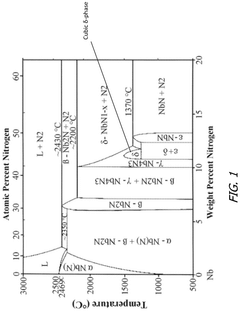
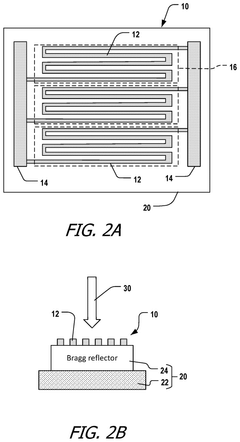
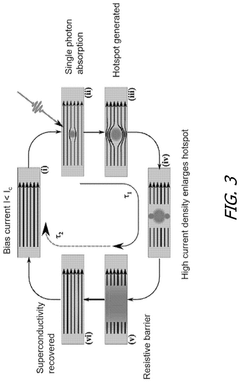
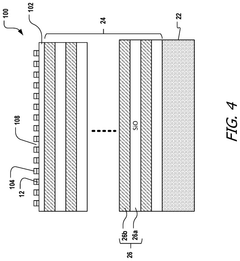
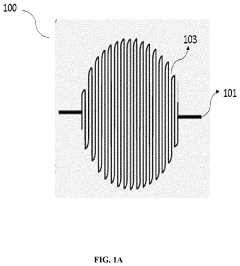
- The implementation of a seed layer of metal nitride, such as aluminum nitride, below the superconductive wire in the SNSPD device, which improves the critical temperature of the niobium nitride layer and enhances the material quality and light absorption efficiency.
Method and systems for fabricating superconducting nanowire single photon detector (SNSPD)
PatentPendingUS20230031577A1
Innovation
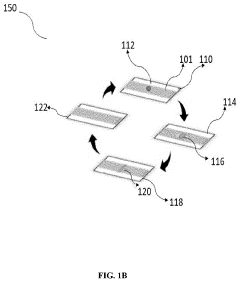
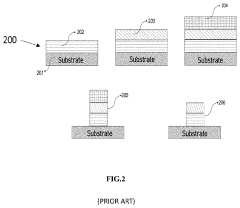
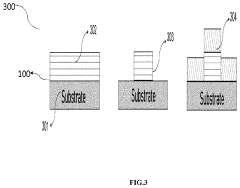
- A method and system for fabricating superconducting nanowire single photon detectors using high temperature superconductors with pulsed laser deposition, eliminating post-processing of superconducting thin films and gold encapsulation to maintain material quality and enable operation above 4 K.
Materials Science Advancements for Enhanced SNSPD Performance
The advancement of materials science has been pivotal in addressing the photolithography challenges faced in Superconducting Nanowire Single-Photon Detector (SNSPD) fabrication. Recent breakthroughs in superconducting materials have significantly enhanced SNSPD performance metrics, including detection efficiency, timing resolution, and dark count rates.
Niobium nitride (NbN) has traditionally been the material of choice for SNSPDs due to its relatively high critical temperature and established deposition techniques. However, its limitations in terms of optical absorption and kinetic inductance have prompted exploration of alternative materials. Amorphous tungsten silicide (WSi) has emerged as a promising candidate, offering superior uniformity across large areas and higher yield in device fabrication processes.
Molybdenum silicide (MoSi) represents another significant advancement, providing a balance between the higher critical temperature of NbN and the superior uniformity of WSi. The amorphous nature of MoSi films reduces the impact of grain boundaries on superconducting properties, addressing a key challenge in photolithography where structural defects can significantly impact device performance.
Multilayer material stacks have revolutionized SNSPD design by enabling precise control over optical absorption while maintaining optimal superconducting properties. These engineered structures incorporate optical cavities and anti-reflection coatings that enhance photon absorption at target wavelengths without compromising the superconducting film quality during photolithographic processing.
The development of ultra-thin superconducting films (2-4 nm) has been facilitated by advanced deposition techniques such as atomic layer deposition (ALD) and molecular beam epitaxy (MBE). These methods provide atomic-level control over film thickness and composition, critical for maintaining uniformity during subsequent photolithography steps and ensuring consistent device performance across wafers.
Surface passivation techniques have addressed the degradation of superconducting properties at material interfaces. Novel approaches using atomic layer deposited dielectrics create protective barriers that preserve the integrity of the superconducting film during photolithography processing, particularly during etching steps where chemical reactions can damage material properties.
Strain engineering has emerged as a powerful tool for enhancing superconducting properties. By carefully controlling the lattice mismatch between the superconducting film and substrate, researchers have demonstrated improvements in critical current density and critical temperature, which directly translate to better SNSPD performance metrics while maintaining compatibility with standard photolithography processes.
These materials science advancements collectively address the fundamental challenges in SNSPD photolithography, enabling the fabrication of devices with superior performance characteristics and higher manufacturing yield, thus accelerating the adoption of this technology in quantum information processing, space communications, and biomedical imaging applications.
Niobium nitride (NbN) has traditionally been the material of choice for SNSPDs due to its relatively high critical temperature and established deposition techniques. However, its limitations in terms of optical absorption and kinetic inductance have prompted exploration of alternative materials. Amorphous tungsten silicide (WSi) has emerged as a promising candidate, offering superior uniformity across large areas and higher yield in device fabrication processes.
Molybdenum silicide (MoSi) represents another significant advancement, providing a balance between the higher critical temperature of NbN and the superior uniformity of WSi. The amorphous nature of MoSi films reduces the impact of grain boundaries on superconducting properties, addressing a key challenge in photolithography where structural defects can significantly impact device performance.
Multilayer material stacks have revolutionized SNSPD design by enabling precise control over optical absorption while maintaining optimal superconducting properties. These engineered structures incorporate optical cavities and anti-reflection coatings that enhance photon absorption at target wavelengths without compromising the superconducting film quality during photolithographic processing.
The development of ultra-thin superconducting films (2-4 nm) has been facilitated by advanced deposition techniques such as atomic layer deposition (ALD) and molecular beam epitaxy (MBE). These methods provide atomic-level control over film thickness and composition, critical for maintaining uniformity during subsequent photolithography steps and ensuring consistent device performance across wafers.
Surface passivation techniques have addressed the degradation of superconducting properties at material interfaces. Novel approaches using atomic layer deposited dielectrics create protective barriers that preserve the integrity of the superconducting film during photolithography processing, particularly during etching steps where chemical reactions can damage material properties.
Strain engineering has emerged as a powerful tool for enhancing superconducting properties. By carefully controlling the lattice mismatch between the superconducting film and substrate, researchers have demonstrated improvements in critical current density and critical temperature, which directly translate to better SNSPD performance metrics while maintaining compatibility with standard photolithography processes.
These materials science advancements collectively address the fundamental challenges in SNSPD photolithography, enabling the fabrication of devices with superior performance characteristics and higher manufacturing yield, thus accelerating the adoption of this technology in quantum information processing, space communications, and biomedical imaging applications.
Cryogenic Testing and Validation Methodologies
Cryogenic testing represents a critical phase in the development and validation of Superconducting Nanowire Single-Photon Detectors (SNSPDs), as these devices operate at extremely low temperatures, typically below 4 Kelvin. The photolithography processes used to fabricate SNSPDs must produce devices that maintain their superconducting properties and optical detection capabilities under these harsh conditions.
Standard testing methodologies begin with temperature-dependent resistance measurements to verify the superconducting transition temperature (Tc) of the nanowires. This characterization provides initial validation that the photolithography process has preserved the material properties essential for SNSPD operation. The measurement typically employs a four-point probe technique to eliminate contact resistance effects, with temperature gradually reduced while monitoring resistance changes.
Dark count rate (DCR) testing represents another fundamental validation procedure, conducted in complete optical isolation to measure the detector's intrinsic noise level. This parameter directly reflects the quality of the photolithographic process, as edge roughness and material defects introduced during fabrication can significantly increase dark counts through the creation of current crowding points.
Quantum efficiency measurements provide perhaps the most comprehensive assessment of SNSPD performance. These tests evaluate the detector's ability to register incident photons across various wavelengths, with results directly correlating to the precision of nanowire dimensions achieved through photolithography. Testing protocols typically involve calibrated light sources attenuated to the single-photon level, with detection efficiency calculated as the ratio of detected to incident photons.
Timing jitter characterization completes the core validation suite, measuring the temporal precision of the detector's response. This parameter depends heavily on the uniformity of the nanowire cross-section throughout its length, directly reflecting photolithography quality. Standard measurement techniques employ time-correlated single-photon counting systems with picosecond resolution.
Advanced cryogenic testing may also include magnetic field dependence studies, which can reveal microscopic defects in the nanowires not apparent through other methods. Additionally, long-term stability tests conducted over weeks or months at operating temperature provide crucial information about device reliability, particularly regarding thermal cycling effects on the nanowire structures created through photolithography.
The integration of these validation methodologies creates a comprehensive framework for assessing how effectively photolithography challenges have been addressed in SNSPD fabrication, establishing clear correlations between fabrication parameters and device performance metrics.
Standard testing methodologies begin with temperature-dependent resistance measurements to verify the superconducting transition temperature (Tc) of the nanowires. This characterization provides initial validation that the photolithography process has preserved the material properties essential for SNSPD operation. The measurement typically employs a four-point probe technique to eliminate contact resistance effects, with temperature gradually reduced while monitoring resistance changes.
Dark count rate (DCR) testing represents another fundamental validation procedure, conducted in complete optical isolation to measure the detector's intrinsic noise level. This parameter directly reflects the quality of the photolithographic process, as edge roughness and material defects introduced during fabrication can significantly increase dark counts through the creation of current crowding points.
Quantum efficiency measurements provide perhaps the most comprehensive assessment of SNSPD performance. These tests evaluate the detector's ability to register incident photons across various wavelengths, with results directly correlating to the precision of nanowire dimensions achieved through photolithography. Testing protocols typically involve calibrated light sources attenuated to the single-photon level, with detection efficiency calculated as the ratio of detected to incident photons.
Timing jitter characterization completes the core validation suite, measuring the temporal precision of the detector's response. This parameter depends heavily on the uniformity of the nanowire cross-section throughout its length, directly reflecting photolithography quality. Standard measurement techniques employ time-correlated single-photon counting systems with picosecond resolution.
Advanced cryogenic testing may also include magnetic field dependence studies, which can reveal microscopic defects in the nanowires not apparent through other methods. Additionally, long-term stability tests conducted over weeks or months at operating temperature provide crucial information about device reliability, particularly regarding thermal cycling effects on the nanowire structures created through photolithography.
The integration of these validation methodologies creates a comprehensive framework for assessing how effectively photolithography challenges have been addressed in SNSPD fabrication, establishing clear correlations between fabrication parameters and device performance metrics.
Unlock deeper insights with PatSnap Eureka Quick Research — get a full tech report to explore trends and direct your research. Try now!
Generate Your Research Report Instantly with AI Agent
Supercharge your innovation with PatSnap Eureka AI Agent Platform!