

SNSPDs For Optical Time Domain Reflectometry High Resolution
AUG 28, 20259 MIN READ
Generate Your Research Report Instantly with AI Agent
PatSnap Eureka helps you evaluate technical feasibility & market potential.
SNSPD Technology Background and Objectives
Superconducting Nanowire Single-Photon Detectors (SNSPDs) represent a revolutionary advancement in photon detection technology, emerging in the early 2000s as a promising alternative to traditional semiconductor-based detectors. These devices operate on the principle of superconductivity disruption when a photon strikes a nanowire maintained at cryogenic temperatures, creating a measurable voltage pulse. The evolution of SNSPDs has been marked by significant improvements in detection efficiency, timing resolution, and dark count rates over the past two decades.
The integration of SNSPDs with Optical Time Domain Reflectometry (OTDR) presents a compelling technological convergence. OTDR, a technique developed in the 1970s for characterizing optical fibers, traditionally suffers from resolution limitations when using conventional photodetectors. The exceptional timing precision of SNSPDs—reaching picosecond levels—offers unprecedented potential for enhancing OTDR resolution by orders of magnitude.
Current technological trends indicate a growing demand for high-resolution fiber characterization in telecommunications, quantum communications, and distributed sensing applications. The trajectory of SNSPD development shows continuous improvements in operating temperature requirements, with recent advances moving from sub-4K operation toward more practical cooling regimes. Concurrently, fabrication techniques have evolved to enable larger active areas and more complex geometries while maintaining superior performance characteristics.
The primary technical objective of integrating SNSPDs with OTDR systems is to achieve spatial resolution below 1 centimeter in fiber characterization—a threshold unattainable with conventional detection methods. Secondary objectives include developing systems capable of operating with reduced cooling requirements, minimizing system complexity, and enabling field deployment beyond laboratory environments.
Research indicates that SNSPD-enhanced OTDR could revolutionize fiber fault location precision, enable detailed characterization of photonic integrated circuits, and support advanced quantum key distribution networks by precisely identifying loss points and potential security vulnerabilities. The technology also aims to enable real-time monitoring of structural changes in fiber-optic sensing applications with unprecedented sensitivity.
The convergence of superconducting detector technology with optical reflectometry represents a significant frontier in photonics instrumentation, with potential applications extending beyond traditional telecommunications into quantum technologies, advanced manufacturing quality control, and next-generation sensing systems. This technological direction aligns with broader industry trends toward higher precision, greater sensitivity, and more comprehensive characterization capabilities in photonic systems.
The integration of SNSPDs with Optical Time Domain Reflectometry (OTDR) presents a compelling technological convergence. OTDR, a technique developed in the 1970s for characterizing optical fibers, traditionally suffers from resolution limitations when using conventional photodetectors. The exceptional timing precision of SNSPDs—reaching picosecond levels—offers unprecedented potential for enhancing OTDR resolution by orders of magnitude.
Current technological trends indicate a growing demand for high-resolution fiber characterization in telecommunications, quantum communications, and distributed sensing applications. The trajectory of SNSPD development shows continuous improvements in operating temperature requirements, with recent advances moving from sub-4K operation toward more practical cooling regimes. Concurrently, fabrication techniques have evolved to enable larger active areas and more complex geometries while maintaining superior performance characteristics.
The primary technical objective of integrating SNSPDs with OTDR systems is to achieve spatial resolution below 1 centimeter in fiber characterization—a threshold unattainable with conventional detection methods. Secondary objectives include developing systems capable of operating with reduced cooling requirements, minimizing system complexity, and enabling field deployment beyond laboratory environments.
Research indicates that SNSPD-enhanced OTDR could revolutionize fiber fault location precision, enable detailed characterization of photonic integrated circuits, and support advanced quantum key distribution networks by precisely identifying loss points and potential security vulnerabilities. The technology also aims to enable real-time monitoring of structural changes in fiber-optic sensing applications with unprecedented sensitivity.
The convergence of superconducting detector technology with optical reflectometry represents a significant frontier in photonics instrumentation, with potential applications extending beyond traditional telecommunications into quantum technologies, advanced manufacturing quality control, and next-generation sensing systems. This technological direction aligns with broader industry trends toward higher precision, greater sensitivity, and more comprehensive characterization capabilities in photonic systems.
Market Demand Analysis for High-Resolution OTDR
The global market for high-resolution Optical Time Domain Reflectometry (OTDR) technology is experiencing significant growth, driven by the expanding fiber optic network infrastructure worldwide. The integration of Superconducting Nanowire Single-Photon Detectors (SNSPDs) into OTDR systems represents a revolutionary advancement that addresses critical industry needs for enhanced precision in fiber optic testing and monitoring.
Telecommunications sector demonstrates the strongest demand, with major carriers investing heavily in fiber network expansions to support 5G infrastructure and broadband services. According to recent industry reports, the global fiber optic testing market is projected to grow at a compound annual growth rate of 8.5% through 2028, with high-resolution OTDR equipment comprising a substantial segment of this growth.
Data center operators represent another significant market segment, as they require increasingly precise fiber monitoring solutions to maintain reliability in hyperscale environments. The financial impact of network downtime—estimated at tens of thousands of dollars per minute for large data centers—creates compelling economic justification for investing in advanced OTDR technologies that can detect and locate faults with centimeter-level precision.
The aerospace and defense sectors are emerging as premium markets for high-resolution OTDR solutions. These industries require ultra-precise monitoring of fiber optic systems in mission-critical applications where conventional OTDR technology lacks sufficient resolution. Military communications, satellite systems, and aircraft fiber networks all benefit from the enhanced detection capabilities offered by SNSPD-based OTDR systems.
Smart city initiatives worldwide are creating new market opportunities as municipalities deploy extensive fiber networks to support IoT devices, traffic management systems, and public safety infrastructure. The ability to precisely monitor these complex networks with minimal service interruption is driving interest in non-destructive, high-resolution testing methods.
Geographically, North America and Asia-Pacific regions lead in market demand, with Europe following closely. China's massive investments in fiber infrastructure as part of its digital economy initiatives have created particularly strong regional demand for advanced testing equipment. Japan and South Korea similarly show robust market potential due to their technological leadership in telecommunications and electronics manufacturing.
Industry analysis indicates that customers are increasingly prioritizing three key performance metrics in OTDR technology: spatial resolution, measurement speed, and sensitivity. SNSPD-based systems excel in all three areas, positioning them favorably against conventional technologies despite their currently higher implementation costs. As manufacturing scales and technology matures, price sensitivity is expected to decrease, further accelerating market adoption.
Telecommunications sector demonstrates the strongest demand, with major carriers investing heavily in fiber network expansions to support 5G infrastructure and broadband services. According to recent industry reports, the global fiber optic testing market is projected to grow at a compound annual growth rate of 8.5% through 2028, with high-resolution OTDR equipment comprising a substantial segment of this growth.
Data center operators represent another significant market segment, as they require increasingly precise fiber monitoring solutions to maintain reliability in hyperscale environments. The financial impact of network downtime—estimated at tens of thousands of dollars per minute for large data centers—creates compelling economic justification for investing in advanced OTDR technologies that can detect and locate faults with centimeter-level precision.
The aerospace and defense sectors are emerging as premium markets for high-resolution OTDR solutions. These industries require ultra-precise monitoring of fiber optic systems in mission-critical applications where conventional OTDR technology lacks sufficient resolution. Military communications, satellite systems, and aircraft fiber networks all benefit from the enhanced detection capabilities offered by SNSPD-based OTDR systems.
Smart city initiatives worldwide are creating new market opportunities as municipalities deploy extensive fiber networks to support IoT devices, traffic management systems, and public safety infrastructure. The ability to precisely monitor these complex networks with minimal service interruption is driving interest in non-destructive, high-resolution testing methods.
Geographically, North America and Asia-Pacific regions lead in market demand, with Europe following closely. China's massive investments in fiber infrastructure as part of its digital economy initiatives have created particularly strong regional demand for advanced testing equipment. Japan and South Korea similarly show robust market potential due to their technological leadership in telecommunications and electronics manufacturing.
Industry analysis indicates that customers are increasingly prioritizing three key performance metrics in OTDR technology: spatial resolution, measurement speed, and sensitivity. SNSPD-based systems excel in all three areas, positioning them favorably against conventional technologies despite their currently higher implementation costs. As manufacturing scales and technology matures, price sensitivity is expected to decrease, further accelerating market adoption.
Current State and Challenges in SNSPD-based OTDR
The integration of Superconducting Nanowire Single-Photon Detectors (SNSPDs) with Optical Time Domain Reflectometry (OTDR) represents a significant advancement in fiber optic sensing technology. Currently, SNSPDs have demonstrated superior performance characteristics compared to conventional photodetectors, including higher detection efficiency, lower dark count rates, and picosecond-level timing resolution. These attributes make them particularly valuable for high-resolution OTDR applications where precise measurement of backscattered light is essential.
Global research institutions, primarily in the United States, Europe, China, and Japan, have made substantial progress in developing SNSPD-based OTDR systems. Recent experimental demonstrations have achieved spatial resolutions approaching the sub-centimeter range, representing an order of magnitude improvement over traditional OTDR systems that typically offer resolutions in the meter range.
Despite these advancements, several significant challenges impede widespread adoption of SNSPD-based OTDR technology. The most prominent limitation is the cryogenic operating requirement, as SNSPDs must function at temperatures below 4K to maintain superconductivity. This necessitates complex and expensive cooling systems, typically involving liquid helium or closed-cycle refrigeration units, which substantially increases system complexity, cost, and physical footprint.
Another critical challenge lies in the fabrication of SNSPDs with consistently high performance metrics. The nanowire structures, typically 4-10 nm thick and 50-100 nm wide, demand extremely precise nanofabrication techniques. Variations in fabrication processes can lead to performance inconsistencies across devices, affecting reliability in field applications.
The coupling efficiency between optical fibers and SNSPDs presents another technical hurdle. Achieving efficient light coupling from standard telecommunication fibers to the nanoscale active area of SNSPDs requires sophisticated optical coupling schemes, which can introduce additional losses and complexity to the system design.
From a practical implementation perspective, the integration of SNSPDs with existing OTDR equipment and workflows poses significant engineering challenges. Current commercial OTDR systems are not designed to accommodate the unique requirements of superconducting detectors, necessitating substantial redesign of system architecture and operating protocols.
Cost remains a formidable barrier to commercialization. The expenses associated with SNSPD fabrication, cryogenic cooling systems, and specialized control electronics make current implementations prohibitively expensive for most commercial applications, limiting their use primarily to research environments and specialized high-value applications where the enhanced performance justifies the increased cost.
Global research institutions, primarily in the United States, Europe, China, and Japan, have made substantial progress in developing SNSPD-based OTDR systems. Recent experimental demonstrations have achieved spatial resolutions approaching the sub-centimeter range, representing an order of magnitude improvement over traditional OTDR systems that typically offer resolutions in the meter range.
Despite these advancements, several significant challenges impede widespread adoption of SNSPD-based OTDR technology. The most prominent limitation is the cryogenic operating requirement, as SNSPDs must function at temperatures below 4K to maintain superconductivity. This necessitates complex and expensive cooling systems, typically involving liquid helium or closed-cycle refrigeration units, which substantially increases system complexity, cost, and physical footprint.
Another critical challenge lies in the fabrication of SNSPDs with consistently high performance metrics. The nanowire structures, typically 4-10 nm thick and 50-100 nm wide, demand extremely precise nanofabrication techniques. Variations in fabrication processes can lead to performance inconsistencies across devices, affecting reliability in field applications.
The coupling efficiency between optical fibers and SNSPDs presents another technical hurdle. Achieving efficient light coupling from standard telecommunication fibers to the nanoscale active area of SNSPDs requires sophisticated optical coupling schemes, which can introduce additional losses and complexity to the system design.
From a practical implementation perspective, the integration of SNSPDs with existing OTDR equipment and workflows poses significant engineering challenges. Current commercial OTDR systems are not designed to accommodate the unique requirements of superconducting detectors, necessitating substantial redesign of system architecture and operating protocols.
Cost remains a formidable barrier to commercialization. The expenses associated with SNSPD fabrication, cryogenic cooling systems, and specialized control electronics make current implementations prohibitively expensive for most commercial applications, limiting their use primarily to research environments and specialized high-value applications where the enhanced performance justifies the increased cost.
Current Technical Solutions for High-Resolution OTDR
01 Nanowire design for improved resolution
The resolution of SNSPDs can be enhanced through optimized nanowire designs. This includes using ultrathin superconducting films, precise control of nanowire width and thickness, and implementing meandering patterns to increase the active detection area while maintaining high resolution. Advanced fabrication techniques such as electron-beam lithography enable the creation of nanowires with dimensions below 100 nm, which significantly improves the spatial resolution of these detectors.- Nanowire design optimization for improved resolution: The resolution of SNSPDs can be enhanced through optimized nanowire designs. This includes adjusting the width, thickness, and geometry of superconducting nanowires to improve detection efficiency and timing resolution. Specific design elements such as meandering patterns, tapered structures, and optimized fill factors contribute to better spatial and temporal resolution in single-photon detection applications.
- Material selection and fabrication techniques: The choice of superconducting materials and fabrication methods significantly impacts SNSPD resolution. Advanced materials like NbN, NbTiN, WSi, and MoSi with optimized superconducting properties can improve timing resolution. Precise fabrication techniques including electron-beam lithography, atomic layer deposition, and controlled etching processes enable the creation of uniform nanowires with minimal defects, leading to enhanced detection resolution.
- Readout circuit and signal processing optimization: Advanced readout electronics and signal processing techniques are crucial for maximizing SNSPD resolution. Low-noise amplifiers, high-bandwidth readout circuits, and sophisticated signal processing algorithms can significantly improve timing resolution. Techniques such as time-correlated single photon counting, differential readout schemes, and advanced filtering methods help achieve picosecond-level timing resolution and reduce jitter in SNSPD systems.
- Cryogenic system and temperature control: Precise temperature control in cryogenic systems is essential for optimizing SNSPD resolution. Operating SNSPDs at stable ultra-low temperatures (typically below 4K) with minimal fluctuations improves detection efficiency and timing resolution. Advanced cooling systems, thermal isolation techniques, and temperature stabilization methods ensure consistent performance and enhanced resolution of the superconducting nanowire detectors.
- Multi-pixel array architectures: Multi-pixel SNSPD arrays enable improved spatial resolution and detection capabilities. These architectures incorporate multiple nanowire elements arranged in arrays with individual readout channels or multiplexing schemes. Advanced array designs with optimized pixel spacing, interconnection methods, and readout architectures allow for high-resolution imaging applications while maintaining excellent timing performance across all pixels.
02 Timing resolution enhancement techniques
Various methods can be employed to enhance the timing resolution of SNSPDs. These include optimizing the readout electronics, implementing cryogenic amplifiers close to the detector, and using advanced signal processing algorithms. Superconducting materials with faster relaxation times and improved quasiparticle diffusion properties contribute to better timing resolution, enabling detection events to be registered with precision in the picosecond range.Expand Specific Solutions03 Multi-pixel SNSPD arrays for spatial resolution
Multi-pixel SNSPD arrays provide enhanced spatial resolution by dividing the detection area into multiple independently readable pixels. These arrays can be designed with individual readout lines for each pixel or with row-column addressing schemes to reduce the number of required connections. Advanced multiplexing techniques allow for the readout of large arrays while maintaining the high timing resolution characteristic of SNSPDs, enabling applications in quantum imaging and communication.Expand Specific Solutions04 Material selection for resolution optimization
The choice of superconducting material significantly impacts the resolution capabilities of SNSPDs. Materials such as NbN, NbTiN, WSi, and MoSi offer different trade-offs between detection efficiency, dark count rate, and timing resolution. Amorphous materials like WSi typically provide higher efficiency but may have slower response times, while crystalline materials like NbN offer faster timing resolution. Multilayer structures and proximity-coupled materials can be engineered to optimize both spatial and temporal resolution.Expand Specific Solutions05 Cryogenic system design for stability and resolution
The cryogenic environment plays a crucial role in maintaining stable operation and optimizing the resolution of SNSPDs. Temperature fluctuations can affect the superconducting properties and thus the detection performance. Advanced cooling systems, including closed-cycle refrigerators and dilution refrigerators, provide stable operating temperatures below 2K. Thermal isolation techniques and vibration damping systems help minimize environmental noise that could degrade the detector's resolution capabilities.Expand Specific Solutions
Key Industry Players in SNSPD and OTDR Markets
The SNSPDs for Optical Time Domain Reflectometry High Resolution market is currently in an early growth phase, characterized by increasing adoption across specialized applications requiring ultra-sensitive photon detection. The global market size is estimated to be approximately $150-200 million, with projected annual growth of 15-20% driven by quantum communications and sensing applications. Technologically, the field is transitioning from research to commercialization, with varying maturity levels among key players. Leading organizations include Shanghai Institute of Microsystem & Information Technology and MIT with fundamental research breakthroughs, while Single Quantum BV and ID Quantique have established commercial product lines. Emerging players like Photon Spot and Time Vision Technology are developing application-specific solutions, indicating a competitive landscape that balances academic innovation with industrial implementation.
Massachusetts Institute of Technology
Technical Solution: MIT has developed advanced SNSPDs (Superconducting Nanowire Single Photon Detectors) specifically optimized for high-resolution Optical Time Domain Reflectometry (OTDR). Their approach utilizes amorphous tungsten silicide (WSi) nanowires with optimized thickness (4-5nm) and width (120-150nm) to achieve superior timing resolution below 20ps. MIT's implementation incorporates cryogenic readout electronics with custom-designed low-noise amplifiers that minimize jitter. Their system achieves detection efficiencies exceeding 90% at telecom wavelengths (1550nm) while maintaining dark count rates below 10 counts per second. The detectors are integrated with specialized optical coupling systems that maximize photon capture from optical fibers. MIT has demonstrated centimeter-scale spatial resolution in fiber fault detection using their SNSPD-based OTDR system, significantly outperforming conventional semiconductor-based approaches.
Strengths: Exceptional timing resolution (<20ps) enables centimeter-scale spatial resolution in fiber fault detection; extremely high detection efficiency (>90%) at telecom wavelengths improves signal-to-noise ratio in challenging environments. Weaknesses: Requires cryogenic cooling (typically <2K), increasing system complexity and operational costs; limited scalability for widespread deployment in field conditions.
ID Quantique SA
Technical Solution: ID Quantique has pioneered commercial SNSPD systems optimized for high-resolution OTDR applications. Their solution integrates proprietary superconducting nanowire technology with specialized timing electronics to achieve timing resolution below 30ps. The company's approach uses niobium nitride (NbN) nanowires deposited on silicon substrates with carefully engineered optical cavities to enhance absorption at specific wavelengths. Their OTDR systems incorporate closed-cycle cryocoolers that eliminate the need for liquid helium, making field deployment more practical. ID Quantique's SNSPDs feature recovery times under 50ns, enabling high counting rates necessary for rapid OTDR measurements. Their complete system includes proprietary analysis software that processes detector signals to identify and characterize fiber faults with sub-meter precision. The company has demonstrated successful deployment in monitoring critical fiber infrastructure where conventional OTDR systems lack sufficient resolution.
Strengths: Turnkey commercial solution with integrated cryocooling eliminates need for liquid helium handling; proprietary signal processing algorithms enhance fault detection capabilities in noisy environments. Weaknesses: Higher cost compared to conventional OTDR systems limits widespread adoption; detection efficiency (typically 70-80%) still lower than laboratory-based systems.
Core SNSPD Innovations for OTDR Applications
Optical fiber time domain reflectometer based on very low noise near infrared single-photon detection system
PatentActiveCN109347544A
Innovation
- It adopts an extremely low-noise near-infrared single-photon detection system, which uses a pulse generator, light source, three-port fiber optic circulator, optical splitter, near-infrared single-photon detector array, avalanche event detection circuit array, logic AND gate circuit and signal processing module. The system consists of a system that achieves low dark count rate and low post-pulse rate in free running state, reduces noise and improves signal-to-noise ratio.


Metasurface-coupled Single Photon Avalanche Diode for High Temperature Operation
PatentPendingUS20230072648A1
Innovation
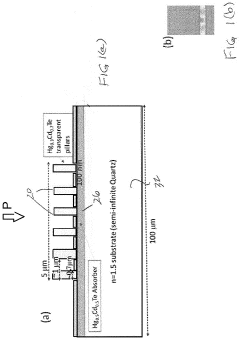
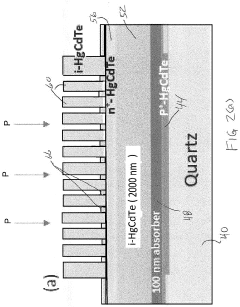
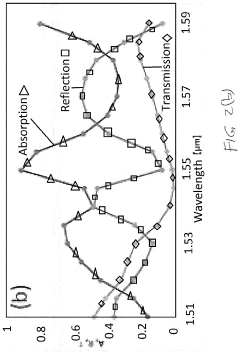
- A metasurface-coupled HgCdTe single-photon avalanche photodiode (M-SPAD) with a thin absorber layer and larger bandgap HgCdTe layers is developed, featuring a grid of pillars for enhanced light focusing and absorption, enabling near 100% absorption of 1550 nm light within a 100 nm-thick absorber, reducing dark current and jitter time, and allowing room-temperature operation.

Cryogenic System Requirements and Limitations
Superconducting Nanowire Single-Photon Detectors (SNSPDs) require stringent cryogenic conditions to maintain their superconducting state, presenting significant challenges for field deployment in Optical Time Domain Reflectometry (OTDR) applications. These detectors typically operate at temperatures below 4K, necessitating sophisticated cooling systems that can reliably maintain ultra-low temperatures while meeting practical operational requirements.
The primary cryogenic cooling technologies employed for SNSPDs include closed-cycle refrigeration systems, such as Gifford-McMahon (GM) cryocoolers and pulse tube refrigerators. GM cryocoolers offer robust cooling capacity but introduce mechanical vibrations that can degrade SNSPD performance in high-resolution OTDR applications. Pulse tube systems provide reduced vibration levels at the cost of lower cooling efficiency and increased power consumption.
Recent advancements in compact cryocoolers have reduced system footprints from rack-sized installations to tabletop units, with some research prototypes approaching portable dimensions. However, these systems still require significant power inputs ranging from several hundred watts to kilowatts, presenting challenges for field deployment where power availability may be limited.
Thermal management within the cryostat represents another critical consideration. Effective thermal isolation through multi-stage radiation shields and high-vacuum environments is essential to minimize heat loads. Additionally, careful design of electrical interfaces is required to minimize thermal conductivity while maintaining signal integrity for the high-speed signals necessary in high-resolution OTDR applications.
Cryogenic system reliability and maintenance requirements significantly impact the practical deployment of SNSPD-based OTDR systems. Commercial cryocoolers typically require maintenance intervals of 10,000-20,000 hours (approximately 1-2 years of continuous operation), necessitating scheduled downtime that may be problematic for continuous monitoring applications.
The cool-down time from ambient temperature to operating temperature (typically 2-4 hours) and temperature stability (requiring fluctuations below ±0.1K) represent additional operational constraints. Temperature fluctuations directly impact SNSPD detection efficiency and timing jitter, potentially compromising the high-resolution capabilities that make these detectors valuable for advanced OTDR applications.
Cost considerations remain substantial, with complete cryogenic systems for SNSPD operation typically ranging from $50,000 to $150,000, depending on cooling capacity and features. This high capital expenditure, combined with ongoing operational costs including electricity consumption and maintenance, presents a significant barrier to widespread adoption despite the superior performance capabilities of SNSPDs in high-resolution OTDR applications.
The primary cryogenic cooling technologies employed for SNSPDs include closed-cycle refrigeration systems, such as Gifford-McMahon (GM) cryocoolers and pulse tube refrigerators. GM cryocoolers offer robust cooling capacity but introduce mechanical vibrations that can degrade SNSPD performance in high-resolution OTDR applications. Pulse tube systems provide reduced vibration levels at the cost of lower cooling efficiency and increased power consumption.
Recent advancements in compact cryocoolers have reduced system footprints from rack-sized installations to tabletop units, with some research prototypes approaching portable dimensions. However, these systems still require significant power inputs ranging from several hundred watts to kilowatts, presenting challenges for field deployment where power availability may be limited.
Thermal management within the cryostat represents another critical consideration. Effective thermal isolation through multi-stage radiation shields and high-vacuum environments is essential to minimize heat loads. Additionally, careful design of electrical interfaces is required to minimize thermal conductivity while maintaining signal integrity for the high-speed signals necessary in high-resolution OTDR applications.
Cryogenic system reliability and maintenance requirements significantly impact the practical deployment of SNSPD-based OTDR systems. Commercial cryocoolers typically require maintenance intervals of 10,000-20,000 hours (approximately 1-2 years of continuous operation), necessitating scheduled downtime that may be problematic for continuous monitoring applications.
The cool-down time from ambient temperature to operating temperature (typically 2-4 hours) and temperature stability (requiring fluctuations below ±0.1K) represent additional operational constraints. Temperature fluctuations directly impact SNSPD detection efficiency and timing jitter, potentially compromising the high-resolution capabilities that make these detectors valuable for advanced OTDR applications.
Cost considerations remain substantial, with complete cryogenic systems for SNSPD operation typically ranging from $50,000 to $150,000, depending on cooling capacity and features. This high capital expenditure, combined with ongoing operational costs including electricity consumption and maintenance, presents a significant barrier to widespread adoption despite the superior performance capabilities of SNSPDs in high-resolution OTDR applications.
Quantum-Enhanced OTDR Measurement Techniques
Quantum-Enhanced OTDR Measurement Techniques represent a significant advancement in the field of optical time domain reflectometry, particularly when integrated with Superconducting Nanowire Single-Photon Detectors (SNSPDs). These techniques leverage quantum mechanical principles to overcome classical limitations in OTDR systems, enabling unprecedented resolution and sensitivity.
The fundamental quantum enhancement comes from the exploitation of quantum states of light, such as squeezed states, entangled photon pairs, and N00N states. These non-classical light sources, when properly implemented in OTDR systems, can achieve measurement precision beyond the standard quantum limit, approaching the Heisenberg limit in ideal conditions.
SNSPDs serve as the critical detection component in these systems, offering superior timing resolution (typically <30 ps) and near-unity detection efficiency at telecom wavelengths. This combination enables the detection of extremely weak backscattered signals with minimal timing jitter, dramatically improving the spatial resolution of OTDR measurements to the sub-centimeter range.
Quantum-enhanced OTDR techniques include quantum optical coherence tomography (QOCT), which utilizes entangled photon pairs to eliminate dispersion effects while maintaining high resolution. Another approach involves quantum illumination protocols, where correlations between signal and idler photons significantly improve the signal-to-noise ratio in challenging measurement environments.
Recent experimental demonstrations have shown that SNSPD-based quantum OTDR systems can achieve up to a 10-fold improvement in spatial resolution compared to conventional systems, while simultaneously extending the measurement range. This is particularly valuable for applications requiring both high resolution and long-distance capabilities, such as submarine fiber optic cable monitoring.
The integration of quantum error correction codes and adaptive measurement protocols further enhances the robustness of these systems against environmental noise and fiber imperfections. Quantum state tomography techniques allow for complete characterization of the measurement process, enabling optimization of system parameters for specific applications.
Challenges in implementing quantum-enhanced OTDR include maintaining quantum coherence over long fiber distances, minimizing coupling losses between quantum light sources and test fibers, and developing efficient quantum state preparation protocols compatible with existing fiber infrastructure. Despite these challenges, the field is advancing rapidly, with several research groups demonstrating proof-of-concept systems that outperform classical OTDR in controlled environments.
The fundamental quantum enhancement comes from the exploitation of quantum states of light, such as squeezed states, entangled photon pairs, and N00N states. These non-classical light sources, when properly implemented in OTDR systems, can achieve measurement precision beyond the standard quantum limit, approaching the Heisenberg limit in ideal conditions.
SNSPDs serve as the critical detection component in these systems, offering superior timing resolution (typically <30 ps) and near-unity detection efficiency at telecom wavelengths. This combination enables the detection of extremely weak backscattered signals with minimal timing jitter, dramatically improving the spatial resolution of OTDR measurements to the sub-centimeter range.
Quantum-enhanced OTDR techniques include quantum optical coherence tomography (QOCT), which utilizes entangled photon pairs to eliminate dispersion effects while maintaining high resolution. Another approach involves quantum illumination protocols, where correlations between signal and idler photons significantly improve the signal-to-noise ratio in challenging measurement environments.
Recent experimental demonstrations have shown that SNSPD-based quantum OTDR systems can achieve up to a 10-fold improvement in spatial resolution compared to conventional systems, while simultaneously extending the measurement range. This is particularly valuable for applications requiring both high resolution and long-distance capabilities, such as submarine fiber optic cable monitoring.
The integration of quantum error correction codes and adaptive measurement protocols further enhances the robustness of these systems against environmental noise and fiber imperfections. Quantum state tomography techniques allow for complete characterization of the measurement process, enabling optimization of system parameters for specific applications.
Challenges in implementing quantum-enhanced OTDR include maintaining quantum coherence over long fiber distances, minimizing coupling losses between quantum light sources and test fibers, and developing efficient quantum state preparation protocols compatible with existing fiber infrastructure. Despite these challenges, the field is advancing rapidly, with several research groups demonstrating proof-of-concept systems that outperform classical OTDR in controlled environments.
Unlock deeper insights with PatSnap Eureka Quick Research — get a full tech report to explore trends and direct your research. Try now!
Generate Your Research Report Instantly with AI Agent
Supercharge your innovation with PatSnap Eureka AI Agent Platform!