

SNSPDs For Single Photon Quantum Key Distribution Case Studies
AUG 28, 20259 MIN READ
Generate Your Research Report Instantly with AI Agent
PatSnap Eureka helps you evaluate technical feasibility & market potential.
SNSPD Technology Evolution and Objectives
Superconducting Nanowire Single-Photon Detectors (SNSPDs) have emerged as a revolutionary technology in quantum communication systems, particularly for Quantum Key Distribution (QKD) applications. The evolution of SNSPDs began in the early 2000s when researchers discovered that superconducting nanowires could detect single photons with unprecedented efficiency and timing resolution. This breakthrough opened new possibilities for secure quantum communication protocols that rely on the detection of individual photons.
The fundamental principle behind SNSPDs involves a superconducting nanowire maintained just below its critical temperature. When a single photon strikes the nanowire, it creates a local hotspot that disrupts the superconducting state, generating a measurable voltage pulse. This mechanism allows for the detection of individual photons with remarkable precision, a capability crucial for QKD systems where information security depends on the accurate measurement of quantum states.
Over the past two decades, SNSPD technology has progressed through several distinct phases. The initial development phase (2001-2010) focused on proof-of-concept demonstrations and basic performance improvements. The second phase (2010-2015) saw significant advancements in detection efficiency, with researchers achieving system detection efficiencies exceeding 90% for specific wavelengths. The current phase (2015-present) has concentrated on practical implementation challenges, including cryogenic integration, scalability, and system reliability.
The primary technical objectives for SNSPDs in QKD applications include achieving near-unity detection efficiency across broader wavelength ranges, particularly in the telecommunications bands (1310nm and 1550nm). Reducing timing jitter below 10 picoseconds remains crucial for high-speed QKD systems, while decreasing dark count rates to negligible levels enhances the signal-to-noise ratio in quantum communications.
Another critical objective is the development of more practical cryogenic systems. Current SNSPDs typically require operating temperatures below 4 Kelvin, necessitating bulky and expensive cooling systems. Research efforts are directed toward raising operating temperatures and developing more compact, energy-efficient cooling solutions to enable field deployment of SNSPD-based QKD systems.
The technology trajectory suggests that future SNSPDs will likely incorporate novel materials beyond traditional niobium nitride, such as amorphous tungsten silicide and molybdenum silicide, which offer improved performance characteristics. Additionally, integration with photonic circuits and the development of SNSPD arrays for multiplexed detection represent promising directions for enhancing QKD system capabilities.
As quantum communication networks expand globally, SNSPDs are positioned to become a cornerstone technology, with research objectives increasingly focused on addressing practical deployment challenges while maintaining the exceptional performance metrics that make these detectors indispensable for secure quantum communications.
The fundamental principle behind SNSPDs involves a superconducting nanowire maintained just below its critical temperature. When a single photon strikes the nanowire, it creates a local hotspot that disrupts the superconducting state, generating a measurable voltage pulse. This mechanism allows for the detection of individual photons with remarkable precision, a capability crucial for QKD systems where information security depends on the accurate measurement of quantum states.
Over the past two decades, SNSPD technology has progressed through several distinct phases. The initial development phase (2001-2010) focused on proof-of-concept demonstrations and basic performance improvements. The second phase (2010-2015) saw significant advancements in detection efficiency, with researchers achieving system detection efficiencies exceeding 90% for specific wavelengths. The current phase (2015-present) has concentrated on practical implementation challenges, including cryogenic integration, scalability, and system reliability.
The primary technical objectives for SNSPDs in QKD applications include achieving near-unity detection efficiency across broader wavelength ranges, particularly in the telecommunications bands (1310nm and 1550nm). Reducing timing jitter below 10 picoseconds remains crucial for high-speed QKD systems, while decreasing dark count rates to negligible levels enhances the signal-to-noise ratio in quantum communications.
Another critical objective is the development of more practical cryogenic systems. Current SNSPDs typically require operating temperatures below 4 Kelvin, necessitating bulky and expensive cooling systems. Research efforts are directed toward raising operating temperatures and developing more compact, energy-efficient cooling solutions to enable field deployment of SNSPD-based QKD systems.
The technology trajectory suggests that future SNSPDs will likely incorporate novel materials beyond traditional niobium nitride, such as amorphous tungsten silicide and molybdenum silicide, which offer improved performance characteristics. Additionally, integration with photonic circuits and the development of SNSPD arrays for multiplexed detection represent promising directions for enhancing QKD system capabilities.
As quantum communication networks expand globally, SNSPDs are positioned to become a cornerstone technology, with research objectives increasingly focused on addressing practical deployment challenges while maintaining the exceptional performance metrics that make these detectors indispensable for secure quantum communications.
Quantum Key Distribution Market Analysis
The global Quantum Key Distribution (QKD) market is experiencing significant growth, driven by increasing concerns over data security and the looming threat of quantum computers breaking traditional encryption methods. Current market valuations place the QKD sector at approximately 500 million USD in 2023, with projections indicating growth to reach 3 billion USD by 2030, representing a compound annual growth rate (CAGR) of 25.3% during this forecast period.
North America currently dominates the market share at 38%, followed by Europe at 29% and Asia-Pacific at 26%. The remaining 7% is distributed across other regions. This distribution reflects the concentration of quantum technology research and cybersecurity investments in developed economies. However, the Asia-Pacific region, particularly China, is demonstrating the fastest growth rate at 32% annually, fueled by substantial government investments in quantum technologies.
The market segmentation reveals distinct application sectors for QKD technology. Government and defense applications constitute the largest segment at 42% of the market, followed by banking and financial services at 28%, healthcare at 15%, and telecommunications at 10%. The remaining 5% encompasses various other industries exploring quantum security solutions.
Key market drivers include the escalating frequency and sophistication of cyberattacks, with financial damages from data breaches reaching 4.35 million USD per incident on average in 2022. Additionally, regulatory pressures for enhanced data protection, particularly in sectors handling sensitive information, are accelerating adoption. The increasing awareness of quantum computing threats to current encryption standards (known as "harvest now, decrypt later" attacks) is creating urgency among organizations to implement quantum-resistant security measures.
Market challenges include the high implementation costs of QKD systems, with enterprise-grade solutions ranging from 100,000 to 500,000 USD, creating adoption barriers for smaller organizations. Technical limitations such as distance constraints in quantum key transmission (typically limited to 100-200 km without quantum repeaters) and integration complexities with existing infrastructure also impede widespread deployment.
The competitive landscape features established telecommunications companies like Toshiba, ID Quantique, and MagiQ Technologies alongside specialized quantum technology startups such as QuintessenceLabs and Quantum Xchange. Recent market developments include strategic partnerships between QKD providers and cybersecurity firms, aiming to create comprehensive quantum-safe security solutions that incorporate both quantum and post-quantum cryptographic methods.
North America currently dominates the market share at 38%, followed by Europe at 29% and Asia-Pacific at 26%. The remaining 7% is distributed across other regions. This distribution reflects the concentration of quantum technology research and cybersecurity investments in developed economies. However, the Asia-Pacific region, particularly China, is demonstrating the fastest growth rate at 32% annually, fueled by substantial government investments in quantum technologies.
The market segmentation reveals distinct application sectors for QKD technology. Government and defense applications constitute the largest segment at 42% of the market, followed by banking and financial services at 28%, healthcare at 15%, and telecommunications at 10%. The remaining 5% encompasses various other industries exploring quantum security solutions.
Key market drivers include the escalating frequency and sophistication of cyberattacks, with financial damages from data breaches reaching 4.35 million USD per incident on average in 2022. Additionally, regulatory pressures for enhanced data protection, particularly in sectors handling sensitive information, are accelerating adoption. The increasing awareness of quantum computing threats to current encryption standards (known as "harvest now, decrypt later" attacks) is creating urgency among organizations to implement quantum-resistant security measures.
Market challenges include the high implementation costs of QKD systems, with enterprise-grade solutions ranging from 100,000 to 500,000 USD, creating adoption barriers for smaller organizations. Technical limitations such as distance constraints in quantum key transmission (typically limited to 100-200 km without quantum repeaters) and integration complexities with existing infrastructure also impede widespread deployment.
The competitive landscape features established telecommunications companies like Toshiba, ID Quantique, and MagiQ Technologies alongside specialized quantum technology startups such as QuintessenceLabs and Quantum Xchange. Recent market developments include strategic partnerships between QKD providers and cybersecurity firms, aiming to create comprehensive quantum-safe security solutions that incorporate both quantum and post-quantum cryptographic methods.
SNSPD Development Status and Technical Barriers
Superconducting Nanowire Single Photon Detectors (SNSPDs) have emerged as a critical enabling technology for quantum key distribution (QKD) systems due to their superior performance characteristics. Currently, SNSPDs demonstrate detection efficiencies exceeding 90% across various wavelength bands, timing jitters below 20 picoseconds, dark count rates under 1 count per second, and recovery times in the nanosecond range. These parameters significantly outperform alternative single-photon detection technologies such as avalanche photodiodes, particularly in the telecommunications wavelength bands.
Despite these impressive capabilities, SNSPDs face several significant technical barriers that limit their widespread adoption in practical QKD systems. The most prominent challenge remains the cryogenic cooling requirement, as SNSPDs typically operate at temperatures below 4 Kelvin. This necessitates bulky, power-hungry, and expensive cryogenic systems that constrain field deployment scenarios and increase overall system complexity.
Material optimization presents another substantial hurdle. While NbN, NbTiN, and WSi are commonly used superconducting materials, researchers continue to explore alternative materials and fabrication techniques to enhance detection efficiency, reduce recovery time, and improve wavelength sensitivity. The trade-off between these performance parameters remains a complex optimization problem that varies with specific QKD implementation requirements.
Scalability challenges persist in SNSPD array development. Creating large arrays with uniform performance characteristics across all pixels while maintaining low crosstalk between adjacent nanowires requires sophisticated fabrication and readout techniques. This limitation affects the potential for implementing multi-pixel detection schemes that could enhance QKD system performance through spatial filtering or wavelength division multiplexing.
Integration with optical coupling systems represents another significant barrier. Achieving high coupling efficiency between optical fibers and the active area of SNSPDs demands precise alignment and specialized optical interfaces. The development of integrated photonic platforms that seamlessly incorporate SNSPDs remains an active research area with considerable technical challenges.
Cost factors continue to impede commercial viability. The specialized fabrication processes, expensive materials, and cryogenic requirements contribute to high unit costs that limit market penetration. Efforts to develop more cost-effective fabrication methods and cryogenic solutions are ongoing but have yet to yield breakthrough reductions in system costs.
Reliability and operational stability in field conditions present additional concerns. Long-term performance degradation, sensitivity to environmental factors, and maintenance requirements for cryogenic systems all affect the practical deployment of SNSPD-based QKD systems in real-world scenarios. These challenges are particularly acute for satellite-based or mobile QKD implementations where size, weight, and power constraints are stringent.
Despite these impressive capabilities, SNSPDs face several significant technical barriers that limit their widespread adoption in practical QKD systems. The most prominent challenge remains the cryogenic cooling requirement, as SNSPDs typically operate at temperatures below 4 Kelvin. This necessitates bulky, power-hungry, and expensive cryogenic systems that constrain field deployment scenarios and increase overall system complexity.
Material optimization presents another substantial hurdle. While NbN, NbTiN, and WSi are commonly used superconducting materials, researchers continue to explore alternative materials and fabrication techniques to enhance detection efficiency, reduce recovery time, and improve wavelength sensitivity. The trade-off between these performance parameters remains a complex optimization problem that varies with specific QKD implementation requirements.
Scalability challenges persist in SNSPD array development. Creating large arrays with uniform performance characteristics across all pixels while maintaining low crosstalk between adjacent nanowires requires sophisticated fabrication and readout techniques. This limitation affects the potential for implementing multi-pixel detection schemes that could enhance QKD system performance through spatial filtering or wavelength division multiplexing.
Integration with optical coupling systems represents another significant barrier. Achieving high coupling efficiency between optical fibers and the active area of SNSPDs demands precise alignment and specialized optical interfaces. The development of integrated photonic platforms that seamlessly incorporate SNSPDs remains an active research area with considerable technical challenges.
Cost factors continue to impede commercial viability. The specialized fabrication processes, expensive materials, and cryogenic requirements contribute to high unit costs that limit market penetration. Efforts to develop more cost-effective fabrication methods and cryogenic solutions are ongoing but have yet to yield breakthrough reductions in system costs.
Reliability and operational stability in field conditions present additional concerns. Long-term performance degradation, sensitivity to environmental factors, and maintenance requirements for cryogenic systems all affect the practical deployment of SNSPD-based QKD systems in real-world scenarios. These challenges are particularly acute for satellite-based or mobile QKD implementations where size, weight, and power constraints are stringent.
Current SNSPD Implementation in QKD Systems
01 Design and fabrication of SNSPD structures
Superconducting Nanowire Single Photon Detectors (SNSPDs) can be fabricated using various materials and structures to optimize their performance. The design typically involves nanowire patterns made from superconducting materials like niobium nitride (NbN) or tungsten silicide (WSi). Advanced fabrication techniques such as electron beam lithography and thin film deposition are used to create these nanoscale structures. The geometry, thickness, and width of the nanowires significantly impact the detector's efficiency, timing resolution, and dark count rate.- Fabrication and structure of SNSPDs: Superconducting Nanowire Single Photon Detectors (SNSPDs) are fabricated using thin film superconducting materials patterned into nanowire structures. The fabrication process typically involves deposition of superconducting materials like niobium nitride (NbN) or niobium titanium nitride (NbTiN) on suitable substrates, followed by nanolithography techniques to create the meandering nanowire patterns. The structural design, including nanowire width, thickness, and pattern geometry, significantly impacts the detector's performance characteristics such as detection efficiency, timing resolution, and dark count rate.
- Performance enhancement techniques for SNSPDs: Various techniques are employed to enhance the performance of SNSPDs, including optical cavity integration to improve photon absorption, anti-reflection coatings to reduce optical losses, and optimization of nanowire geometry. Advanced materials engineering approaches focus on creating defect-free superconducting films with controlled thickness and composition. Cryogenic packaging solutions are developed to maintain stable operating temperatures while allowing efficient optical coupling. These enhancements collectively improve quantum efficiency, reduce dark count rates, and enhance timing resolution of the detectors.
- Integration of SNSPDs in quantum information systems: SNSPDs are increasingly integrated into quantum information processing systems due to their superior detection efficiency and timing resolution. These detectors serve as critical components in quantum key distribution (QKD) systems, quantum computing architectures, and quantum communication networks. Integration challenges include efficient optical coupling between photonic circuits and detectors, minimizing thermal loads in cryogenic environments, and developing scalable readout electronics. Advanced packaging solutions enable multiple SNSPDs to be incorporated into complex quantum systems while maintaining their performance characteristics.
- Cryogenic systems and temperature control for SNSPDs: SNSPDs require precise temperature control at cryogenic temperatures (typically below 4K) to maintain superconductivity and optimal performance. Specialized cryogenic systems are developed to provide stable cooling while allowing optical access and electrical connections to the detectors. These systems often employ closed-cycle refrigerators, pulse tube coolers, or dilution refrigerators depending on the target operating temperature. Thermal management techniques include radiation shielding, vibration isolation, and careful thermal anchoring to minimize thermal fluctuations that could degrade detector performance.
- Readout electronics and signal processing for SNSPDs: Advanced readout electronics and signal processing techniques are essential for extracting maximum performance from SNSPDs. These include low-noise amplification circuits, time-correlated single photon counting systems, and specialized bias current sources. Signal processing algorithms are developed to discriminate true photon detection events from noise and to achieve precise timing information. Multiplexing techniques allow multiple detectors to be read out through shared electronics, enabling scalable detector arrays while maintaining high timing resolution and count rates.
02 Integration of SNSPDs with optical systems
SNSPDs can be integrated with various optical systems to enhance their functionality in quantum information processing and communication applications. This integration involves coupling the detectors with optical fibers, waveguides, or photonic circuits to efficiently collect photons. Techniques such as fiber coupling, on-chip integration, and alignment optimization are employed to maximize the coupling efficiency between the optical components and the detector. These integrated systems enable applications in quantum key distribution, quantum computing, and quantum sensing.Expand Specific Solutions03 Cryogenic systems for SNSPD operation
SNSPDs require extremely low temperatures to operate effectively, typically below 4 Kelvin. Specialized cryogenic systems are developed to maintain these temperatures while allowing optical access to the detectors. These systems often use closed-cycle refrigerators, liquid helium cooling, or dilution refrigerators. The design of these cryogenic systems must address challenges such as thermal management, vibration isolation, and electrical connections to ensure stable detector operation while maintaining the superconducting state of the nanowires.Expand Specific Solutions04 Readout electronics and signal processing for SNSPDs
Advanced readout electronics and signal processing techniques are essential for extracting information from SNSPD detection events. These systems typically include low-noise amplifiers, time-to-digital converters, and pulse discrimination circuits. Signal processing algorithms are employed to extract timing information, reduce noise, and improve detection efficiency. The readout systems must handle the fast rise times of SNSPD pulses (typically sub-nanosecond) while maintaining low jitter and high count rates to fully leverage the capabilities of these detectors.Expand Specific Solutions05 Performance enhancement and novel applications of SNSPDs
Research focuses on enhancing SNSPD performance metrics such as detection efficiency, timing resolution, and dark count rate. Novel materials like amorphous superconductors, multilayer structures, and alternative geometries are being explored to improve these parameters. Additionally, SNSPDs are finding applications in emerging fields such as deep-space optical communication, biomedical imaging, LIDAR systems, and quantum metrology. The unique combination of high efficiency, low jitter, and broad spectral sensitivity makes SNSPDs particularly valuable for these advanced applications.Expand Specific Solutions
Leading SNSPD and QKD Industry Players
The SNSPDs for Single Photon Quantum Key Distribution market is currently in a growth phase, with increasing adoption across quantum communication networks. The global market size is expanding rapidly, driven by heightened focus on quantum-secure communications and estimated to reach significant value in the coming years. Technologically, SNSPDs are advancing toward greater maturity, with key players demonstrating varied levels of expertise. Academic institutions like Shanghai Institute of Microsystem & Information Technology, Nanjing University, and Tsinghua University are conducting foundational research, while commercial entities including ID Quantique, QuantumCTek, and Pixel Photonics are developing practical implementations. Companies like NEC, Fujitsu, and NTT are integrating these technologies into broader quantum communication infrastructures, creating a competitive landscape balanced between specialized detector manufacturers and comprehensive solution providers.
Shanghai Institute of Microsystem & Information Technology
Technical Solution: 上海微系统与信息技术研究所(SIMIT)在SNSPDs技术领域拥有深厚的研究基础,开发了一套完整的超导纳米线单光子探测器技术方案用于量子密钥分发。SIMIT的技术特点在于采用了创新的超导材料组合和纳米结构设计,包括NbN/NbTiN双层膜结构和螺旋形纳米线布局,有效提高了探测器的饱和功率和计数率能力。其探测器在1550nm波长处实现了超过80%的探测效率,暗计数率低至1cps以下,时间抖动小于60ps。SIMIT还开发了专有的光纤耦合技术,将耦合效率提高到95%以上,并设计了高效的低温制冷系统,使整个探测系统能在闭循环制冷机中稳定运行。在量子密钥分发应用中,SIMIT的SNSPDs系统已在多个实验网络中得到验证,支持BB84、MDI-QKD等多种协议,并实现了超过200km的安全密钥分发。研究所还与多家企业合作,推动该技术的产业化应用。
优势:探测器性能参数全面均衡,特别是在高计数率和低暗计数方面表现突出;技术成熟度高,已有多项实际应用验证;与国内多家企业有合作,技术转化能力强。劣势:系统体积相对较大,便携性有限;低温系统能耗较高,在野外或资源受限环境应用受限。
NEC Corp.
Technical Solution: NEC在SNSPDs技术领域开发了独特的"薄膜超导纳米线单光子探测器"技术方案,专为量子密钥分发系统优化。其核心技术包括使用氮化铌(NbN)或氮化钛(TiN)超导材料制造的纳米线结构,线宽控制在约100nm,厚度仅4-5nm。NEC的探测器在1550nm波长处实现了超过90%的探测效率,暗计数率低于10cps,时间分辨率优于50ps。特别值得注意的是,NEC开发了专有的多通道读出电路,能同时处理多达16个探测器信号,大幅提高了系统的密钥生成率。在实际应用中,NEC已将此技术整合到其量子通信网络解决方案中,实现了超过100km的安全密钥分发,并通过专有的稳定化技术,使系统在实际环境中能连续运行数月而无需人工干预。NEC还与多个研究机构合作,持续优化探测器的性能参数和系统稳定性。
优势:探测效率极高,暗计数率低,多通道处理能力强,系统稳定性好,适合长期运行的商业网络。劣势:制造工艺复杂,对超导材料纯度和均匀性要求高,生产良率相对较低,导致单位成本较高。
Critical SNSPD Patents and Research Breakthroughs
Method and systems for fabricating superconducting nanowire single photon detector (SNSPD)
PatentPendingUS20230031577A1
Innovation
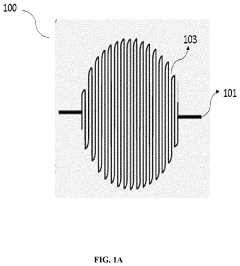
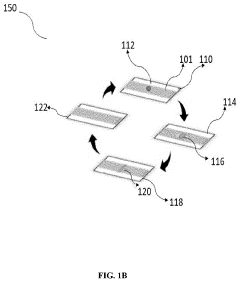
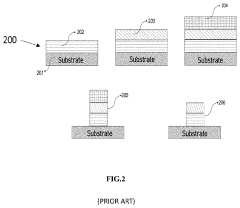
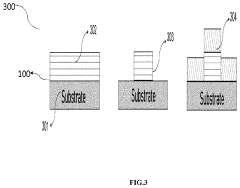
- A method and system for fabricating superconducting nanowire single photon detectors using high temperature superconductors with pulsed laser deposition, eliminating post-processing of superconducting thin films and gold encapsulation to maintain material quality and enable operation above 4 K.
Single photon detector for regulating superconducting NANO wire and preparation method therefor
PatentActiveUS20210184095A1
Innovation
- Introducing stress into the superconducting nanowire using ion implantation to adjust the critical temperature while maintaining material uniformity and optical absorption, thereby enhancing the intrinsic detection efficiency.


Quantum Cryptography Standards and Protocols
Quantum cryptography standards and protocols have evolved significantly to accommodate the integration of Superconducting Nanowire Single-Photon Detectors (SNSPDs) in Quantum Key Distribution (QKD) systems. The International Telecommunication Union (ITU) has established the Y.3800 series recommendations specifically addressing quantum key distribution networks, providing a framework for implementing SNSPDs within standardized QKD infrastructures.
The European Telecommunications Standards Institute (ETSI) has developed comprehensive standards through its Industry Specification Group for QKD (ISG-QKD), which includes protocols optimized for single-photon detection using SNSPDs. These standards address critical aspects such as key generation rates, quantum bit error rates, and security parameters that directly impact SNSPD implementation requirements.
BB84 remains the most widely implemented QKD protocol, with specific adaptations for SNSPD-based systems that leverage their superior timing resolution and detection efficiency. The protocol's time-bin encoding variation has proven particularly effective when paired with SNSPDs, achieving secure key rates exceeding 1 Mbps over metropolitan distances in field deployments.
Measurement-Device-Independent QKD (MDI-QKD) protocols have gained prominence as they eliminate detector-side channel attacks, a critical consideration when implementing high-performance SNSPDs. These protocols utilize Bell state measurements with coincidence detection, where SNSPDs' low timing jitter (typically <30ps) provides a significant advantage in distinguishing quantum states accurately.
The Coherent One-Way (COW) protocol has been optimized specifically for SNSPD implementation, taking advantage of their high detection efficiency at telecom wavelengths. Commercial implementations using this protocol have demonstrated stable operation in installed fiber networks with key rates suitable for practical encryption applications.
Continuous-Variable QKD (CV-QKD) protocols represent an alternative approach that traditionally relied on homodyne detection rather than single-photon detection. However, recent hybrid protocols have emerged that combine discrete and continuous variables, utilizing SNSPDs for specific measurement stages and enhancing overall system performance.
Standardization efforts are increasingly focusing on interoperability between different QKD systems. The ETSI GS QKD 014 specification addresses interface requirements that enable SNSPD-based QKD systems from different vendors to operate within the same quantum network infrastructure, facilitating wider adoption of this technology in commercial applications.
The European Telecommunications Standards Institute (ETSI) has developed comprehensive standards through its Industry Specification Group for QKD (ISG-QKD), which includes protocols optimized for single-photon detection using SNSPDs. These standards address critical aspects such as key generation rates, quantum bit error rates, and security parameters that directly impact SNSPD implementation requirements.
BB84 remains the most widely implemented QKD protocol, with specific adaptations for SNSPD-based systems that leverage their superior timing resolution and detection efficiency. The protocol's time-bin encoding variation has proven particularly effective when paired with SNSPDs, achieving secure key rates exceeding 1 Mbps over metropolitan distances in field deployments.
Measurement-Device-Independent QKD (MDI-QKD) protocols have gained prominence as they eliminate detector-side channel attacks, a critical consideration when implementing high-performance SNSPDs. These protocols utilize Bell state measurements with coincidence detection, where SNSPDs' low timing jitter (typically <30ps) provides a significant advantage in distinguishing quantum states accurately.
The Coherent One-Way (COW) protocol has been optimized specifically for SNSPD implementation, taking advantage of their high detection efficiency at telecom wavelengths. Commercial implementations using this protocol have demonstrated stable operation in installed fiber networks with key rates suitable for practical encryption applications.
Continuous-Variable QKD (CV-QKD) protocols represent an alternative approach that traditionally relied on homodyne detection rather than single-photon detection. However, recent hybrid protocols have emerged that combine discrete and continuous variables, utilizing SNSPDs for specific measurement stages and enhancing overall system performance.
Standardization efforts are increasingly focusing on interoperability between different QKD systems. The ETSI GS QKD 014 specification addresses interface requirements that enable SNSPD-based QKD systems from different vendors to operate within the same quantum network infrastructure, facilitating wider adoption of this technology in commercial applications.
SNSPD Manufacturing Challenges and Solutions
The manufacturing of Superconducting Nanowire Single Photon Detectors (SNSPDs) presents significant challenges due to the precision and specialized conditions required. One primary challenge is the deposition of ultrathin superconducting films, typically 4-10 nm thick, which must maintain uniform thickness and composition across the substrate. Even minor variations can lead to inconsistent detection efficiency and increased dark count rates, compromising the detector's performance in quantum key distribution (QKD) applications.
Material selection poses another critical challenge. While niobium nitride (NbN) has been traditionally used, newer materials like tungsten silicide (WSi) and molybdenum silicide (MoSi) offer improved detection efficiency at specific wavelengths. However, these materials require precise stoichiometric control during deposition, adding complexity to the manufacturing process.
Nanopatterning of the meandering wire structure demands advanced lithography techniques. Electron beam lithography is commonly employed for its nanometer-scale precision, but this process is inherently slow and expensive, limiting mass production capabilities. The nanowire width must be controlled within 50-100 nm with minimal edge roughness to prevent current crowding effects that can degrade performance.
Integration challenges extend to coupling SNSPDs with optical fibers or waveguides. Achieving high coupling efficiency requires precise alignment between the active area of the detector and the optical path, often necessitating complex packaging solutions that maintain alignment stability across cryogenic temperature cycles.
The cryogenic packaging of SNSPDs represents a significant manufacturing hurdle. These detectors typically operate at temperatures below 3K, requiring specialized cryostats or closed-cycle refrigeration systems. Thermal management within these packages must ensure uniform cooling while minimizing thermal loads from electrical connections.
Industry solutions have emerged to address these challenges. Advanced thin film deposition techniques like atomic layer deposition (ALD) provide better thickness control. Multi-layer photolithography processes combined with reactive ion etching have improved nanopatterning efficiency. Self-aligning optical coupling techniques using silicon photonics platforms have enhanced integration capabilities.
Commercial entities like Single Quantum, Quantum Opus, and Photon Spot have developed standardized SNSPD modules with integrated cooling and readout electronics, simplifying deployment in QKD systems. Collaborative efforts between academic institutions and industry partners have established best practices for material characterization and quality control, gradually improving manufacturing yields and reducing costs.
Material selection poses another critical challenge. While niobium nitride (NbN) has been traditionally used, newer materials like tungsten silicide (WSi) and molybdenum silicide (MoSi) offer improved detection efficiency at specific wavelengths. However, these materials require precise stoichiometric control during deposition, adding complexity to the manufacturing process.
Nanopatterning of the meandering wire structure demands advanced lithography techniques. Electron beam lithography is commonly employed for its nanometer-scale precision, but this process is inherently slow and expensive, limiting mass production capabilities. The nanowire width must be controlled within 50-100 nm with minimal edge roughness to prevent current crowding effects that can degrade performance.
Integration challenges extend to coupling SNSPDs with optical fibers or waveguides. Achieving high coupling efficiency requires precise alignment between the active area of the detector and the optical path, often necessitating complex packaging solutions that maintain alignment stability across cryogenic temperature cycles.
The cryogenic packaging of SNSPDs represents a significant manufacturing hurdle. These detectors typically operate at temperatures below 3K, requiring specialized cryostats or closed-cycle refrigeration systems. Thermal management within these packages must ensure uniform cooling while minimizing thermal loads from electrical connections.
Industry solutions have emerged to address these challenges. Advanced thin film deposition techniques like atomic layer deposition (ALD) provide better thickness control. Multi-layer photolithography processes combined with reactive ion etching have improved nanopatterning efficiency. Self-aligning optical coupling techniques using silicon photonics platforms have enhanced integration capabilities.
Commercial entities like Single Quantum, Quantum Opus, and Photon Spot have developed standardized SNSPD modules with integrated cooling and readout electronics, simplifying deployment in QKD systems. Collaborative efforts between academic institutions and industry partners have established best practices for material characterization and quality control, gradually improving manufacturing yields and reducing costs.
Unlock deeper insights with PatSnap Eureka Quick Research — get a full tech report to explore trends and direct your research. Try now!
Generate Your Research Report Instantly with AI Agent
Supercharge your innovation with PatSnap Eureka AI Agent Platform!