

SNSPD Detector Modeling From Electrothermal First Principles
AUG 28, 202510 MIN READ
Generate Your Research Report Instantly with AI Agent
PatSnap Eureka helps you evaluate technical feasibility & market potential.
SNSPD Technology Background and Objectives
Superconducting Nanowire Single-Photon Detectors (SNSPDs) have emerged as a revolutionary technology in quantum information processing and quantum communication systems over the past two decades. These detectors leverage the unique properties of superconducting materials to achieve unprecedented performance in photon detection efficiency, timing resolution, and dark count rates. The fundamental operating principle relies on the transition of a superconducting nanowire from the superconducting state to the normal state upon absorption of a single photon, creating a detectable voltage pulse.
The evolution of SNSPD technology traces back to the early 2000s when researchers first demonstrated the concept using niobium nitride (NbN) thin films. Since then, significant advancements have been made in materials science, fabrication techniques, and device architectures. The field has witnessed a transition from simple straight nanowires to complex meandering patterns and waveguide-integrated designs, enabling higher detection efficiencies and broader spectral responses.
Current technological trends in SNSPD development focus on several key areas: expanding the operational wavelength range beyond the traditional telecom bands, increasing the maximum count rates through improved reset times, enhancing system-level integration for practical quantum applications, and developing multi-pixel arrays for imaging and multiplexed detection capabilities. Additionally, there is growing interest in understanding and optimizing the fundamental electrothermal processes that govern detector performance.
The primary objective of electrothermal modeling from first principles is to establish a comprehensive theoretical framework that accurately describes the complex interplay between electrical, thermal, and quantum mechanical phenomena in SNSPDs. This modeling approach aims to bridge the gap between empirical observations and fundamental physics, enabling more precise prediction of detector behavior under various operating conditions.
Specific technical goals include developing accurate models for the hotspot formation process, understanding the influence of material properties and geometry on detection efficiency, predicting timing jitter contributions from various physical mechanisms, and optimizing the thermal recovery dynamics to enhance reset times. These models must account for nanoscale heat diffusion, electron-phonon coupling, vortex dynamics, and other quantum effects relevant at operating temperatures near absolute zero.
By achieving these objectives, researchers and engineers can design next-generation SNSPDs with optimized performance metrics tailored to specific applications, ranging from quantum key distribution and optical quantum computing to deep-space optical communications and advanced astronomical observations. The ultimate goal is to establish a robust design methodology that reduces the reliance on empirical testing and accelerates the development cycle for novel SNSPD architectures.
The evolution of SNSPD technology traces back to the early 2000s when researchers first demonstrated the concept using niobium nitride (NbN) thin films. Since then, significant advancements have been made in materials science, fabrication techniques, and device architectures. The field has witnessed a transition from simple straight nanowires to complex meandering patterns and waveguide-integrated designs, enabling higher detection efficiencies and broader spectral responses.
Current technological trends in SNSPD development focus on several key areas: expanding the operational wavelength range beyond the traditional telecom bands, increasing the maximum count rates through improved reset times, enhancing system-level integration for practical quantum applications, and developing multi-pixel arrays for imaging and multiplexed detection capabilities. Additionally, there is growing interest in understanding and optimizing the fundamental electrothermal processes that govern detector performance.
The primary objective of electrothermal modeling from first principles is to establish a comprehensive theoretical framework that accurately describes the complex interplay between electrical, thermal, and quantum mechanical phenomena in SNSPDs. This modeling approach aims to bridge the gap between empirical observations and fundamental physics, enabling more precise prediction of detector behavior under various operating conditions.
Specific technical goals include developing accurate models for the hotspot formation process, understanding the influence of material properties and geometry on detection efficiency, predicting timing jitter contributions from various physical mechanisms, and optimizing the thermal recovery dynamics to enhance reset times. These models must account for nanoscale heat diffusion, electron-phonon coupling, vortex dynamics, and other quantum effects relevant at operating temperatures near absolute zero.
By achieving these objectives, researchers and engineers can design next-generation SNSPDs with optimized performance metrics tailored to specific applications, ranging from quantum key distribution and optical quantum computing to deep-space optical communications and advanced astronomical observations. The ultimate goal is to establish a robust design methodology that reduces the reliance on empirical testing and accelerates the development cycle for novel SNSPD architectures.
Market Applications and Demand Analysis for SNSPD Detectors
The market for Superconducting Nanowire Single-Photon Detectors (SNSPDs) has experienced significant growth driven by advancements in quantum technologies and photonics applications. Current market analysis indicates a robust demand trajectory, particularly in quantum computing, quantum cryptography, and advanced scientific research sectors.
Quantum information processing represents the primary market driver for SNSPD technology. Quantum computers require highly efficient single-photon detection capabilities for quantum state measurement and error correction protocols. The quantum computing market, valued at approximately $866 million in 2023, is projected to grow at a CAGR of 38.3% through 2030, creating substantial demand for high-performance photon detection systems.
Quantum cryptography and communications, particularly Quantum Key Distribution (QKD) systems, constitute another major application area. These systems rely on the detection of individual photons to ensure secure communication channels. The global quantum cryptography market is expanding rapidly as governments and financial institutions invest in quantum-secure communication infrastructure, creating sustained demand for advanced detector technologies.
Deep-space optical communications represent an emerging application field where SNSPDs offer significant advantages over traditional detector technologies. Space agencies are increasingly adopting optical communication systems for higher data transmission rates, with SNSPDs enabling reliable photon detection from distant spacecraft and satellites.
Biomedical imaging applications, particularly time-correlated single-photon counting techniques, are creating new market opportunities. Advanced fluorescence lifetime imaging microscopy (FLIM) and other photon-counting imaging modalities benefit from the superior timing resolution and detection efficiency of SNSPDs, expanding their application beyond traditional physics research environments.
Industry analysis reveals that current market penetration remains limited by production scalability challenges and operating requirements. The necessity for cryogenic cooling systems increases implementation costs and complexity, restricting widespread adoption. However, recent developments in closed-cycle cryocooler technology are gradually reducing these barriers.
Market forecasts indicate that demand for electrothermal modeling capabilities will grow proportionally with the SNSPD market itself. As commercial applications expand, manufacturers require more sophisticated modeling tools to optimize detector performance, improve yield rates, and reduce production costs. This creates a parallel market for simulation software and design tools based on first-principles electrothermal modeling approaches.
Regional market analysis shows North America leading in SNSPD adoption, followed by Europe and Asia-Pacific regions. China has demonstrated particularly aggressive investment in quantum technologies, including detector development, as part of its national strategic technology initiatives.
Quantum information processing represents the primary market driver for SNSPD technology. Quantum computers require highly efficient single-photon detection capabilities for quantum state measurement and error correction protocols. The quantum computing market, valued at approximately $866 million in 2023, is projected to grow at a CAGR of 38.3% through 2030, creating substantial demand for high-performance photon detection systems.
Quantum cryptography and communications, particularly Quantum Key Distribution (QKD) systems, constitute another major application area. These systems rely on the detection of individual photons to ensure secure communication channels. The global quantum cryptography market is expanding rapidly as governments and financial institutions invest in quantum-secure communication infrastructure, creating sustained demand for advanced detector technologies.
Deep-space optical communications represent an emerging application field where SNSPDs offer significant advantages over traditional detector technologies. Space agencies are increasingly adopting optical communication systems for higher data transmission rates, with SNSPDs enabling reliable photon detection from distant spacecraft and satellites.
Biomedical imaging applications, particularly time-correlated single-photon counting techniques, are creating new market opportunities. Advanced fluorescence lifetime imaging microscopy (FLIM) and other photon-counting imaging modalities benefit from the superior timing resolution and detection efficiency of SNSPDs, expanding their application beyond traditional physics research environments.
Industry analysis reveals that current market penetration remains limited by production scalability challenges and operating requirements. The necessity for cryogenic cooling systems increases implementation costs and complexity, restricting widespread adoption. However, recent developments in closed-cycle cryocooler technology are gradually reducing these barriers.
Market forecasts indicate that demand for electrothermal modeling capabilities will grow proportionally with the SNSPD market itself. As commercial applications expand, manufacturers require more sophisticated modeling tools to optimize detector performance, improve yield rates, and reduce production costs. This creates a parallel market for simulation software and design tools based on first-principles electrothermal modeling approaches.
Regional market analysis shows North America leading in SNSPD adoption, followed by Europe and Asia-Pacific regions. China has demonstrated particularly aggressive investment in quantum technologies, including detector development, as part of its national strategic technology initiatives.
Current Electrothermal Modeling Challenges
Despite significant advancements in superconducting nanowire single-photon detector (SNSPD) technology, current electrothermal modeling approaches face several critical challenges that limit our ability to fully optimize detector performance. The fundamental difficulty lies in accurately capturing the complex interplay between electrical, thermal, and quantum mechanical processes occurring at nanoscale dimensions and ultrafast timescales.
One primary challenge is the multi-scale nature of the physical phenomena involved. Electrothermal models must simultaneously account for processes spanning from sub-nanometer electron-phonon interactions to micrometer-scale thermal diffusion, while also capturing events occurring on timescales from picoseconds to microseconds. This extreme range of scales creates significant computational complexity that current numerical methods struggle to handle efficiently.
The accurate representation of material properties presents another substantial hurdle. Superconducting thin films exhibit properties that differ significantly from bulk materials, with characteristics highly dependent on fabrication processes, film thickness, and operating conditions. Parameters such as thermal conductivity, electron-phonon coupling strength, and superconducting energy gap show temperature and current density dependencies that are difficult to measure experimentally and incorporate into models.
Boundary conditions and interfaces between different materials introduce additional modeling complexities. The thermal boundary resistance between the nanowire and substrate critically affects detector recovery time but remains challenging to characterize precisely. Similarly, the interfaces between superconducting and normal metal regions create complex electrothermal dynamics that current models often simplify excessively.
Non-equilibrium phenomena represent perhaps the most significant modeling challenge. During photon detection events, the superconducting system is driven far from equilibrium, with electron and phonon subsystems at different effective temperatures. Most existing models rely on simplified two-temperature approximations that may not fully capture the complex non-equilibrium dynamics, particularly during the initial hotspot formation phase.
Computational limitations further constrain modeling capabilities. Full three-dimensional simulations incorporating all relevant physical processes require substantial computational resources, forcing researchers to make simplifications that may compromise model accuracy. The development of more efficient numerical methods and algorithms remains an active area of research.
Finally, validation of electrothermal models presents significant experimental challenges. The ultrafast nature of detection events makes direct measurement of internal detector dynamics extremely difficult, limiting our ability to verify model predictions against experimental data. This validation gap creates uncertainty in model reliability and predictive power for novel detector designs.
One primary challenge is the multi-scale nature of the physical phenomena involved. Electrothermal models must simultaneously account for processes spanning from sub-nanometer electron-phonon interactions to micrometer-scale thermal diffusion, while also capturing events occurring on timescales from picoseconds to microseconds. This extreme range of scales creates significant computational complexity that current numerical methods struggle to handle efficiently.
The accurate representation of material properties presents another substantial hurdle. Superconducting thin films exhibit properties that differ significantly from bulk materials, with characteristics highly dependent on fabrication processes, film thickness, and operating conditions. Parameters such as thermal conductivity, electron-phonon coupling strength, and superconducting energy gap show temperature and current density dependencies that are difficult to measure experimentally and incorporate into models.
Boundary conditions and interfaces between different materials introduce additional modeling complexities. The thermal boundary resistance between the nanowire and substrate critically affects detector recovery time but remains challenging to characterize precisely. Similarly, the interfaces between superconducting and normal metal regions create complex electrothermal dynamics that current models often simplify excessively.
Non-equilibrium phenomena represent perhaps the most significant modeling challenge. During photon detection events, the superconducting system is driven far from equilibrium, with electron and phonon subsystems at different effective temperatures. Most existing models rely on simplified two-temperature approximations that may not fully capture the complex non-equilibrium dynamics, particularly during the initial hotspot formation phase.
Computational limitations further constrain modeling capabilities. Full three-dimensional simulations incorporating all relevant physical processes require substantial computational resources, forcing researchers to make simplifications that may compromise model accuracy. The development of more efficient numerical methods and algorithms remains an active area of research.
Finally, validation of electrothermal models presents significant experimental challenges. The ultrafast nature of detection events makes direct measurement of internal detector dynamics extremely difficult, limiting our ability to verify model predictions against experimental data. This validation gap creates uncertainty in model reliability and predictive power for novel detector designs.
State-of-the-Art Electrothermal Modeling Approaches
01 Electrothermal modeling of SNSPD detection mechanisms
Electrothermal modeling is used to understand the fundamental detection mechanisms in Superconducting Nanowire Single-Photon Detectors (SNSPDs). These models simulate the thermal and electrical processes that occur when a photon is absorbed by the superconducting nanowire, causing a transition from the superconducting to the resistive state. The models account for heat diffusion, electron-phonon interactions, and the formation of a resistive hotspot that leads to a measurable voltage pulse.- Electrothermal modeling techniques for SNSPD: Various electrothermal modeling techniques are employed to understand the thermal and electrical behavior of Superconducting Nanowire Single-Photon Detectors. These models simulate the heat distribution, current flow, and phase transitions in nanowires when a photon is absorbed. Advanced computational methods help predict detector performance parameters such as detection efficiency, recovery time, and dark count rates by analyzing the complex interplay between electrical and thermal phenomena in superconducting materials at cryogenic temperatures.
- Nanowire material optimization for thermal response: Research focuses on optimizing nanowire materials to enhance the electrothermal response in SNSPDs. Different superconducting materials such as NbN, WSi, and MoSi are studied for their thermal properties and hotspot formation characteristics. The composition, thickness, and crystalline structure of these materials significantly impact the detector's sensitivity, speed, and quantum efficiency. Material engineering approaches aim to achieve the optimal balance between critical current density, thermal conductivity, and superconducting transition temperature.
- Hotspot formation and evolution dynamics: The study of hotspot formation and evolution is crucial for SNSPD electrothermal modeling. When a photon is absorbed by the superconducting nanowire, it creates a localized region of elevated temperature (hotspot) that disrupts the superconducting state. Models describe how this hotspot expands, interacts with the bias current, and eventually leads to a measurable voltage pulse. Understanding these dynamics helps optimize detector design for improved timing resolution, reduced jitter, and higher detection efficiency across different wavelengths.
- Readout circuit and bias current optimization: Electrothermal models help optimize the readout circuits and bias current configurations for SNSPDs. The interaction between the detector's thermal response and the electrical readout system significantly impacts overall performance. Models simulate how different bias conditions affect the detector's recovery time, latching probability, and afterpulsing behavior. Advanced circuit designs incorporating impedance matching, amplification stages, and feedback mechanisms can be evaluated through electrothermal simulations to maximize signal-to-noise ratio and counting rates.
- Multi-pixel array thermal crosstalk analysis: For multi-pixel SNSPD arrays, electrothermal modeling addresses thermal crosstalk between adjacent nanowires. When one detector element registers a photon and generates a hotspot, the heat can propagate to neighboring elements, potentially causing false detections or reduced sensitivity. Models analyze heat diffusion through the substrate and between nanowires to optimize pixel spacing, thermal isolation structures, and heat sinking approaches. These simulations help design large-scale arrays with minimal crosstalk while maintaining high fill factors and uniform detection characteristics across all pixels.
02 Nanowire material optimization for SNSPD performance
The choice and optimization of nanowire materials significantly impact SNSPD performance. Electrothermal modeling helps in selecting appropriate superconducting materials and optimizing their properties such as critical temperature, critical current density, and thermal conductivity. Materials like niobium nitride (NbN), niobium titanium nitride (NbTiN), and amorphous tungsten silicide (WSi) are commonly studied, with models predicting how their intrinsic properties affect detector efficiency, reset time, and dark count rates.Expand Specific Solutions03 Geometric design optimization using electrothermal simulations
Electrothermal modeling enables the optimization of SNSPD geometric designs, including nanowire width, thickness, and meandering patterns. These simulations predict how geometry affects key performance metrics such as detection efficiency, timing jitter, and recovery time. Advanced designs like parallel nanowire configurations, tapered structures, and waveguide-integrated geometries can be evaluated through electrothermal simulations before fabrication, saving time and resources in the development process.Expand Specific Solutions04 Thermal management and substrate engineering
Electrothermal models address thermal management challenges in SNSPDs, particularly the heat dissipation through the substrate. These models simulate how different substrate materials and structures affect the thermal boundary resistance and heat flow from the nanowire. Engineered substrates with optimized thermal properties can improve detector reset time and maximum count rate. The models also help in designing effective cooling strategies and predicting thermal crosstalk in detector arrays.Expand Specific Solutions05 Bias current and readout circuit optimization
Electrothermal modeling assists in optimizing the bias current and readout circuit design for SNSPDs. These models simulate the interaction between the electrical bias conditions and the thermal evolution of the hotspot, predicting how bias current affects detection efficiency, latching probability, and afterpulsing. Advanced readout schemes, including impedance matching networks and cryogenic amplifiers, can be designed based on electrothermal simulations to maximize signal-to-noise ratio and minimize timing jitter.Expand Specific Solutions
Leading Research Groups and Commercial Players
The SNSPD detector modeling market is currently in an early growth phase, characterized by increasing research activity and emerging commercial applications. The global superconducting detector market is expanding, with projections suggesting significant growth as quantum technologies mature. Technologically, the field shows moderate maturity with academic institutions leading fundamental research while specialized companies develop commercial applications. Shanghai Institute of Microsystem & Information Technology, MIT, and Single Quantum BV represent key academic-industrial players advancing electrothermal modeling approaches. Other significant contributors include ID Quantique, PsiQuantum, and Photonic Inc., who are integrating SNSPD technology into quantum computing and communication systems. The collaboration between research institutions like Nanjing University and ICFO with commercial entities is accelerating the transition from theoretical models to practical implementations.
Shanghai Institute of Microsystem & Information Technology
Technical Solution: Shanghai Institute of Microsystem & Information Technology (SIMIT) has developed a comprehensive electrothermal modeling approach for Superconducting Nanowire Single-Photon Detectors (SNSPDs). Their model integrates both electrical and thermal dynamics in a two-temperature framework that accounts for electron-phonon coupling in superconducting nanowires. SIMIT researchers have implemented finite element analysis to simulate the spatiotemporal evolution of hotspot formation following photon absorption, capturing the complex interplay between Joule heating, thermal diffusion, and superconducting phase transitions[1]. Their approach incorporates material-specific parameters for NbN, WSi, and MoSi superconducting films, allowing for accurate prediction of detection efficiency, timing jitter, and recovery time across different operating temperatures and bias currents[3]. SIMIT has validated their models against experimental measurements, demonstrating strong correlation between simulated and measured detector performance metrics.
Strengths: Strong integration of both electrical and thermal physics in their modeling approach; extensive experimental validation capabilities; expertise in various superconducting materials. Weaknesses: Models may require significant computational resources; some simplifications in the treatment of quantum effects at nanoscale dimensions may limit accuracy in certain edge cases.
ID Quantique SA
Technical Solution: ID Quantique has developed proprietary electrothermal modeling tools for SNSPDs that focus on practical implementation and system-level performance optimization. Their approach combines first-principles physics with empirical models calibrated through extensive testing of commercial detector systems. ID Quantique's modeling framework incorporates the effects of bias current distribution, thermal coupling to substrates, and optical absorption efficiency to predict real-world detector performance metrics[6]. Their models specifically address the challenges of scaling detector arrays and integrating SNSPDs with readout electronics, accounting for electrical parasitics and thermal crosstalk between adjacent nanowires[7]. ID Quantique has implemented temperature-dependent material parameters and geometry-specific current crowding effects to accurately predict detection efficiency across different wavelengths. Their modeling tools enable rapid prototyping and optimization of detector designs for specific applications, balancing quantum efficiency, dark count rate, and timing performance based on customer requirements.
Strengths: Strong focus on practical implementation and system-level integration; models calibrated with extensive real-world testing data; optimization for commercial applications. Weaknesses: Models may prioritize practical utility over fundamental physics in some cases; proprietary nature limits academic validation and peer review.
Key Theoretical Frameworks and Simulation Methods
Method and systems for fabricating superconducting nanowire single photon detector (SNSPD)
PatentPendingUS20230031577A1
Innovation
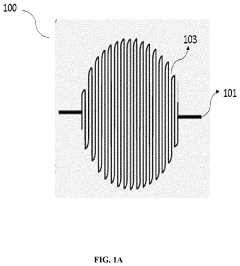
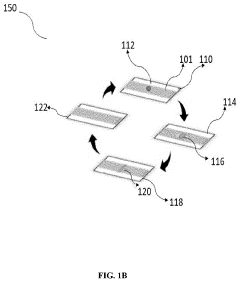
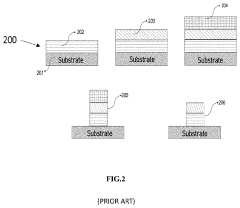
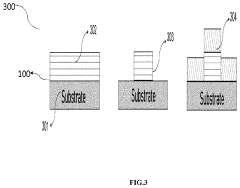
- A method and system for fabricating superconducting nanowire single photon detectors using high temperature superconductors with pulsed laser deposition, eliminating post-processing of superconducting thin films and gold encapsulation to maintain material quality and enable operation above 4 K.
Quantum Information Processing Integration Opportunities
The integration of SNSPD (Superconducting Nanowire Single Photon Detector) technology into quantum information processing systems represents a significant opportunity for advancing quantum computing, communication, and sensing applications. SNSPDs offer unparalleled performance in terms of detection efficiency, timing resolution, and dark count rates, making them ideal components for quantum information architectures.
Quantum computing platforms that rely on photonic qubits can benefit substantially from SNSPD integration. The ability to accurately model SNSPD behavior from electrothermal first principles enables precise optimization of detector parameters for specific quantum computing requirements, such as high-fidelity qubit readout and quantum gate operations. This modeling capability allows for customization of detection characteristics to match the specific wavelengths and timing requirements of different quantum computing architectures.
In quantum communication networks, particularly quantum key distribution (QKD) systems, SNSPDs serve as critical components for secure information transfer. Electrothermal modeling facilitates the development of detectors with optimized sensitivity at telecommunication wavelengths, enabling long-distance quantum communication through existing fiber infrastructure. The precise understanding of detection mechanisms also supports the development of countermeasures against side-channel attacks that might target detector vulnerabilities.
Integrated quantum photonic circuits represent another promising integration opportunity. By incorporating SNSPDs directly into photonic integrated circuits, researchers can develop compact, scalable quantum information processing systems. Accurate electrothermal modeling enables co-design of detectors with waveguides, beam splitters, and other photonic components, ensuring optimal performance of the integrated system.
Quantum sensing and metrology applications also benefit from SNSPD integration. The high timing resolution of these detectors enables precise measurements for quantum-enhanced sensing applications, including quantum radar, quantum imaging, and quantum-enhanced microscopy. Electrothermal modeling allows for optimization of detector parameters to achieve the quantum advantage in these sensing applications.
Multi-pixel SNSPD arrays, enabled by advanced modeling techniques, open possibilities for parallel quantum information processing. These arrays can simultaneously detect multiple photons across different spatial modes, supporting applications such as boson sampling, quantum machine learning, and multi-qubit operations in photonic quantum computers.
The integration of SNSPDs with cryogenic control electronics represents a frontier opportunity for creating fully integrated quantum information processing systems. Electrothermal modeling that accounts for the interaction between detectors and readout electronics can guide the development of optimized cryogenic readout circuits, reducing latency and improving system performance.
Quantum computing platforms that rely on photonic qubits can benefit substantially from SNSPD integration. The ability to accurately model SNSPD behavior from electrothermal first principles enables precise optimization of detector parameters for specific quantum computing requirements, such as high-fidelity qubit readout and quantum gate operations. This modeling capability allows for customization of detection characteristics to match the specific wavelengths and timing requirements of different quantum computing architectures.
In quantum communication networks, particularly quantum key distribution (QKD) systems, SNSPDs serve as critical components for secure information transfer. Electrothermal modeling facilitates the development of detectors with optimized sensitivity at telecommunication wavelengths, enabling long-distance quantum communication through existing fiber infrastructure. The precise understanding of detection mechanisms also supports the development of countermeasures against side-channel attacks that might target detector vulnerabilities.
Integrated quantum photonic circuits represent another promising integration opportunity. By incorporating SNSPDs directly into photonic integrated circuits, researchers can develop compact, scalable quantum information processing systems. Accurate electrothermal modeling enables co-design of detectors with waveguides, beam splitters, and other photonic components, ensuring optimal performance of the integrated system.
Quantum sensing and metrology applications also benefit from SNSPD integration. The high timing resolution of these detectors enables precise measurements for quantum-enhanced sensing applications, including quantum radar, quantum imaging, and quantum-enhanced microscopy. Electrothermal modeling allows for optimization of detector parameters to achieve the quantum advantage in these sensing applications.
Multi-pixel SNSPD arrays, enabled by advanced modeling techniques, open possibilities for parallel quantum information processing. These arrays can simultaneously detect multiple photons across different spatial modes, supporting applications such as boson sampling, quantum machine learning, and multi-qubit operations in photonic quantum computers.
The integration of SNSPDs with cryogenic control electronics represents a frontier opportunity for creating fully integrated quantum information processing systems. Electrothermal modeling that accounts for the interaction between detectors and readout electronics can guide the development of optimized cryogenic readout circuits, reducing latency and improving system performance.
Cryogenic System Requirements and Limitations
Superconducting Nanowire Single-Photon Detectors (SNSPDs) operate at extremely low temperatures, typically below 4 Kelvin, which necessitates sophisticated cryogenic systems. These systems must maintain stable ultra-low temperatures while accommodating various operational constraints. The primary cooling methods employed include liquid helium-based systems, closed-cycle refrigerators, and dilution refrigerators, each offering different temperature ranges and cooling capacities.
Liquid helium systems provide temperatures down to approximately 4.2K but require regular replenishment of helium, which is increasingly expensive and scarce. Closed-cycle refrigerators, particularly pulse tube coolers, have become more prevalent due to their lower operational costs and maintenance requirements, though they introduce mechanical vibrations that can affect detector performance. Dilution refrigerators can reach temperatures below 100mK, enabling exploration of quantum effects in superconducting materials, but at significantly higher system complexity and cost.
The thermal budget represents a critical limitation in SNSPD operation. Heat loads from various sources—including radiation shields, electrical connections, and readout electronics—must be carefully managed. Thermal anchoring techniques and specialized low-thermal-conductivity wiring are essential to minimize heat transfer to the detector stage. Additionally, the cooling power at the lowest temperature stages is typically limited to microwatts or less, constraining the number of detectors that can be simultaneously operated.
Vibration isolation presents another significant challenge, as mechanical vibrations can induce false counts or degrade timing resolution in SNSPDs. Advanced vibration isolation platforms and pulse tube coolers with reduced vibration characteristics have been developed to address this issue, though complete elimination remains difficult in practical systems.
The physical space constraints within cryostats also limit detector array sizes and integration possibilities. Modern designs increasingly incorporate specialized radiation shields, optical access paths, and RF feedthroughs to accommodate complex experimental setups while maintaining thermal isolation. The trade-off between optical access and thermal isolation is particularly challenging, requiring innovative solutions such as fiber-coupled designs or specialized optical windows with minimal heat load.
Electrothermal modeling of SNSPDs must account for these cryogenic system limitations, particularly the temperature stability and gradients across the detector. Fluctuations as small as a few millikelvin can significantly impact detector performance parameters such as detection efficiency, timing jitter, and dark count rates. Comprehensive models must therefore incorporate the dynamic thermal environment created by the cryogenic system to accurately predict detector behavior under realistic operating conditions.
Liquid helium systems provide temperatures down to approximately 4.2K but require regular replenishment of helium, which is increasingly expensive and scarce. Closed-cycle refrigerators, particularly pulse tube coolers, have become more prevalent due to their lower operational costs and maintenance requirements, though they introduce mechanical vibrations that can affect detector performance. Dilution refrigerators can reach temperatures below 100mK, enabling exploration of quantum effects in superconducting materials, but at significantly higher system complexity and cost.
The thermal budget represents a critical limitation in SNSPD operation. Heat loads from various sources—including radiation shields, electrical connections, and readout electronics—must be carefully managed. Thermal anchoring techniques and specialized low-thermal-conductivity wiring are essential to minimize heat transfer to the detector stage. Additionally, the cooling power at the lowest temperature stages is typically limited to microwatts or less, constraining the number of detectors that can be simultaneously operated.
Vibration isolation presents another significant challenge, as mechanical vibrations can induce false counts or degrade timing resolution in SNSPDs. Advanced vibration isolation platforms and pulse tube coolers with reduced vibration characteristics have been developed to address this issue, though complete elimination remains difficult in practical systems.
The physical space constraints within cryostats also limit detector array sizes and integration possibilities. Modern designs increasingly incorporate specialized radiation shields, optical access paths, and RF feedthroughs to accommodate complex experimental setups while maintaining thermal isolation. The trade-off between optical access and thermal isolation is particularly challenging, requiring innovative solutions such as fiber-coupled designs or specialized optical windows with minimal heat load.
Electrothermal modeling of SNSPDs must account for these cryogenic system limitations, particularly the temperature stability and gradients across the detector. Fluctuations as small as a few millikelvin can significantly impact detector performance parameters such as detection efficiency, timing jitter, and dark count rates. Comprehensive models must therefore incorporate the dynamic thermal environment created by the cryogenic system to accurately predict detector behavior under realistic operating conditions.
Unlock deeper insights with PatSnap Eureka Quick Research — get a full tech report to explore trends and direct your research. Try now!
Generate Your Research Report Instantly with AI Agent
Supercharge your innovation with PatSnap Eureka AI Agent Platform!