

SNSPD Timing Calibration And Jitter Characterization Methods
AUG 28, 20259 MIN READ
Generate Your Research Report Instantly with AI Agent
PatSnap Eureka helps you evaluate technical feasibility & market potential.
SNSPD Technology Evolution and Calibration Objectives
Superconducting Nanowire Single-Photon Detectors (SNSPDs) have emerged as a revolutionary technology in quantum information processing, quantum communication, and quantum computing due to their exceptional detection efficiency, low dark count rates, and superior timing resolution. The evolution of SNSPD technology can be traced back to the early 2000s when the first practical demonstrations were achieved using niobium nitride (NbN) nanowires cooled to cryogenic temperatures.
The technological progression of SNSPDs has been marked by significant improvements in materials science, nanofabrication techniques, and cryogenic engineering. Early SNSPDs suffered from limited detection efficiency (below 20%) and relatively high timing jitter (>100 ps). However, through continuous refinement in nanowire geometry, material composition, and readout electronics, modern SNSPDs now routinely achieve detection efficiencies exceeding 90% and timing jitter below 20 ps.
A critical milestone in SNSPD development was the transition from simple linear nanowires to meandering patterns, which dramatically increased the active detection area while maintaining high performance. Subsequently, the introduction of optical cavities and waveguide integration further enhanced coupling efficiency and system performance. The incorporation of amorphous superconducting materials like WSi and MoSi represented another significant advancement, offering higher yield and more uniform performance compared to crystalline materials.
Timing calibration and jitter characterization have become increasingly important as SNSPDs find applications in time-critical quantum technologies. The evolution of calibration methods has progressed from basic time-correlated single-photon counting (TCSPC) approaches to sophisticated techniques involving femtosecond lasers and precision delay lines. Early calibration methods typically achieved timing accuracies in the range of tens of picoseconds, whereas current state-of-the-art techniques can reach sub-picosecond precision.
The primary objectives of modern SNSPD timing calibration are threefold: achieving absolute timing accuracy for synchronization across distributed quantum systems, minimizing system jitter to enhance timing resolution, and ensuring long-term stability under varying operating conditions. These objectives are particularly crucial for applications such as quantum key distribution over long distances, where precise timing is essential for security protocols.
Current research trends are focused on developing automated, scalable calibration methods suitable for large SNSPD arrays, as quantum technologies move toward more complex multi-detector systems. Additionally, there is growing interest in understanding and mitigating environmental factors that affect timing performance, such as temperature fluctuations, electromagnetic interference, and mechanical vibrations.
The trajectory of SNSPD technology points toward integrated calibration systems that combine hardware precision with advanced software algorithms for real-time jitter compensation and drift correction, ultimately aiming to push timing resolution boundaries toward the fundamental physical limits.
The technological progression of SNSPDs has been marked by significant improvements in materials science, nanofabrication techniques, and cryogenic engineering. Early SNSPDs suffered from limited detection efficiency (below 20%) and relatively high timing jitter (>100 ps). However, through continuous refinement in nanowire geometry, material composition, and readout electronics, modern SNSPDs now routinely achieve detection efficiencies exceeding 90% and timing jitter below 20 ps.
A critical milestone in SNSPD development was the transition from simple linear nanowires to meandering patterns, which dramatically increased the active detection area while maintaining high performance. Subsequently, the introduction of optical cavities and waveguide integration further enhanced coupling efficiency and system performance. The incorporation of amorphous superconducting materials like WSi and MoSi represented another significant advancement, offering higher yield and more uniform performance compared to crystalline materials.
Timing calibration and jitter characterization have become increasingly important as SNSPDs find applications in time-critical quantum technologies. The evolution of calibration methods has progressed from basic time-correlated single-photon counting (TCSPC) approaches to sophisticated techniques involving femtosecond lasers and precision delay lines. Early calibration methods typically achieved timing accuracies in the range of tens of picoseconds, whereas current state-of-the-art techniques can reach sub-picosecond precision.
The primary objectives of modern SNSPD timing calibration are threefold: achieving absolute timing accuracy for synchronization across distributed quantum systems, minimizing system jitter to enhance timing resolution, and ensuring long-term stability under varying operating conditions. These objectives are particularly crucial for applications such as quantum key distribution over long distances, where precise timing is essential for security protocols.
Current research trends are focused on developing automated, scalable calibration methods suitable for large SNSPD arrays, as quantum technologies move toward more complex multi-detector systems. Additionally, there is growing interest in understanding and mitigating environmental factors that affect timing performance, such as temperature fluctuations, electromagnetic interference, and mechanical vibrations.
The trajectory of SNSPD technology points toward integrated calibration systems that combine hardware precision with advanced software algorithms for real-time jitter compensation and drift correction, ultimately aiming to push timing resolution boundaries toward the fundamental physical limits.
Market Applications and Demand for High-Precision SNSPD Systems
The demand for high-precision Superconducting Nanowire Single-Photon Detector (SNSPD) systems has been growing significantly across multiple sectors due to their unparalleled timing resolution and detection efficiency. The global quantum technology market, where SNSPDs play a crucial role, is projected to reach $32 billion by 2030, with an annual growth rate of approximately 25% between 2023 and 2030.
Quantum communication represents the most mature application area for high-precision SNSPDs. These systems are fundamental components in quantum key distribution (QKD) networks, where timing precision directly impacts secure key generation rates and transmission distances. Commercial QKD networks in metropolitan areas across Asia, Europe, and North America have already deployed SNSPDs with sub-50 picosecond timing resolution.
The quantum computing sector presents another significant market opportunity. As quantum computers scale beyond 100 qubits, the need for precise readout systems becomes critical. SNSPDs with advanced timing calibration are increasingly being integrated into quantum computing architectures by major industry players including IBM, Google, and various specialized quantum startups.
In scientific research, particularly high-energy physics and astronomy, the demand for precisely calibrated SNSPDs continues to expand. Large-scale experiments such as those at CERN and major astronomical observatories require detector systems with timing jitter below 20 picoseconds to capture fleeting quantum phenomena or distant cosmic events.
The biomedical imaging sector has emerged as a rapidly growing application area. Fluorescence lifetime imaging microscopy (FLIM) and positron emission tomography (PET) benefit tremendously from the picosecond timing resolution that well-calibrated SNSPDs provide. The global biomedical imaging market segment utilizing advanced photon detection is growing at 18% annually, with SNSPD systems capturing an increasing share.
Defense and security applications represent a high-value market segment where timing precision is paramount. LIDAR systems for autonomous navigation, secure communications, and long-range sensing all benefit from SNSPDs with minimal timing jitter. Government contracts in this sector often exceed $50 million for specialized photonic systems.
Industry analysis indicates that the market increasingly demands not just high-performance SNSPDs, but complete systems with automated calibration capabilities and comprehensive jitter characterization. End users across sectors are willing to pay premium prices for systems that maintain sub-10 picosecond timing precision with minimal maintenance requirements and clear performance metrics.
Quantum communication represents the most mature application area for high-precision SNSPDs. These systems are fundamental components in quantum key distribution (QKD) networks, where timing precision directly impacts secure key generation rates and transmission distances. Commercial QKD networks in metropolitan areas across Asia, Europe, and North America have already deployed SNSPDs with sub-50 picosecond timing resolution.
The quantum computing sector presents another significant market opportunity. As quantum computers scale beyond 100 qubits, the need for precise readout systems becomes critical. SNSPDs with advanced timing calibration are increasingly being integrated into quantum computing architectures by major industry players including IBM, Google, and various specialized quantum startups.
In scientific research, particularly high-energy physics and astronomy, the demand for precisely calibrated SNSPDs continues to expand. Large-scale experiments such as those at CERN and major astronomical observatories require detector systems with timing jitter below 20 picoseconds to capture fleeting quantum phenomena or distant cosmic events.
The biomedical imaging sector has emerged as a rapidly growing application area. Fluorescence lifetime imaging microscopy (FLIM) and positron emission tomography (PET) benefit tremendously from the picosecond timing resolution that well-calibrated SNSPDs provide. The global biomedical imaging market segment utilizing advanced photon detection is growing at 18% annually, with SNSPD systems capturing an increasing share.
Defense and security applications represent a high-value market segment where timing precision is paramount. LIDAR systems for autonomous navigation, secure communications, and long-range sensing all benefit from SNSPDs with minimal timing jitter. Government contracts in this sector often exceed $50 million for specialized photonic systems.
Industry analysis indicates that the market increasingly demands not just high-performance SNSPDs, but complete systems with automated calibration capabilities and comprehensive jitter characterization. End users across sectors are willing to pay premium prices for systems that maintain sub-10 picosecond timing precision with minimal maintenance requirements and clear performance metrics.
Current Challenges in SNSPD Timing Precision
Despite significant advancements in Superconducting Nanowire Single Photon Detector (SNSPD) technology, achieving optimal timing precision remains a formidable challenge. Current SNSPDs face several critical timing-related issues that limit their performance in quantum information processing, quantum key distribution, and other applications requiring precise photon arrival time measurements.
The fundamental limitation stems from timing jitter, which typically ranges from 15-100 picoseconds in commercial systems. This intrinsic uncertainty in detection time arises from multiple sources, including the stochastic nature of the hotspot formation process, variations in the superconducting energy gap, and non-uniform current distribution across the nanowire.
Environmental factors significantly compound these challenges. Temperature fluctuations, even at the millikelvin level, can alter the superconducting properties of the nanowire, directly affecting timing performance. Similarly, magnetic field interference and electromagnetic noise from surrounding equipment introduce additional timing uncertainties that are difficult to characterize and mitigate.
Calibration methodology presents another substantial hurdle. Current approaches often rely on complex optical setups with femtosecond lasers as reference sources. These systems require frequent recalibration and are susceptible to drift, making long-term stability problematic. The lack of standardized calibration protocols across the industry further complicates cross-comparison of timing performance between different SNSPD systems.
Readout electronics contribute significantly to overall timing uncertainty. While SNSPDs themselves may have intrinsic jitter below 10 picoseconds, amplifier noise, impedance mismatches, and signal distortion in the readout chain can degrade this performance substantially. The trade-off between bandwidth, noise, and gain in cryogenic amplifiers remains particularly challenging to optimize.
Multi-pixel SNSPD arrays face additional timing challenges related to crosstalk and readout multiplexing. As detector counts increase, maintaining uniform timing performance across all channels becomes increasingly difficult. Current multiplexing schemes often introduce channel-dependent timing offsets that require complex calibration procedures.
Real-time jitter characterization represents perhaps the most significant unresolved challenge. Most current methods characterize jitter under controlled laboratory conditions, but cannot effectively monitor performance drift during actual operation. This limitation severely impacts applications requiring sustained timing precision over extended periods, such as long-distance quantum communication experiments.
The fundamental limitation stems from timing jitter, which typically ranges from 15-100 picoseconds in commercial systems. This intrinsic uncertainty in detection time arises from multiple sources, including the stochastic nature of the hotspot formation process, variations in the superconducting energy gap, and non-uniform current distribution across the nanowire.
Environmental factors significantly compound these challenges. Temperature fluctuations, even at the millikelvin level, can alter the superconducting properties of the nanowire, directly affecting timing performance. Similarly, magnetic field interference and electromagnetic noise from surrounding equipment introduce additional timing uncertainties that are difficult to characterize and mitigate.
Calibration methodology presents another substantial hurdle. Current approaches often rely on complex optical setups with femtosecond lasers as reference sources. These systems require frequent recalibration and are susceptible to drift, making long-term stability problematic. The lack of standardized calibration protocols across the industry further complicates cross-comparison of timing performance between different SNSPD systems.
Readout electronics contribute significantly to overall timing uncertainty. While SNSPDs themselves may have intrinsic jitter below 10 picoseconds, amplifier noise, impedance mismatches, and signal distortion in the readout chain can degrade this performance substantially. The trade-off between bandwidth, noise, and gain in cryogenic amplifiers remains particularly challenging to optimize.
Multi-pixel SNSPD arrays face additional timing challenges related to crosstalk and readout multiplexing. As detector counts increase, maintaining uniform timing performance across all channels becomes increasingly difficult. Current multiplexing schemes often introduce channel-dependent timing offsets that require complex calibration procedures.
Real-time jitter characterization represents perhaps the most significant unresolved challenge. Most current methods characterize jitter under controlled laboratory conditions, but cannot effectively monitor performance drift during actual operation. This limitation severely impacts applications requiring sustained timing precision over extended periods, such as long-distance quantum communication experiments.
State-of-the-Art SNSPD Timing Calibration Methods
01 Timing calibration methods for SNSPD systems
Various methods are employed for timing calibration of Superconducting Nanowire Single-Photon Detector systems to ensure accurate photon detection timing. These methods include using precision time-to-digital converters, reference clock signals, and calibration against known timing standards. The calibration process typically involves measuring and compensating for systematic timing offsets in the detection system, which is crucial for applications requiring precise timing measurements such as quantum communication and quantum computing.- SNSPD timing calibration methods: Various methods are employed for timing calibration of Superconducting Nanowire Single-Photon Detectors (SNSPDs) to ensure accurate photon detection timing. These methods include using precision time-to-digital converters, reference clock signals, and calibration against known timing standards. The calibration process typically involves measuring the time delay between the photon arrival and the electrical output signal, accounting for various factors that can affect timing accuracy such as temperature fluctuations and electronic delays in the readout circuitry.
- Jitter characterization techniques for SNSPDs: Jitter characterization is crucial for evaluating the timing performance of SNSPDs. Techniques include statistical analysis of timing distributions, histogram-based measurements, and correlation methods. Advanced characterization approaches measure both intrinsic and system-level jitter contributions, distinguishing between quantum efficiency fluctuations and electronic noise sources. These techniques typically involve repeated measurements of photon arrival times under controlled conditions to quantify timing uncertainty and identify factors affecting jitter performance.
- Advanced readout electronics for timing improvement: Specialized readout electronics are developed to improve timing performance in SNSPD systems. These include cryogenic amplifiers, low-noise bias circuits, and high-speed signal processing components designed to minimize added jitter. Some implementations use superconducting electronics co-integrated with the detector to reduce signal propagation delays. Advanced readout architectures may incorporate real-time digital signal processing for timing extraction and adaptive filtering to compensate for systematic timing variations.
- Temperature-dependent timing calibration: The timing performance of SNSPDs is significantly affected by operating temperature, requiring specialized calibration approaches. Methods include temperature-dependent delay compensation, thermal stabilization systems, and characterization of timing parameters across temperature ranges. Some systems implement continuous monitoring and feedback control to maintain timing accuracy despite temperature fluctuations. These calibration techniques are essential for applications requiring stable timing performance in variable thermal environments.
- Multi-channel SNSPD synchronization and calibration: For systems employing multiple SNSPD channels, specialized techniques ensure synchronized operation and consistent timing across all detectors. These include cross-correlation methods, common reference timing signals, and channel-to-channel delay calibration procedures. Advanced synchronization approaches may use optical frequency combs or distributed timing references. These techniques are particularly important for applications such as quantum information processing and time-correlated photon counting that require precise relative timing between multiple detection events.
02 Jitter characterization techniques for SNSPDs
Jitter characterization in Superconducting Nanowire Single-Photon Detectors involves measuring the timing uncertainty in photon detection events. Techniques include statistical analysis of timing distributions, histogram-based measurements, and correlation methods. Advanced characterization approaches use specialized equipment such as high-speed oscilloscopes and time-correlated single photon counting systems to quantify timing jitter at picosecond scales. Minimizing jitter is essential for applications requiring high timing resolution.Expand Specific Solutions03 Integrated calibration systems for SNSPDs
Integrated calibration systems for Superconducting Nanowire Single-Photon Detectors incorporate on-chip or in-system calibration capabilities. These systems feature dedicated calibration light sources, reference timing signals, and feedback mechanisms to maintain timing accuracy during operation. Some implementations use programmable delay lines and phase-locked loops to dynamically adjust timing parameters. Integrated approaches enable automated calibration procedures, reducing the need for external equipment and improving system reliability.Expand Specific Solutions04 Temperature compensation for timing stability
Temperature fluctuations significantly affect the timing performance of Superconducting Nanowire Single-Photon Detectors. Temperature compensation techniques include active thermal management systems, temperature-dependent calibration models, and thermally stabilized detector environments. Some approaches incorporate temperature sensors with feedback control to maintain optimal operating conditions. Advanced systems may use computational models to predict and compensate for temperature-induced timing shifts, ensuring consistent timing performance across varying environmental conditions.Expand Specific Solutions05 Multi-channel synchronization and cross-correlation techniques
For systems employing multiple Superconducting Nanowire Single-Photon Detectors, specialized techniques ensure synchronized operation across channels. These include cross-correlation methods to characterize relative timing offsets between channels, common reference clock distribution, and inter-channel calibration procedures. Some implementations use coincidence detection between channels to establish timing relationships. Advanced systems may incorporate machine learning algorithms to optimize multi-channel timing alignment and compensate for channel-specific jitter characteristics.Expand Specific Solutions
Leading Research Groups and Manufacturers in SNSPD Technology
SNSPD Timing Calibration and Jitter Characterization Methods are currently in a growth phase, with the market expanding due to increasing demand for high-precision quantum detection applications. The global market size is projected to reach significant value as quantum technologies gain commercial traction. Technologically, this field is approaching maturity with established players like Tektronix, Advantest, and Rohde & Schwarz leading instrumentation development, while research institutions such as University of Washington, KAIST, and Xidian University drive innovation. Companies including Sony, Intel, and IBM are investing in SNSPD technology integration for quantum computing applications. The competitive landscape features a mix of test equipment manufacturers, semiconductor companies, and academic research centers collaborating to address timing precision challenges critical for quantum information processing.
Tektronix, Inc.
Technical Solution: Tektronix has developed advanced timing calibration systems specifically for Superconducting Nanowire Single-Photon Detectors (SNSPDs) that incorporate precision time-to-digital converters (TDCs) with sub-picosecond resolution. Their solution employs a multi-channel synchronization architecture that enables simultaneous calibration of multiple SNSPD channels, critical for quantum communication and computing applications. The system utilizes proprietary algorithms for real-time jitter compensation that dynamically adjust for temperature fluctuations and other environmental factors affecting SNSPD timing performance. Tektronix's platform integrates with their high-performance oscilloscopes (>20 GHz bandwidth) to provide comprehensive visualization and analysis of timing distributions, allowing researchers to characterize both Gaussian and non-Gaussian jitter components with exceptional precision[1]. Their calibration methodology incorporates reference clock distribution networks with <100 femtosecond stability to ensure accurate timing across distributed SNSPD arrays.
Strengths: Industry-leading temporal resolution (<10ps jitter measurement capability), seamless integration with existing test equipment ecosystem, and sophisticated software analysis tools. Weaknesses: High system cost compared to competitors, complex setup procedures requiring specialized expertise, and limited compatibility with some third-party SNSPD hardware.
Rohde & Schwarz GmbH & Co. KG
Technical Solution: Rohde & Schwarz has developed a specialized SNSPD timing calibration system that leverages their expertise in high-frequency measurement technology. Their solution incorporates phase-coherent multichannel analyzers capable of characterizing timing jitter across arrays of up to 64 SNSPD elements simultaneously with cross-correlation precision below 500 femtoseconds. The system employs a hierarchical calibration approach that first establishes absolute timing references using optical frequency combs, then transfers this precision to individual detector channels through a series of calibrated delay lines. R&S's technology features advanced digital signal processing algorithms that can extract timing information even from weak SNSPD output pulses, improving sensitivity in quantum sensing applications[3]. Their platform includes specialized hardware for characterizing wavelength-dependent jitter variations, critical for broadband quantum applications. The system's modular architecture allows for customization to specific experimental requirements while maintaining calibration traceability to international standards. R&S has also implemented machine learning algorithms that can predict and compensate for drift patterns in SNSPD timing performance based on historical measurement data.
Strengths: Superior multichannel synchronization capabilities, excellent RF isolation preventing cross-talk between channels, and robust performance in electromagnetically noisy environments. Weaknesses: Higher initial investment compared to some alternatives, more complex integration with custom experimental setups, and limited deployment history specifically with newest generation SNSPDs.
Critical Patents and Literature on Jitter Reduction Techniques
Method and systems for fabricating superconducting nanowire single photon detector (SNSPD)
PatentPendingUS20230031577A1
Innovation
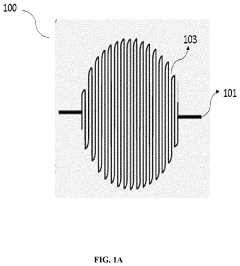
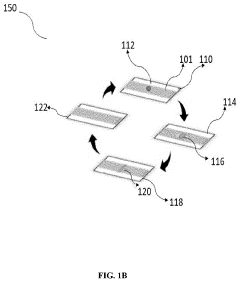
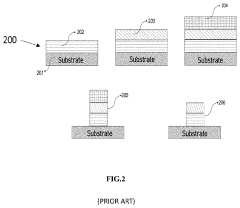
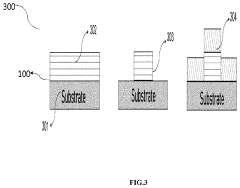
- A method and system for fabricating superconducting nanowire single photon detectors using high temperature superconductors with pulsed laser deposition, eliminating post-processing of superconducting thin films and gold encapsulation to maintain material quality and enable operation above 4 K.
Single photon detector for regulating superconducting NANO wire and preparation method therefor
PatentWO2019091045A1
Innovation
- By introducing stress into the superconducting nanowires, the ion implantation process is used to form a stressed superconducting nanowire structure, and the critical temperature Tc of the material is controlled, thereby improving the intrinsic detection efficiency of the device.


Cryogenic System Integration Considerations
The integration of Superconducting Nanowire Single-Photon Detectors (SNSPDs) into cryogenic systems presents unique challenges that significantly impact timing calibration and jitter characterization methodologies. Cryogenic environments, typically operating at temperatures below 4K, require specialized design considerations to maintain thermal stability and minimize electromagnetic interference that could affect timing precision.
Temperature fluctuations within the cryogenic system directly influence SNSPD performance parameters, particularly timing jitter. Even minor temperature variations of a few millikelvin can alter the superconducting properties of nanowires, resulting in inconsistent detection efficiency and timing response. Therefore, robust temperature stabilization mechanisms must be implemented, including PID-controlled heating elements and multi-stage thermal isolation, to achieve the sub-picosecond timing precision required for advanced quantum applications.
Signal transmission between room temperature electronics and cryogenic detectors introduces additional timing uncertainties. Coaxial cables traversing large temperature gradients experience thermal contraction and varying impedance characteristics, potentially causing signal reflections and timing delays. Calibration protocols must account for these temperature-dependent transmission effects through reference measurements at various temperature points during system cool-down cycles.
Electromagnetic interference (EMI) shielding becomes particularly critical in cryogenic environments where SNSPDs operate with extremely low energy thresholds. Proper grounding schemes and Faraday cage implementations must be carefully designed to prevent ground loops and external RF interference from degrading timing performance. Recent studies have demonstrated that inadequate EMI protection can contribute up to 15ps of additional timing jitter in otherwise well-calibrated systems.
Mechanical vibrations transmitted through cryostat components represent another significant challenge for timing stability. Pulse-tube refrigerators, commonly used in closed-cycle cryogenic systems, generate periodic vibrations that can couple to detector mounts and optical components. Advanced vibration isolation techniques, including suspended platforms and active damping systems, have been shown to reduce vibration-induced timing jitter by up to 40% in laboratory demonstrations.
The physical layout of components within the cryogenic environment must be optimized to minimize signal path lengths while maintaining thermal isolation. Recent innovations include integrating cryogenic amplifiers and initial signal processing electronics directly at the 4K stage, reducing cable lengths and associated timing uncertainties. However, these approaches require careful power dissipation management to prevent thermal loading of the cryogenic system.
Temperature fluctuations within the cryogenic system directly influence SNSPD performance parameters, particularly timing jitter. Even minor temperature variations of a few millikelvin can alter the superconducting properties of nanowires, resulting in inconsistent detection efficiency and timing response. Therefore, robust temperature stabilization mechanisms must be implemented, including PID-controlled heating elements and multi-stage thermal isolation, to achieve the sub-picosecond timing precision required for advanced quantum applications.
Signal transmission between room temperature electronics and cryogenic detectors introduces additional timing uncertainties. Coaxial cables traversing large temperature gradients experience thermal contraction and varying impedance characteristics, potentially causing signal reflections and timing delays. Calibration protocols must account for these temperature-dependent transmission effects through reference measurements at various temperature points during system cool-down cycles.
Electromagnetic interference (EMI) shielding becomes particularly critical in cryogenic environments where SNSPDs operate with extremely low energy thresholds. Proper grounding schemes and Faraday cage implementations must be carefully designed to prevent ground loops and external RF interference from degrading timing performance. Recent studies have demonstrated that inadequate EMI protection can contribute up to 15ps of additional timing jitter in otherwise well-calibrated systems.
Mechanical vibrations transmitted through cryostat components represent another significant challenge for timing stability. Pulse-tube refrigerators, commonly used in closed-cycle cryogenic systems, generate periodic vibrations that can couple to detector mounts and optical components. Advanced vibration isolation techniques, including suspended platforms and active damping systems, have been shown to reduce vibration-induced timing jitter by up to 40% in laboratory demonstrations.
The physical layout of components within the cryogenic environment must be optimized to minimize signal path lengths while maintaining thermal isolation. Recent innovations include integrating cryogenic amplifiers and initial signal processing electronics directly at the 4K stage, reducing cable lengths and associated timing uncertainties. However, these approaches require careful power dissipation management to prevent thermal loading of the cryogenic system.
Quantum Information Applications and Requirements
Quantum information processing represents a revolutionary paradigm that leverages quantum mechanical phenomena to perform computational tasks beyond the capabilities of classical systems. Superconducting Nanowire Single-Photon Detectors (SNSPDs) have emerged as critical components in quantum information applications due to their exceptional detection efficiency, low dark count rates, and superior timing resolution. These characteristics make them indispensable for quantum key distribution (QKD), quantum computing, and quantum sensing applications where precise photon detection timing is paramount.
In quantum communication networks, particularly QKD systems, the security of information transfer relies heavily on the precise timing of photon detection events. Even minor timing jitter in SNSPDs can compromise the integrity of quantum protocols, potentially exposing vulnerabilities that adversaries could exploit. Current QKD implementations typically require timing resolutions below 100 picoseconds, with next-generation systems pushing requirements toward sub-50 picosecond precision.
Quantum computing architectures that utilize photonic qubits similarly demand exacting timing precision. Linear optical quantum computing (LOQC) protocols, for instance, rely on photon interference effects that are highly sensitive to timing variations. The fidelity of quantum gate operations in these systems correlates directly with detector timing performance, where jitter introduces computational errors that can propagate through quantum algorithms.
Distributed quantum sensing networks represent another application domain with stringent timing requirements. These systems often synchronize multiple SNSPDs across different locations to achieve enhanced measurement precision. The overall sensitivity of such networks scales with the collective timing resolution of the constituent detectors, making SNSPD timing calibration essential for achieving quantum-enhanced measurement advantages.
The requirements for SNSPD timing performance continue to evolve as quantum technologies mature. Current state-of-the-art quantum information systems typically operate with timing jitter in the 15-30 picosecond range, but emerging applications in quantum repeater networks and fault-tolerant quantum computing architectures are beginning to specify sub-10 picosecond requirements. This trajectory necessitates continuous advancement in calibration methodologies to keep pace with application demands.
Beyond raw timing performance, quantum information applications also require long-term stability in detector timing characteristics. Environmental factors and operational aging can introduce drift in timing parameters, potentially degrading system performance over time. Consequently, robust calibration methods must not only achieve high precision but also maintain that precision throughout operational lifetimes spanning months or years in deployed quantum systems.
In quantum communication networks, particularly QKD systems, the security of information transfer relies heavily on the precise timing of photon detection events. Even minor timing jitter in SNSPDs can compromise the integrity of quantum protocols, potentially exposing vulnerabilities that adversaries could exploit. Current QKD implementations typically require timing resolutions below 100 picoseconds, with next-generation systems pushing requirements toward sub-50 picosecond precision.
Quantum computing architectures that utilize photonic qubits similarly demand exacting timing precision. Linear optical quantum computing (LOQC) protocols, for instance, rely on photon interference effects that are highly sensitive to timing variations. The fidelity of quantum gate operations in these systems correlates directly with detector timing performance, where jitter introduces computational errors that can propagate through quantum algorithms.
Distributed quantum sensing networks represent another application domain with stringent timing requirements. These systems often synchronize multiple SNSPDs across different locations to achieve enhanced measurement precision. The overall sensitivity of such networks scales with the collective timing resolution of the constituent detectors, making SNSPD timing calibration essential for achieving quantum-enhanced measurement advantages.
The requirements for SNSPD timing performance continue to evolve as quantum technologies mature. Current state-of-the-art quantum information systems typically operate with timing jitter in the 15-30 picosecond range, but emerging applications in quantum repeater networks and fault-tolerant quantum computing architectures are beginning to specify sub-10 picosecond requirements. This trajectory necessitates continuous advancement in calibration methodologies to keep pace with application demands.
Beyond raw timing performance, quantum information applications also require long-term stability in detector timing characteristics. Environmental factors and operational aging can introduce drift in timing parameters, potentially degrading system performance over time. Consequently, robust calibration methods must not only achieve high precision but also maintain that precision throughout operational lifetimes spanning months or years in deployed quantum systems.
Unlock deeper insights with PatSnap Eureka Quick Research — get a full tech report to explore trends and direct your research. Try now!
Generate Your Research Report Instantly with AI Agent
Supercharge your innovation with PatSnap Eureka AI Agent Platform!