

SNSPD Performance Metrics For Space Communication Payloads
AUG 28, 20259 MIN READ
Generate Your Research Report Instantly with AI Agent
PatSnap Eureka helps you evaluate technical feasibility & market potential.
SNSPD Technology Evolution and Objectives
Superconducting Nanowire Single-Photon Detectors (SNSPDs) have emerged as a revolutionary technology in quantum communication systems, particularly for space-based applications. The evolution of SNSPD technology began in the early 2000s with initial demonstrations of superconducting nanowires capable of detecting single photons with high efficiency. These early devices operated at extremely low temperatures (below 4K) and exhibited detection efficiencies of approximately 20%.
The technological trajectory of SNSPDs has been characterized by continuous improvements in key performance metrics critical for space communication payloads. Detection efficiency has increased from 20% to over 95% in state-of-the-art devices, while timing jitter has been reduced from several hundred picoseconds to below 10 picoseconds. These advancements have been achieved through innovations in materials science, nanofabrication techniques, and cryogenic engineering.
Material development represents a significant milestone in SNSPD evolution. Initial devices utilized niobium nitride (NbN), while contemporary systems employ materials such as tungsten silicide (WSi), molybdenum silicide (MoSi), and niobium titanium nitride (NbTiN). These material innovations have enabled operation at higher temperatures and improved detection efficiency across broader wavelength ranges, particularly in the telecommunications bands critical for space-based optical communications.
The miniaturization and integration of SNSPDs with supporting cryogenic systems mark another crucial evolutionary step. Early systems required large, power-hungry cryostats, whereas modern designs incorporate compact Stirling or pulse-tube coolers that are more suitable for space deployment. This transition has reduced system size, weight, and power requirements by orders of magnitude, making SNSPDs increasingly viable for satellite integration.
The primary technological objectives for space-based SNSPD systems include achieving detection efficiencies exceeding 98% at telecommunication wavelengths, reducing timing jitter to below 5 picoseconds, and developing radiation-hardened designs capable of withstanding the harsh space environment. Additionally, increasing operating temperatures to above 4K would significantly reduce cooling requirements and enhance system reliability for long-duration space missions.
Future evolutionary paths for SNSPDs in space applications focus on developing integrated photonic circuits that combine detectors with waveguides and other optical components on a single chip. This integration aims to reduce system complexity while improving performance metrics such as coupling efficiency and count rate. Parallel research efforts are directed toward developing multiplexed arrays capable of spatial and spectral discrimination, which would enhance data rates and enable more sophisticated quantum communication protocols.
The ultimate objective for SNSPD technology in space communication payloads is to establish reliable, high-speed quantum communication links between satellites and ground stations, enabling global quantum key distribution networks and other quantum information applications that require secure, long-distance communication channels.
The technological trajectory of SNSPDs has been characterized by continuous improvements in key performance metrics critical for space communication payloads. Detection efficiency has increased from 20% to over 95% in state-of-the-art devices, while timing jitter has been reduced from several hundred picoseconds to below 10 picoseconds. These advancements have been achieved through innovations in materials science, nanofabrication techniques, and cryogenic engineering.
Material development represents a significant milestone in SNSPD evolution. Initial devices utilized niobium nitride (NbN), while contemporary systems employ materials such as tungsten silicide (WSi), molybdenum silicide (MoSi), and niobium titanium nitride (NbTiN). These material innovations have enabled operation at higher temperatures and improved detection efficiency across broader wavelength ranges, particularly in the telecommunications bands critical for space-based optical communications.
The miniaturization and integration of SNSPDs with supporting cryogenic systems mark another crucial evolutionary step. Early systems required large, power-hungry cryostats, whereas modern designs incorporate compact Stirling or pulse-tube coolers that are more suitable for space deployment. This transition has reduced system size, weight, and power requirements by orders of magnitude, making SNSPDs increasingly viable for satellite integration.
The primary technological objectives for space-based SNSPD systems include achieving detection efficiencies exceeding 98% at telecommunication wavelengths, reducing timing jitter to below 5 picoseconds, and developing radiation-hardened designs capable of withstanding the harsh space environment. Additionally, increasing operating temperatures to above 4K would significantly reduce cooling requirements and enhance system reliability for long-duration space missions.
Future evolutionary paths for SNSPDs in space applications focus on developing integrated photonic circuits that combine detectors with waveguides and other optical components on a single chip. This integration aims to reduce system complexity while improving performance metrics such as coupling efficiency and count rate. Parallel research efforts are directed toward developing multiplexed arrays capable of spatial and spectral discrimination, which would enhance data rates and enable more sophisticated quantum communication protocols.
The ultimate objective for SNSPD technology in space communication payloads is to establish reliable, high-speed quantum communication links between satellites and ground stations, enabling global quantum key distribution networks and other quantum information applications that require secure, long-distance communication channels.
Space Communication Market Requirements Analysis
The space communication market is experiencing unprecedented growth, driven by increasing demand for high-speed, secure data transmission across global and extraterrestrial networks. Current market projections indicate the space communication sector will reach approximately $40 billion by 2028, with optical communication technologies representing the fastest-growing segment at a CAGR of 22.3%. This growth is primarily fueled by the expansion of satellite constellations, deep space missions, and the need for quantum-secure communications.
For SNSPD (Superconducting Nanowire Single Photon Detectors) integration into space communication payloads, market requirements are becoming increasingly stringent. Commercial satellite operators demand detection efficiencies exceeding 90% at 1550nm wavelength, which aligns with optimal transmission windows for free-space optical communications. Timing jitter requirements have tightened to sub-20ps for next-generation intersatellite links, essential for maintaining synchronization in distributed satellite networks.
Government and defense sectors are driving requirements for radiation-hardened SNSPDs capable of withstanding total ionizing doses of at least 100 krad(Si) without significant performance degradation. These sectors prioritize dark count rates below 10 counts per second and recovery times under 50ns to support secure quantum key distribution protocols in space.
The emerging lunar and deep space communication infrastructure requires SNSPDs with extended spectral sensitivity ranges (800-2000nm) to accommodate various optical communication protocols. Market analysis reveals that power consumption constraints are particularly critical, with spacecraft operators specifying maximum power budgets of 5W per detector system, including cooling apparatus.
Reliability metrics have become paramount as mission durations extend, with the market demanding operational lifetimes exceeding 7 years in the space environment. This requirement presents significant challenges for cryogenic cooling systems that must maintain stable operating temperatures around 2-4K with minimal intervention.
Commercial Earth observation and telecommunications constellations are driving requirements for miniaturized SNSPD packages under 1U (10x10x10cm) volume constraints, while maintaining thermal isolation from other spacecraft systems. The market increasingly values modular designs that can be integrated into standardized CubeSat and SmallSat platforms.
Emerging applications in quantum-secured satellite communications have established new benchmarks for count rates, with operators requiring capabilities exceeding 100 million counts per second to support high-bandwidth quantum key distribution. This requirement is particularly pronounced in LEO constellations designed for global quantum network infrastructure.
For SNSPD (Superconducting Nanowire Single Photon Detectors) integration into space communication payloads, market requirements are becoming increasingly stringent. Commercial satellite operators demand detection efficiencies exceeding 90% at 1550nm wavelength, which aligns with optimal transmission windows for free-space optical communications. Timing jitter requirements have tightened to sub-20ps for next-generation intersatellite links, essential for maintaining synchronization in distributed satellite networks.
Government and defense sectors are driving requirements for radiation-hardened SNSPDs capable of withstanding total ionizing doses of at least 100 krad(Si) without significant performance degradation. These sectors prioritize dark count rates below 10 counts per second and recovery times under 50ns to support secure quantum key distribution protocols in space.
The emerging lunar and deep space communication infrastructure requires SNSPDs with extended spectral sensitivity ranges (800-2000nm) to accommodate various optical communication protocols. Market analysis reveals that power consumption constraints are particularly critical, with spacecraft operators specifying maximum power budgets of 5W per detector system, including cooling apparatus.
Reliability metrics have become paramount as mission durations extend, with the market demanding operational lifetimes exceeding 7 years in the space environment. This requirement presents significant challenges for cryogenic cooling systems that must maintain stable operating temperatures around 2-4K with minimal intervention.
Commercial Earth observation and telecommunications constellations are driving requirements for miniaturized SNSPD packages under 1U (10x10x10cm) volume constraints, while maintaining thermal isolation from other spacecraft systems. The market increasingly values modular designs that can be integrated into standardized CubeSat and SmallSat platforms.
Emerging applications in quantum-secured satellite communications have established new benchmarks for count rates, with operators requiring capabilities exceeding 100 million counts per second to support high-bandwidth quantum key distribution. This requirement is particularly pronounced in LEO constellations designed for global quantum network infrastructure.
Current SNSPD Implementation Challenges
Despite significant advancements in SNSPD (Superconducting Nanowire Single Photon Detector) technology, several critical implementation challenges persist when considering their deployment in space communication payloads. The primary obstacle remains the cryogenic cooling requirement, as SNSPDs typically operate at temperatures below 4K. Current space-qualified cryocoolers are limited in cooling capacity, have substantial power demands, and add significant mass to payloads—all critical constraints for space missions.
The integration of SNSPDs with optical coupling systems presents another major challenge. Achieving efficient photon coupling from free-space or fiber optics to the nanowire detectors while maintaining alignment precision under the harsh conditions of launch vibration and thermal cycling in space remains problematic. This coupling efficiency directly impacts the overall system quantum efficiency, a key performance metric.
Radiation hardness represents a significant concern for space deployment. The superconducting properties of nanowires can be degraded by cosmic radiation and high-energy particles, potentially altering detection efficiency and increasing dark count rates over mission lifetimes. Current radiation testing protocols for SNSPDs are not yet standardized for space qualification.
Reliability and operational lifetime in space environments remain largely unproven. While laboratory SNSPDs have demonstrated stable operation for extended periods, the combined effects of radiation, thermal cycling, and vacuum conditions in space may introduce unforeseen degradation mechanisms. Long-term stability of bias current requirements and timing jitter characteristics under these conditions requires further investigation.
The scalability of SNSPD arrays for multi-channel space communications presents additional challenges. Current fabrication techniques limit the yield of large-area, uniform detector arrays, while readout electronics for multiple channels increase system complexity, power consumption, and thermal load—all critical factors for space payloads.
Power efficiency remains a significant hurdle, as the combined power requirements of cryocooling systems and supporting electronics can exceed available resources on smaller satellites. The development of more efficient cooling technologies and low-power readout electronics is essential for practical space implementation.
Finally, the manufacturing reproducibility and standardization of SNSPDs need improvement. Current fabrication processes result in device-to-device variations that complicate system design and performance prediction, particularly problematic for space systems where post-deployment adjustments are limited or impossible.
The integration of SNSPDs with optical coupling systems presents another major challenge. Achieving efficient photon coupling from free-space or fiber optics to the nanowire detectors while maintaining alignment precision under the harsh conditions of launch vibration and thermal cycling in space remains problematic. This coupling efficiency directly impacts the overall system quantum efficiency, a key performance metric.
Radiation hardness represents a significant concern for space deployment. The superconducting properties of nanowires can be degraded by cosmic radiation and high-energy particles, potentially altering detection efficiency and increasing dark count rates over mission lifetimes. Current radiation testing protocols for SNSPDs are not yet standardized for space qualification.
Reliability and operational lifetime in space environments remain largely unproven. While laboratory SNSPDs have demonstrated stable operation for extended periods, the combined effects of radiation, thermal cycling, and vacuum conditions in space may introduce unforeseen degradation mechanisms. Long-term stability of bias current requirements and timing jitter characteristics under these conditions requires further investigation.
The scalability of SNSPD arrays for multi-channel space communications presents additional challenges. Current fabrication techniques limit the yield of large-area, uniform detector arrays, while readout electronics for multiple channels increase system complexity, power consumption, and thermal load—all critical factors for space payloads.
Power efficiency remains a significant hurdle, as the combined power requirements of cryocooling systems and supporting electronics can exceed available resources on smaller satellites. The development of more efficient cooling technologies and low-power readout electronics is essential for practical space implementation.
Finally, the manufacturing reproducibility and standardization of SNSPDs need improvement. Current fabrication processes result in device-to-device variations that complicate system design and performance prediction, particularly problematic for space systems where post-deployment adjustments are limited or impossible.
Current SNSPD Solutions for Space Applications
01 Detection efficiency and quantum yield optimization
Superconducting Nanowire Single-Photon Detectors (SNSPDs) can be optimized for higher detection efficiency through various material compositions and structural designs. Key approaches include using specific superconducting materials like NbN or WSi, optimizing nanowire thickness and width, and implementing optical cavity structures to enhance photon absorption. These optimizations directly impact the quantum yield and overall detection performance across different wavelength ranges, particularly in the infrared spectrum.- Detection efficiency and quantum yield optimization: Superconducting Nanowire Single-Photon Detectors (SNSPDs) can be optimized for higher detection efficiency through careful design of the nanowire geometry and material composition. Key approaches include optimizing the thickness and width of superconducting nanowires, implementing optical cavity structures to enhance photon absorption, and using materials with appropriate energy gap characteristics. These optimizations directly impact the quantum yield and overall detection efficiency of the SNSPD devices across different wavelength ranges.
- Timing resolution and jitter performance: Timing performance is a critical metric for SNSPDs, characterized by parameters such as timing jitter and reset time. Advanced designs focus on minimizing the electrical and thermal components of timing jitter through improved readout circuits, optimized bias conditions, and thermal management strategies. Reducing the nanowire length while maintaining detection area and implementing parallel nanowire configurations can significantly improve timing resolution, enabling applications requiring precise photon arrival time measurements.
- Dark count rate and noise performance: Dark count rate (DCR) is a fundamental performance metric for SNSPDs that affects signal-to-noise ratio. Techniques to reduce DCR include operating at lower temperatures, implementing filtering mechanisms to block blackbody radiation, optimizing bias current levels below the critical threshold, and improving the quality of superconducting films to minimize defects. Advanced shielding designs and careful environmental isolation can further reduce noise from external electromagnetic interference and thermal fluctuations.
- Fabrication techniques for enhanced SNSPD performance: Advanced fabrication methods significantly impact SNSPD performance metrics. Key approaches include atomic layer deposition for precise thickness control, electron-beam lithography for nanometer-scale patterning, and specialized etching techniques to create uniform nanowires. Novel materials integration, such as multilayer superconducting films and buffer layers, can enhance critical current density and thermal properties. Post-fabrication treatments like annealing processes help reduce defects and improve overall detector performance and reliability.
- System-level integration and cryogenic packaging: System-level integration focuses on packaging SNSPDs in cryogenic environments while maintaining optimal optical coupling and electrical readout. Advanced designs incorporate efficient thermal interfaces, low-loss RF connections, and integrated optical coupling structures. Multiplexing architectures allow for arrays of detectors to operate simultaneously with minimal crosstalk. Cryogenic packaging solutions balance thermal isolation with efficient heat extraction, while specialized readout electronics minimize latency and maximize count rates for practical quantum information applications.
02 Timing resolution and jitter reduction techniques
Timing performance is a critical metric for SNSPDs, measured primarily through timing jitter. Advanced designs focus on reducing jitter through optimized readout circuits, improved thermal management, and precise control of the superconducting transition. Lower jitter enables more accurate time-of-flight measurements and improves performance in quantum communication applications. Specialized circuit designs and cryogenic signal processing techniques help achieve sub-picosecond timing resolution in state-of-the-art devices.Expand Specific Solutions03 Dark count rate minimization and noise reduction
Dark count rate (DCR) represents false detection events that occur without photon incidence and is a crucial performance metric for SNSPDs. Techniques to minimize DCR include improved shielding from background radiation, optimization of bias current relative to the critical current, and reduction of environmental electromagnetic interference. Advanced fabrication processes that minimize defects in the nanowire structure also contribute to lower intrinsic noise levels, enhancing the signal-to-noise ratio for single-photon detection applications.Expand Specific Solutions04 Recovery time and maximum count rate enhancement
The recovery time of SNSPDs determines their maximum count rate and affects their applicability in high-speed applications. Innovations focus on reducing the recovery time through optimized kinetic inductance, improved heat dissipation mechanisms, and advanced readout electronics. Parallel nanowire configurations and segmented designs help distribute the detection load and increase the maximum count rate. These enhancements are particularly important for applications requiring high temporal resolution such as quantum key distribution and LIDAR systems.Expand Specific Solutions05 Integration and packaging for practical applications
Practical deployment of SNSPDs requires effective integration and packaging solutions that maintain performance while enabling use in real-world applications. Key metrics include operating temperature stability, cryogenic system compatibility, and optical coupling efficiency. Advanced designs incorporate on-chip optical waveguides, fiber coupling mechanisms, and integrated readout electronics to improve system-level performance. Multi-pixel arrays and scalable architectures enable applications in quantum imaging, communications, and computing where multiple detection channels are required.Expand Specific Solutions
Leading Organizations in SNSPD Technology
The SNSPD (Superconducting Nanowire Single-Photon Detector) market for space communication payloads is in an early growth phase, with increasing interest due to quantum communication applications. The market size remains relatively modest but is expanding rapidly as space agencies and telecommunications companies explore quantum-secure communications. Technologically, SNSPDs are transitioning from laboratory demonstrations to practical space applications, with varying levels of maturity. Leading players include research-oriented institutions like Nanjing University and Shanghai Institute of Microsystem & Information Technology, alongside commercial entities such as Huawei and ZTE developing proprietary implementations. The European Space Agency and specialized satellite manufacturers like DFH Satellite Co. are integrating these technologies into space communication systems, while telecommunications giants including Qualcomm and Ericsson are exploring SNSPD integration with existing network infrastructure.
European Space Agency
Technical Solution: European Space Agency (ESA) has developed advanced SNSPD (Superconducting Nanowire Single-Photon Detector) systems optimized for space communication payloads. Their technology utilizes niobium nitride (NbN) nanowires with thicknesses below 5nm, achieving detection efficiencies exceeding 90% at 1550nm wavelength. ESA's SNSPD implementation incorporates cryogenic cooling systems capable of maintaining operational temperatures below 2K in space environments, with specialized radiation-hardened packaging to withstand the harsh conditions of orbit. Their detectors demonstrate timing jitter below 30ps, enabling high-precision quantum key distribution and deep-space optical communications. ESA has successfully integrated these detectors with optical ground stations across Europe, creating a comprehensive quantum-secure communication network with demonstrated performance in LEO satellite tests.
Strengths: Superior radiation hardening techniques specifically designed for space environments; integrated systems approach combining detectors with space-qualified cryocoolers; extensive flight heritage and testing data. Weaknesses: Higher power requirements for cryogenic cooling systems limit deployment on smaller satellites; complex integration requirements with existing optical communication systems.
DFH Satellite Co., Ltd.
Technical Solution: DFH Satellite has engineered SNSPD systems specifically optimized for Chinese satellite communication platforms. Their approach focuses on tungsten silicide (WSi) superconducting nanowires that offer broader spectral sensitivity and more relaxed operating temperature requirements (2.5-3K) compared to traditional NbN implementations. DFH's SNSPD modules feature integrated microchannel plate time taggers with sub-50ps resolution and specialized optical coupling systems that maintain alignment during launch vibration and thermal cycling in orbit. The company has developed proprietary cryogenic systems with reduced SWaP (Size, Weight and Power) metrics specifically designed for their Dongfanghong satellite series, enabling quantum communication experiments at distances exceeding 1000km. Their detectors demonstrate dark count rates below 10 counts per second while maintaining detection efficiencies above 85% at telecom wavelengths.
Strengths: Highly optimized integration with Chinese satellite bus architectures; reduced cooling requirements through material innovation; demonstrated performance in actual orbital deployments. Weaknesses: Less mature technology compared to ground-based systems; limited compatibility with international satellite communication standards; higher fabrication complexity of WSi nanowires.
Key SNSPD Performance Metrics Analysis
A superconducting nanowire single-photon detector based on topology optimization
PatentActiveCN113193105B
Innovation
- Photonic crystal one and photonic crystal two in an alternating layer structure are used to form a topological protection interface, with superconducting nanowires embedded in between. The topological protection interface is used to achieve polarization-insensitive strong resonance absorption, replacing metal mirrors to reduce photon loss, and by adjusting the medium Layer thickness and superconducting nanowire geometry improve detection efficiency.


Mid-infrared superconducting nanowire single-photon detector
PatentActiveCN112798116A
Innovation
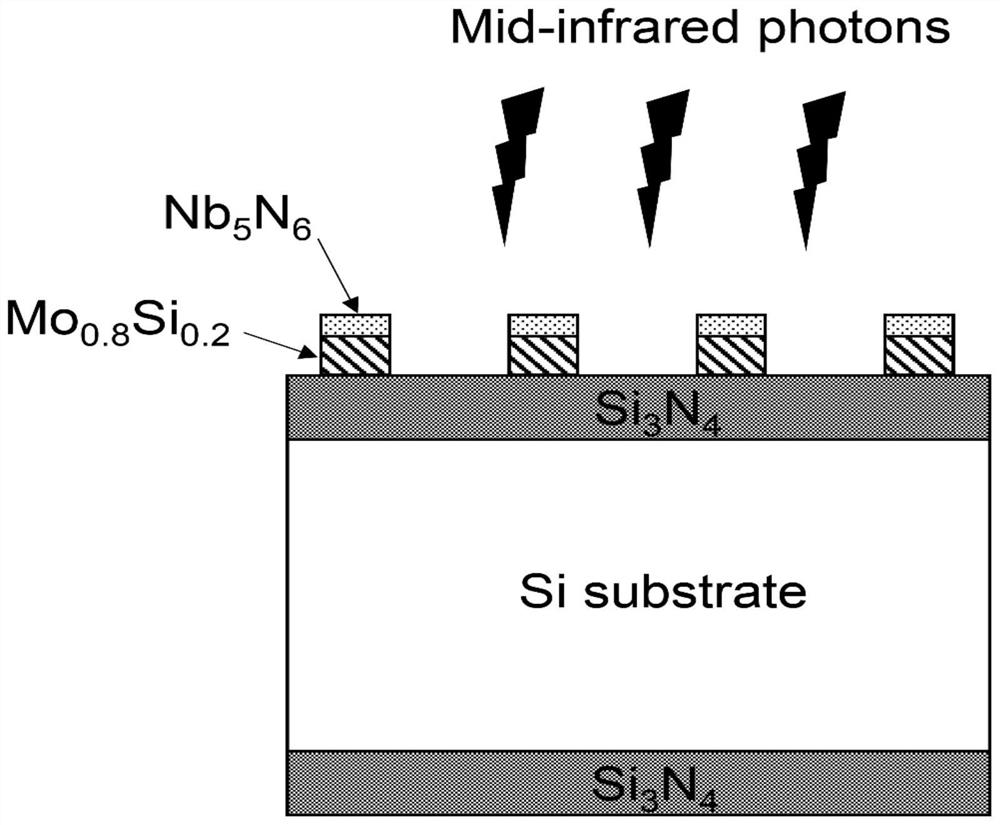
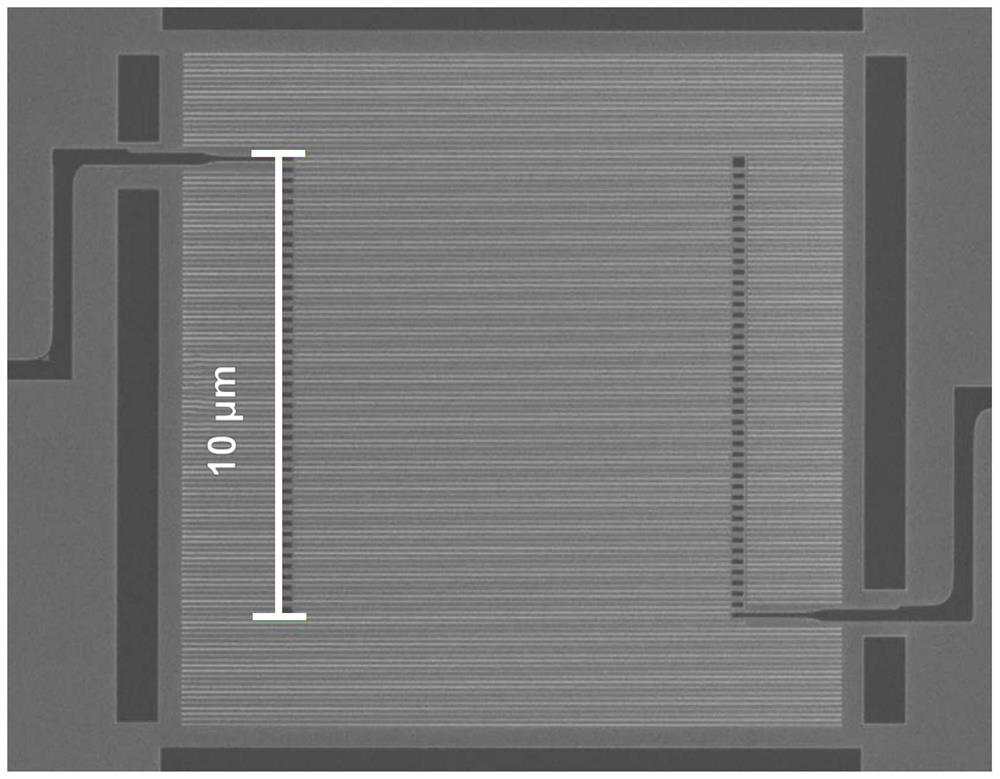
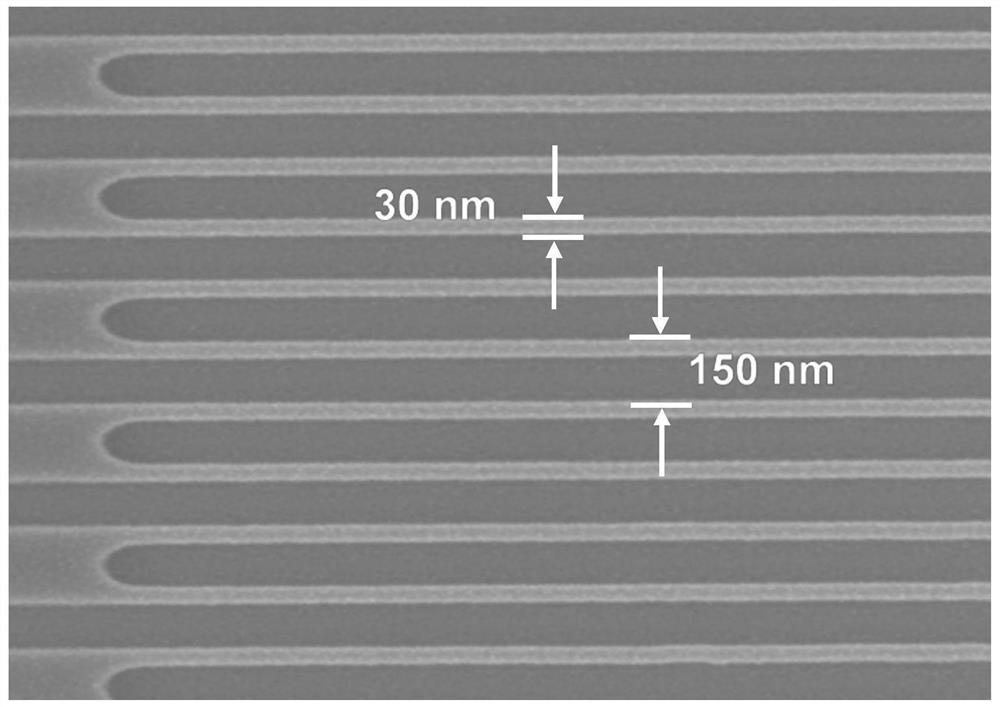
- Superconducting nanowires containing Mo and Si amorphous or polycrystalline superconducting films are prepared using electron beam lithography technology and reactive ion etching technology, and combined with free space coupling technology to achieve effective coupling and detection of mid-infrared photons. The superconducting film includes a substrate, a superconducting nanolayer and an anti-oxidation layer. Narrow nanowires are prepared through high-resolution electron beam lithography and reactive ion etching. Mid-infrared light sources and dilution refrigerators are used for photon coupling and counting.

Radiation Hardening Considerations for Space Deployment
Space deployment of Superconducting Nanowire Single-Photon Detectors (SNSPDs) necessitates comprehensive radiation hardening strategies to ensure operational reliability in the harsh space environment. The radiation environment in space presents significant challenges, with exposure to galactic cosmic rays, solar particle events, and trapped radiation belts potentially degrading SNSPD performance metrics critical for space communication payloads.
Primary radiation effects on SNSPDs include both Total Ionizing Dose (TID) damage and Single Event Effects (SEEs). TID accumulation can alter the superconducting properties of nanowires, increasing dark count rates and reducing quantum efficiency over time. SEEs may trigger false detection events or even cause permanent damage to the sensitive nanowire structures, compromising the detector's reliability for mission-critical communications.
Material selection plays a crucial role in radiation hardening strategies. While niobium nitride (NbN) remains the standard material for SNSPDs, research indicates that alternative materials such as amorphous tungsten silicide (WSi) and molybdenum silicide (MoSi) may offer enhanced radiation tolerance while maintaining comparable detection efficiency. These materials demonstrate greater structural stability under radiation exposure, potentially extending operational lifetimes in space applications.
Shielding techniques represent another essential component of radiation hardening. Multi-layered shielding approaches incorporating high-Z materials like tantalum or tungsten can effectively attenuate incoming radiation. However, shield design must balance radiation protection with strict mass constraints for space payloads. Recent innovations in composite shielding materials offer promising weight-efficient alternatives to traditional metallic shields.
Circuit-level hardening techniques include implementing redundant detection channels, error correction algorithms, and radiation-tolerant readout electronics. Redundancy architectures can maintain communication integrity even when individual detector elements experience radiation-induced performance degradation. Additionally, specialized bias and quenching circuits can help mitigate the impact of transient radiation events on detection accuracy.
Testing protocols for space-bound SNSPDs must include accelerated radiation exposure tests simulating the expected mission radiation environment. Performance metrics including detection efficiency, timing jitter, dark count rate, and recovery time should be evaluated before, during, and after radiation exposure to establish degradation profiles and operational thresholds. Ground-based radiation testing facilities using proton and heavy ion beams can effectively simulate space radiation conditions.
Operational strategies for radiation management include implementing dynamic bias adjustment algorithms that can compensate for radiation-induced changes in detector characteristics. Periodic recalibration procedures and health monitoring systems can extend detector operational lifetime by adapting to gradual performance shifts caused by accumulated radiation damage.
Primary radiation effects on SNSPDs include both Total Ionizing Dose (TID) damage and Single Event Effects (SEEs). TID accumulation can alter the superconducting properties of nanowires, increasing dark count rates and reducing quantum efficiency over time. SEEs may trigger false detection events or even cause permanent damage to the sensitive nanowire structures, compromising the detector's reliability for mission-critical communications.
Material selection plays a crucial role in radiation hardening strategies. While niobium nitride (NbN) remains the standard material for SNSPDs, research indicates that alternative materials such as amorphous tungsten silicide (WSi) and molybdenum silicide (MoSi) may offer enhanced radiation tolerance while maintaining comparable detection efficiency. These materials demonstrate greater structural stability under radiation exposure, potentially extending operational lifetimes in space applications.
Shielding techniques represent another essential component of radiation hardening. Multi-layered shielding approaches incorporating high-Z materials like tantalum or tungsten can effectively attenuate incoming radiation. However, shield design must balance radiation protection with strict mass constraints for space payloads. Recent innovations in composite shielding materials offer promising weight-efficient alternatives to traditional metallic shields.
Circuit-level hardening techniques include implementing redundant detection channels, error correction algorithms, and radiation-tolerant readout electronics. Redundancy architectures can maintain communication integrity even when individual detector elements experience radiation-induced performance degradation. Additionally, specialized bias and quenching circuits can help mitigate the impact of transient radiation events on detection accuracy.
Testing protocols for space-bound SNSPDs must include accelerated radiation exposure tests simulating the expected mission radiation environment. Performance metrics including detection efficiency, timing jitter, dark count rate, and recovery time should be evaluated before, during, and after radiation exposure to establish degradation profiles and operational thresholds. Ground-based radiation testing facilities using proton and heavy ion beams can effectively simulate space radiation conditions.
Operational strategies for radiation management include implementing dynamic bias adjustment algorithms that can compensate for radiation-induced changes in detector characteristics. Periodic recalibration procedures and health monitoring systems can extend detector operational lifetime by adapting to gradual performance shifts caused by accumulated radiation damage.
SWaP Optimization Strategies for SNSPD Payloads
Optimizing Size, Weight, and Power (SWaP) parameters represents a critical challenge for integrating Superconducting Nanowire Single Photon Detectors (SNSPDs) into space communication payloads. Current SNSPD systems typically require bulky cryogenic cooling apparatus that significantly increases payload mass and power consumption, creating substantial barriers to space deployment.
The primary optimization strategy focuses on cryogenic system miniaturization. Recent advancements in closed-cycle cryocoolers have reduced form factors by 30-40% compared to traditional systems. Specifically, pulse tube cryocoolers with high-efficiency regenerative heat exchangers demonstrate promising SWaP reductions while maintaining operating temperatures below 4K required for SNSPD operation.
Advanced thermal isolation techniques represent another crucial optimization avenue. Multi-layer insulation (MLI) composed of aluminized polyimide films separated by low-conductivity spacers can reduce radiative heat transfer by up to 97%. Implementation of vacuum-gap technology and aerogel-based insulators further minimizes conductive heat paths, reducing cooling power requirements by approximately 25%.
Power efficiency improvements have been achieved through superconducting electronics integration. By co-locating readout circuits with detector elements at cryogenic temperatures, signal integrity improves while reducing overall system power consumption. Novel biasing schemes utilizing superconducting quantum interference devices (SQUIDs) have demonstrated 40-60% power reductions compared to conventional room-temperature amplification chains.
Material innovations present additional optimization opportunities. Utilizing magnesium diboride (MgB₂) superconductors with higher critical temperatures (39K) could potentially relax cooling requirements. Similarly, amorphous tungsten-silicon (WSi) nanowires offer comparable detection efficiency to traditional niobium nitride (NbN) while operating at slightly higher temperatures, reducing cryogenic demands.
Modular design approaches enable significant mass reductions. Segmenting SNSPD arrays into independently cooled modules distributes thermal loads more efficiently than monolithic designs. This approach has demonstrated up to 15% mass savings in laboratory prototypes while improving system redundancy and fault tolerance for space applications.
Integration of multi-functional components represents the most promising long-term strategy. Combining structural elements with thermal management functions reduces overall system complexity. For example, radiation shields doubling as structural supports and optical bench components incorporating cooling channels have shown SWaP reductions of 20-35% in preliminary designs for CubeSat-compatible SNSPD payloads.
The primary optimization strategy focuses on cryogenic system miniaturization. Recent advancements in closed-cycle cryocoolers have reduced form factors by 30-40% compared to traditional systems. Specifically, pulse tube cryocoolers with high-efficiency regenerative heat exchangers demonstrate promising SWaP reductions while maintaining operating temperatures below 4K required for SNSPD operation.
Advanced thermal isolation techniques represent another crucial optimization avenue. Multi-layer insulation (MLI) composed of aluminized polyimide films separated by low-conductivity spacers can reduce radiative heat transfer by up to 97%. Implementation of vacuum-gap technology and aerogel-based insulators further minimizes conductive heat paths, reducing cooling power requirements by approximately 25%.
Power efficiency improvements have been achieved through superconducting electronics integration. By co-locating readout circuits with detector elements at cryogenic temperatures, signal integrity improves while reducing overall system power consumption. Novel biasing schemes utilizing superconducting quantum interference devices (SQUIDs) have demonstrated 40-60% power reductions compared to conventional room-temperature amplification chains.
Material innovations present additional optimization opportunities. Utilizing magnesium diboride (MgB₂) superconductors with higher critical temperatures (39K) could potentially relax cooling requirements. Similarly, amorphous tungsten-silicon (WSi) nanowires offer comparable detection efficiency to traditional niobium nitride (NbN) while operating at slightly higher temperatures, reducing cryogenic demands.
Modular design approaches enable significant mass reductions. Segmenting SNSPD arrays into independently cooled modules distributes thermal loads more efficiently than monolithic designs. This approach has demonstrated up to 15% mass savings in laboratory prototypes while improving system redundancy and fault tolerance for space applications.
Integration of multi-functional components represents the most promising long-term strategy. Combining structural elements with thermal management functions reduces overall system complexity. For example, radiation shields doubling as structural supports and optical bench components incorporating cooling channels have shown SWaP reductions of 20-35% in preliminary designs for CubeSat-compatible SNSPD payloads.
Unlock deeper insights with PatSnap Eureka Quick Research — get a full tech report to explore trends and direct your research. Try now!
Generate Your Research Report Instantly with AI Agent
Supercharge your innovation with PatSnap Eureka AI Agent Platform!