

Establishing Built Environments via Laminar Flow Methodologies
JUL 10, 20259 MIN READ
Generate Your Research Report Instantly with AI Agent
PatSnap Eureka helps you evaluate technical feasibility & market potential.
Laminar Flow Fundamentals
Laminar flow is a fundamental concept in fluid dynamics characterized by smooth, predictable fluid motion with minimal mixing between adjacent layers. In the context of establishing built environments, laminar flow methodologies play a crucial role in creating controlled and efficient air distribution systems. This approach is particularly valuable in settings where precise environmental control is essential, such as cleanrooms, operating theaters, and advanced manufacturing facilities.
The principles of laminar flow are rooted in the Navier-Stokes equations, which describe the motion of viscous fluid substances. In laminar flow, fluid particles move in parallel layers without disruption between the layers. This orderly movement is typically observed at low Reynolds numbers, where viscous forces dominate over inertial forces. The Reynolds number, a dimensionless quantity, is used to predict flow patterns in different fluid flow situations.
When applied to built environments, laminar flow systems are designed to create a unidirectional airflow pattern. This is achieved by introducing air at one end of a space and exhausting it at the opposite end, with minimal turbulence or mixing along the way. The air moves in a single direction, typically from ceiling to floor or from one wall to the opposite wall, effectively sweeping contaminants away from critical areas.
The implementation of laminar flow in built environments requires careful consideration of several factors. These include the geometry of the space, air velocity, temperature gradients, and the presence of obstacles or heat sources that could disrupt the flow. Advanced computational fluid dynamics (CFD) simulations are often employed to optimize the design of laminar flow systems, ensuring that the desired flow characteristics are maintained throughout the target area.
One of the key advantages of laminar flow in built environments is its ability to minimize the spread of airborne particles and contaminants. By maintaining a consistent, unidirectional airflow, particles are effectively carried away from sensitive areas, reducing the risk of contamination. This is particularly important in healthcare settings, where preventing the spread of infectious agents is paramount, and in manufacturing processes that require ultra-clean environments.
However, implementing laminar flow systems in built environments also presents challenges. These systems typically require significant energy input to maintain the desired flow characteristics, which can impact overall building efficiency. Additionally, the need for unobstructed airflow paths can impose constraints on interior design and space utilization. Balancing these factors with the benefits of laminar flow is a key consideration in the application of this technology.
The principles of laminar flow are rooted in the Navier-Stokes equations, which describe the motion of viscous fluid substances. In laminar flow, fluid particles move in parallel layers without disruption between the layers. This orderly movement is typically observed at low Reynolds numbers, where viscous forces dominate over inertial forces. The Reynolds number, a dimensionless quantity, is used to predict flow patterns in different fluid flow situations.
When applied to built environments, laminar flow systems are designed to create a unidirectional airflow pattern. This is achieved by introducing air at one end of a space and exhausting it at the opposite end, with minimal turbulence or mixing along the way. The air moves in a single direction, typically from ceiling to floor or from one wall to the opposite wall, effectively sweeping contaminants away from critical areas.
The implementation of laminar flow in built environments requires careful consideration of several factors. These include the geometry of the space, air velocity, temperature gradients, and the presence of obstacles or heat sources that could disrupt the flow. Advanced computational fluid dynamics (CFD) simulations are often employed to optimize the design of laminar flow systems, ensuring that the desired flow characteristics are maintained throughout the target area.
One of the key advantages of laminar flow in built environments is its ability to minimize the spread of airborne particles and contaminants. By maintaining a consistent, unidirectional airflow, particles are effectively carried away from sensitive areas, reducing the risk of contamination. This is particularly important in healthcare settings, where preventing the spread of infectious agents is paramount, and in manufacturing processes that require ultra-clean environments.
However, implementing laminar flow systems in built environments also presents challenges. These systems typically require significant energy input to maintain the desired flow characteristics, which can impact overall building efficiency. Additionally, the need for unobstructed airflow paths can impose constraints on interior design and space utilization. Balancing these factors with the benefits of laminar flow is a key consideration in the application of this technology.
Built Environment Needs
The built environment industry is experiencing a paradigm shift towards more sustainable, efficient, and health-focused construction methodologies. Laminar flow technologies present a promising avenue for addressing several critical needs in this sector. Primarily, there is a growing demand for improved indoor air quality and ventilation systems, especially in the wake of global health concerns. Laminar flow techniques can significantly enhance air circulation and filtration, reducing the spread of airborne contaminants and creating healthier indoor spaces.
Energy efficiency is another paramount concern in the built environment. Traditional HVAC systems often consume substantial amounts of energy, contributing to high operational costs and environmental impact. Laminar flow methodologies offer the potential for more precise and efficient temperature control, potentially leading to reduced energy consumption and lower carbon footprints for buildings.
The need for flexible and adaptable spaces has become increasingly important, particularly in commercial and institutional settings. Laminar flow systems can provide more localized and customizable climate control, allowing for the creation of micro-environments within larger spaces. This adaptability is crucial for optimizing comfort and functionality in multi-use buildings.
Noise reduction is a significant factor in improving the quality of built environments. Laminar flow techniques can contribute to quieter HVAC operations, enhancing acoustic comfort in various settings, from offices to residential spaces. This aspect is particularly valuable in urban environments where noise pollution is a persistent issue.
Sustainability and green building practices are at the forefront of construction industry priorities. Laminar flow methodologies align well with these goals, offering potential improvements in resource utilization and environmental impact reduction. The integration of these technologies can contribute to achieving higher ratings in green building certification systems, such as LEED or BREEAM.
There is also a growing need for smart building solutions that can integrate with IoT and building management systems. Laminar flow technologies can be incorporated into these smart systems, providing real-time data on air quality, temperature, and energy usage. This integration enables more responsive and efficient building operations, aligning with the trend towards intelligent and connected infrastructure.
Lastly, the construction industry is seeking innovative solutions to address challenges in specialized environments, such as cleanrooms, healthcare facilities, and data centers. Laminar flow methodologies offer precise control over air movement and particulate contamination, making them particularly valuable in these critical applications where air quality and temperature control are paramount.
Energy efficiency is another paramount concern in the built environment. Traditional HVAC systems often consume substantial amounts of energy, contributing to high operational costs and environmental impact. Laminar flow methodologies offer the potential for more precise and efficient temperature control, potentially leading to reduced energy consumption and lower carbon footprints for buildings.
The need for flexible and adaptable spaces has become increasingly important, particularly in commercial and institutional settings. Laminar flow systems can provide more localized and customizable climate control, allowing for the creation of micro-environments within larger spaces. This adaptability is crucial for optimizing comfort and functionality in multi-use buildings.
Noise reduction is a significant factor in improving the quality of built environments. Laminar flow techniques can contribute to quieter HVAC operations, enhancing acoustic comfort in various settings, from offices to residential spaces. This aspect is particularly valuable in urban environments where noise pollution is a persistent issue.
Sustainability and green building practices are at the forefront of construction industry priorities. Laminar flow methodologies align well with these goals, offering potential improvements in resource utilization and environmental impact reduction. The integration of these technologies can contribute to achieving higher ratings in green building certification systems, such as LEED or BREEAM.
There is also a growing need for smart building solutions that can integrate with IoT and building management systems. Laminar flow technologies can be incorporated into these smart systems, providing real-time data on air quality, temperature, and energy usage. This integration enables more responsive and efficient building operations, aligning with the trend towards intelligent and connected infrastructure.
Lastly, the construction industry is seeking innovative solutions to address challenges in specialized environments, such as cleanrooms, healthcare facilities, and data centers. Laminar flow methodologies offer precise control over air movement and particulate contamination, making them particularly valuable in these critical applications where air quality and temperature control are paramount.
Laminar Flow Challenges
Laminar flow methodologies present several significant challenges in establishing built environments. One of the primary obstacles is maintaining consistent laminar flow conditions across large spaces. As the scale of the environment increases, it becomes increasingly difficult to control airflow patterns and prevent turbulence. This challenge is particularly acute in cleanroom settings, where even minor disruptions can compromise the integrity of the controlled environment.
Another major hurdle is the energy efficiency of laminar flow systems. Creating and sustaining laminar flow requires substantial energy input, especially in larger spaces. This high energy consumption not only increases operational costs but also raises environmental concerns. Balancing the need for precise environmental control with energy efficiency remains a persistent challenge for researchers and engineers in this field.
The integration of laminar flow systems with other building systems poses additional complexities. HVAC systems, lighting fixtures, and other necessary infrastructure can disrupt laminar flow patterns. Designing these elements to coexist harmoniously with laminar flow requirements often necessitates innovative engineering solutions and careful spatial planning.
Particle control is another critical challenge in laminar flow environments. While laminar flow is effective at reducing particle contamination, achieving and maintaining ultra-low particle counts, especially in industrial or research settings with ongoing activities, remains a significant technical hurdle. This challenge is compounded by the need to filter and control not just particulate matter but also gaseous contaminants in some applications.
The human factor introduces further complications in laminar flow environments. Movement of personnel, opening of doors, and other human activities can disrupt laminar flow patterns. Developing strategies to minimize these disruptions while maintaining operational efficiency and worker comfort is an ongoing area of research and development.
Cost considerations also present a substantial challenge. The initial investment for laminar flow systems, particularly for large-scale environments, can be prohibitively high. This includes not only the cost of the flow systems themselves but also the specialized construction and materials required to support them. Ongoing maintenance and operational costs further add to the financial burden, making the implementation of laminar flow solutions a significant economic consideration for many organizations.
Lastly, the adaptability of laminar flow systems to different types of built environments remains a challenge. Each application, whether it's a cleanroom, a hospital operating theater, or a specialized manufacturing facility, has unique requirements. Developing flexible, scalable solutions that can be tailored to diverse environments while maintaining optimal performance is a complex engineering task that continues to drive research and innovation in this field.
Another major hurdle is the energy efficiency of laminar flow systems. Creating and sustaining laminar flow requires substantial energy input, especially in larger spaces. This high energy consumption not only increases operational costs but also raises environmental concerns. Balancing the need for precise environmental control with energy efficiency remains a persistent challenge for researchers and engineers in this field.
The integration of laminar flow systems with other building systems poses additional complexities. HVAC systems, lighting fixtures, and other necessary infrastructure can disrupt laminar flow patterns. Designing these elements to coexist harmoniously with laminar flow requirements often necessitates innovative engineering solutions and careful spatial planning.
Particle control is another critical challenge in laminar flow environments. While laminar flow is effective at reducing particle contamination, achieving and maintaining ultra-low particle counts, especially in industrial or research settings with ongoing activities, remains a significant technical hurdle. This challenge is compounded by the need to filter and control not just particulate matter but also gaseous contaminants in some applications.
The human factor introduces further complications in laminar flow environments. Movement of personnel, opening of doors, and other human activities can disrupt laminar flow patterns. Developing strategies to minimize these disruptions while maintaining operational efficiency and worker comfort is an ongoing area of research and development.
Cost considerations also present a substantial challenge. The initial investment for laminar flow systems, particularly for large-scale environments, can be prohibitively high. This includes not only the cost of the flow systems themselves but also the specialized construction and materials required to support them. Ongoing maintenance and operational costs further add to the financial burden, making the implementation of laminar flow solutions a significant economic consideration for many organizations.
Lastly, the adaptability of laminar flow systems to different types of built environments remains a challenge. Each application, whether it's a cleanroom, a hospital operating theater, or a specialized manufacturing facility, has unique requirements. Developing flexible, scalable solutions that can be tailored to diverse environments while maintaining optimal performance is a complex engineering task that continues to drive research and innovation in this field.
Current Methodologies
01 Laminar flow control in HVAC systems
Methodologies for controlling laminar airflow in built environments, particularly in HVAC systems. These techniques focus on optimizing air distribution, reducing turbulence, and improving overall air quality and energy efficiency in indoor spaces.- Laminar flow control in HVAC systems: Methodologies for controlling laminar airflow in built environments, particularly in HVAC systems. These techniques focus on optimizing air distribution, reducing turbulence, and improving overall air quality and energy efficiency in indoor spaces.
- Computational fluid dynamics for built environment design: Application of computational fluid dynamics (CFD) simulations to analyze and optimize laminar flow patterns in architectural designs. This approach helps in predicting air movement, temperature distribution, and contaminant dispersion in built environments.
- Laminar flow workstations for clean environments: Design and implementation of laminar flow workstations and clean rooms in built environments. These systems maintain a controlled, particle-free atmosphere by creating a uniform, unidirectional airflow across the work area.
- Energy-efficient laminar flow ventilation: Development of energy-efficient ventilation systems that utilize laminar flow principles. These methodologies aim to reduce energy consumption while maintaining optimal air quality and thermal comfort in built environments.
- Integration of laminar flow in smart building systems: Incorporation of laminar flow methodologies into smart building management systems. This approach involves using sensors, automation, and data analytics to dynamically adjust airflow patterns based on occupancy, environmental conditions, and energy efficiency goals.
02 Computational fluid dynamics for built environment design
Application of computational fluid dynamics (CFD) simulations to analyze and optimize laminar flow patterns in architectural designs. This approach helps in predicting air movement, temperature distribution, and contaminant dispersion in built environments.Expand Specific Solutions03 Laminar flow workstations for clean environments
Design and implementation of laminar flow workstations and clean rooms in built environments. These systems maintain a controlled, particle-free atmosphere by creating a uniform, unidirectional airflow across the work area.Expand Specific Solutions04 Energy-efficient laminar flow ventilation systems
Development of energy-efficient ventilation systems that utilize laminar flow principles. These systems aim to reduce energy consumption while maintaining optimal air quality and thermal comfort in built environments.Expand Specific Solutions05 Integration of laminar flow concepts in building information modeling
Incorporation of laminar flow methodologies into building information modeling (BIM) software and processes. This integration allows for better prediction and optimization of airflow patterns during the design and construction phases of built environments.Expand Specific Solutions
Key Industry Players
The research on establishing built environments via laminar flow methodologies is in an emerging stage, with a growing market potential as industries seek more efficient and controlled environmental solutions. The technology is advancing rapidly, but still requires further development to reach full maturity. Key players in this field include Yeda Research & Development Co. Ltd., Cytiva Sweden AB, and The Charles Stark Draper Laboratory, Inc., each contributing unique expertise in fluid dynamics, biotechnology, and engineering applications. As the technology progresses, we can expect increased collaboration between academic institutions and industry leaders to refine and expand laminar flow methodologies for various built environment applications.
Yeda Research & Development Co. Ltd.
Technical Solution: Yeda Research & Development Co. Ltd. has developed advanced laminar flow methodologies for establishing controlled built environments. Their approach utilizes precision-engineered air handling systems that create uniform, unidirectional airflow patterns. This technology enables the creation of ultra-clean spaces with minimal turbulence and particle contamination. The company has implemented innovative sensor arrays and real-time monitoring systems to maintain optimal laminar flow conditions[1]. Their solutions have been successfully applied in semiconductor manufacturing facilities, pharmaceutical cleanrooms, and advanced research laboratories[3].
Strengths: Highly precise control of airflow, minimal contamination risk, adaptable to various industries. Weaknesses: High initial setup costs, energy-intensive operation, requires regular maintenance and calibration.
Cytiva Sweden AB
Technical Solution: Cytiva Sweden AB has pioneered laminar flow technologies for bioprocessing and pharmaceutical manufacturing environments. Their approach integrates advanced computational fluid dynamics (CFD) modeling with modular cleanroom designs. This combination allows for the creation of customized laminar flow environments tailored to specific process requirements. Cytiva's systems incorporate HEPA filtration, pressure cascade management, and intelligent airflow control algorithms to maintain consistent laminar flow patterns[2]. The company has also developed innovative solutions for integrating laminar flow hoods and workstations within larger controlled environments, enhancing workflow efficiency and contamination control[4].
Strengths: Highly customizable solutions, integration with existing bioprocessing equipment, advanced contamination control. Weaknesses: Specialized for biotech/pharma industries, potentially limited applicability in other sectors.
Core Innovations
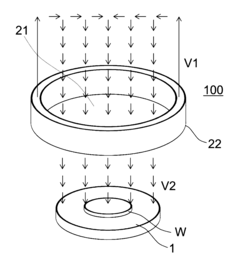
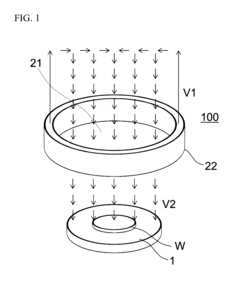
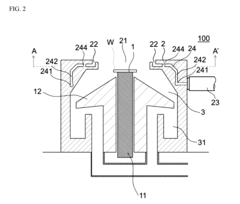
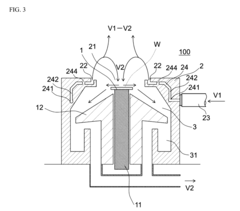
Columnar laminar flow generation device and method for generating columnar laminar flows
PatentActiveUS20170072438A1
Innovation
- A columnar laminar flow generation device that focuses gas blow-out and suction within a localized columnar area, allowing for adjustable flow velocity and reduced gas usage by positioning a gas blow-out port vertically within an opening and a corresponding suction path, thereby generating laminar flows only where needed, with a feed pipe filter for purification.
Method of depositing a coating for improving laminar flow
PatentInactiveEP2304204A1
Innovation
- A method involving determining the theoretical continuous surface, creating a shallow groove to accommodate the panels, and filling it with a coating to match the surface, thereby eliminating protrusions and optimizing the junction for laminar flow.
Regulatory Framework
The regulatory framework surrounding laminar flow methodologies in built environments is a complex and evolving landscape. As these technologies gain prominence in creating controlled indoor spaces, governments and industry bodies are developing guidelines to ensure safety, efficiency, and environmental compliance.
At the international level, organizations such as the International Organization for Standardization (ISO) have established standards for cleanroom technologies, which often incorporate laminar flow principles. ISO 14644 series, particularly ISO 14644-1, provides guidelines for air cleanliness classification in cleanrooms and controlled environments. These standards serve as a foundation for many national regulations.
In the United States, the Food and Drug Administration (FDA) has specific requirements for laminar flow in pharmaceutical and medical device manufacturing facilities. The FDA's Current Good Manufacturing Practice (cGMP) regulations outline the necessary conditions for sterile product manufacturing, including the use of laminar airflow systems. Similarly, the Environmental Protection Agency (EPA) has regulations pertaining to air quality in indoor environments, which indirectly impact the implementation of laminar flow systems.
The European Union has established the EU GMP (Good Manufacturing Practice) guidelines, which include provisions for cleanroom technologies and laminar flow systems in pharmaceutical production. These guidelines are harmonized across EU member states, providing a consistent regulatory approach within the European market.
In Asia, countries like Japan and Singapore have developed their own regulatory frameworks for cleanroom technologies. The Japanese Industrial Standards (JIS) include specific standards for laminar flow equipment and cleanroom design, while Singapore's Workplace Safety and Health (WSH) Act encompasses regulations for controlled environments in various industries.
Emerging economies are also recognizing the importance of regulating laminar flow technologies. Countries like China and India are developing their own standards and regulations, often adapting international guidelines to suit their local industrial and environmental contexts.
As the application of laminar flow methodologies expands beyond traditional cleanroom settings into areas such as sustainable building design and energy-efficient HVAC systems, new regulatory challenges are emerging. Policymakers are grappling with how to balance innovation with safety and environmental concerns. This has led to ongoing discussions about the need for updated building codes and energy efficiency standards that specifically address laminar flow technologies in diverse built environments.
The regulatory landscape is further complicated by the intersection of laminar flow methodologies with other emerging technologies, such as smart building systems and Internet of Things (IoT) devices. As these technologies converge, regulators are faced with the task of developing comprehensive frameworks that address not only air quality and energy efficiency but also data privacy and cybersecurity concerns.
At the international level, organizations such as the International Organization for Standardization (ISO) have established standards for cleanroom technologies, which often incorporate laminar flow principles. ISO 14644 series, particularly ISO 14644-1, provides guidelines for air cleanliness classification in cleanrooms and controlled environments. These standards serve as a foundation for many national regulations.
In the United States, the Food and Drug Administration (FDA) has specific requirements for laminar flow in pharmaceutical and medical device manufacturing facilities. The FDA's Current Good Manufacturing Practice (cGMP) regulations outline the necessary conditions for sterile product manufacturing, including the use of laminar airflow systems. Similarly, the Environmental Protection Agency (EPA) has regulations pertaining to air quality in indoor environments, which indirectly impact the implementation of laminar flow systems.
The European Union has established the EU GMP (Good Manufacturing Practice) guidelines, which include provisions for cleanroom technologies and laminar flow systems in pharmaceutical production. These guidelines are harmonized across EU member states, providing a consistent regulatory approach within the European market.
In Asia, countries like Japan and Singapore have developed their own regulatory frameworks for cleanroom technologies. The Japanese Industrial Standards (JIS) include specific standards for laminar flow equipment and cleanroom design, while Singapore's Workplace Safety and Health (WSH) Act encompasses regulations for controlled environments in various industries.
Emerging economies are also recognizing the importance of regulating laminar flow technologies. Countries like China and India are developing their own standards and regulations, often adapting international guidelines to suit their local industrial and environmental contexts.
As the application of laminar flow methodologies expands beyond traditional cleanroom settings into areas such as sustainable building design and energy-efficient HVAC systems, new regulatory challenges are emerging. Policymakers are grappling with how to balance innovation with safety and environmental concerns. This has led to ongoing discussions about the need for updated building codes and energy efficiency standards that specifically address laminar flow technologies in diverse built environments.
The regulatory landscape is further complicated by the intersection of laminar flow methodologies with other emerging technologies, such as smart building systems and Internet of Things (IoT) devices. As these technologies converge, regulators are faced with the task of developing comprehensive frameworks that address not only air quality and energy efficiency but also data privacy and cybersecurity concerns.
Energy Efficiency Impact
The implementation of laminar flow methodologies in establishing built environments has significant implications for energy efficiency. By creating controlled airflow patterns, these systems can substantially reduce energy consumption in heating, ventilation, and air conditioning (HVAC) processes. The precise management of air currents minimizes turbulence and optimizes thermal distribution, leading to more efficient temperature regulation and reduced power requirements.
In conventional HVAC systems, energy is often wasted due to uneven air distribution and mixing of different temperature zones. Laminar flow techniques address this issue by establishing distinct layers of air, each maintaining its temperature and velocity. This stratification allows for targeted cooling or heating of specific areas without affecting the entire space, resulting in lower overall energy expenditure.
The energy efficiency impact is particularly notable in cleanroom environments, where laminar flow is crucial for maintaining sterile conditions. These facilities traditionally consume vast amounts of energy due to stringent air quality requirements. However, by implementing laminar flow methodologies, cleanrooms can achieve the same level of cleanliness with significantly reduced air change rates, translating to substantial energy savings.
Moreover, laminar flow systems can be integrated with advanced sensor technologies and smart building management systems. This integration enables real-time adjustments to airflow patterns based on occupancy, external weather conditions, and specific zone requirements. The result is a dynamic and responsive environment that optimizes energy usage while maintaining comfort and functionality.
The energy-saving potential of laminar flow methodologies extends beyond direct HVAC operations. By reducing the load on cooling and heating systems, these techniques can lead to downsizing of equipment, further decreasing energy consumption and operational costs. Additionally, the improved air quality and thermal comfort achieved through laminar flow can enhance occupant productivity, indirectly contributing to energy efficiency by reducing the need for personal comfort devices.
As sustainability becomes increasingly critical in building design and operation, the energy efficiency impact of laminar flow methodologies positions them as a valuable tool in achieving green building certifications and meeting stringent energy performance standards. The long-term benefits of these systems in reducing carbon footprints and operational costs make them an attractive option for both new constructions and retrofits of existing buildings.
In conventional HVAC systems, energy is often wasted due to uneven air distribution and mixing of different temperature zones. Laminar flow techniques address this issue by establishing distinct layers of air, each maintaining its temperature and velocity. This stratification allows for targeted cooling or heating of specific areas without affecting the entire space, resulting in lower overall energy expenditure.
The energy efficiency impact is particularly notable in cleanroom environments, where laminar flow is crucial for maintaining sterile conditions. These facilities traditionally consume vast amounts of energy due to stringent air quality requirements. However, by implementing laminar flow methodologies, cleanrooms can achieve the same level of cleanliness with significantly reduced air change rates, translating to substantial energy savings.
Moreover, laminar flow systems can be integrated with advanced sensor technologies and smart building management systems. This integration enables real-time adjustments to airflow patterns based on occupancy, external weather conditions, and specific zone requirements. The result is a dynamic and responsive environment that optimizes energy usage while maintaining comfort and functionality.
The energy-saving potential of laminar flow methodologies extends beyond direct HVAC operations. By reducing the load on cooling and heating systems, these techniques can lead to downsizing of equipment, further decreasing energy consumption and operational costs. Additionally, the improved air quality and thermal comfort achieved through laminar flow can enhance occupant productivity, indirectly contributing to energy efficiency by reducing the need for personal comfort devices.
As sustainability becomes increasingly critical in building design and operation, the energy efficiency impact of laminar flow methodologies positions them as a valuable tool in achieving green building certifications and meeting stringent energy performance standards. The long-term benefits of these systems in reducing carbon footprints and operational costs make them an attractive option for both new constructions and retrofits of existing buildings.
Unlock deeper insights with PatSnap Eureka Quick Research — get a full tech report to explore trends and direct your research. Try now!
Generate Your Research Report Instantly with AI Agent
Supercharge your innovation with PatSnap Eureka AI Agent Platform!