

Research on Self-Powered Sensor Algorithms in Autonomous Technology
OCT 21, 202510 MIN READ
Generate Your Research Report Instantly with AI Agent
PatSnap Eureka helps you evaluate technical feasibility & market potential.
Self-Powered Sensor Technology Background and Objectives
Self-powered sensor technology has evolved significantly over the past decade, transforming from simple energy harvesting concepts to sophisticated autonomous sensing systems. The fundamental principle behind this technology involves converting ambient energy sources—such as mechanical vibrations, thermal gradients, solar radiation, and electromagnetic waves—into electrical energy sufficient to power sensing operations without external power supplies. This technological evolution addresses critical limitations in conventional sensor networks, particularly in remote monitoring applications where battery replacement is impractical or impossible.
The historical trajectory of self-powered sensors began with basic piezoelectric and thermoelectric generators in the early 2000s, progressing through significant advancements in nanomaterials and micro-electromechanical systems (MEMS) in the 2010s. Recent breakthroughs in ultra-low-power electronics and energy-efficient algorithms have further accelerated development, enabling increasingly complex sensing operations with minimal energy requirements.
In autonomous technology applications, self-powered sensors represent a paradigm shift from traditional sensing methodologies. These systems must not only collect and process data but do so with extreme energy efficiency while maintaining reliability in diverse and often harsh operating environments. The integration of these sensors into autonomous vehicles, industrial automation systems, and smart infrastructure creates unique technical challenges that drive innovation in both hardware design and algorithmic approaches.
The primary technical objectives in this field focus on several interconnected areas. First, maximizing energy harvesting efficiency across diverse environmental conditions remains paramount, with researchers targeting conversion efficiencies exceeding 30% for next-generation devices. Second, developing ultra-low-power sensing algorithms capable of intelligent data acquisition, processing, and transmission with minimal energy expenditure represents a critical research direction. Third, creating adaptive power management systems that dynamically balance energy harvesting, storage, and consumption based on environmental conditions and application requirements continues to challenge researchers.
Additionally, the field aims to enhance sensor longevity and reliability through improved materials and system architectures that resist degradation in challenging environments. Miniaturization represents another key objective, with efforts focused on reducing form factors while maintaining or improving functionality. Finally, researchers are working toward seamless integration capabilities that allow self-powered sensors to function effectively within larger autonomous systems without compromising overall performance or reliability.
The convergence of these technological advances and research objectives positions self-powered sensor algorithms as a transformative force in autonomous technology, potentially enabling previously impossible applications in environmental monitoring, infrastructure management, healthcare, and transportation systems.
The historical trajectory of self-powered sensors began with basic piezoelectric and thermoelectric generators in the early 2000s, progressing through significant advancements in nanomaterials and micro-electromechanical systems (MEMS) in the 2010s. Recent breakthroughs in ultra-low-power electronics and energy-efficient algorithms have further accelerated development, enabling increasingly complex sensing operations with minimal energy requirements.
In autonomous technology applications, self-powered sensors represent a paradigm shift from traditional sensing methodologies. These systems must not only collect and process data but do so with extreme energy efficiency while maintaining reliability in diverse and often harsh operating environments. The integration of these sensors into autonomous vehicles, industrial automation systems, and smart infrastructure creates unique technical challenges that drive innovation in both hardware design and algorithmic approaches.
The primary technical objectives in this field focus on several interconnected areas. First, maximizing energy harvesting efficiency across diverse environmental conditions remains paramount, with researchers targeting conversion efficiencies exceeding 30% for next-generation devices. Second, developing ultra-low-power sensing algorithms capable of intelligent data acquisition, processing, and transmission with minimal energy expenditure represents a critical research direction. Third, creating adaptive power management systems that dynamically balance energy harvesting, storage, and consumption based on environmental conditions and application requirements continues to challenge researchers.
Additionally, the field aims to enhance sensor longevity and reliability through improved materials and system architectures that resist degradation in challenging environments. Miniaturization represents another key objective, with efforts focused on reducing form factors while maintaining or improving functionality. Finally, researchers are working toward seamless integration capabilities that allow self-powered sensors to function effectively within larger autonomous systems without compromising overall performance or reliability.
The convergence of these technological advances and research objectives positions self-powered sensor algorithms as a transformative force in autonomous technology, potentially enabling previously impossible applications in environmental monitoring, infrastructure management, healthcare, and transportation systems.
Market Demand Analysis for Autonomous Self-Powered Systems
The global market for autonomous self-powered sensor systems is experiencing unprecedented growth, driven by the convergence of IoT expansion, industrial automation, and sustainable technology demands. Current market valuations indicate that the self-powered sensor market reached approximately $2.5 billion in 2022, with projections suggesting a compound annual growth rate of 14-16% through 2030, potentially reaching $8.7 billion by the end of the decade.
The automotive sector represents the largest demand segment, with autonomous vehicles requiring extensive sensor networks that can operate reliably without constant power supply connections. This demand is particularly acute as Level 3 and Level 4 autonomous driving technologies advance toward commercial deployment, creating requirements for sensors that can maintain operation even during primary power system failures.
Industrial IoT applications constitute the second-largest market segment, where remote monitoring in harsh environments necessitates sensors that can harvest energy from their surroundings. Manufacturing facilities are increasingly implementing predictive maintenance systems using self-powered vibration and temperature sensors, reducing downtime by up to 40% in early adopter facilities.
Consumer electronics manufacturers are also driving significant demand, seeking to eliminate battery replacement in wearable devices and smart home systems. Market research indicates that consumers are willing to pay a 15-20% premium for devices that never require charging or battery replacement, creating a substantial value proposition for self-powered technology.
Healthcare applications represent the fastest-growing segment, with implantable medical devices and remote patient monitoring systems requiring ultra-reliable, long-term power solutions. The aging global population and shift toward home healthcare are accelerating this trend, with the medical self-powered sensor market expected to grow at 18% annually.
Geographic analysis reveals that North America currently leads market demand (38%), followed by Europe (29%) and Asia-Pacific (27%), though the latter is expected to overtake other regions by 2026 due to rapid industrial automation in China, South Korea, and India.
Key market constraints include cost barriers, with self-powered sensors typically commanding a 2-3x price premium over conventional alternatives, and performance limitations in low-energy environments. However, these constraints are rapidly diminishing as energy harvesting technologies improve and manufacturing scales increase.
The market shows strong correlation with broader sustainability initiatives, as organizations seek to reduce battery waste and minimize maintenance requirements for distributed sensor networks. This alignment with environmental goals is creating additional market pull beyond pure technical requirements, particularly in regions with stringent environmental regulations.
The automotive sector represents the largest demand segment, with autonomous vehicles requiring extensive sensor networks that can operate reliably without constant power supply connections. This demand is particularly acute as Level 3 and Level 4 autonomous driving technologies advance toward commercial deployment, creating requirements for sensors that can maintain operation even during primary power system failures.
Industrial IoT applications constitute the second-largest market segment, where remote monitoring in harsh environments necessitates sensors that can harvest energy from their surroundings. Manufacturing facilities are increasingly implementing predictive maintenance systems using self-powered vibration and temperature sensors, reducing downtime by up to 40% in early adopter facilities.
Consumer electronics manufacturers are also driving significant demand, seeking to eliminate battery replacement in wearable devices and smart home systems. Market research indicates that consumers are willing to pay a 15-20% premium for devices that never require charging or battery replacement, creating a substantial value proposition for self-powered technology.
Healthcare applications represent the fastest-growing segment, with implantable medical devices and remote patient monitoring systems requiring ultra-reliable, long-term power solutions. The aging global population and shift toward home healthcare are accelerating this trend, with the medical self-powered sensor market expected to grow at 18% annually.
Geographic analysis reveals that North America currently leads market demand (38%), followed by Europe (29%) and Asia-Pacific (27%), though the latter is expected to overtake other regions by 2026 due to rapid industrial automation in China, South Korea, and India.
Key market constraints include cost barriers, with self-powered sensors typically commanding a 2-3x price premium over conventional alternatives, and performance limitations in low-energy environments. However, these constraints are rapidly diminishing as energy harvesting technologies improve and manufacturing scales increase.
The market shows strong correlation with broader sustainability initiatives, as organizations seek to reduce battery waste and minimize maintenance requirements for distributed sensor networks. This alignment with environmental goals is creating additional market pull beyond pure technical requirements, particularly in regions with stringent environmental regulations.
Current State and Challenges in Self-Powered Sensor Technology
Self-powered sensor technology has witnessed significant advancements globally, with research institutions and companies across North America, Europe, and Asia making substantial contributions. Currently, the technology encompasses various energy harvesting mechanisms including piezoelectric, triboelectric, thermoelectric, and photovoltaic approaches, each with distinct advantages and limitations in autonomous applications. Despite progress, these technologies face considerable challenges in energy efficiency, with most self-powered sensors generating only microwatts to milliwatts of power—insufficient for complex computational tasks required in advanced autonomous systems.
A critical limitation in current implementations is the power-performance trade-off. Existing algorithms must operate within severe energy constraints, often sacrificing accuracy, response time, or functionality. This fundamental challenge has led to the development of ultra-low-power processing techniques and event-driven architectures that activate only when necessary, though these solutions remain inadequate for many high-demand applications.
Miniaturization presents another significant hurdle. As sensors decrease in size to accommodate modern autonomous devices, available surface area for energy harvesting diminishes proportionally. This physical constraint fundamentally limits power generation capacity, creating a technological bottleneck that requires innovative materials science solutions and novel energy conversion mechanisms.
Environmental adaptability remains problematic for current self-powered sensor technologies. Performance varies dramatically across different operating conditions, with many energy harvesting mechanisms showing significant efficiency drops in suboptimal environments. Piezoelectric harvesters require consistent vibration, thermoelectric generators need temperature differentials, and photovoltaic cells depend on adequate light exposure—conditions that cannot be guaranteed in many autonomous applications.
Data reliability and transmission capabilities are additionally constrained by power limitations. Current self-powered sensor networks struggle with consistent data collection and transmission, particularly in applications requiring continuous monitoring or real-time response. This has necessitated the development of specialized communication protocols and data compression algorithms specifically designed for energy-constrained environments.
Standardization across the industry remains fragmented, with various proprietary solutions and limited interoperability between different self-powered sensor ecosystems. This lack of unified standards has slowed widespread adoption and integration into existing autonomous systems, creating market hesitancy despite the technology's potential benefits.
Recent technological breakthroughs in materials science, particularly in the development of high-efficiency piezoelectric nanomaterials and flexible energy harvesting surfaces, show promise for addressing some of these limitations. However, significant research gaps remain in algorithm optimization for variable power availability and in creating truly adaptive systems that can function reliably across diverse operating conditions.
A critical limitation in current implementations is the power-performance trade-off. Existing algorithms must operate within severe energy constraints, often sacrificing accuracy, response time, or functionality. This fundamental challenge has led to the development of ultra-low-power processing techniques and event-driven architectures that activate only when necessary, though these solutions remain inadequate for many high-demand applications.
Miniaturization presents another significant hurdle. As sensors decrease in size to accommodate modern autonomous devices, available surface area for energy harvesting diminishes proportionally. This physical constraint fundamentally limits power generation capacity, creating a technological bottleneck that requires innovative materials science solutions and novel energy conversion mechanisms.
Environmental adaptability remains problematic for current self-powered sensor technologies. Performance varies dramatically across different operating conditions, with many energy harvesting mechanisms showing significant efficiency drops in suboptimal environments. Piezoelectric harvesters require consistent vibration, thermoelectric generators need temperature differentials, and photovoltaic cells depend on adequate light exposure—conditions that cannot be guaranteed in many autonomous applications.
Data reliability and transmission capabilities are additionally constrained by power limitations. Current self-powered sensor networks struggle with consistent data collection and transmission, particularly in applications requiring continuous monitoring or real-time response. This has necessitated the development of specialized communication protocols and data compression algorithms specifically designed for energy-constrained environments.
Standardization across the industry remains fragmented, with various proprietary solutions and limited interoperability between different self-powered sensor ecosystems. This lack of unified standards has slowed widespread adoption and integration into existing autonomous systems, creating market hesitancy despite the technology's potential benefits.
Recent technological breakthroughs in materials science, particularly in the development of high-efficiency piezoelectric nanomaterials and flexible energy harvesting surfaces, show promise for addressing some of these limitations. However, significant research gaps remain in algorithm optimization for variable power availability and in creating truly adaptive systems that can function reliably across diverse operating conditions.
Current Algorithm Solutions for Self-Powered Sensors
01 Energy harvesting for self-powered sensors
Self-powered sensors utilize energy harvesting techniques to generate power from ambient sources such as vibration, thermal gradients, light, or RF signals. These techniques enable sensors to operate autonomously without external power sources, making them suitable for remote or inaccessible locations. The algorithms optimize energy collection efficiency and manage power consumption to ensure continuous operation even under varying environmental conditions.- Energy harvesting for self-powered sensors: Self-powered sensors utilize energy harvesting techniques to generate power from ambient sources such as vibration, thermal gradients, light, or RF signals. These techniques eliminate the need for external power sources or battery replacement, enabling autonomous operation in remote or inaccessible locations. The harvested energy powers both the sensing elements and the algorithmic processing units, allowing for continuous monitoring and data collection without maintenance.
- Adaptive power management algorithms: Adaptive power management algorithms optimize energy consumption in self-powered sensors by dynamically adjusting operational parameters based on available energy and application requirements. These algorithms implement duty cycling, variable sampling rates, and selective data processing to extend operational lifetime. By intelligently managing power states and prioritizing critical functions, the sensors can maintain functionality even under energy-constrained conditions.
- Machine learning for sensor data processing: Machine learning algorithms enhance the capabilities of self-powered sensors by enabling efficient data processing, feature extraction, and pattern recognition with minimal computational resources. These algorithms can be optimized to operate within the energy constraints of self-powered systems while maintaining high accuracy. Techniques such as lightweight neural networks, decision trees, and Bayesian methods allow sensors to perform complex analysis tasks locally, reducing the need for energy-intensive data transmission.
- Distributed sensing and collaborative algorithms: Distributed sensing networks utilize collaborative algorithms to optimize overall system performance while minimizing individual sensor energy consumption. These algorithms enable load balancing, cooperative sensing, and distributed data processing across multiple self-powered nodes. By sharing sensing tasks and computational loads, the network can achieve higher reliability and coverage while extending the operational lifetime of individual sensors.
- Self-calibration and fault-tolerant operation: Self-calibration algorithms enable sensors to maintain accuracy despite environmental variations and component degradation without requiring external intervention. These algorithms can detect and compensate for drift, noise, and other measurement errors automatically. Additionally, fault-tolerant operation techniques allow sensors to continue functioning even when components fail or energy availability fluctuates, ensuring reliable operation in critical applications.
02 Adaptive sampling and processing algorithms
These algorithms dynamically adjust sensor sampling rates and processing parameters based on available energy and detected events. By implementing context-aware operation modes, the sensors can conserve energy during periods of inactivity and increase sensitivity when events of interest occur. This approach optimizes the balance between power consumption and sensing performance, extending operational lifetime while maintaining data quality.Expand Specific Solutions03 Machine learning for sensor data optimization
Machine learning algorithms enable self-powered sensors to intelligently process and analyze data at the edge. These algorithms can identify patterns, detect anomalies, and make predictions while minimizing computational requirements. By performing local data processing and compression, the sensors reduce transmission power needs and improve overall energy efficiency while maintaining high accuracy in environmental monitoring and condition assessment applications.Expand Specific Solutions04 Power management and distribution algorithms
These algorithms focus on optimizing power usage across sensor networks by implementing intelligent duty cycling, sleep modes, and prioritized task scheduling. They enable dynamic power allocation based on critical sensing needs and available energy resources. The algorithms incorporate predictive models to anticipate energy availability and adjust sensor operations accordingly, ensuring reliable performance even under energy constraints.Expand Specific Solutions05 Distributed sensing and collaborative algorithms
Collaborative algorithms enable multiple self-powered sensors to work together as a coordinated system. These approaches distribute sensing tasks across the network based on each node's energy status and capabilities. By sharing processing loads and implementing consensus mechanisms, the network can achieve higher accuracy and reliability while minimizing individual sensor power consumption. The algorithms also incorporate fault tolerance to maintain operation when individual sensors have insufficient power.Expand Specific Solutions
Key Industry Players in Self-Powered Autonomous Systems
The self-powered sensor algorithm market in autonomous technology is currently in a growth phase, with increasing adoption across automotive and industrial sectors. The competitive landscape features established automotive players like Waymo, Tesla, Toyota, and Hyundai developing proprietary solutions alongside technology specialists such as EnOcean and Clear Blue Technologies focusing on energy harvesting innovations. Academic institutions including Chongqing University and UESTC contribute fundamental research, while tech giants like Intel, Huawei, and Bosch leverage their semiconductor expertise to develop integrated solutions. The market is characterized by strategic partnerships between automotive manufacturers and technology providers, with companies like TuSimple and Argo AI focusing on specialized autonomous applications requiring efficient sensor algorithms that minimize power consumption while maximizing data processing capabilities.
Intel Corp.
Technical Solution: Intel has developed comprehensive self-powered sensor solutions focusing on edge computing capabilities for autonomous systems. Their approach combines ultra-low-power processor architectures with specialized algorithms designed to maximize computational efficiency per energy unit. Intel's self-powered sensor algorithms implement neuromorphic computing principles that mimic brain functions to achieve significant energy efficiency improvements. Their system utilizes specialized hardware accelerators for common sensor processing tasks, reducing energy requirements by orders of magnitude compared to general-purpose processing. Intel has developed adaptive precision algorithms that dynamically adjust computational precision based on available energy and application requirements. Their approach includes distributed intelligence frameworks where processing tasks are optimally allocated across sensor networks based on energy availability at each node. Intel's algorithms incorporate sophisticated power gating techniques that selectively deactivate circuit components when not needed, dramatically reducing standby power consumption.
Strengths: Industry-leading expertise in processor architecture optimization; extensive research capabilities in neuromorphic and other energy-efficient computing paradigms. Weaknesses: Solutions often require specialized hardware components that increase system complexity; higher implementation costs compared to simpler sensor solutions.
EnOcean GmbH
Technical Solution: EnOcean specializes exclusively in self-powered wireless sensor technology, making them a leader in this specific domain. Their algorithms are designed around their patented energy harvesting wireless technology that operates on minimal energy from motion, light, and temperature differences. EnOcean's self-powered sensor algorithms implement ultra-efficient radio protocols specifically designed for energy-harvested operation, requiring as little as 50 μWs for a standard transmission. Their approach includes sophisticated power management algorithms that store harvested energy and optimize its use across sensing, processing, and communication functions. EnOcean has developed specialized data compression and transmission algorithms that minimize energy consumption while maintaining data integrity. Their system incorporates adaptive transmission power control that automatically adjusts based on distance and environmental conditions. EnOcean's algorithms include intelligent sleep modes with configurable wake-up thresholds that respond to environmental triggers while consuming virtually no standby power.
Strengths: Highly specialized expertise in energy harvesting technologies; proven deployments with over 1 million self-powered sensors in commercial applications. Weaknesses: Limited focus on high-computation autonomous applications; solutions primarily designed for building automation rather than mobile autonomous systems.
Core Technical Innovations in Energy Harvesting Algorithms
Self-powered detection device with a non-volatile memory
PatentActiveUS8411505B2
Innovation
- A self-powered detection device comprising a non-volatile memory unit and a sensor that uses a clamp circuit to harness energy from physical or chemical events, allowing efficient storage and protection of data without external power, while preventing unauthorized resets through a clamp circuit that blocks inappropriate voltage signals.
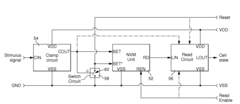
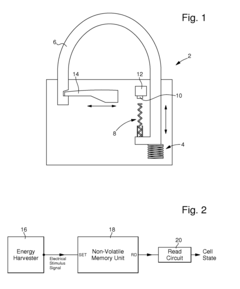
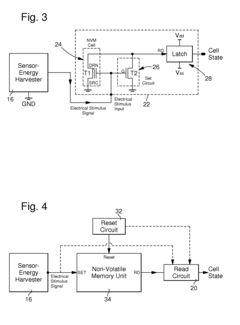
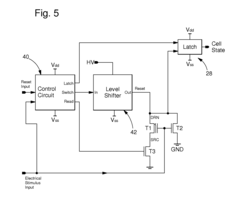
Self-powered environmental sensor with wake-up circuitry
PatentInactiveUS8309942B2
Innovation
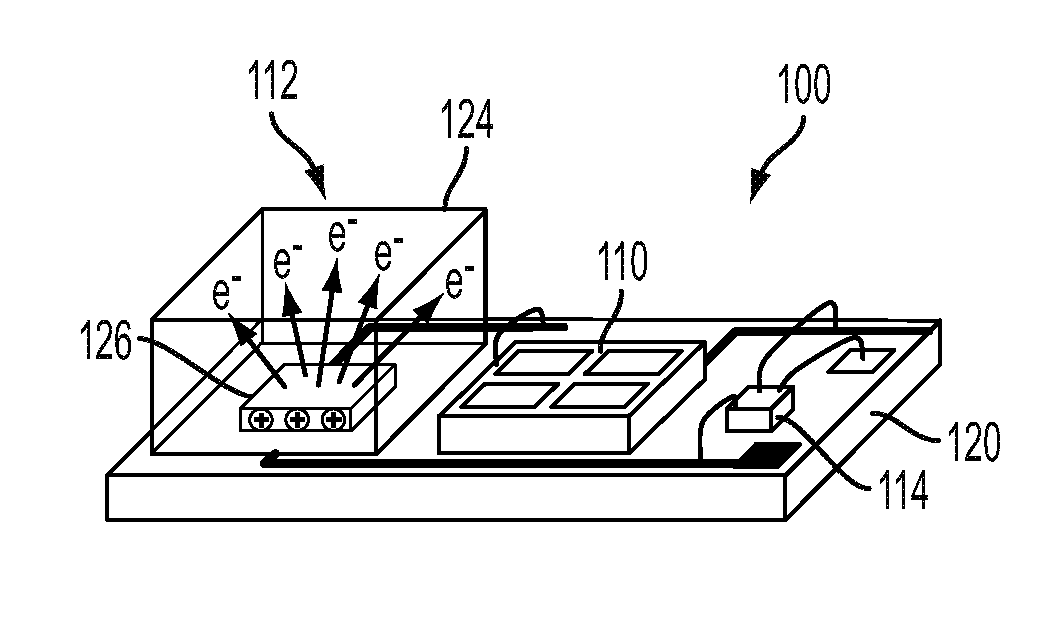
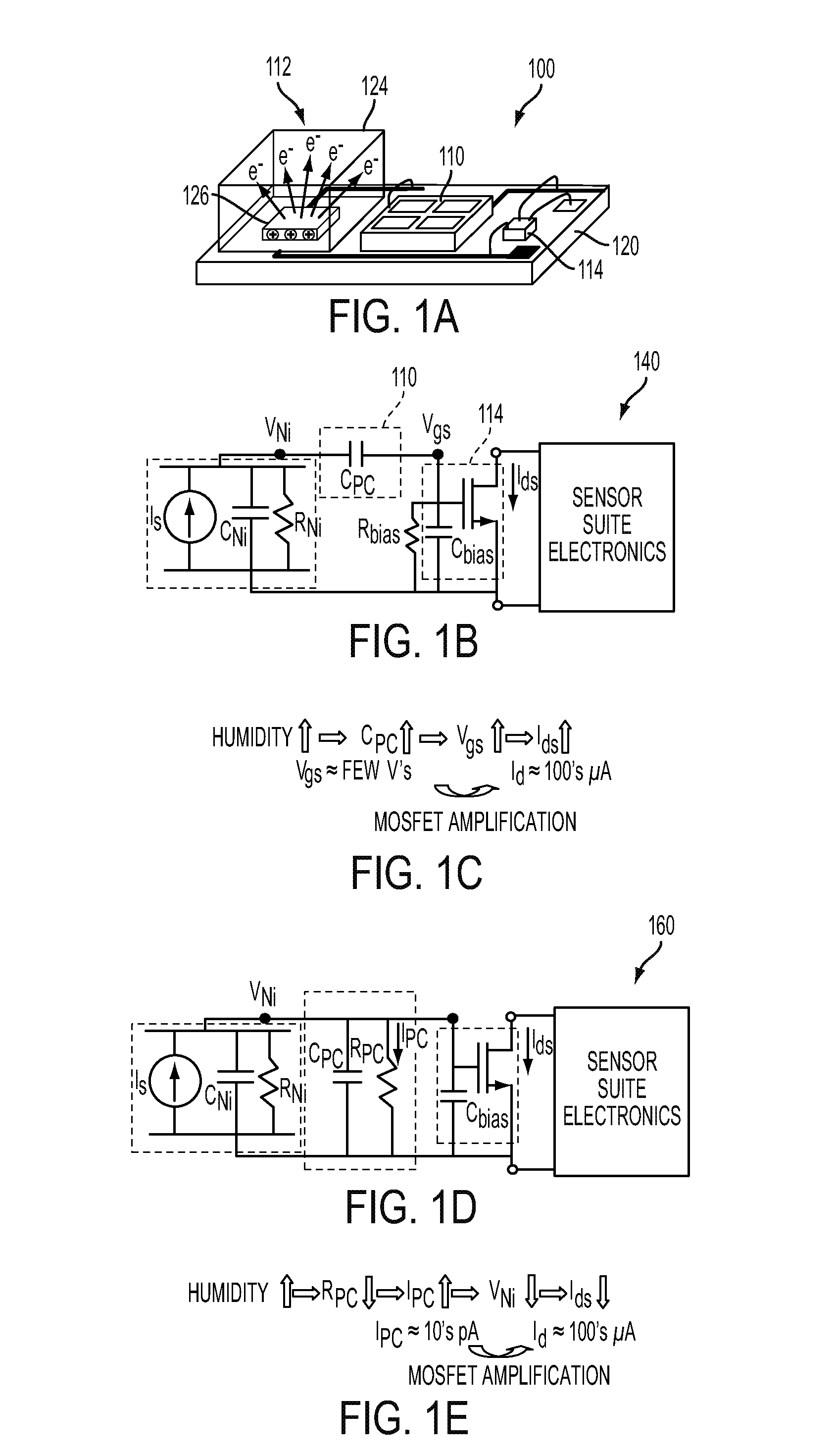
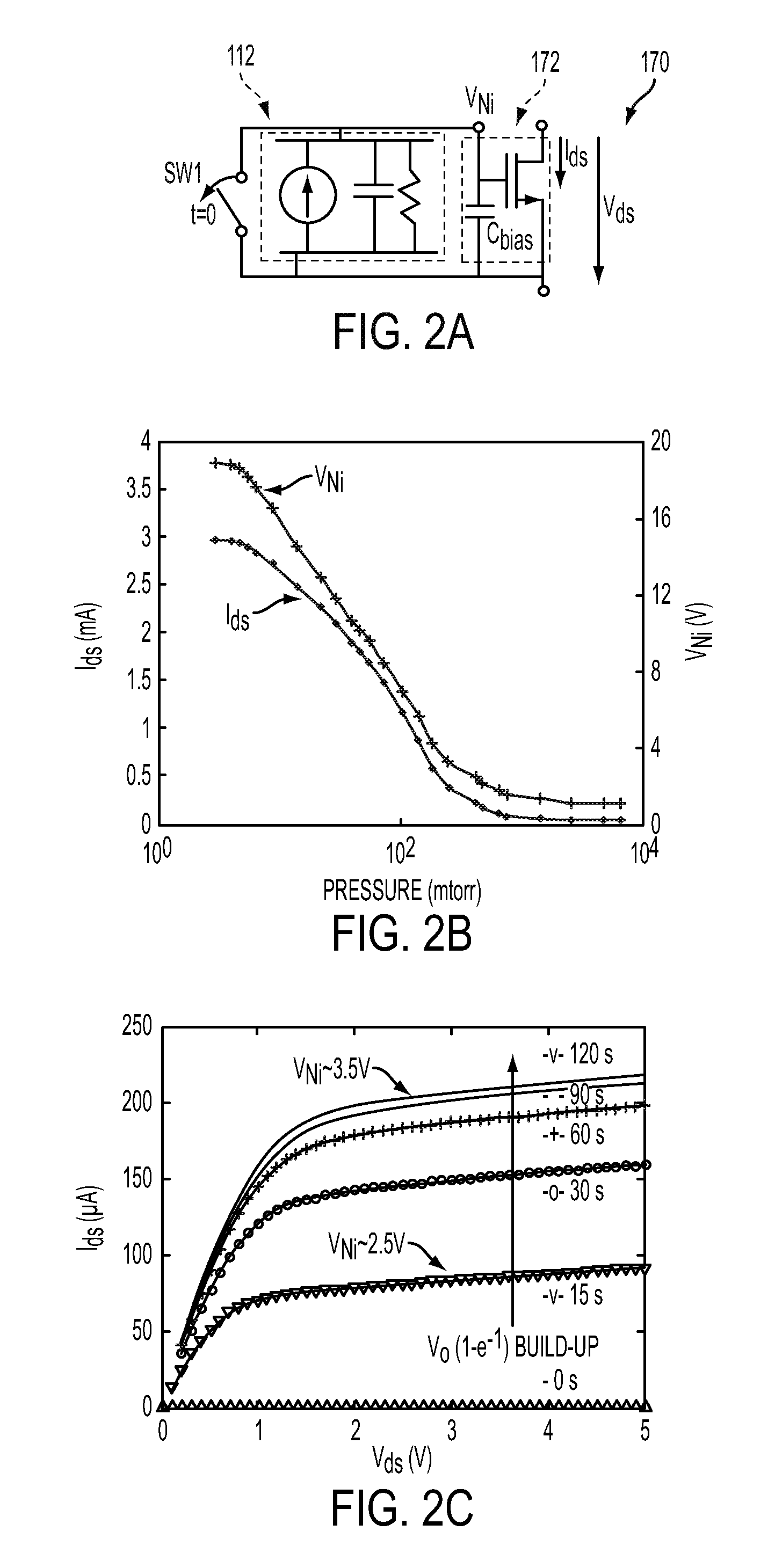
- The development of zero-power sensors using radioisotope-powered humidity and temperature sensors with self-powered capacitors and mechanical amplifiers, employing Nickel-63 as a safe radioisotope source, which modulates conductance in MOSFETs for energy-efficient operation and high sensitivity detection.
Energy Efficiency Metrics and Performance Benchmarks
Establishing robust energy efficiency metrics and performance benchmarks is critical for evaluating self-powered sensor algorithms in autonomous technologies. The primary energy efficiency metrics include power consumption rate (measured in microwatts), energy harvesting efficiency (percentage of available ambient energy successfully converted), and operational longevity (duration of continuous operation without external power input). These metrics provide quantitative frameworks for comparing different algorithmic approaches and hardware implementations.
Performance benchmarks must address both energy considerations and functional capabilities. Sensor response time, measured in milliseconds, indicates how quickly a self-powered system can detect and process environmental changes. Data accuracy rates, typically expressed as percentage deviation from ground truth, reflect the reliability of sensor readings despite energy constraints. Processing efficiency, measured in operations per joule, quantifies computational performance relative to energy expenditure.
Industry-standard testing protocols have emerged to standardize evaluation procedures. The IEEE 1451 framework provides guidelines for sensor testing, while the more recent Energy Harvesting Sensor Benchmark Suite (EHSBS) specifically addresses self-powered systems. These protocols typically involve controlled environment testing followed by real-world deployment scenarios to assess performance under varying energy availability conditions.
Comparative analysis across different autonomous domains reveals varying priorities in performance metrics. Automotive applications prioritize reliability and response time, accepting higher energy requirements. In contrast, environmental monitoring applications emphasize extended operational longevity, often trading off processing speed for power efficiency. Industrial IoT applications typically seek balance between these extremes, with moderate requirements across all metrics.
Recent advancements in benchmark methodologies include energy-aware testing frameworks that simulate dynamic energy harvesting conditions. These frameworks subject algorithms to fluctuating power availability scenarios, evaluating their adaptive capabilities and graceful performance degradation. The Energy-Adaptive Algorithm Performance Index (EAAPI) has gained traction as a composite metric that combines multiple performance indicators weighted by application requirements.
Standardization efforts continue to evolve, with organizations like the International Electrotechnical Commission (IEC) developing comprehensive guidelines specifically for self-powered sensing systems. These emerging standards aim to facilitate fair comparison between different technological approaches and accelerate industry-wide adoption of the most efficient solutions for autonomous technology applications.
Performance benchmarks must address both energy considerations and functional capabilities. Sensor response time, measured in milliseconds, indicates how quickly a self-powered system can detect and process environmental changes. Data accuracy rates, typically expressed as percentage deviation from ground truth, reflect the reliability of sensor readings despite energy constraints. Processing efficiency, measured in operations per joule, quantifies computational performance relative to energy expenditure.
Industry-standard testing protocols have emerged to standardize evaluation procedures. The IEEE 1451 framework provides guidelines for sensor testing, while the more recent Energy Harvesting Sensor Benchmark Suite (EHSBS) specifically addresses self-powered systems. These protocols typically involve controlled environment testing followed by real-world deployment scenarios to assess performance under varying energy availability conditions.
Comparative analysis across different autonomous domains reveals varying priorities in performance metrics. Automotive applications prioritize reliability and response time, accepting higher energy requirements. In contrast, environmental monitoring applications emphasize extended operational longevity, often trading off processing speed for power efficiency. Industrial IoT applications typically seek balance between these extremes, with moderate requirements across all metrics.
Recent advancements in benchmark methodologies include energy-aware testing frameworks that simulate dynamic energy harvesting conditions. These frameworks subject algorithms to fluctuating power availability scenarios, evaluating their adaptive capabilities and graceful performance degradation. The Energy-Adaptive Algorithm Performance Index (EAAPI) has gained traction as a composite metric that combines multiple performance indicators weighted by application requirements.
Standardization efforts continue to evolve, with organizations like the International Electrotechnical Commission (IEC) developing comprehensive guidelines specifically for self-powered sensing systems. These emerging standards aim to facilitate fair comparison between different technological approaches and accelerate industry-wide adoption of the most efficient solutions for autonomous technology applications.
Sustainability Impact of Self-Powered Autonomous Systems
The integration of self-powered sensors into autonomous systems represents a significant advancement in sustainable technology development. These systems, by generating their own operational energy, substantially reduce the environmental footprint associated with traditional power sources. The elimination of battery replacement and disposal cycles directly addresses the growing electronic waste crisis, which currently contributes approximately 50 million tons of waste globally each year.
Self-powered autonomous systems demonstrate remarkable efficiency in resource utilization. By harvesting ambient energy from sources such as vibration, temperature differentials, and light, these systems operate with minimal environmental disruption. Research indicates that widespread adoption of self-powered sensors could reduce energy consumption in monitoring applications by up to 70% compared to conventional battery-powered alternatives.
The sustainability benefits extend beyond waste reduction and energy efficiency. Self-powered sensors enable continuous environmental monitoring in previously inaccessible or economically unfeasible locations. This capability has proven invaluable for tracking ecological changes, monitoring pollution levels, and providing early warning systems for natural disasters without requiring intrusive infrastructure development.
From a lifecycle perspective, self-powered autonomous systems offer significant advantages. Analysis shows that the carbon footprint associated with manufacturing and operating these systems can be 40-60% lower than traditional sensor networks when measured over a five-year operational period. The extended operational lifespan—often exceeding ten years without maintenance—further enhances their sustainability profile.
In agricultural applications, self-powered autonomous systems have demonstrated water conservation improvements of 30-45% through precision irrigation control. Similarly, in urban environments, these systems optimize energy usage in buildings, potentially reducing consumption by 15-25% through intelligent management of lighting, heating, and cooling systems.
The economic sustainability of these technologies is equally compelling. While initial implementation costs may exceed conventional alternatives, the total cost of ownership analysis reveals significant long-term advantages. The elimination of maintenance visits, battery replacements, and associated labor costs typically results in return on investment within 18-36 months, depending on application complexity and deployment environment.
As climate change concerns intensify, the carbon-neutral operation of self-powered autonomous systems positions them as essential components in sustainable development strategies. Their ability to function independently of fossil fuel-based energy infrastructure aligns perfectly with global carbon reduction targets and supports the transition toward more resilient and environmentally responsible technological ecosystems.
Self-powered autonomous systems demonstrate remarkable efficiency in resource utilization. By harvesting ambient energy from sources such as vibration, temperature differentials, and light, these systems operate with minimal environmental disruption. Research indicates that widespread adoption of self-powered sensors could reduce energy consumption in monitoring applications by up to 70% compared to conventional battery-powered alternatives.
The sustainability benefits extend beyond waste reduction and energy efficiency. Self-powered sensors enable continuous environmental monitoring in previously inaccessible or economically unfeasible locations. This capability has proven invaluable for tracking ecological changes, monitoring pollution levels, and providing early warning systems for natural disasters without requiring intrusive infrastructure development.
From a lifecycle perspective, self-powered autonomous systems offer significant advantages. Analysis shows that the carbon footprint associated with manufacturing and operating these systems can be 40-60% lower than traditional sensor networks when measured over a five-year operational period. The extended operational lifespan—often exceeding ten years without maintenance—further enhances their sustainability profile.
In agricultural applications, self-powered autonomous systems have demonstrated water conservation improvements of 30-45% through precision irrigation control. Similarly, in urban environments, these systems optimize energy usage in buildings, potentially reducing consumption by 15-25% through intelligent management of lighting, heating, and cooling systems.
The economic sustainability of these technologies is equally compelling. While initial implementation costs may exceed conventional alternatives, the total cost of ownership analysis reveals significant long-term advantages. The elimination of maintenance visits, battery replacements, and associated labor costs typically results in return on investment within 18-36 months, depending on application complexity and deployment environment.
As climate change concerns intensify, the carbon-neutral operation of self-powered autonomous systems positions them as essential components in sustainable development strategies. Their ability to function independently of fossil fuel-based energy infrastructure aligns perfectly with global carbon reduction targets and supports the transition toward more resilient and environmentally responsible technological ecosystems.
Unlock deeper insights with PatSnap Eureka Quick Research — get a full tech report to explore trends and direct your research. Try now!
Generate Your Research Report Instantly with AI Agent
Supercharge your innovation with PatSnap Eureka AI Agent Platform!