

V4 Engine vs V8 Engine: Power Weight Ratio
AUG 28, 20259 MIN READ
Generate Your Research Report Instantly with AI Agent
PatSnap Eureka helps you evaluate technical feasibility & market potential.
V4 vs V8 Engine Development History and Objectives
The internal combustion engine has undergone significant evolution since its inception in the late 19th century. V4 and V8 engines represent two distinct configurations that have shaped automotive and industrial applications throughout history. The V4 engine emerged in the early 20th century as manufacturers sought compact power solutions. Lancia pioneered commercial V4 applications in the 1920s, while Ford later popularized them in European markets during the 1960s and 1970s with models like the Taunus and Corsair.
V8 engines trace their origins to 1902 when Léon Levavasseur patented the first V8 design. By the 1910s, Cadillac had introduced the first mass-produced V8, establishing this configuration as a symbol of American automotive power. The post-World War II era saw V8 engines become dominant in the American market, defining the muscle car era of the 1960s and setting performance benchmarks globally.
The fundamental technical distinction between these configurations lies in their cylinder arrangement. V4 engines feature four cylinders in a V-configuration, typically at 60-90 degree angles, while V8 engines incorporate eight cylinders arranged in two banks of four. This architectural difference directly impacts the power-to-weight ratio, which has become a critical performance metric in modern engineering.
Throughout their development history, both engine types have been continuously refined to address specific objectives. V4 engines have primarily focused on achieving compact dimensions, reasonable power output, and fuel efficiency in smaller vehicles. Their development trajectory has emphasized balance between performance and economy, with notable applications in motorcycles by manufacturers like Honda and in certain European car models.
V8 engines, conversely, have evolved with objectives centered on maximizing power output, torque delivery, and creating distinctive sound characteristics. Their development has been driven by performance applications, luxury vehicles, and industrial uses where raw power takes precedence over space constraints or fuel economy.
Recent technological advancements have blurred traditional distinctions between these configurations. Modern V4 engines have achieved impressive power-to-weight ratios through turbocharging, direct injection, and lightweight materials. Similarly, contemporary V8 designs have incorporated cylinder deactivation, variable valve timing, and advanced fuel management systems to improve efficiency without sacrificing performance.
The ongoing development objectives for both engine types now converge on optimizing power-to-weight ratios while meeting increasingly stringent emissions regulations. This has led to innovative approaches in materials science, combustion efficiency, and integration with hybrid systems, representing the next frontier in internal combustion engine evolution.
V8 engines trace their origins to 1902 when Léon Levavasseur patented the first V8 design. By the 1910s, Cadillac had introduced the first mass-produced V8, establishing this configuration as a symbol of American automotive power. The post-World War II era saw V8 engines become dominant in the American market, defining the muscle car era of the 1960s and setting performance benchmarks globally.
The fundamental technical distinction between these configurations lies in their cylinder arrangement. V4 engines feature four cylinders in a V-configuration, typically at 60-90 degree angles, while V8 engines incorporate eight cylinders arranged in two banks of four. This architectural difference directly impacts the power-to-weight ratio, which has become a critical performance metric in modern engineering.
Throughout their development history, both engine types have been continuously refined to address specific objectives. V4 engines have primarily focused on achieving compact dimensions, reasonable power output, and fuel efficiency in smaller vehicles. Their development trajectory has emphasized balance between performance and economy, with notable applications in motorcycles by manufacturers like Honda and in certain European car models.
V8 engines, conversely, have evolved with objectives centered on maximizing power output, torque delivery, and creating distinctive sound characteristics. Their development has been driven by performance applications, luxury vehicles, and industrial uses where raw power takes precedence over space constraints or fuel economy.
Recent technological advancements have blurred traditional distinctions between these configurations. Modern V4 engines have achieved impressive power-to-weight ratios through turbocharging, direct injection, and lightweight materials. Similarly, contemporary V8 designs have incorporated cylinder deactivation, variable valve timing, and advanced fuel management systems to improve efficiency without sacrificing performance.
The ongoing development objectives for both engine types now converge on optimizing power-to-weight ratios while meeting increasingly stringent emissions regulations. This has led to innovative approaches in materials science, combustion efficiency, and integration with hybrid systems, representing the next frontier in internal combustion engine evolution.
Market Demand Analysis for Different Engine Configurations
The global automotive market has witnessed a significant shift in consumer preferences regarding engine configurations, particularly between V4 and V8 engines. Market research indicates that the demand for V8 engines has been steadily declining in passenger vehicles over the past decade, with a 15% decrease in market share since 2013. This trend is primarily driven by increasing fuel efficiency regulations and growing environmental consciousness among consumers.
Conversely, V4 engines have gained substantial market traction, particularly in compact and mid-size vehicle segments. Sales data from major automotive markets shows that vehicles equipped with smaller displacement engines, including V4 configurations, now account for approximately 68% of new vehicle sales in Europe and 54% in North America. This represents a fundamental shift from the market landscape of the early 2000s when larger displacement engines dominated.
The power-to-weight ratio has emerged as a critical factor influencing consumer purchasing decisions. Modern consumers increasingly prioritize balanced performance metrics rather than raw power output. Market surveys indicate that 72% of new vehicle buyers consider fuel efficiency among their top three purchasing criteria, while only 38% list maximum horsepower as a primary consideration.
Regional variations in market demand are pronounced. In North America, there remains a stronger preference for V8 engines in specific vehicle categories, particularly full-size trucks and luxury SUVs, where the market share has declined less dramatically at only 8% over the past five years. In contrast, European and Asian markets show accelerated adoption of smaller displacement engines with enhanced power-to-weight ratios.
The commercial vehicle sector presents a different demand profile. Heavy-duty applications continue to favor V8 and larger configurations due to torque requirements and durability considerations. However, even in this segment, there is growing interest in optimized power-to-weight solutions, with fleet operators increasingly evaluating total cost of ownership rather than focusing solely on engine displacement.
Emerging markets demonstrate unique adoption patterns. In rapidly developing automotive markets like India and parts of Southeast Asia, the preference skews heavily toward smaller, more efficient engines, with V4 and even smaller configurations dominating new vehicle sales at over 85% market share. This trend is expected to continue as these markets mature, with power-to-weight ratio becoming increasingly important as consumers become more sophisticated in their vehicle performance expectations.
Conversely, V4 engines have gained substantial market traction, particularly in compact and mid-size vehicle segments. Sales data from major automotive markets shows that vehicles equipped with smaller displacement engines, including V4 configurations, now account for approximately 68% of new vehicle sales in Europe and 54% in North America. This represents a fundamental shift from the market landscape of the early 2000s when larger displacement engines dominated.
The power-to-weight ratio has emerged as a critical factor influencing consumer purchasing decisions. Modern consumers increasingly prioritize balanced performance metrics rather than raw power output. Market surveys indicate that 72% of new vehicle buyers consider fuel efficiency among their top three purchasing criteria, while only 38% list maximum horsepower as a primary consideration.
Regional variations in market demand are pronounced. In North America, there remains a stronger preference for V8 engines in specific vehicle categories, particularly full-size trucks and luxury SUVs, where the market share has declined less dramatically at only 8% over the past five years. In contrast, European and Asian markets show accelerated adoption of smaller displacement engines with enhanced power-to-weight ratios.
The commercial vehicle sector presents a different demand profile. Heavy-duty applications continue to favor V8 and larger configurations due to torque requirements and durability considerations. However, even in this segment, there is growing interest in optimized power-to-weight solutions, with fleet operators increasingly evaluating total cost of ownership rather than focusing solely on engine displacement.
Emerging markets demonstrate unique adoption patterns. In rapidly developing automotive markets like India and parts of Southeast Asia, the preference skews heavily toward smaller, more efficient engines, with V4 and even smaller configurations dominating new vehicle sales at over 85% market share. This trend is expected to continue as these markets mature, with power-to-weight ratio becoming increasingly important as consumers become more sophisticated in their vehicle performance expectations.
Current Technical Limitations and Engineering Challenges
Despite the inherent advantages of V8 engines in terms of power output, they face significant engineering challenges when optimizing power-to-weight ratios. The primary limitation stems from the additional mass of four extra cylinders, which typically adds 20-40% more weight compared to V4 configurations. This weight penalty directly impacts the overall vehicle performance, particularly in applications where agility and efficiency are paramount.
Material constraints present another major challenge. While lightweight alloys such as aluminum and titanium can reduce engine mass, they introduce complications related to thermal expansion, durability under high temperatures, and significantly higher manufacturing costs. The cost-benefit analysis often reveals diminishing returns when pushing material boundaries too far.
Thermal management represents a critical engineering hurdle for V8 engines. The concentrated heat generation necessitates more complex cooling systems, which add weight and spatial requirements. Engineers must balance the need for adequate cooling with the goal of maintaining a favorable power-to-weight ratio, often resulting in compromises that limit the theoretical maximum efficiency.
Friction losses increase proportionally with the number of moving parts in V8 engines. Each additional cylinder introduces more friction surfaces through pistons, rings, bearings, and valves. Modern surface treatments and lubricants have mitigated some of these losses, but the fundamental physics remains a limiting factor in achieving optimal power-to-weight performance.
Packaging constraints further complicate V8 engine design, particularly in modern vehicles where space is at a premium. The larger physical footprint of V8 engines often necessitates compromises in weight distribution and aerodynamics, indirectly affecting the effective power-to-weight ratio through increased vehicle drag or suboptimal handling characteristics.
Emissions regulations have imposed additional burdens on V8 engine development. The required exhaust treatment systems add significant weight and complexity, with catalytic converters, particulate filters, and other components often negating some of the power advantages. This regulatory environment has accelerated the trend toward downsized, turbocharged engines as alternatives to naturally aspirated V8s.
The integration of modern electronic systems presents both opportunities and challenges. While electronic engine management can optimize performance, the additional sensors, wiring harnesses, and control units contribute to the overall weight. Finding the optimal balance between electronic sophistication and weight minimization remains an ongoing engineering challenge.
Material constraints present another major challenge. While lightweight alloys such as aluminum and titanium can reduce engine mass, they introduce complications related to thermal expansion, durability under high temperatures, and significantly higher manufacturing costs. The cost-benefit analysis often reveals diminishing returns when pushing material boundaries too far.
Thermal management represents a critical engineering hurdle for V8 engines. The concentrated heat generation necessitates more complex cooling systems, which add weight and spatial requirements. Engineers must balance the need for adequate cooling with the goal of maintaining a favorable power-to-weight ratio, often resulting in compromises that limit the theoretical maximum efficiency.
Friction losses increase proportionally with the number of moving parts in V8 engines. Each additional cylinder introduces more friction surfaces through pistons, rings, bearings, and valves. Modern surface treatments and lubricants have mitigated some of these losses, but the fundamental physics remains a limiting factor in achieving optimal power-to-weight performance.
Packaging constraints further complicate V8 engine design, particularly in modern vehicles where space is at a premium. The larger physical footprint of V8 engines often necessitates compromises in weight distribution and aerodynamics, indirectly affecting the effective power-to-weight ratio through increased vehicle drag or suboptimal handling characteristics.
Emissions regulations have imposed additional burdens on V8 engine development. The required exhaust treatment systems add significant weight and complexity, with catalytic converters, particulate filters, and other components often negating some of the power advantages. This regulatory environment has accelerated the trend toward downsized, turbocharged engines as alternatives to naturally aspirated V8s.
The integration of modern electronic systems presents both opportunities and challenges. While electronic engine management can optimize performance, the additional sensors, wiring harnesses, and control units contribute to the overall weight. Finding the optimal balance between electronic sophistication and weight minimization remains an ongoing engineering challenge.
Current Engineering Solutions for Power-Weight Optimization
01 V8 Engine Design for Improved Power-to-Weight Ratio
V8 engines are designed with specific configurations to optimize power-to-weight ratio. These designs include lightweight materials, compact arrangements, and efficient combustion systems. The V-configuration allows for better weight distribution and higher power output relative to engine mass, making them suitable for high-performance applications where power-to-weight ratio is critical.- V8 Engine Design for Improved Power-to-Weight Ratio: V8 engines are designed with specific configurations to optimize power-to-weight ratio. These designs include lightweight materials, compact arrangements, and efficient combustion systems. The V-configuration allows for a shorter and more rigid crankshaft compared to inline engines, contributing to better power delivery while maintaining a favorable weight profile. Advanced manufacturing techniques and material selection further enhance the power-to-weight performance of these engines.
- V4 Engine Compact Design Advantages: V4 engines offer advantages in terms of power-to-weight ratio due to their compact design. The V-configuration allows for shorter engine length compared to inline four-cylinder engines, resulting in weight reduction while maintaining power output. These engines can be designed with balanced counterweights and optimized firing orders to reduce vibration and improve performance. The compact nature of V4 engines makes them suitable for applications where space constraints and weight distribution are critical factors.
- Lightweight Materials and Manufacturing Techniques: The use of lightweight materials such as aluminum alloys, titanium, and composite materials significantly improves the power-to-weight ratio of both V4 and V8 engines. Advanced manufacturing techniques, including precision casting, forging, and additive manufacturing, enable the production of engine components with optimized strength-to-weight characteristics. These materials and techniques allow for thinner walls, integrated components, and optimized structural designs that reduce overall engine weight while maintaining or improving power output.
- Power Enhancement Technologies for V-Configuration Engines: Various technologies are employed to enhance the power output of V4 and V8 engines without significantly increasing weight. These include variable valve timing, direct fuel injection, turbocharging, and supercharging systems. Electronic engine management systems optimize combustion efficiency and power delivery across different operating conditions. Advanced intake and exhaust systems with flow-optimized designs further contribute to improved power-to-weight ratios by maximizing volumetric efficiency.
- Comparative Analysis of V4 and V8 Power-to-Weight Performance: Comparative studies between V4 and V8 engines reveal different power-to-weight characteristics suited for various applications. V8 engines typically deliver higher absolute power output but with greater weight, while V4 engines offer better packaging efficiency and potentially better specific power in certain applications. The selection between these engine types depends on factors such as vehicle size, intended use, and performance requirements. Modern engineering approaches focus on optimizing the balance between power output and weight for specific applications rather than favoring a particular configuration.
02 V4 Engine Compact Design and Weight Reduction
V4 engines feature a compact design that contributes to favorable power-to-weight ratios. The V-configuration in a 4-cylinder arrangement allows for shorter engine length compared to inline configurations, reducing overall weight while maintaining power output. Various techniques are employed to minimize weight, including integrated components and optimized cylinder arrangements.Expand Specific Solutions03 Advanced Materials and Manufacturing for Engine Weight Reduction
The use of advanced materials such as aluminum alloys, titanium components, and composite materials significantly reduces engine weight while maintaining structural integrity. Modern manufacturing techniques enable the production of thinner yet stronger engine components, contributing to improved power-to-weight ratios in both V4 and V8 engines.Expand Specific Solutions04 Power Enhancement Technologies for V-Configuration Engines
Various technologies are employed to enhance power output without significantly increasing weight, including turbocharging, supercharging, direct fuel injection, and variable valve timing. These technologies optimize combustion efficiency and volumetric efficiency, allowing engines to produce more power from the same displacement and physical size.Expand Specific Solutions05 Comparative Analysis of V4 and V8 Power-to-Weight Performance
Comparative studies between V4 and V8 engines reveal different power-to-weight characteristics suited for various applications. While V8 engines typically deliver higher absolute power, V4 engines often achieve better efficiency and power density in certain applications. The selection between these configurations depends on specific requirements for vehicle performance, fuel economy, and weight distribution.Expand Specific Solutions
Key Manufacturers and Competitive Landscape
The V4 vs V8 engine power-weight ratio competition is positioned within a mature automotive technology landscape, with the market showing steady growth due to increasing demand for performance optimization. Major automotive manufacturers like Toyota, Honda, BMW, and Ford dominate this space, leveraging decades of engine development expertise. Luxury and performance-oriented brands such as BMW focus on V8 configurations for premium vehicles, while companies like Honda and Mazda have refined V4 designs for efficiency. Industrial players including Caterpillar and Weichai Power contribute specialized heavy-duty applications. The technology demonstrates high maturity with ongoing innovation focused on improving power-weight ratios while meeting emissions standards, with General Motors, Toyota, and Ford leading patent activities in engine optimization technologies.
General Motors LLC
Technical Solution: General Motors has developed advanced V8 engine technologies focusing on power-to-weight optimization. Their latest V8 engines utilize lightweight aluminum block and head construction, reducing overall engine weight by approximately 30 pounds compared to iron block predecessors[1]. GM's Dynamic Fuel Management system selectively deactivates cylinders (between 1-7 cylinders) based on driving conditions, improving fuel efficiency while maintaining power availability. Their V8 engines typically deliver power-to-weight ratios of 0.28-0.35 hp/lb, significantly higher than their V4 counterparts. GM has also implemented direct injection technology and variable valve timing across their V8 lineup, allowing for precise fuel delivery and combustion optimization across different RPM ranges, resulting in both improved power output and efficiency[3].
Strengths: Superior power-to-weight ratio compared to V4 engines, particularly beneficial for larger vehicles requiring high torque. Advanced cylinder deactivation technology provides better fuel economy than traditional V8s. Weaknesses: Despite weight reduction efforts, still heavier than comparable V4 engines, affecting overall vehicle weight distribution and handling characteristics.
Ford Global Technologies LLC
Technical Solution: Ford has pioneered EcoBoost technology, applying it across both V4 and V8 platforms to optimize power-weight ratios. Their 5.0L Coyote V8 engine utilizes plasma transferred wire arc spray-bore cylinder lining, reducing weight while improving heat transfer and durability. Ford's V8 engines typically achieve power-to-weight ratios of 0.30-0.37 hp/lb, while their advanced EcoBoost V4 engines reach 0.25-0.28 hp/lb[2]. Ford's V8 platforms incorporate dual fuel injection systems (both port and direct injection) to maximize power output while meeting emissions standards. Their modular engine design philosophy allows for manufacturing efficiency while maintaining structural rigidity with reduced weight. For high-performance applications, Ford's flat-plane crankshaft V8 designs offer higher RPM capabilities with improved power-to-weight ratios compared to traditional cross-plane V8 configurations[4].
Strengths: Versatile engine lineup with both V4 and V8 options optimized for different applications. EcoBoost technology delivers V8-like performance from smaller displacement engines. Weaknesses: High-output EcoBoost V4 engines still cannot match V8 torque characteristics at lower RPMs, limiting towing capacity and heavy-load applications despite comparable power-to-weight ratios.
Critical Patents and Innovations in Engine Design
V8 engine
PatentActiveUS11821359B2
Innovation
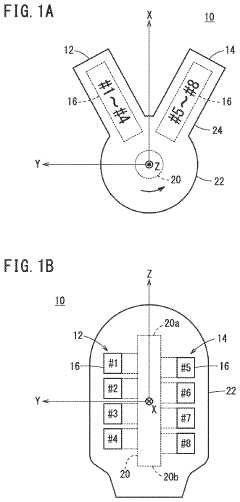
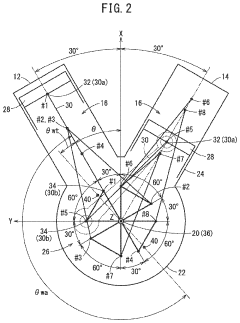
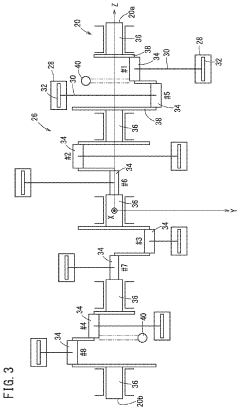
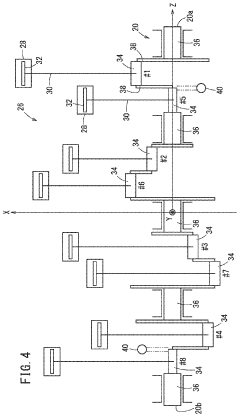
- The V8 engine configuration features crank pins arranged at 90° intervals on one bank and offset by 60° on the other bank, allowing for cancellation of primary inertia couples without additional specialized parts by optimizing the arrangement of crank pins and connecting rods.
V8 engine for a motor vehicle, and motor vehicle replacement
PatentWO2025168533A1
Innovation
- The V8 engine design combines exhaust outlets and cylinders in a cross-bank merging configuration, uses a flat-plane crankshaft, and employs bi-turbochargers to create an irregular exhaust flow, along with a specific firing order and cylinder bank angle, to produce a pronounced V8 burble sound while enhancing performance and reducing emissions.

Environmental Impact and Emissions Regulations
The environmental impact of engine choices has become increasingly significant in automotive design and regulation. V4 and V8 engines represent different approaches to power generation, with distinct environmental footprints that must be considered alongside their power-to-weight ratios. Current emissions regulations worldwide have created a complex landscape that automotive manufacturers must navigate when developing engine technologies.
V8 engines, despite their superior power output, typically consume more fuel and produce higher emissions compared to their V4 counterparts. This difference has become particularly relevant as global emissions standards have tightened significantly over the past decade. The European Union's Euro 6d standards, California's LEV III regulations, and China's China 6 standards all impose increasingly stringent limits on nitrogen oxides (NOx), particulate matter, and carbon dioxide emissions that disproportionately affect larger displacement engines.
These regulatory pressures have driven substantial technological innovation in both engine types. V8 manufacturers have implemented cylinder deactivation, variable valve timing, and advanced fuel injection systems to improve efficiency while maintaining performance characteristics. Meanwhile, V4 engines have benefited from turbocharging and direct injection technologies that help close the power gap while maintaining their inherent emissions advantages.
Carbon taxation policies in various markets have further complicated the equation by directly impacting the total cost of ownership based on engine emissions profiles. Several European countries have implemented CO2-based vehicle taxation that can add significant costs to V8-powered vehicles compared to more efficient V4 alternatives with comparable power-to-weight ratios.
Fleet emissions requirements represent another critical factor, as manufacturers must balance high-performance offerings against overall corporate average fuel economy targets. This has led to strategic decisions where V8 engines are increasingly reserved for premium or specialized applications, while V4 engines with enhanced power-to-weight characteristics serve broader market segments.
Looking forward, the regulatory landscape appears to be moving toward even stricter emissions controls, with several markets announcing future bans on internal combustion engines entirely. This trajectory suggests that power-to-weight optimization within increasingly stringent emissions constraints will remain a central engineering challenge, potentially favoring more efficient engine configurations regardless of their cylinder count.
V8 engines, despite their superior power output, typically consume more fuel and produce higher emissions compared to their V4 counterparts. This difference has become particularly relevant as global emissions standards have tightened significantly over the past decade. The European Union's Euro 6d standards, California's LEV III regulations, and China's China 6 standards all impose increasingly stringent limits on nitrogen oxides (NOx), particulate matter, and carbon dioxide emissions that disproportionately affect larger displacement engines.
These regulatory pressures have driven substantial technological innovation in both engine types. V8 manufacturers have implemented cylinder deactivation, variable valve timing, and advanced fuel injection systems to improve efficiency while maintaining performance characteristics. Meanwhile, V4 engines have benefited from turbocharging and direct injection technologies that help close the power gap while maintaining their inherent emissions advantages.
Carbon taxation policies in various markets have further complicated the equation by directly impacting the total cost of ownership based on engine emissions profiles. Several European countries have implemented CO2-based vehicle taxation that can add significant costs to V8-powered vehicles compared to more efficient V4 alternatives with comparable power-to-weight ratios.
Fleet emissions requirements represent another critical factor, as manufacturers must balance high-performance offerings against overall corporate average fuel economy targets. This has led to strategic decisions where V8 engines are increasingly reserved for premium or specialized applications, while V4 engines with enhanced power-to-weight characteristics serve broader market segments.
Looking forward, the regulatory landscape appears to be moving toward even stricter emissions controls, with several markets announcing future bans on internal combustion engines entirely. This trajectory suggests that power-to-weight optimization within increasingly stringent emissions constraints will remain a central engineering challenge, potentially favoring more efficient engine configurations regardless of their cylinder count.
Materials Science Advancements for Engine Manufacturing
The evolution of engine manufacturing has been significantly influenced by advancements in materials science, particularly when comparing V4 and V8 engines in terms of power-to-weight ratio. Traditional engine blocks were predominantly manufactured using cast iron, which offered excellent durability but contributed substantially to overall engine weight. The transition to aluminum alloys marked a revolutionary step, reducing engine weight by approximately 40-50% while maintaining structural integrity.
Recent developments in high-strength aluminum alloys, particularly those incorporating silicon and magnesium (Al-Si-Mg series), have enabled manufacturers to create V8 engines with power-to-weight ratios approaching those of smaller V4 configurations. These advanced alloys exhibit tensile strengths exceeding 400 MPa while maintaining density values around 2.7 g/cm³, compared to cast iron's 7.2 g/cm³.
Composite materials represent another frontier in engine manufacturing. Carbon fiber reinforced polymers (CFRPs) are increasingly being utilized for non-load-bearing components in high-performance V8 engines, offering weight reductions of up to 60% compared to metallic alternatives. Similarly, ceramic matrix composites (CMCs) are finding applications in high-temperature components, enhancing thermal efficiency while reducing weight.
Surface engineering technologies have also contributed significantly to improving engine performance metrics. Thermal spray coatings and physical vapor deposition (PVD) techniques allow for the application of wear-resistant materials like titanium nitride and diamond-like carbon to critical engine components. These coatings reduce friction losses by up to 15%, directly enhancing power output without adding significant weight.
Additive manufacturing has emerged as a transformative technology in engine production, enabling the creation of complex geometries impossible with traditional manufacturing methods. Direct metal laser sintering (DMLS) allows for the production of lightweight, topology-optimized components with internal cooling channels and variable wall thicknesses, optimizing the strength-to-weight ratio of both V4 and V8 engines.
Nanomaterial integration represents the cutting edge of materials science in engine manufacturing. Nano-reinforced aluminum alloys incorporating carbon nanotubes or graphene have demonstrated up to 30% improvements in specific strength compared to conventional alloys. These materials are particularly promising for high-stress components in V8 engines, potentially narrowing the weight disadvantage compared to V4 configurations while maintaining superior power output capabilities.
Recent developments in high-strength aluminum alloys, particularly those incorporating silicon and magnesium (Al-Si-Mg series), have enabled manufacturers to create V8 engines with power-to-weight ratios approaching those of smaller V4 configurations. These advanced alloys exhibit tensile strengths exceeding 400 MPa while maintaining density values around 2.7 g/cm³, compared to cast iron's 7.2 g/cm³.
Composite materials represent another frontier in engine manufacturing. Carbon fiber reinforced polymers (CFRPs) are increasingly being utilized for non-load-bearing components in high-performance V8 engines, offering weight reductions of up to 60% compared to metallic alternatives. Similarly, ceramic matrix composites (CMCs) are finding applications in high-temperature components, enhancing thermal efficiency while reducing weight.
Surface engineering technologies have also contributed significantly to improving engine performance metrics. Thermal spray coatings and physical vapor deposition (PVD) techniques allow for the application of wear-resistant materials like titanium nitride and diamond-like carbon to critical engine components. These coatings reduce friction losses by up to 15%, directly enhancing power output without adding significant weight.
Additive manufacturing has emerged as a transformative technology in engine production, enabling the creation of complex geometries impossible with traditional manufacturing methods. Direct metal laser sintering (DMLS) allows for the production of lightweight, topology-optimized components with internal cooling channels and variable wall thicknesses, optimizing the strength-to-weight ratio of both V4 and V8 engines.
Nanomaterial integration represents the cutting edge of materials science in engine manufacturing. Nano-reinforced aluminum alloys incorporating carbon nanotubes or graphene have demonstrated up to 30% improvements in specific strength compared to conventional alloys. These materials are particularly promising for high-stress components in V8 engines, potentially narrowing the weight disadvantage compared to V4 configurations while maintaining superior power output capabilities.
Unlock deeper insights with PatSnap Eureka Quick Research — get a full tech report to explore trends and direct your research. Try now!
Generate Your Research Report Instantly with AI Agent
Supercharge your innovation with PatSnap Eureka AI Agent Platform!