

V8 Engine Cutting-Edge Development: What to Expect
JUL 4, 20259 MIN READ
Generate Your Research Report Instantly with AI Agent
PatSnap Eureka helps you evaluate technical feasibility & market potential.
V8 Engine Evolution and Objectives
The V8 engine, a marvel of automotive engineering, has undergone significant evolution since its inception. Originally designed to provide high performance and power output, the V8 has become a symbol of automotive excellence. Its development trajectory has been shaped by the ever-changing demands of the automotive industry, including the need for increased fuel efficiency, reduced emissions, and enhanced power delivery.
In recent years, the focus of V8 engine development has shifted towards achieving a balance between performance and environmental sustainability. This has led to the integration of advanced technologies such as direct fuel injection, variable valve timing, and cylinder deactivation. These innovations have allowed V8 engines to maintain their characteristic power while significantly improving fuel economy and reducing emissions.
The current objectives for V8 engine development are multifaceted. Manufacturers are striving to further enhance power output without compromising efficiency. This involves exploring new materials and manufacturing techniques to reduce engine weight and improve thermal management. Additionally, there is a growing emphasis on hybridization, with many automakers incorporating electric motors to supplement V8 engines, creating high-performance hybrid powertrains.
Another key objective is the adaptation of V8 engines to meet increasingly stringent emissions regulations worldwide. This has spurred research into advanced exhaust after-treatment systems and the potential use of alternative fuels. Some manufacturers are even exploring the possibility of carbon-neutral synthetic fuels as a means to extend the lifespan of V8 engines in an environmentally conscious automotive landscape.
The future of V8 engine technology is likely to see a convergence of traditional mechanical engineering with cutting-edge digital technologies. The integration of artificial intelligence and machine learning algorithms for engine management systems is expected to optimize performance and efficiency in real-time driving conditions. Furthermore, advancements in 3D printing and nanotechnology may revolutionize the manufacturing processes and materials used in V8 engine production.
As we look ahead, the V8 engine faces both challenges and opportunities. While there is increasing pressure to transition towards fully electric powertrains, the unique characteristics of the V8 engine continue to captivate enthusiasts and engineers alike. The ongoing development of V8 engines aims to preserve their legacy while adapting to the changing automotive landscape, potentially leading to innovative hybrid and even hydrogen-powered V8 configurations in the future.
In recent years, the focus of V8 engine development has shifted towards achieving a balance between performance and environmental sustainability. This has led to the integration of advanced technologies such as direct fuel injection, variable valve timing, and cylinder deactivation. These innovations have allowed V8 engines to maintain their characteristic power while significantly improving fuel economy and reducing emissions.
The current objectives for V8 engine development are multifaceted. Manufacturers are striving to further enhance power output without compromising efficiency. This involves exploring new materials and manufacturing techniques to reduce engine weight and improve thermal management. Additionally, there is a growing emphasis on hybridization, with many automakers incorporating electric motors to supplement V8 engines, creating high-performance hybrid powertrains.
Another key objective is the adaptation of V8 engines to meet increasingly stringent emissions regulations worldwide. This has spurred research into advanced exhaust after-treatment systems and the potential use of alternative fuels. Some manufacturers are even exploring the possibility of carbon-neutral synthetic fuels as a means to extend the lifespan of V8 engines in an environmentally conscious automotive landscape.
The future of V8 engine technology is likely to see a convergence of traditional mechanical engineering with cutting-edge digital technologies. The integration of artificial intelligence and machine learning algorithms for engine management systems is expected to optimize performance and efficiency in real-time driving conditions. Furthermore, advancements in 3D printing and nanotechnology may revolutionize the manufacturing processes and materials used in V8 engine production.
As we look ahead, the V8 engine faces both challenges and opportunities. While there is increasing pressure to transition towards fully electric powertrains, the unique characteristics of the V8 engine continue to captivate enthusiasts and engineers alike. The ongoing development of V8 engines aims to preserve their legacy while adapting to the changing automotive landscape, potentially leading to innovative hybrid and even hydrogen-powered V8 configurations in the future.
Market Demand for Advanced JavaScript Engines
The demand for advanced JavaScript engines, particularly V8, has been steadily increasing in recent years. This growth is driven by the expanding role of JavaScript in web development, server-side applications, and emerging technologies such as IoT and edge computing. As web applications become more complex and feature-rich, developers and businesses are seeking JavaScript engines that can deliver superior performance, lower memory consumption, and enhanced security.
In the web development sector, there's a growing need for JavaScript engines that can handle large-scale, data-intensive applications with minimal latency. E-commerce platforms, social media networks, and content streaming services are pushing the boundaries of what's possible in the browser, necessitating more efficient JavaScript execution. This demand extends to mobile web applications, where optimized JavaScript engines can significantly improve user experience and battery life.
Server-side JavaScript, primarily through Node.js, has seen widespread adoption in enterprise environments. This has created a market for JavaScript engines that can efficiently handle concurrent operations, manage memory effectively, and provide robust security features. Companies are increasingly looking for engines that can support microservices architectures and serverless computing paradigms, where fast startup times and efficient resource utilization are crucial.
The rise of progressive web applications (PWAs) has further fueled the demand for advanced JavaScript engines. PWAs blur the line between web and native applications, requiring JavaScript engines that can deliver near-native performance across various devices and platforms. This has led to increased interest in engines that can optimize code for specific hardware architectures and leverage modern CPU features.
In the realm of IoT and edge computing, there's a growing market for lightweight JavaScript engines that can run on resource-constrained devices. These engines need to provide adequate performance while minimizing power consumption and memory usage. As more devices become connected and capable of running complex logic, the demand for efficient JavaScript execution in these environments is expected to grow significantly.
The financial technology sector has also emerged as a significant driver of demand for advanced JavaScript engines. With the increasing complexity of trading algorithms and real-time data processing requirements, fintech companies are seeking JavaScript engines that can handle high-frequency operations with minimal latency and maximum reliability.
As artificial intelligence and machine learning become more prevalent in web applications, there's a growing need for JavaScript engines that can efficiently execute AI models in the browser. This includes support for WebAssembly and optimizations for tensor operations, which are crucial for running machine learning algorithms on the client side.
In the web development sector, there's a growing need for JavaScript engines that can handle large-scale, data-intensive applications with minimal latency. E-commerce platforms, social media networks, and content streaming services are pushing the boundaries of what's possible in the browser, necessitating more efficient JavaScript execution. This demand extends to mobile web applications, where optimized JavaScript engines can significantly improve user experience and battery life.
Server-side JavaScript, primarily through Node.js, has seen widespread adoption in enterprise environments. This has created a market for JavaScript engines that can efficiently handle concurrent operations, manage memory effectively, and provide robust security features. Companies are increasingly looking for engines that can support microservices architectures and serverless computing paradigms, where fast startup times and efficient resource utilization are crucial.
The rise of progressive web applications (PWAs) has further fueled the demand for advanced JavaScript engines. PWAs blur the line between web and native applications, requiring JavaScript engines that can deliver near-native performance across various devices and platforms. This has led to increased interest in engines that can optimize code for specific hardware architectures and leverage modern CPU features.
In the realm of IoT and edge computing, there's a growing market for lightweight JavaScript engines that can run on resource-constrained devices. These engines need to provide adequate performance while minimizing power consumption and memory usage. As more devices become connected and capable of running complex logic, the demand for efficient JavaScript execution in these environments is expected to grow significantly.
The financial technology sector has also emerged as a significant driver of demand for advanced JavaScript engines. With the increasing complexity of trading algorithms and real-time data processing requirements, fintech companies are seeking JavaScript engines that can handle high-frequency operations with minimal latency and maximum reliability.
As artificial intelligence and machine learning become more prevalent in web applications, there's a growing need for JavaScript engines that can efficiently execute AI models in the browser. This includes support for WebAssembly and optimizations for tensor operations, which are crucial for running machine learning algorithms on the client side.
Current V8 Challenges and Limitations
V8, as Google's open-source high-performance JavaScript and WebAssembly engine, has made significant strides in recent years. However, it still faces several challenges and limitations that hinder its further development and widespread adoption.
One of the primary challenges for V8 is maintaining performance consistency across diverse hardware architectures. As the variety of devices running JavaScript continues to expand, from high-end servers to low-power mobile devices, ensuring optimal performance across all platforms becomes increasingly complex. This challenge is particularly evident in the realm of just-in-time (JIT) compilation, where V8 must balance the need for rapid code execution with the constraints of different hardware capabilities.
Memory management remains another critical limitation for V8. Despite improvements in garbage collection algorithms, managing memory efficiently in large-scale applications with complex object graphs continues to be a significant challenge. This issue can lead to increased memory consumption and potential performance degradation, especially in long-running applications or those with intensive data processing requirements.
The ever-growing complexity of modern web applications poses another hurdle for V8. As developers push the boundaries of what's possible in web-based environments, V8 must keep pace with new language features, APIs, and programming paradigms. This constant evolution necessitates frequent updates and optimizations to the engine, which can introduce compatibility issues and require significant development resources.
Security concerns also present ongoing challenges for V8. As a crucial component in web browsers and server-side JavaScript environments, V8 is a prime target for potential exploits. Ensuring robust security measures while maintaining high performance is a delicate balance that requires continuous attention and refinement.
The increasing adoption of WebAssembly introduces both opportunities and challenges for V8. While WebAssembly offers the potential for near-native performance, integrating it seamlessly with JavaScript and optimizing its execution within V8 presents technical hurdles that are still being addressed.
Lastly, V8 faces challenges in terms of startup time and initial parsing of JavaScript code. For applications that require quick load times, such as progressive web apps or mobile web experiences, reducing the time it takes for V8 to initialize and begin executing code is crucial. This limitation becomes particularly apparent in scenarios where users expect near-instant interactivity.
Addressing these challenges and limitations is crucial for the continued evolution of V8 and its ability to meet the demands of modern web development. As the JavaScript ecosystem continues to grow and diversify, overcoming these obstacles will be key to maintaining V8's position as a leading JavaScript engine and enabling the next generation of web applications.
One of the primary challenges for V8 is maintaining performance consistency across diverse hardware architectures. As the variety of devices running JavaScript continues to expand, from high-end servers to low-power mobile devices, ensuring optimal performance across all platforms becomes increasingly complex. This challenge is particularly evident in the realm of just-in-time (JIT) compilation, where V8 must balance the need for rapid code execution with the constraints of different hardware capabilities.
Memory management remains another critical limitation for V8. Despite improvements in garbage collection algorithms, managing memory efficiently in large-scale applications with complex object graphs continues to be a significant challenge. This issue can lead to increased memory consumption and potential performance degradation, especially in long-running applications or those with intensive data processing requirements.
The ever-growing complexity of modern web applications poses another hurdle for V8. As developers push the boundaries of what's possible in web-based environments, V8 must keep pace with new language features, APIs, and programming paradigms. This constant evolution necessitates frequent updates and optimizations to the engine, which can introduce compatibility issues and require significant development resources.
Security concerns also present ongoing challenges for V8. As a crucial component in web browsers and server-side JavaScript environments, V8 is a prime target for potential exploits. Ensuring robust security measures while maintaining high performance is a delicate balance that requires continuous attention and refinement.
The increasing adoption of WebAssembly introduces both opportunities and challenges for V8. While WebAssembly offers the potential for near-native performance, integrating it seamlessly with JavaScript and optimizing its execution within V8 presents technical hurdles that are still being addressed.
Lastly, V8 faces challenges in terms of startup time and initial parsing of JavaScript code. For applications that require quick load times, such as progressive web apps or mobile web experiences, reducing the time it takes for V8 to initialize and begin executing code is crucial. This limitation becomes particularly apparent in scenarios where users expect near-instant interactivity.
Addressing these challenges and limitations is crucial for the continued evolution of V8 and its ability to meet the demands of modern web development. As the JavaScript ecosystem continues to grow and diversify, overcoming these obstacles will be key to maintaining V8's position as a leading JavaScript engine and enabling the next generation of web applications.
Existing V8 Optimization Techniques
01 V8 Engine Design and Configuration
V8 engines are designed with eight cylinders arranged in two banks of four, forming a V-shape. This configuration allows for a compact design, improved power output, and better balance compared to inline engines. Various aspects of V8 engine design, including cylinder arrangement, crankshaft configuration, and valve train systems, are continuously improved to enhance performance and efficiency.- V8 Engine Design and Configuration: V8 engines are designed with eight cylinders arranged in two banks of four, forming a V-shape. This configuration allows for a compact design, improved power output, and balanced operation. Various aspects of V8 engine design, including cylinder arrangement, crankshaft configuration, and valve timing, are optimized for performance and efficiency.
- Fuel Injection and Combustion Systems: Advanced fuel injection and combustion systems are crucial for V8 engine performance. These systems include direct injection, variable valve timing, and cylinder deactivation technologies. Improvements in fuel delivery and combustion efficiency lead to increased power output, reduced emissions, and better fuel economy in V8 engines.
- Turbocharging and Supercharging: Forced induction systems, such as turbochargers and superchargers, are often employed in V8 engines to boost power output. These systems compress the intake air, allowing for more fuel to be burned and resulting in increased horsepower. Various designs and configurations of turbochargers and superchargers are used to optimize V8 engine performance across different operating conditions.
- Cooling and Lubrication Systems: Efficient cooling and lubrication systems are essential for V8 engine reliability and longevity. Advanced cooling systems manage engine temperature under high-performance conditions, while improved lubrication systems ensure proper oil distribution to critical components. These systems are designed to handle the increased heat and stress generated by high-output V8 engines.
- Materials and Manufacturing Techniques: Innovative materials and manufacturing techniques are employed in V8 engine production to enhance performance and durability. Lightweight alloys, advanced coatings, and precision manufacturing processes are used to reduce engine weight, improve heat dissipation, and increase component strength. These advancements contribute to improved power-to-weight ratios and overall engine efficiency.
02 Fuel Efficiency and Emissions Control
Modern V8 engines incorporate advanced technologies to improve fuel efficiency and reduce emissions. These may include direct fuel injection, variable valve timing, cylinder deactivation, and advanced exhaust gas recirculation systems. Innovations in engine management systems and combustion processes aim to optimize performance while meeting stringent environmental regulations.Expand Specific Solutions03 Performance Enhancement and Tuning
Various methods and components are developed to enhance V8 engine performance. These include turbocharging, supercharging, intercooling, and high-flow intake and exhaust systems. Advanced materials and manufacturing techniques are employed to reduce weight, increase strength, and improve heat dissipation in critical engine components.Expand Specific Solutions04 Cooling and Lubrication Systems
Efficient cooling and lubrication are crucial for V8 engine reliability and longevity. Innovations in coolant flow management, oil circulation, and heat exchanger designs help maintain optimal operating temperatures and reduce friction. Advanced cooling systems may incorporate precision-controlled electric water pumps and thermostats for improved efficiency.Expand Specific Solutions05 Integration with Hybrid and Electric Systems
As automotive technology evolves, V8 engines are being integrated with hybrid and electric systems to improve overall vehicle efficiency. This includes the development of mild hybrid systems, regenerative braking, and start-stop technologies specifically designed for V8 engines. These innovations aim to combine the power of V8 engines with the efficiency benefits of electrification.Expand Specific Solutions
Key Players in JavaScript Engine Development
The V8 engine development landscape is characterized by intense competition among established automotive manufacturers and emerging technology players. The industry is in a mature phase, with a significant market size driven by ongoing demand for high-performance vehicles. However, the technology is evolving rapidly as companies strive to improve efficiency and meet stricter emissions standards. Key players like BMW, Toyota, Honda, and Ford are investing heavily in R&D to enhance V8 performance and fuel economy. Simultaneously, newer entrants such as Tesla and tech giants like Alibaba are disrupting the market with electric and hybrid alternatives, pushing traditional V8 manufacturers to innovate further. The technological maturity varies, with some companies focusing on incremental improvements while others explore radical redesigns or alternative powertrains.
Bayerische Motoren Werke AG
Technical Solution: BMW's V8 engine development is centered on their TwinPower Turbo technology, which combines twin-scroll turbochargers with high-precision direct fuel injection and VALVETRONIC fully variable valve control[7]. They are also implementing a water injection system in their high-performance V8 engines, which cools the intake air to increase power output and efficiency[8]. BMW is exploring the use of electric compressors to eliminate turbo lag and improve low-end torque in their V8 engines[9]. Additionally, they are integrating 48V mild hybrid systems with their V8 engines to enhance performance and fuel efficiency[10].
Strengths: High performance, reduced turbo lag, and improved efficiency. Weaknesses: Increased complexity and higher production costs.
Toyota Motor Corp.
Technical Solution: Toyota's V8 engine development is focused on their D-4S (Direct injection 4-stroke gasoline engine Superior version) technology, which combines direct and port fuel injection for optimal fuel efficiency and power output[11]. They are also implementing an advanced Variable Valve Timing with Intelligence (VVT-i) system that allows for precise control of valve timing on both intake and exhaust camshafts[12]. Toyota is exploring the use of a high-compression ratio (up to 13:1) in their V8 engines to improve thermal efficiency[13]. Furthermore, they are developing a new electrically controlled variable displacement oil pump to reduce parasitic losses and improve fuel economy[14].
Strengths: Improved fuel efficiency, optimized power delivery, and reduced emissions. Weaknesses: Potential increased production costs and complexity.
Core Innovations in V8 Engine Technology
V8 engine
PatentActiveUS11821359B2
Innovation
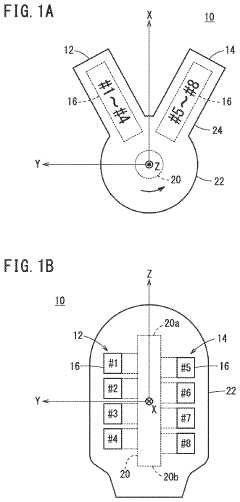
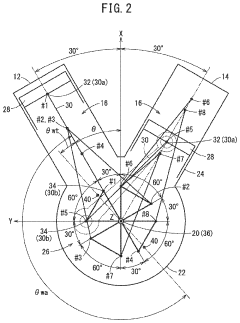
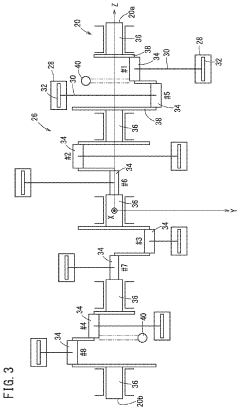
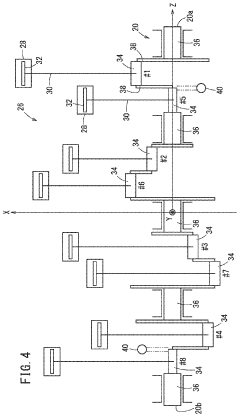
- The V8 engine configuration features crank pins arranged at 90° intervals on one bank and offset by 60° on the other bank, allowing for cancellation of primary inertia couples without additional specialized parts by optimizing the arrangement of crank pins and connecting rods.
V8 engine and outboard motor
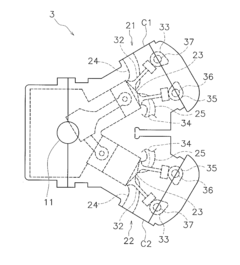
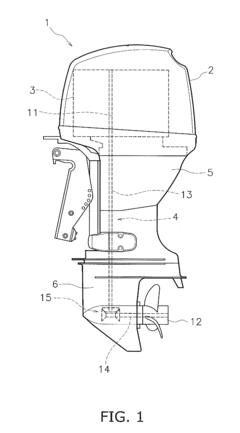
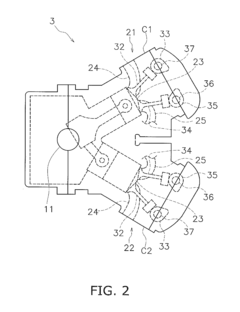
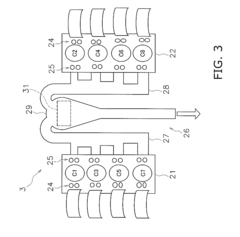
PatentActiveUS20160341097A1
Innovation
- A V8 engine design with a simple construction featuring aggregated exhaust pathways and adjustable exhaust cams, where the central angle of exhaust cams for each cylinder is optimized to minimize valve overlap and reduce exhaust interference, allowing for even firing intervals and improved exhaust gas management.
V8 Engine Performance Benchmarks
Performance benchmarks play a crucial role in evaluating the advancements and capabilities of the V8 engine. These benchmarks provide quantitative measures of various aspects of engine performance, allowing developers and users to assess improvements and compare different versions or implementations.
One of the primary benchmarks for V8 is the Octane benchmark suite, which includes a set of JavaScript tests designed to measure the performance of JavaScript engines. Octane covers a wide range of JavaScript use cases, from simple function calls to complex applications. It provides scores for individual tests as well as an overall score, enabling detailed analysis of specific performance aspects.
Another significant benchmark is the JetStream suite, which combines a variety of JavaScript and WebAssembly benchmarks. JetStream is particularly useful for measuring the performance of advanced web applications, as it includes tests for both traditional JavaScript workloads and more modern, computation-intensive tasks.
The Speedometer benchmark focuses on simulating user interactions in web applications, providing insights into real-world performance scenarios. It measures the responsiveness of web applications by timing simulated user actions and is particularly relevant for assessing the impact of V8 improvements on everyday web browsing experiences.
For more specific performance metrics, the V8 team utilizes internal benchmarks that target particular aspects of engine performance. These may include memory usage, startup time, and execution speed for specific JavaScript patterns or language features.
It's important to note that benchmark results can vary depending on the hardware and software environment. Therefore, when comparing V8 performance across different versions or with other JavaScript engines, it's crucial to consider the testing conditions and methodology.
Recent V8 performance improvements have shown significant gains in areas such as parsing and compilation speed, execution of modern JavaScript features, and memory efficiency. These improvements are often reflected in benchmark scores, with newer versions of V8 consistently outperforming their predecessors across various test suites.
As V8 continues to evolve, we can expect to see new benchmarks emerge that focus on cutting-edge JavaScript features, WebAssembly performance, and increasingly complex web application scenarios. These benchmarks will play a vital role in guiding future optimizations and ensuring that V8 remains at the forefront of JavaScript engine technology.
One of the primary benchmarks for V8 is the Octane benchmark suite, which includes a set of JavaScript tests designed to measure the performance of JavaScript engines. Octane covers a wide range of JavaScript use cases, from simple function calls to complex applications. It provides scores for individual tests as well as an overall score, enabling detailed analysis of specific performance aspects.
Another significant benchmark is the JetStream suite, which combines a variety of JavaScript and WebAssembly benchmarks. JetStream is particularly useful for measuring the performance of advanced web applications, as it includes tests for both traditional JavaScript workloads and more modern, computation-intensive tasks.
The Speedometer benchmark focuses on simulating user interactions in web applications, providing insights into real-world performance scenarios. It measures the responsiveness of web applications by timing simulated user actions and is particularly relevant for assessing the impact of V8 improvements on everyday web browsing experiences.
For more specific performance metrics, the V8 team utilizes internal benchmarks that target particular aspects of engine performance. These may include memory usage, startup time, and execution speed for specific JavaScript patterns or language features.
It's important to note that benchmark results can vary depending on the hardware and software environment. Therefore, when comparing V8 performance across different versions or with other JavaScript engines, it's crucial to consider the testing conditions and methodology.
Recent V8 performance improvements have shown significant gains in areas such as parsing and compilation speed, execution of modern JavaScript features, and memory efficiency. These improvements are often reflected in benchmark scores, with newer versions of V8 consistently outperforming their predecessors across various test suites.
As V8 continues to evolve, we can expect to see new benchmarks emerge that focus on cutting-edge JavaScript features, WebAssembly performance, and increasingly complex web application scenarios. These benchmarks will play a vital role in guiding future optimizations and ensuring that V8 remains at the forefront of JavaScript engine technology.
V8 Integration with Web Technologies
V8's integration with web technologies is a crucial aspect of its development, as it directly impacts the performance and capabilities of web applications. The engine's ability to efficiently execute JavaScript code is fundamental to the modern web ecosystem, and its ongoing evolution aims to enhance this synergy further.
One of the key areas of integration is V8's optimization for WebAssembly (Wasm). As Wasm gains traction as a low-level language for the web, V8 is continuously improving its compilation and execution of Wasm modules. This includes enhancements in the tiered compilation process, where V8 can quickly start executing Wasm code while simultaneously optimizing it for peak performance.
Another significant integration point is V8's support for ECMAScript modules. As the web moves towards a more modular development approach, V8 is refining its handling of ES modules to provide faster parsing, compilation, and execution. This includes improvements in module resolution, caching mechanisms, and integration with the browser's networking layer for more efficient loading of module dependencies.
V8's garbage collection mechanisms are also evolving to better suit web application needs. The engine is implementing more sophisticated algorithms to reduce pause times and improve memory management, particularly for long-running web applications and progressive web apps (PWAs) that demand consistent performance over extended periods.
In the realm of APIs, V8 is expanding its support for Web APIs that require high-performance JavaScript execution. This includes optimizations for APIs like Web Workers, which enable multi-threaded JavaScript execution, and SharedArrayBuffer, which facilitates efficient data sharing between threads. V8's implementation of these APIs is crucial for enabling complex, performance-intensive web applications.
The engine is also focusing on improving its integration with browser rendering engines. This involves optimizing the interaction between V8's JavaScript execution and the browser's DOM manipulation and rendering processes. By reducing the overhead of these interactions, V8 aims to contribute to smoother animations and more responsive user interfaces in web applications.
Looking ahead, V8's integration efforts are likely to focus on emerging web technologies such as WebGPU, which promises to bring high-performance graphics and computation to the web platform. V8's role in efficiently compiling and executing JavaScript code that interacts with these new APIs will be crucial for their adoption and success in the web ecosystem.
One of the key areas of integration is V8's optimization for WebAssembly (Wasm). As Wasm gains traction as a low-level language for the web, V8 is continuously improving its compilation and execution of Wasm modules. This includes enhancements in the tiered compilation process, where V8 can quickly start executing Wasm code while simultaneously optimizing it for peak performance.
Another significant integration point is V8's support for ECMAScript modules. As the web moves towards a more modular development approach, V8 is refining its handling of ES modules to provide faster parsing, compilation, and execution. This includes improvements in module resolution, caching mechanisms, and integration with the browser's networking layer for more efficient loading of module dependencies.
V8's garbage collection mechanisms are also evolving to better suit web application needs. The engine is implementing more sophisticated algorithms to reduce pause times and improve memory management, particularly for long-running web applications and progressive web apps (PWAs) that demand consistent performance over extended periods.
In the realm of APIs, V8 is expanding its support for Web APIs that require high-performance JavaScript execution. This includes optimizations for APIs like Web Workers, which enable multi-threaded JavaScript execution, and SharedArrayBuffer, which facilitates efficient data sharing between threads. V8's implementation of these APIs is crucial for enabling complex, performance-intensive web applications.
The engine is also focusing on improving its integration with browser rendering engines. This involves optimizing the interaction between V8's JavaScript execution and the browser's DOM manipulation and rendering processes. By reducing the overhead of these interactions, V8 aims to contribute to smoother animations and more responsive user interfaces in web applications.
Looking ahead, V8's integration efforts are likely to focus on emerging web technologies such as WebGPU, which promises to bring high-performance graphics and computation to the web platform. V8's role in efficiently compiling and executing JavaScript code that interacts with these new APIs will be crucial for their adoption and success in the web ecosystem.
Unlock deeper insights with PatSnap Eureka Quick Research — get a full tech report to explore trends and direct your research. Try now!
Generate Your Research Report Instantly with AI Agent
Supercharge your innovation with PatSnap Eureka AI Agent Platform!