

V8 Engine Design Impacts on Consumer Vehicle Preferences
JUL 4, 20259 MIN READ
Generate Your Research Report Instantly with AI Agent
PatSnap Eureka helps you evaluate technical feasibility & market potential.
V8 Engine Evolution and Objectives
The V8 engine has been a cornerstone of automotive engineering since its inception in the early 20th century. Its evolution has been marked by significant technological advancements, driven by the ever-changing demands of consumers and regulatory requirements. The V8's journey from a symbol of raw power to a sophisticated powerplant reflects the broader trends in automotive design and engineering.
Initially, V8 engines were primarily focused on delivering maximum horsepower and torque, catering to the American market's appetite for high-performance vehicles. However, as global awareness of environmental issues grew, the objectives for V8 engine design shifted towards achieving a balance between power and efficiency. This paradigm shift led to the development of technologies such as variable valve timing, cylinder deactivation, and direct fuel injection.
The 1970s and 1980s saw a temporary decline in V8 popularity due to fuel crises and stricter emissions standards. However, innovative engineering solutions emerged, allowing V8 engines to comply with new regulations while maintaining their performance characteristics. The introduction of electronic fuel injection and computer-controlled engine management systems marked a turning point in V8 engine evolution.
In recent years, the objectives of V8 engine design have expanded to include not only power and efficiency but also refinement and reduced environmental impact. Manufacturers have invested heavily in lightweight materials, advanced turbocharging systems, and hybrid technologies to meet these goals. The modern V8 engine is often a showcase of cutting-edge automotive technology, incorporating features like start-stop systems, regenerative braking, and even electric motor assistance.
Looking forward, the objectives for V8 engine development are increasingly influenced by global trends towards electrification and sustainability. Engineers are now tasked with creating V8 engines that can serve as a bridge between traditional internal combustion technology and future powertrain solutions. This includes developing V8 engines that can operate on alternative fuels, integrate seamlessly with hybrid systems, and deliver exceptional performance while meeting stringent emissions standards.
The evolution of V8 engines also reflects changing consumer preferences. While raw power remains a key selling point, modern buyers increasingly value fuel economy, reliability, and technological sophistication. As a result, V8 engine design objectives now encompass a broader range of performance metrics, including not just acceleration and top speed, but also fuel efficiency, emissions, and even the engine's acoustic properties.
Initially, V8 engines were primarily focused on delivering maximum horsepower and torque, catering to the American market's appetite for high-performance vehicles. However, as global awareness of environmental issues grew, the objectives for V8 engine design shifted towards achieving a balance between power and efficiency. This paradigm shift led to the development of technologies such as variable valve timing, cylinder deactivation, and direct fuel injection.
The 1970s and 1980s saw a temporary decline in V8 popularity due to fuel crises and stricter emissions standards. However, innovative engineering solutions emerged, allowing V8 engines to comply with new regulations while maintaining their performance characteristics. The introduction of electronic fuel injection and computer-controlled engine management systems marked a turning point in V8 engine evolution.
In recent years, the objectives of V8 engine design have expanded to include not only power and efficiency but also refinement and reduced environmental impact. Manufacturers have invested heavily in lightweight materials, advanced turbocharging systems, and hybrid technologies to meet these goals. The modern V8 engine is often a showcase of cutting-edge automotive technology, incorporating features like start-stop systems, regenerative braking, and even electric motor assistance.
Looking forward, the objectives for V8 engine development are increasingly influenced by global trends towards electrification and sustainability. Engineers are now tasked with creating V8 engines that can serve as a bridge between traditional internal combustion technology and future powertrain solutions. This includes developing V8 engines that can operate on alternative fuels, integrate seamlessly with hybrid systems, and deliver exceptional performance while meeting stringent emissions standards.
The evolution of V8 engines also reflects changing consumer preferences. While raw power remains a key selling point, modern buyers increasingly value fuel economy, reliability, and technological sophistication. As a result, V8 engine design objectives now encompass a broader range of performance metrics, including not just acceleration and top speed, but also fuel efficiency, emissions, and even the engine's acoustic properties.
Market Demand Analysis for V8-Powered Vehicles
The market demand for V8-powered vehicles has undergone significant shifts in recent years, influenced by various factors including environmental concerns, fuel efficiency standards, and changing consumer preferences. Despite these challenges, there remains a dedicated segment of consumers who continue to value the power, performance, and prestige associated with V8 engines.
In the luxury and high-performance vehicle segments, V8 engines maintain a strong presence. Brands such as BMW, Mercedes-Benz, and Audi continue to offer V8 options in their flagship sedans and SUVs, catering to customers who prioritize performance and status. The demand for these vehicles is particularly robust in markets like the United States, Middle East, and China, where larger engines are often equated with luxury and prestige.
The sports car and muscle car markets also demonstrate sustained demand for V8-powered vehicles. Iconic models like the Ford Mustang GT, Chevrolet Camaro SS, and Dodge Challenger continue to attract enthusiasts who value the distinctive sound and power delivery of V8 engines. These vehicles often serve as halo products for their respective brands, generating customer interest and driving showroom traffic.
However, the overall market share of V8-powered vehicles has been declining in many regions due to stricter emissions regulations and a general shift towards more fuel-efficient options. This trend is particularly evident in Europe, where many manufacturers have begun phasing out V8 engines in favor of smaller, turbocharged alternatives or hybrid powertrains.
The pickup truck segment presents a unique case for V8 engines. While there is a trend towards smaller, turbocharged engines in this category, V8 options remain popular for their towing capacity and durability. Manufacturers like Ford, General Motors, and Ram continue to offer V8 engines in their full-size pickup trucks to meet the demands of customers who require high-performance capabilities for work or recreational purposes.
Looking ahead, the market for V8-powered vehicles is likely to become increasingly niche. As electrification gains momentum across the automotive industry, traditional V8 engines may be reserved for specialized performance vehicles or limited-edition models. However, some manufacturers are exploring ways to combine V8 power with hybrid technology to meet emissions standards while still appealing to performance enthusiasts.
In conclusion, while the overall demand for V8-powered vehicles is declining, there remains a significant market for these engines in specific segments. The challenge for manufacturers will be to balance the desires of V8 enthusiasts with the need for improved fuel efficiency and reduced emissions, potentially through the integration of new technologies or by positioning V8 engines as premium options within their product lineups.
In the luxury and high-performance vehicle segments, V8 engines maintain a strong presence. Brands such as BMW, Mercedes-Benz, and Audi continue to offer V8 options in their flagship sedans and SUVs, catering to customers who prioritize performance and status. The demand for these vehicles is particularly robust in markets like the United States, Middle East, and China, where larger engines are often equated with luxury and prestige.
The sports car and muscle car markets also demonstrate sustained demand for V8-powered vehicles. Iconic models like the Ford Mustang GT, Chevrolet Camaro SS, and Dodge Challenger continue to attract enthusiasts who value the distinctive sound and power delivery of V8 engines. These vehicles often serve as halo products for their respective brands, generating customer interest and driving showroom traffic.
However, the overall market share of V8-powered vehicles has been declining in many regions due to stricter emissions regulations and a general shift towards more fuel-efficient options. This trend is particularly evident in Europe, where many manufacturers have begun phasing out V8 engines in favor of smaller, turbocharged alternatives or hybrid powertrains.
The pickup truck segment presents a unique case for V8 engines. While there is a trend towards smaller, turbocharged engines in this category, V8 options remain popular for their towing capacity and durability. Manufacturers like Ford, General Motors, and Ram continue to offer V8 engines in their full-size pickup trucks to meet the demands of customers who require high-performance capabilities for work or recreational purposes.
Looking ahead, the market for V8-powered vehicles is likely to become increasingly niche. As electrification gains momentum across the automotive industry, traditional V8 engines may be reserved for specialized performance vehicles or limited-edition models. However, some manufacturers are exploring ways to combine V8 power with hybrid technology to meet emissions standards while still appealing to performance enthusiasts.
In conclusion, while the overall demand for V8-powered vehicles is declining, there remains a significant market for these engines in specific segments. The challenge for manufacturers will be to balance the desires of V8 enthusiasts with the need for improved fuel efficiency and reduced emissions, potentially through the integration of new technologies or by positioning V8 engines as premium options within their product lineups.
Current V8 Technology Challenges
V8 engines, long celebrated for their power and performance, face significant challenges in the current automotive landscape. The primary hurdle is meeting increasingly stringent emissions regulations while maintaining the characteristic performance that consumers expect. This has led to a complex balancing act between power output and environmental compliance.
One of the main technical challenges is improving fuel efficiency without compromising the engine's performance. Traditional V8 engines are known for their high fuel consumption, which is at odds with modern environmental standards and consumer expectations for better mileage. Engineers are grappling with the task of reducing fuel consumption through various means, such as advanced fuel injection systems, variable valve timing, and cylinder deactivation technologies.
Another significant challenge is the reduction of carbon emissions. V8 engines typically produce higher levels of CO2 compared to smaller, more efficient engines. This necessitates the development and integration of advanced exhaust after-treatment systems, which adds complexity and cost to the overall engine design. The challenge lies in implementing these systems without significantly impacting the engine's performance or the vehicle's weight.
Heat management is also a critical issue in V8 engine design. The high power output generates substantial heat, which must be efficiently dissipated to maintain optimal performance and longevity. This requires innovative cooling systems and materials that can withstand high temperatures while keeping the engine's weight in check.
The integration of hybrid technologies presents another layer of complexity. As automakers move towards electrification, finding ways to combine V8 engines with electric motors in hybrid powertrains poses significant engineering challenges. This includes managing the interplay between the combustion engine and electric components, optimizing power delivery, and integrating complex control systems.
Weight reduction is an ongoing challenge for V8 engines. The inherent size and complexity of these engines contribute to increased vehicle weight, which in turn affects fuel efficiency and handling. Engineers are exploring the use of lightweight materials and innovative design techniques to reduce the overall mass of V8 engines without compromising their structural integrity or performance characteristics.
Lastly, the cost of manufacturing and maintaining V8 engines remains a significant hurdle. As these engines become more technologically advanced to meet various challenges, their production and maintenance costs increase. This impacts not only the initial price of vehicles equipped with V8 engines but also the long-term ownership costs, potentially influencing consumer preferences and market demand.
One of the main technical challenges is improving fuel efficiency without compromising the engine's performance. Traditional V8 engines are known for their high fuel consumption, which is at odds with modern environmental standards and consumer expectations for better mileage. Engineers are grappling with the task of reducing fuel consumption through various means, such as advanced fuel injection systems, variable valve timing, and cylinder deactivation technologies.
Another significant challenge is the reduction of carbon emissions. V8 engines typically produce higher levels of CO2 compared to smaller, more efficient engines. This necessitates the development and integration of advanced exhaust after-treatment systems, which adds complexity and cost to the overall engine design. The challenge lies in implementing these systems without significantly impacting the engine's performance or the vehicle's weight.
Heat management is also a critical issue in V8 engine design. The high power output generates substantial heat, which must be efficiently dissipated to maintain optimal performance and longevity. This requires innovative cooling systems and materials that can withstand high temperatures while keeping the engine's weight in check.
The integration of hybrid technologies presents another layer of complexity. As automakers move towards electrification, finding ways to combine V8 engines with electric motors in hybrid powertrains poses significant engineering challenges. This includes managing the interplay between the combustion engine and electric components, optimizing power delivery, and integrating complex control systems.
Weight reduction is an ongoing challenge for V8 engines. The inherent size and complexity of these engines contribute to increased vehicle weight, which in turn affects fuel efficiency and handling. Engineers are exploring the use of lightweight materials and innovative design techniques to reduce the overall mass of V8 engines without compromising their structural integrity or performance characteristics.
Lastly, the cost of manufacturing and maintaining V8 engines remains a significant hurdle. As these engines become more technologically advanced to meet various challenges, their production and maintenance costs increase. This impacts not only the initial price of vehicles equipped with V8 engines but also the long-term ownership costs, potentially influencing consumer preferences and market demand.
Contemporary V8 Design Solutions
01 Consumer preference analysis for V8 engines
Methods and systems for analyzing consumer preferences related to V8 engines, including data collection, market research, and predictive modeling to understand customer needs and desires in engine performance, fuel efficiency, and overall vehicle characteristics.- Consumer preference analysis for V8 engines: Methods and systems for analyzing consumer preferences related to V8 engines, including data collection, market research, and predictive modeling to understand customer needs and desires in the automotive industry.
- Performance optimization of V8 engines based on consumer feedback: Techniques for improving V8 engine performance based on consumer preferences and feedback, involving adjustments to power output, fuel efficiency, and overall driving experience to meet customer expectations.
- Marketing strategies for V8 engines: Development of targeted marketing campaigns and promotional strategies for V8 engines, taking into account consumer preferences, demographic data, and market trends to effectively position and sell V8-powered vehicles.
- Customization options for V8 engines: Implementation of customization features and options for V8 engines to cater to diverse consumer preferences, including performance upgrades, aesthetic modifications, and personalized tuning capabilities.
- Environmental considerations in V8 engine design: Integration of eco-friendly technologies and fuel efficiency improvements in V8 engine design to address growing consumer preferences for environmentally conscious vehicles without compromising performance.
02 V8 engine performance optimization
Techniques for optimizing V8 engine performance based on consumer preferences, involving adjustments to power output, fuel consumption, and emissions to meet market demands while maintaining regulatory compliance.Expand Specific Solutions03 Marketing strategies for V8 engines
Development of targeted marketing strategies for V8 engines, utilizing consumer data and preferences to create effective advertising campaigns, promotional materials, and sales approaches tailored to specific customer segments.Expand Specific Solutions04 V8 engine design customization
Methods for customizing V8 engine designs based on consumer preferences, including modular approaches to engine configuration, allowing for personalization of power, efficiency, and sound characteristics to meet individual customer needs.Expand Specific Solutions05 V8 engine consumer feedback integration
Systems for collecting and integrating consumer feedback into V8 engine development processes, utilizing surveys, social media analysis, and real-time data collection to continuously improve engine designs and meet evolving customer expectations.Expand Specific Solutions
Major V8 Engine Manufacturers
The V8 engine design's impact on consumer vehicle preferences is shaped by a competitive landscape in a mature automotive industry. Major players like GM, Ford, Toyota, and Honda dominate the market, with emerging electric vehicle manufacturers like NIO and Leapmotor challenging traditional paradigms. The market size remains substantial, driven by ongoing consumer demand for powerful vehicles. However, the technology's maturity level is high, with companies like Delphi Technology and ExxonMobil Chemical Patents focusing on incremental improvements rather than radical innovations. This stability in V8 technology has led to a shift in focus towards fuel efficiency and environmental concerns, prompting manufacturers to explore alternative powertrains and hybrid solutions to meet evolving consumer preferences and regulatory requirements.
GM Global Technology Operations LLC
Technical Solution: GM has developed advanced V8 engine designs focusing on improved fuel efficiency and performance. Their Dynamic Fuel Management (DFM) system can deactivate up to seven cylinders in light-load conditions, improving fuel economy by up to 15% compared to traditional V8 engines[1]. GM's latest V8 engines also incorporate direct injection, variable valve timing, and advanced materials to reduce weight and friction. The company has invested in cylinder deactivation technology, allowing their V8 engines to operate as four-cylinder engines when full power is not needed, significantly improving fuel efficiency without sacrificing performance when required[2].
Strengths: Improved fuel efficiency, maintained performance, advanced cylinder deactivation. Weaknesses: Complexity of systems may increase maintenance costs, potential reliability concerns with new technologies.
Honda Motor Co., Ltd.
Technical Solution: Honda has focused on developing more efficient V6 engines rather than V8s for consumer vehicles, aligning with their commitment to fuel efficiency and environmental responsibility. However, they have applied V8 technology in their racing programs, which has influenced their overall engine design philosophy. Honda's Earth Dreams Technology initiative has led to the development of high-efficiency engines with reduced friction and improved thermal efficiency, principles which could be applied to V8 designs if market demand shifts[3]. Their variable cylinder management (VCM) system, while primarily used in V6 engines, demonstrates technology that could be adapted for V8 applications to improve fuel economy[4].
Strengths: Expertise in efficient engine design, racing-derived technology. Weaknesses: Limited recent experience with V8 engines in consumer vehicles, potential need to catch up with competitors in V8 technology.
Key V8 Engine Innovations
V8 engine
PatentActiveUS20230109196A1
Innovation
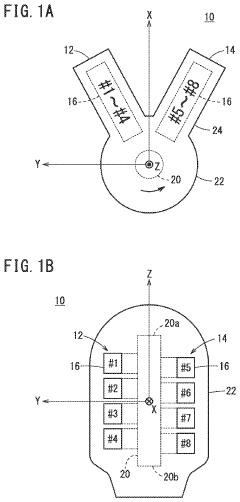
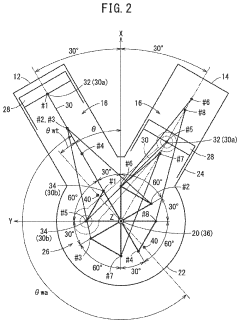
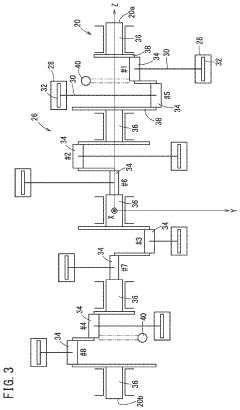
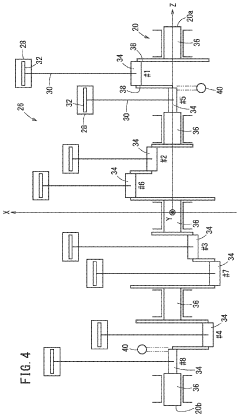
- The V8 engine configuration features crank pins arranged at 90° intervals on one bank and offset by 60° on the other bank, allowing for cancellation of primary inertia couples without additional specialized components by optimizing the arrangement of crank pins and connecting rods.
System for variable valvetrain actuation
PatentInactiveUS7363893B2
Innovation
- An electromechanical VVA system using a single electrical rotary actuator per bank of valves, with a hardened steel rocker subassembly pivotably disposed on a control shaft outside the engine camshaft, allowing for variable valve lift, duration, and phasing without the need for multiple moving parts, reducing parasitic load and simplifying manufacturing and assembly.


Environmental Regulations Impact
Environmental regulations have significantly influenced the design and development of V8 engines, shaping consumer preferences and industry trends. Stringent emission standards, particularly in developed markets, have forced manufacturers to innovate and adapt their V8 engine designs to meet these requirements while maintaining performance characteristics.
The implementation of Corporate Average Fuel Economy (CAFE) standards in the United States has been a driving force behind V8 engine evolution. These regulations have pushed automakers to improve fuel efficiency across their vehicle lineups, including traditionally fuel-hungry V8-powered models. As a result, manufacturers have invested heavily in technologies such as direct injection, variable valve timing, and cylinder deactivation to enhance the efficiency of V8 engines without compromising power output.
European Union regulations, including the Euro 6 emission standards, have also played a crucial role in shaping V8 engine design. These standards have led to the widespread adoption of particulate filters and selective catalytic reduction systems in V8-powered vehicles, particularly in diesel applications. The need to comply with these regulations has influenced consumer preferences, with some buyers shifting towards smaller, turbocharged engines that offer similar performance with reduced emissions.
The introduction of carbon dioxide emission targets has further impacted V8 engine design and consumer choices. Manufacturers have responded by developing hybrid and mild-hybrid V8 powertrains, integrating electric motors to supplement the internal combustion engine and reduce overall emissions. This trend has allowed consumers to maintain their preference for V8-powered vehicles while addressing environmental concerns.
China's increasingly stringent emission standards have also affected global V8 engine design strategies. As the world's largest automotive market, China's regulations have prompted manufacturers to develop V8 engines that can meet these standards, influencing designs for other markets as well. This has led to increased investment in technologies such as advanced catalytic converters and engine management systems.
The impact of environmental regulations on V8 engine design has not been limited to emissions control. Noise pollution regulations have also influenced engine development, leading to the integration of active noise control systems and redesigned exhaust systems. These changes have altered the characteristic sound of V8 engines, a factor that has traditionally been a significant draw for enthusiasts.
As environmental regulations continue to evolve, the future of V8 engine design remains uncertain. Some manufacturers are exploring synthetic fuels and hydrogen combustion as potential pathways to maintain V8 engines in an increasingly eco-conscious market. However, the long-term viability of these solutions in the face of tightening regulations remains to be seen, potentially reshaping consumer preferences and the automotive landscape.
The implementation of Corporate Average Fuel Economy (CAFE) standards in the United States has been a driving force behind V8 engine evolution. These regulations have pushed automakers to improve fuel efficiency across their vehicle lineups, including traditionally fuel-hungry V8-powered models. As a result, manufacturers have invested heavily in technologies such as direct injection, variable valve timing, and cylinder deactivation to enhance the efficiency of V8 engines without compromising power output.
European Union regulations, including the Euro 6 emission standards, have also played a crucial role in shaping V8 engine design. These standards have led to the widespread adoption of particulate filters and selective catalytic reduction systems in V8-powered vehicles, particularly in diesel applications. The need to comply with these regulations has influenced consumer preferences, with some buyers shifting towards smaller, turbocharged engines that offer similar performance with reduced emissions.
The introduction of carbon dioxide emission targets has further impacted V8 engine design and consumer choices. Manufacturers have responded by developing hybrid and mild-hybrid V8 powertrains, integrating electric motors to supplement the internal combustion engine and reduce overall emissions. This trend has allowed consumers to maintain their preference for V8-powered vehicles while addressing environmental concerns.
China's increasingly stringent emission standards have also affected global V8 engine design strategies. As the world's largest automotive market, China's regulations have prompted manufacturers to develop V8 engines that can meet these standards, influencing designs for other markets as well. This has led to increased investment in technologies such as advanced catalytic converters and engine management systems.
The impact of environmental regulations on V8 engine design has not been limited to emissions control. Noise pollution regulations have also influenced engine development, leading to the integration of active noise control systems and redesigned exhaust systems. These changes have altered the characteristic sound of V8 engines, a factor that has traditionally been a significant draw for enthusiasts.
As environmental regulations continue to evolve, the future of V8 engine design remains uncertain. Some manufacturers are exploring synthetic fuels and hydrogen combustion as potential pathways to maintain V8 engines in an increasingly eco-conscious market. However, the long-term viability of these solutions in the face of tightening regulations remains to be seen, potentially reshaping consumer preferences and the automotive landscape.
V8 Performance vs Efficiency Trade-offs
The trade-offs between performance and efficiency in V8 engine design have long been a critical consideration for automotive manufacturers and consumers alike. V8 engines are renowned for their power output and smooth operation, making them popular choices for luxury vehicles, sports cars, and high-performance trucks. However, these engines typically consume more fuel and produce higher emissions compared to smaller, more efficient engine configurations.
In recent years, advancements in engine technology have allowed manufacturers to narrow the gap between performance and efficiency in V8 designs. Variable valve timing, direct fuel injection, and cylinder deactivation systems have all contributed to improved fuel economy without significantly compromising power output. These innovations have enabled V8 engines to remain relevant in an increasingly efficiency-conscious market.
Despite these improvements, V8 engines still face challenges in meeting stringent fuel economy and emissions standards. Manufacturers must carefully balance the desire for high performance with the need for improved efficiency to meet regulatory requirements and consumer expectations. This balancing act often results in compromises, such as reduced engine displacement or the implementation of forced induction systems to maintain power while improving fuel economy.
Consumer preferences play a significant role in shaping the development of V8 engines. While some buyers prioritize raw power and the distinctive V8 sound, others are increasingly concerned with fuel costs and environmental impact. This dichotomy has led to the creation of diverse V8 offerings, ranging from high-output performance variants to more fuel-efficient options that utilize advanced technologies to maximize efficiency.
The future of V8 engines will likely involve further refinements in efficiency-boosting technologies, as well as the potential integration of hybrid systems. Some manufacturers are exploring the use of electric motors to supplement V8 power, allowing for improved fuel economy during low-load conditions while maintaining the ability to deliver high performance when needed. This approach may help extend the viability of V8 engines in an increasingly electrified automotive landscape.
As consumer preferences continue to evolve, the trade-offs between V8 performance and efficiency will remain a key factor in vehicle design and marketing strategies. Manufacturers must carefully consider how to position their V8-powered vehicles to appeal to both performance enthusiasts and efficiency-minded consumers, potentially leading to more diverse and specialized V8 engine offerings in the future.
In recent years, advancements in engine technology have allowed manufacturers to narrow the gap between performance and efficiency in V8 designs. Variable valve timing, direct fuel injection, and cylinder deactivation systems have all contributed to improved fuel economy without significantly compromising power output. These innovations have enabled V8 engines to remain relevant in an increasingly efficiency-conscious market.
Despite these improvements, V8 engines still face challenges in meeting stringent fuel economy and emissions standards. Manufacturers must carefully balance the desire for high performance with the need for improved efficiency to meet regulatory requirements and consumer expectations. This balancing act often results in compromises, such as reduced engine displacement or the implementation of forced induction systems to maintain power while improving fuel economy.
Consumer preferences play a significant role in shaping the development of V8 engines. While some buyers prioritize raw power and the distinctive V8 sound, others are increasingly concerned with fuel costs and environmental impact. This dichotomy has led to the creation of diverse V8 offerings, ranging from high-output performance variants to more fuel-efficient options that utilize advanced technologies to maximize efficiency.
The future of V8 engines will likely involve further refinements in efficiency-boosting technologies, as well as the potential integration of hybrid systems. Some manufacturers are exploring the use of electric motors to supplement V8 power, allowing for improved fuel economy during low-load conditions while maintaining the ability to deliver high performance when needed. This approach may help extend the viability of V8 engines in an increasingly electrified automotive landscape.
As consumer preferences continue to evolve, the trade-offs between V8 performance and efficiency will remain a key factor in vehicle design and marketing strategies. Manufacturers must carefully consider how to position their V8-powered vehicles to appeal to both performance enthusiasts and efficiency-minded consumers, potentially leading to more diverse and specialized V8 engine offerings in the future.
Unlock deeper insights with PatSnap Eureka Quick Research — get a full tech report to explore trends and direct your research. Try now!
Generate Your Research Report Instantly with AI Agent
Supercharge your innovation with PatSnap Eureka AI Agent Platform!