

V8 Engine Power-to-Weight Ratio: Expert Analysis
JUL 4, 20259 MIN READ
Generate Your Research Report Instantly with AI Agent
PatSnap Eureka helps you evaluate technical feasibility & market potential.
V8 Engine Evolution and Objectives
The V8 engine has undergone significant evolution since its inception in the early 20th century. Initially developed to provide more power for larger vehicles, the V8 has become synonymous with high performance and robust power delivery. The primary objective in V8 engine development has consistently been to maximize power output while minimizing weight, thus improving the overall power-to-weight ratio.
Throughout its history, V8 engines have seen numerous advancements aimed at enhancing efficiency, power delivery, and reliability. Early V8 designs focused on increasing displacement to generate more power. However, as automotive technology progressed, engineers shifted their attention to more sophisticated methods of power enhancement, such as improved fuel injection systems, variable valve timing, and forced induction.
The pursuit of a higher power-to-weight ratio has driven significant innovations in materials science and manufacturing techniques. The use of lightweight alloys, such as aluminum and magnesium, has become increasingly common in V8 engine construction. These materials offer substantial weight savings compared to traditional cast iron blocks and heads, without compromising structural integrity.
Another key objective in V8 engine evolution has been the improvement of fuel efficiency and emissions reduction. This has led to the development of technologies like cylinder deactivation, direct fuel injection, and advanced engine management systems. These innovations allow modern V8 engines to deliver impressive power outputs while meeting increasingly stringent environmental regulations.
The racing industry has played a crucial role in pushing the boundaries of V8 engine performance. Motorsport applications have driven the development of high-revving, naturally aspirated V8s, as well as turbocharged and supercharged variants. These racing-derived technologies often find their way into production vehicles, further enhancing the power-to-weight ratios of street-legal V8 engines.
Looking towards the future, the objectives for V8 engine development are likely to focus on further improvements in efficiency and emissions reduction. This may involve the integration of hybrid technologies, advanced thermal management systems, and even more sophisticated electronic controls. The challenge will be to maintain the characteristic power and sound of the V8 while meeting increasingly demanding environmental standards.
Throughout its history, V8 engines have seen numerous advancements aimed at enhancing efficiency, power delivery, and reliability. Early V8 designs focused on increasing displacement to generate more power. However, as automotive technology progressed, engineers shifted their attention to more sophisticated methods of power enhancement, such as improved fuel injection systems, variable valve timing, and forced induction.
The pursuit of a higher power-to-weight ratio has driven significant innovations in materials science and manufacturing techniques. The use of lightweight alloys, such as aluminum and magnesium, has become increasingly common in V8 engine construction. These materials offer substantial weight savings compared to traditional cast iron blocks and heads, without compromising structural integrity.
Another key objective in V8 engine evolution has been the improvement of fuel efficiency and emissions reduction. This has led to the development of technologies like cylinder deactivation, direct fuel injection, and advanced engine management systems. These innovations allow modern V8 engines to deliver impressive power outputs while meeting increasingly stringent environmental regulations.
The racing industry has played a crucial role in pushing the boundaries of V8 engine performance. Motorsport applications have driven the development of high-revving, naturally aspirated V8s, as well as turbocharged and supercharged variants. These racing-derived technologies often find their way into production vehicles, further enhancing the power-to-weight ratios of street-legal V8 engines.
Looking towards the future, the objectives for V8 engine development are likely to focus on further improvements in efficiency and emissions reduction. This may involve the integration of hybrid technologies, advanced thermal management systems, and even more sophisticated electronic controls. The challenge will be to maintain the characteristic power and sound of the V8 while meeting increasingly demanding environmental standards.
Market Demand Analysis
The market demand for high power-to-weight ratio V8 engines has been steadily growing across various sectors, driven by the automotive industry's pursuit of performance and efficiency. In the luxury and sports car segments, there is a consistent demand for engines that can deliver exceptional power while maintaining a lightweight profile. This trend is particularly evident in the high-end market, where consumers are willing to pay a premium for vehicles that offer superior acceleration and handling characteristics.
The racing and motorsport industry continues to be a significant driver of demand for advanced V8 engines with optimized power-to-weight ratios. Formula 1 and other high-performance racing series have stringent requirements for engine efficiency and power output, pushing manufacturers to innovate continuously in this area. This demand not only fuels technological advancements but also creates a trickle-down effect to consumer vehicles, as racing innovations often find their way into production models.
In the commercial vehicle sector, there is an increasing interest in V8 engines that can provide high power output while meeting stringent emissions regulations. Fleet operators and logistics companies are looking for engines that can deliver improved fuel efficiency without compromising on performance, especially for long-haul trucking applications. This has led to a growing market for V8 engines that balance power, weight, and fuel economy.
The marine industry also represents a significant market for high-performance V8 engines. Luxury yachts and high-speed boats require engines that can provide substantial power in a compact package, making the power-to-weight ratio a critical factor. As the marine leisure market expands, particularly in emerging economies, the demand for advanced V8 engines in this sector is expected to grow.
Market analysis indicates that the global V8 engine market is projected to experience steady growth over the next five years. This growth is attributed to the increasing demand for high-performance vehicles, the expansion of the luxury car market in developing countries, and the ongoing technological advancements in engine design and materials. The Asia-Pacific region, in particular, is expected to see significant growth in demand for V8 engines, driven by rising disposable incomes and a growing appetite for luxury and performance vehicles.
However, the market also faces challenges, primarily from the increasing focus on environmental regulations and the shift towards electrification in the automotive industry. Manufacturers are under pressure to improve the efficiency and reduce emissions of V8 engines to meet stricter standards. This has led to innovations in areas such as cylinder deactivation, advanced fuel injection systems, and the integration of hybrid technologies to enhance the overall efficiency of V8 powertrains.
The racing and motorsport industry continues to be a significant driver of demand for advanced V8 engines with optimized power-to-weight ratios. Formula 1 and other high-performance racing series have stringent requirements for engine efficiency and power output, pushing manufacturers to innovate continuously in this area. This demand not only fuels technological advancements but also creates a trickle-down effect to consumer vehicles, as racing innovations often find their way into production models.
In the commercial vehicle sector, there is an increasing interest in V8 engines that can provide high power output while meeting stringent emissions regulations. Fleet operators and logistics companies are looking for engines that can deliver improved fuel efficiency without compromising on performance, especially for long-haul trucking applications. This has led to a growing market for V8 engines that balance power, weight, and fuel economy.
The marine industry also represents a significant market for high-performance V8 engines. Luxury yachts and high-speed boats require engines that can provide substantial power in a compact package, making the power-to-weight ratio a critical factor. As the marine leisure market expands, particularly in emerging economies, the demand for advanced V8 engines in this sector is expected to grow.
Market analysis indicates that the global V8 engine market is projected to experience steady growth over the next five years. This growth is attributed to the increasing demand for high-performance vehicles, the expansion of the luxury car market in developing countries, and the ongoing technological advancements in engine design and materials. The Asia-Pacific region, in particular, is expected to see significant growth in demand for V8 engines, driven by rising disposable incomes and a growing appetite for luxury and performance vehicles.
However, the market also faces challenges, primarily from the increasing focus on environmental regulations and the shift towards electrification in the automotive industry. Manufacturers are under pressure to improve the efficiency and reduce emissions of V8 engines to meet stricter standards. This has led to innovations in areas such as cylinder deactivation, advanced fuel injection systems, and the integration of hybrid technologies to enhance the overall efficiency of V8 powertrains.
Current V8 Technology Challenges
V8 engines, renowned for their power and performance, face several significant challenges in the current automotive landscape. One of the primary hurdles is the increasing demand for improved fuel efficiency and reduced emissions. As environmental regulations become more stringent globally, V8 engine manufacturers must find innovative ways to maintain performance while reducing fuel consumption and carbon footprint.
Another major challenge lies in the power-to-weight ratio optimization. While V8 engines are known for their high power output, they are also typically heavier than smaller engine configurations. This weight penalty can negatively impact overall vehicle performance, handling, and fuel economy. Engineers are constantly striving to develop lighter materials and more compact designs to address this issue without compromising on power delivery.
The complexity of modern V8 engines presents another set of challenges. Advanced technologies such as direct injection, variable valve timing, and turbocharging, while improving performance and efficiency, also increase the intricacy of engine design and maintenance. This complexity can lead to higher production costs and potential reliability issues, which manufacturers must carefully balance against performance gains.
Heat management is a critical concern for V8 engines, particularly in high-performance applications. The substantial power output generates significant heat, which must be effectively dissipated to prevent engine damage and maintain optimal performance. Developing more efficient cooling systems and heat-resistant materials is an ongoing challenge for engineers working on V8 engines.
The shift towards electrification in the automotive industry poses a existential challenge for V8 engines. As hybrid and fully electric powertrains gain popularity, manufacturers must find ways to integrate V8 engines into hybrid systems or justify their continued use in an increasingly eco-conscious market. This may involve developing mild hybrid systems or creating highly specialized applications for V8 engines in niche markets.
Noise, vibration, and harshness (NVH) control is another area of focus for V8 engine development. While the characteristic sound of a V8 is often desirable, stricter noise regulations and consumer preferences for quieter vehicles necessitate improved sound dampening and vibration isolation techniques.
Lastly, the cost-effectiveness of V8 engines in mass-market vehicles is becoming increasingly challenging. As smaller, more efficient engines with turbocharging technology approach V8-level performance, manufacturers must justify the higher production and running costs associated with V8 engines. This economic pressure is pushing V8 engines towards premium and performance-oriented market segments, limiting their broader application.
Another major challenge lies in the power-to-weight ratio optimization. While V8 engines are known for their high power output, they are also typically heavier than smaller engine configurations. This weight penalty can negatively impact overall vehicle performance, handling, and fuel economy. Engineers are constantly striving to develop lighter materials and more compact designs to address this issue without compromising on power delivery.
The complexity of modern V8 engines presents another set of challenges. Advanced technologies such as direct injection, variable valve timing, and turbocharging, while improving performance and efficiency, also increase the intricacy of engine design and maintenance. This complexity can lead to higher production costs and potential reliability issues, which manufacturers must carefully balance against performance gains.
Heat management is a critical concern for V8 engines, particularly in high-performance applications. The substantial power output generates significant heat, which must be effectively dissipated to prevent engine damage and maintain optimal performance. Developing more efficient cooling systems and heat-resistant materials is an ongoing challenge for engineers working on V8 engines.
The shift towards electrification in the automotive industry poses a existential challenge for V8 engines. As hybrid and fully electric powertrains gain popularity, manufacturers must find ways to integrate V8 engines into hybrid systems or justify their continued use in an increasingly eco-conscious market. This may involve developing mild hybrid systems or creating highly specialized applications for V8 engines in niche markets.
Noise, vibration, and harshness (NVH) control is another area of focus for V8 engine development. While the characteristic sound of a V8 is often desirable, stricter noise regulations and consumer preferences for quieter vehicles necessitate improved sound dampening and vibration isolation techniques.
Lastly, the cost-effectiveness of V8 engines in mass-market vehicles is becoming increasingly challenging. As smaller, more efficient engines with turbocharging technology approach V8-level performance, manufacturers must justify the higher production and running costs associated with V8 engines. This economic pressure is pushing V8 engines towards premium and performance-oriented market segments, limiting their broader application.
Current Power-to-Weight Solutions
01 Lightweight materials for V8 engine components
Using lightweight materials such as aluminum alloys, carbon fiber, and composite materials for engine components can significantly reduce the overall weight of V8 engines. This reduction in weight, while maintaining or improving power output, leads to an enhanced power-to-weight ratio. Lightweight components may include engine blocks, cylinder heads, pistons, and connecting rods.- Lightweight materials for V8 engine components: Using lightweight materials such as aluminum alloys, carbon fiber, and composite materials for engine components can significantly reduce the overall weight of V8 engines. This reduction in weight, while maintaining or improving power output, leads to an enhanced power-to-weight ratio. Lightweight components may include engine blocks, cylinder heads, pistons, and other internal parts.
- Advanced fuel injection and combustion technologies: Implementing advanced fuel injection systems and combustion technologies can improve the efficiency and power output of V8 engines without significantly increasing weight. These technologies may include direct injection, variable valve timing, and optimized combustion chamber designs, resulting in better fuel economy and increased power-to-weight ratios.
- Turbocharging and supercharging systems: Incorporating turbocharging or supercharging systems can significantly boost the power output of V8 engines without proportionally increasing their weight. These forced induction systems compress the intake air, allowing for more efficient combustion and increased power density, thereby improving the overall power-to-weight ratio.
- Optimized engine design and layout: Refining the overall engine design and layout can lead to improved power-to-weight ratios in V8 engines. This may include optimizing the cylinder bore and stroke, reducing friction between moving parts, and implementing compact designs that minimize unnecessary weight while maximizing power output.
- Integration of hybrid and electric technologies: Incorporating hybrid or electric technologies into V8 engine systems can enhance power-to-weight ratios by supplementing the combustion engine with electric motors. This approach allows for increased power output during acceleration or high-demand situations while maintaining a relatively low overall weight compared to traditional V8 engines.
02 Advanced fuel injection and combustion technologies
Implementing advanced fuel injection systems and combustion technologies can improve the efficiency and power output of V8 engines without significantly increasing weight. These technologies may include direct fuel injection, variable valve timing, and optimized combustion chamber designs, resulting in a better power-to-weight ratio.Expand Specific Solutions03 Turbocharging and supercharging systems
Incorporating turbocharging or supercharging systems can significantly boost the power output of V8 engines without proportionally increasing their weight. These forced induction systems compress the intake air, allowing for more efficient combustion and increased power density, thus improving the overall power-to-weight ratio.Expand Specific Solutions04 Optimized engine design and layout
Refining the overall engine design and layout can lead to improved power-to-weight ratios in V8 engines. This may include optimizing the cylinder bore and stroke, reducing internal friction, and implementing compact designs that minimize unnecessary weight while maximizing power output.Expand Specific Solutions05 Integration of hybrid and electric technologies
Incorporating hybrid or electric technologies into V8 engine systems can enhance power output while minimizing weight increase. This may involve integrating electric motors, regenerative braking systems, and advanced battery technologies to supplement the V8 engine's power, resulting in an improved overall power-to-weight ratio.Expand Specific Solutions
Key V8 Engine Manufacturers
The V8 engine power-to-weight ratio market is in a mature stage, with established players like Nissan, Honda, and BMW competing for market share. The global market size is substantial, driven by demand in high-performance vehicles and luxury segments. Technological maturity is high, with companies like Toyota, Ford, and Caterpillar continuously innovating to improve efficiency and performance. Emerging players such as Chery Automobile and Guangxi Yuchai Machinery are also making strides in this space, particularly in developing markets. The focus on power-to-weight optimization reflects the industry's push towards better fuel economy and emissions reduction while maintaining performance standards.
Nissan Motor Co., Ltd.
Technical Solution: Nissan's approach to V8 engine power-to-weight ratio optimization is exemplified in their VK56VD engine, used in high-performance and luxury vehicles. The engine features a direct injection system coupled with Variable Valve Event and Lift (VVEL) technology, allowing for precise control over valve timing and lift to optimize power and efficiency[13]. Nissan has implemented a lightweight aluminum block with a ladder frame construction for improved rigidity while minimizing weight[14]. The use of plasma-sprayed cylinder bores eliminates the need for heavy iron liners. Nissan's engineers have also focused on reducing friction through microfinishing of the crankshaft and adopting low-tension piston rings[15]. The integration of a variable displacement oil pump and a water-cooled intercooler system contributes to both weight reduction and improved thermal efficiency.
Strengths: Advanced valve control technology, lightweight block design, and friction reduction techniques. Weaknesses: Complexity of the VVEL system and potential higher maintenance costs in the long term.
Honda Motor Co., Ltd.
Technical Solution: Honda, while not traditionally known for V8 engines, has applied its expertise in high-power-to-weight ratio engines to V8 development for racing applications. Their approach focuses on lightweight construction and high-revving capabilities. Honda's racing V8 engines often feature a flat-plane crankshaft design, which allows for higher RPMs and improved exhaust scavenging[10]. The company utilizes advanced casting techniques to create thin-walled engine blocks, reducing overall weight without compromising structural integrity[11]. Honda also implements titanium valves and connecting rods, further enhancing the power-to-weight ratio. Their VTEC (Variable Valve Timing and Lift Electronic Control) system, adapted for V8 use, allows for optimized performance across a wide RPM range while maintaining efficiency[12].
Strengths: Expertise in high-revving engines, advanced lightweight materials, and innovative valve control systems. Weaknesses: Limited experience with V8 engines in production vehicles and potential durability concerns in high-stress applications.
Core V8 Engine Innovations
V8 engine
PatentWO2021171405A1
Innovation
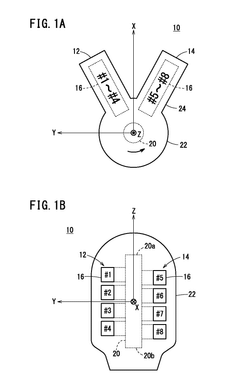
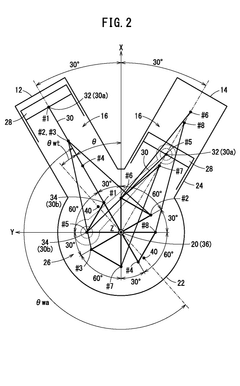
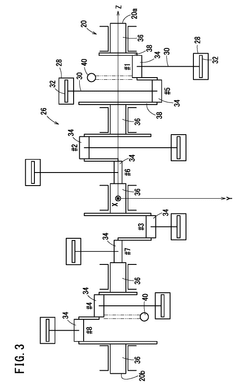
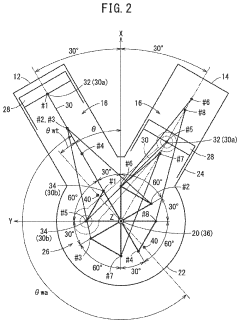
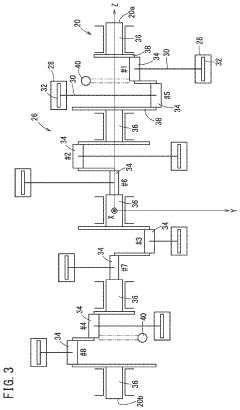
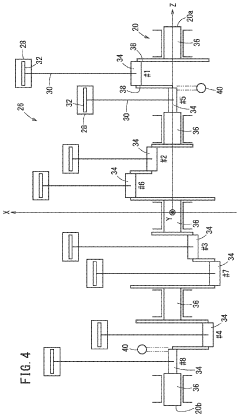
- The engine is configured with a 60° bank angle, where crank pins on one bank are arranged at 90° intervals and offset by 60° from the other bank, allowing for cancellation of the primary inertia couple without additional special parts, and the ignition timing is set to achieve balanced explosions similar to conventional V8 engines.

V8 engine
PatentActiveUS20230109196A1
Innovation
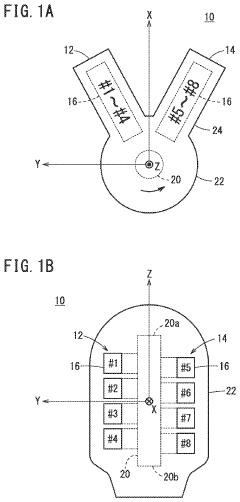
- The V8 engine configuration features crank pins arranged at 90° intervals on one bank and offset by 60° on the other bank, allowing for cancellation of primary inertia couples without additional specialized components by optimizing the arrangement of crank pins and connecting rods.
Environmental Impact Assessment
The environmental impact of V8 engines, particularly in relation to their power-to-weight ratio, is a critical consideration in today's automotive industry. As engines become more powerful and efficient, their environmental footprint remains a significant concern. V8 engines, known for their high performance and distinctive sound, have traditionally been associated with higher fuel consumption and emissions compared to smaller engine configurations.
However, recent advancements in V8 engine technology have led to improvements in their environmental performance. The focus on increasing power-to-weight ratios has resulted in more efficient engines that produce more power with less fuel, thereby reducing emissions per unit of power output. This trend is driven by a combination of factors, including stricter environmental regulations, consumer demand for more fuel-efficient vehicles, and the automotive industry's push towards sustainability.
One of the key environmental benefits of improving the power-to-weight ratio in V8 engines is the reduction in fuel consumption. By optimizing engine design and using lightweight materials, manufacturers have been able to create V8 engines that deliver impressive performance while consuming less fuel. This not only reduces the carbon footprint of vehicles equipped with these engines but also helps conserve fossil fuel resources.
Emissions reduction is another crucial aspect of the environmental impact assessment for V8 engines. Modern V8 engines incorporate advanced technologies such as direct fuel injection, variable valve timing, and cylinder deactivation, which contribute to lower emissions of harmful pollutants like carbon monoxide, nitrogen oxides, and particulate matter. These technologies allow V8 engines to meet increasingly stringent emissions standards while maintaining their performance characteristics.
The lifecycle environmental impact of V8 engines is also an important consideration. While the operation of these engines has become more environmentally friendly, the manufacturing process and end-of-life disposal still present challenges. The production of high-performance engine components often requires energy-intensive processes and specialized materials, which can have significant environmental implications. However, advancements in manufacturing techniques and the use of recycled materials are helping to mitigate these impacts.
Looking towards the future, the environmental impact of V8 engines will likely continue to improve as manufacturers invest in research and development. Hybrid and electric technologies are being integrated into V8 powertrains, further reducing their environmental footprint. These innovations promise to extend the viability of V8 engines in an increasingly eco-conscious automotive landscape, balancing performance with environmental responsibility.
However, recent advancements in V8 engine technology have led to improvements in their environmental performance. The focus on increasing power-to-weight ratios has resulted in more efficient engines that produce more power with less fuel, thereby reducing emissions per unit of power output. This trend is driven by a combination of factors, including stricter environmental regulations, consumer demand for more fuel-efficient vehicles, and the automotive industry's push towards sustainability.
One of the key environmental benefits of improving the power-to-weight ratio in V8 engines is the reduction in fuel consumption. By optimizing engine design and using lightweight materials, manufacturers have been able to create V8 engines that deliver impressive performance while consuming less fuel. This not only reduces the carbon footprint of vehicles equipped with these engines but also helps conserve fossil fuel resources.
Emissions reduction is another crucial aspect of the environmental impact assessment for V8 engines. Modern V8 engines incorporate advanced technologies such as direct fuel injection, variable valve timing, and cylinder deactivation, which contribute to lower emissions of harmful pollutants like carbon monoxide, nitrogen oxides, and particulate matter. These technologies allow V8 engines to meet increasingly stringent emissions standards while maintaining their performance characteristics.
The lifecycle environmental impact of V8 engines is also an important consideration. While the operation of these engines has become more environmentally friendly, the manufacturing process and end-of-life disposal still present challenges. The production of high-performance engine components often requires energy-intensive processes and specialized materials, which can have significant environmental implications. However, advancements in manufacturing techniques and the use of recycled materials are helping to mitigate these impacts.
Looking towards the future, the environmental impact of V8 engines will likely continue to improve as manufacturers invest in research and development. Hybrid and electric technologies are being integrated into V8 powertrains, further reducing their environmental footprint. These innovations promise to extend the viability of V8 engines in an increasingly eco-conscious automotive landscape, balancing performance with environmental responsibility.
V8 Engine Cost-Benefit Analysis
The cost-benefit analysis of V8 engines is a crucial consideration for manufacturers and consumers alike. V8 engines are known for their power and performance, but they come with significant costs that must be weighed against their benefits.
From a manufacturing perspective, V8 engines require more materials and complex engineering compared to smaller engines. The increased number of cylinders, larger displacement, and additional components contribute to higher production costs. These engines also demand more sophisticated tooling and assembly processes, further elevating manufacturing expenses.
Fuel consumption is a major factor in the cost-benefit equation. V8 engines typically consume more fuel than their smaller counterparts, leading to higher operating costs for vehicle owners. This increased fuel consumption also translates to higher emissions, which can impact environmental compliance costs for manufacturers and potentially lead to additional expenses for consumers in regions with strict emissions regulations or carbon taxes.
However, the benefits of V8 engines are substantial, particularly in terms of performance. They offer superior power output and torque, making them ideal for high-performance vehicles, luxury cars, and heavy-duty applications. This performance advantage can command premium prices in the market, potentially offsetting some of the higher production costs.
Maintenance costs for V8 engines tend to be higher due to their complexity and the number of components involved. More frequent oil changes, potential for increased wear on parts, and specialized servicing requirements contribute to long-term ownership costs. However, the durability and longevity of well-designed V8 engines can provide value over time, especially in applications where engine reliability is crucial.
Market positioning is another important consideration. Vehicles equipped with V8 engines often occupy premium segments, allowing manufacturers to leverage higher profit margins. The prestige and brand value associated with V8 power can justify higher price points and create customer loyalty.
Technological advancements have begun to address some of the traditional drawbacks of V8 engines. Innovations such as cylinder deactivation, direct injection, and advanced engine management systems have improved fuel efficiency and emissions performance. While these technologies add to the initial cost, they can enhance the long-term value proposition of V8 engines.
In conclusion, the cost-benefit analysis of V8 engines reveals a complex interplay of factors. While they incur higher production and operating costs, their performance benefits, market positioning, and potential for technological improvement continue to make them viable options in specific automotive segments. Manufacturers must carefully balance these factors against market demands and regulatory pressures to determine the role of V8 engines in their product portfolios.
From a manufacturing perspective, V8 engines require more materials and complex engineering compared to smaller engines. The increased number of cylinders, larger displacement, and additional components contribute to higher production costs. These engines also demand more sophisticated tooling and assembly processes, further elevating manufacturing expenses.
Fuel consumption is a major factor in the cost-benefit equation. V8 engines typically consume more fuel than their smaller counterparts, leading to higher operating costs for vehicle owners. This increased fuel consumption also translates to higher emissions, which can impact environmental compliance costs for manufacturers and potentially lead to additional expenses for consumers in regions with strict emissions regulations or carbon taxes.
However, the benefits of V8 engines are substantial, particularly in terms of performance. They offer superior power output and torque, making them ideal for high-performance vehicles, luxury cars, and heavy-duty applications. This performance advantage can command premium prices in the market, potentially offsetting some of the higher production costs.
Maintenance costs for V8 engines tend to be higher due to their complexity and the number of components involved. More frequent oil changes, potential for increased wear on parts, and specialized servicing requirements contribute to long-term ownership costs. However, the durability and longevity of well-designed V8 engines can provide value over time, especially in applications where engine reliability is crucial.
Market positioning is another important consideration. Vehicles equipped with V8 engines often occupy premium segments, allowing manufacturers to leverage higher profit margins. The prestige and brand value associated with V8 power can justify higher price points and create customer loyalty.
Technological advancements have begun to address some of the traditional drawbacks of V8 engines. Innovations such as cylinder deactivation, direct injection, and advanced engine management systems have improved fuel efficiency and emissions performance. While these technologies add to the initial cost, they can enhance the long-term value proposition of V8 engines.
In conclusion, the cost-benefit analysis of V8 engines reveals a complex interplay of factors. While they incur higher production and operating costs, their performance benefits, market positioning, and potential for technological improvement continue to make them viable options in specific automotive segments. Manufacturers must carefully balance these factors against market demands and regulatory pressures to determine the role of V8 engines in their product portfolios.
Unlock deeper insights with PatSnap Eureka Quick Research — get a full tech report to explore trends and direct your research. Try now!
Generate Your Research Report Instantly with AI Agent
Supercharge your innovation with PatSnap Eureka AI Agent Platform!