

V8 Engine Strategies for Maximizing Output Power
JUL 4, 20259 MIN READ
Generate Your Research Report Instantly with AI Agent
PatSnap Eureka helps you evaluate technical feasibility & market potential.
V8 Engine Power Evolution
The evolution of V8 engine power has been a remarkable journey, characterized by continuous innovation and technological advancements. From its inception in the early 20th century, the V8 engine has undergone significant transformations, driven by the relentless pursuit of increased power output and efficiency.
In the 1950s and 1960s, V8 engines experienced a surge in popularity, particularly in American muscle cars. This era saw the introduction of high-compression ratios and larger displacement engines, resulting in substantial power increases. The iconic Chevrolet Small-Block V8, introduced in 1955, became a benchmark for performance and versatility.
The 1970s brought new challenges with the oil crisis and stricter emissions regulations. Engine designers focused on improving fuel efficiency while maintaining power output. This period saw the introduction of electronic fuel injection systems and computer-controlled engine management, laying the groundwork for future advancements.
The 1980s and 1990s marked a shift towards more sophisticated engine designs. Variable valve timing, multi-valve cylinder heads, and improved intake and exhaust systems became prevalent. These technologies allowed for better control over the combustion process, resulting in increased power and improved fuel economy.
The turn of the millennium ushered in a new era of V8 engine development. Forced induction, particularly turbocharging and supercharging, became more common in production vehicles. These technologies allowed smaller displacement engines to produce power levels previously associated with larger naturally aspirated units.
In recent years, the focus has shifted towards hybridization and electrification. Many manufacturers have integrated electric motors with V8 engines to create high-performance hybrid powertrains. This approach combines the traditional appeal of V8 power with improved efficiency and reduced emissions.
Advanced materials and manufacturing techniques have also played a crucial role in V8 engine evolution. Lightweight alloys, precision machining, and computer-aided design have enabled the creation of engines with tighter tolerances, reduced friction, and improved thermal management.
The latest V8 engines incorporate cutting-edge technologies such as direct fuel injection, cylinder deactivation, and advanced thermal management systems. These innovations allow for precise control over the combustion process, optimizing power output while meeting increasingly stringent emissions standards.
Looking ahead, the future of V8 engine power lies in further refinement of existing technologies and the integration of new ones. Developments in areas such as variable compression ratios, advanced combustion modes, and smart materials promise to push the boundaries of V8 performance even further.
In the 1950s and 1960s, V8 engines experienced a surge in popularity, particularly in American muscle cars. This era saw the introduction of high-compression ratios and larger displacement engines, resulting in substantial power increases. The iconic Chevrolet Small-Block V8, introduced in 1955, became a benchmark for performance and versatility.
The 1970s brought new challenges with the oil crisis and stricter emissions regulations. Engine designers focused on improving fuel efficiency while maintaining power output. This period saw the introduction of electronic fuel injection systems and computer-controlled engine management, laying the groundwork for future advancements.
The 1980s and 1990s marked a shift towards more sophisticated engine designs. Variable valve timing, multi-valve cylinder heads, and improved intake and exhaust systems became prevalent. These technologies allowed for better control over the combustion process, resulting in increased power and improved fuel economy.
The turn of the millennium ushered in a new era of V8 engine development. Forced induction, particularly turbocharging and supercharging, became more common in production vehicles. These technologies allowed smaller displacement engines to produce power levels previously associated with larger naturally aspirated units.
In recent years, the focus has shifted towards hybridization and electrification. Many manufacturers have integrated electric motors with V8 engines to create high-performance hybrid powertrains. This approach combines the traditional appeal of V8 power with improved efficiency and reduced emissions.
Advanced materials and manufacturing techniques have also played a crucial role in V8 engine evolution. Lightweight alloys, precision machining, and computer-aided design have enabled the creation of engines with tighter tolerances, reduced friction, and improved thermal management.
The latest V8 engines incorporate cutting-edge technologies such as direct fuel injection, cylinder deactivation, and advanced thermal management systems. These innovations allow for precise control over the combustion process, optimizing power output while meeting increasingly stringent emissions standards.
Looking ahead, the future of V8 engine power lies in further refinement of existing technologies and the integration of new ones. Developments in areas such as variable compression ratios, advanced combustion modes, and smart materials promise to push the boundaries of V8 performance even further.
Market Demand Analysis
The market demand for V8 engine strategies aimed at maximizing output power has been steadily growing in recent years. This trend is driven by several factors, including the increasing consumer preference for high-performance vehicles, the automotive industry's push for more efficient and powerful engines, and the ongoing competition among manufacturers to produce vehicles with superior power-to-weight ratios.
In the passenger vehicle segment, there is a notable demand for V8 engines in luxury sports cars and high-end SUVs. These vehicles cater to consumers who prioritize performance and are willing to pay a premium for powerful engines. The market for such vehicles has shown resilience even in the face of economic uncertainties, indicating a stable demand for high-output V8 engines.
The commercial vehicle sector also contributes significantly to the demand for powerful V8 engines. Heavy-duty trucks and specialized industrial vehicles require robust engines capable of delivering high torque and power output. As global trade and construction activities continue to expand, the need for such vehicles, and consequently, high-performance V8 engines, is expected to grow.
Motorsports represent another crucial market segment driving the demand for V8 engine power maximization strategies. Racing teams and enthusiasts constantly seek ways to extract more power from their engines while maintaining reliability. This sector often serves as a testing ground for innovative technologies that later find their way into consumer vehicles.
Environmental regulations and fuel efficiency standards pose both challenges and opportunities for V8 engine development. While there is pressure to reduce emissions and improve fuel economy, these factors have spurred innovation in engine design and power optimization techniques. Technologies such as direct injection, variable valve timing, and advanced turbocharging are being increasingly adopted to meet regulatory requirements while satisfying the market demand for power.
The aftermarket tuning industry also plays a significant role in driving demand for V8 engine power maximization strategies. Car enthusiasts and performance shops seek ways to enhance stock V8 engines, creating a market for specialized components and tuning solutions designed to increase horsepower and torque output.
Geographically, North America and Europe remain strong markets for V8-powered vehicles, particularly in the luxury and performance segments. However, emerging markets in Asia and the Middle East are showing increased interest in high-performance vehicles, potentially expanding the global demand for powerful V8 engines.
Looking ahead, the market for V8 engine power maximization strategies is expected to evolve alongside technological advancements and changing consumer preferences. While there is a shift towards electrification in the automotive industry, the demand for high-performance internal combustion engines, including V8s, is likely to persist in specific market segments for the foreseeable future.
In the passenger vehicle segment, there is a notable demand for V8 engines in luxury sports cars and high-end SUVs. These vehicles cater to consumers who prioritize performance and are willing to pay a premium for powerful engines. The market for such vehicles has shown resilience even in the face of economic uncertainties, indicating a stable demand for high-output V8 engines.
The commercial vehicle sector also contributes significantly to the demand for powerful V8 engines. Heavy-duty trucks and specialized industrial vehicles require robust engines capable of delivering high torque and power output. As global trade and construction activities continue to expand, the need for such vehicles, and consequently, high-performance V8 engines, is expected to grow.
Motorsports represent another crucial market segment driving the demand for V8 engine power maximization strategies. Racing teams and enthusiasts constantly seek ways to extract more power from their engines while maintaining reliability. This sector often serves as a testing ground for innovative technologies that later find their way into consumer vehicles.
Environmental regulations and fuel efficiency standards pose both challenges and opportunities for V8 engine development. While there is pressure to reduce emissions and improve fuel economy, these factors have spurred innovation in engine design and power optimization techniques. Technologies such as direct injection, variable valve timing, and advanced turbocharging are being increasingly adopted to meet regulatory requirements while satisfying the market demand for power.
The aftermarket tuning industry also plays a significant role in driving demand for V8 engine power maximization strategies. Car enthusiasts and performance shops seek ways to enhance stock V8 engines, creating a market for specialized components and tuning solutions designed to increase horsepower and torque output.
Geographically, North America and Europe remain strong markets for V8-powered vehicles, particularly in the luxury and performance segments. However, emerging markets in Asia and the Middle East are showing increased interest in high-performance vehicles, potentially expanding the global demand for powerful V8 engines.
Looking ahead, the market for V8 engine power maximization strategies is expected to evolve alongside technological advancements and changing consumer preferences. While there is a shift towards electrification in the automotive industry, the demand for high-performance internal combustion engines, including V8s, is likely to persist in specific market segments for the foreseeable future.
Current V8 Tech Challenges
V8 engines, renowned for their power and performance, face several significant challenges in the pursuit of maximizing output power. One of the primary obstacles is thermal management. As engine output increases, so does the heat generated, which can lead to reduced efficiency and potential damage to engine components. Engineers must develop innovative cooling systems and materials that can withstand higher temperatures without compromising performance or longevity.
Another critical challenge is the balance between power output and fuel efficiency. While increasing power is a primary goal, it often comes at the cost of increased fuel consumption. This presents a dilemma in the face of stricter emissions regulations and growing environmental concerns. Manufacturers must find ways to optimize combustion processes and reduce internal friction to achieve both high power output and improved fuel economy.
The quest for higher compression ratios also poses significant challenges. While higher compression can lead to increased power output, it also increases the risk of engine knock or pre-ignition. This necessitates the development of more sophisticated fuel injection systems and engine management software to precisely control the combustion process under varying conditions.
Weight reduction is another area of focus in V8 engine development. The inherent size and complexity of V8 engines make them heavier than smaller configurations, which can negatively impact overall vehicle performance. Engineers are exploring advanced materials and manufacturing techniques to reduce engine weight without sacrificing strength or durability.
Emissions control remains a persistent challenge for V8 engines. As regulations become increasingly stringent, manufacturers must implement more advanced aftertreatment systems and combustion strategies to reduce harmful emissions. This often involves complex trade-offs between power output, efficiency, and emissions compliance.
The integration of forced induction systems, such as turbochargers or superchargers, while effective in boosting power, introduces additional complexities. These systems must be carefully designed to minimize lag, manage heat, and ensure reliability across a wide range of operating conditions.
Lastly, the challenge of NVH (Noise, Vibration, and Harshness) management becomes more pronounced as power output increases. High-performance V8 engines must deliver exhilarating power while maintaining acceptable levels of refinement and comfort, requiring advanced vibration damping technologies and exhaust system designs.
Another critical challenge is the balance between power output and fuel efficiency. While increasing power is a primary goal, it often comes at the cost of increased fuel consumption. This presents a dilemma in the face of stricter emissions regulations and growing environmental concerns. Manufacturers must find ways to optimize combustion processes and reduce internal friction to achieve both high power output and improved fuel economy.
The quest for higher compression ratios also poses significant challenges. While higher compression can lead to increased power output, it also increases the risk of engine knock or pre-ignition. This necessitates the development of more sophisticated fuel injection systems and engine management software to precisely control the combustion process under varying conditions.
Weight reduction is another area of focus in V8 engine development. The inherent size and complexity of V8 engines make them heavier than smaller configurations, which can negatively impact overall vehicle performance. Engineers are exploring advanced materials and manufacturing techniques to reduce engine weight without sacrificing strength or durability.
Emissions control remains a persistent challenge for V8 engines. As regulations become increasingly stringent, manufacturers must implement more advanced aftertreatment systems and combustion strategies to reduce harmful emissions. This often involves complex trade-offs between power output, efficiency, and emissions compliance.
The integration of forced induction systems, such as turbochargers or superchargers, while effective in boosting power, introduces additional complexities. These systems must be carefully designed to minimize lag, manage heat, and ensure reliability across a wide range of operating conditions.
Lastly, the challenge of NVH (Noise, Vibration, and Harshness) management becomes more pronounced as power output increases. High-performance V8 engines must deliver exhilarating power while maintaining acceptable levels of refinement and comfort, requiring advanced vibration damping technologies and exhaust system designs.
Existing Power Boost Methods
01 Engine management systems for V8 engines
Advanced engine management systems are employed to optimize the output power of V8 engines. These systems control various parameters such as fuel injection, ignition timing, and valve timing to maximize performance and efficiency. They often incorporate sensors and electronic control units to continuously adjust engine operation based on real-time data.- Engine design optimization: Optimizing the design of V8 engines to improve output power. This includes modifications to cylinder configuration, valve timing, and combustion chamber design to enhance efficiency and power generation.
- Fuel injection and management systems: Implementing advanced fuel injection and management systems to increase V8 engine output power. This involves precise control of fuel delivery, air-fuel mixture, and ignition timing to maximize combustion efficiency and power output.
- Turbocharging and supercharging: Incorporating turbocharging or supercharging technologies to boost V8 engine output power. These forced induction systems increase air intake, allowing for more fuel combustion and higher power output.
- Electronic control systems: Utilizing advanced electronic control systems to optimize V8 engine performance and power output. These systems monitor and adjust various engine parameters in real-time to maximize efficiency and power generation.
- Materials and manufacturing techniques: Employing innovative materials and manufacturing techniques to enhance V8 engine components. This includes using lightweight, high-strength materials and advanced manufacturing processes to reduce engine weight, improve heat dissipation, and increase overall power output.
02 Turbocharging and supercharging V8 engines
Forced induction systems, including turbochargers and superchargers, are used to increase the output power of V8 engines. These systems compress the intake air, allowing more air and fuel to be combusted in each cycle, resulting in higher power output. Various designs and configurations of forced induction systems are employed to suit different V8 engine applications.Expand Specific Solutions03 Variable valve timing and lift for V8 engines
Variable valve timing and lift mechanisms are implemented in V8 engines to enhance power output across different engine speeds. These systems allow for optimized valve operation, improving volumetric efficiency, torque, and power output. Advanced designs may include continuous variable valve timing or multi-stage lift systems for further performance gains.Expand Specific Solutions04 Fuel injection systems for V8 engines
High-precision fuel injection systems are crucial for maximizing the output power of V8 engines. Direct injection, multi-port injection, and advanced injector designs are used to optimize fuel delivery and atomization. These systems contribute to improved combustion efficiency, power output, and fuel economy in V8 engines.Expand Specific Solutions05 Exhaust system optimization for V8 engines
Exhaust system design plays a significant role in enhancing the output power of V8 engines. This includes the use of performance headers, high-flow catalytic converters, and tuned exhaust manifolds. Advanced exhaust systems may incorporate variable geometry or active valves to optimize back pressure and scavenging effects across different engine speeds and loads.Expand Specific Solutions
Key V8 Engine Manufacturers
The V8 engine optimization market is in a mature stage, with established players competing to maximize output power. The global automotive engine market size is substantial, projected to reach $110 billion by 2027. Technologically, V8 engine strategies are well-developed but continue to evolve. Key players like Ford, Toyota, GM, BMW, and Honda lead innovation, leveraging advanced materials, precision engineering, and electronic control systems. Emerging companies such as Visteon and Nooter/Eriksen contribute specialized technologies. Research institutions like Beihang University and Beijing Institute of Technology collaborate with industry, driving fundamental advancements in combustion efficiency and emissions reduction for next-generation V8 engines.
Ford Global Technologies LLC
Technical Solution: Ford has developed advanced V8 engine strategies to maximize output power, focusing on direct injection, variable valve timing, and turbocharging technologies. Their EcoBoost V8 engines utilize high-pressure direct fuel injection, which allows for precise fuel delivery and improved combustion efficiency[1]. The company has also implemented dual independent variable camshaft timing (Ti-VCT) to optimize valve timing for different engine speeds and loads, enhancing both power output and fuel economy[2]. Additionally, Ford's latest V8 engines incorporate twin turbochargers to increase air intake and boost power, with some models achieving over 700 horsepower[3]. The company has also explored the use of lightweight materials and advanced cooling systems to further improve engine performance and efficiency.
Strengths: High power output, improved fuel efficiency, and advanced technologies. Weaknesses: Complexity of systems may lead to higher maintenance costs, and potential reliability issues with turbocharging in some applications.
Toyota Motor Corp.
Technical Solution: Toyota's approach to maximizing V8 engine output power involves a combination of innovative technologies and refined engineering. Their D-4S (Direct injection 4-stroke gasoline engine Superior version) system combines both direct and port fuel injection, allowing for optimal fuel delivery across all engine speeds[1]. Toyota has also implemented VVT-iE (Variable Valve Timing-intelligent by Electric motor) on their V8 engines, which uses an electric motor to control valve timing, providing faster response and improved efficiency[2]. The company's latest V8 engines feature a high compression ratio of up to 13:1, contributing to increased thermal efficiency and power output[3]. Toyota has also focused on reducing friction within the engine through the use of low-tension piston rings and a water-cooled oil cooler, further enhancing overall engine performance.
Strengths: High thermal efficiency, advanced valve control, and balanced performance across various engine speeds. Weaknesses: Relatively conservative power outputs compared to some competitors, and potential complexity in maintenance due to advanced systems.
Core V8 Power Innovations
V8 engine
PatentActiveUS11821359B2
Innovation
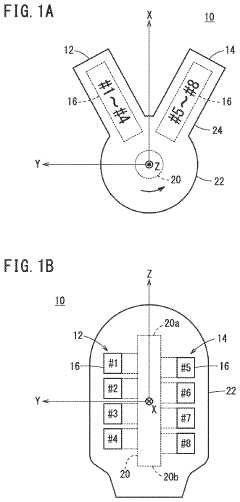
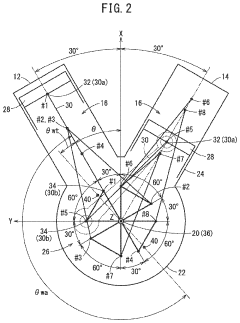
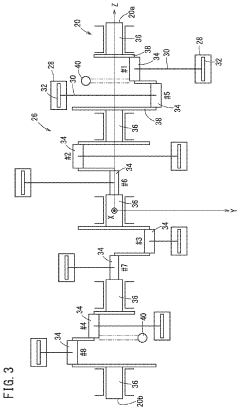
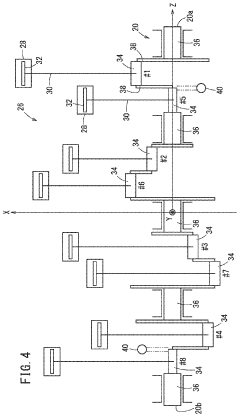
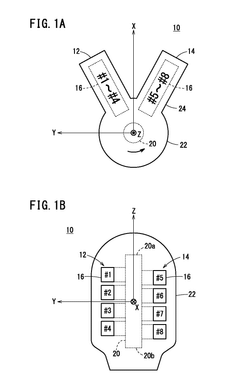
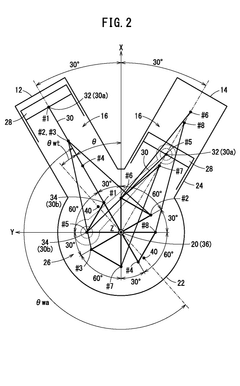
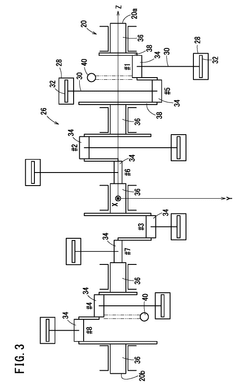
- The V8 engine configuration features crank pins arranged at 90° intervals on one bank and offset by 60° on the other bank, allowing for cancellation of primary inertia couples without additional specialized parts by optimizing the arrangement of crank pins and connecting rods.
V8 engine
PatentWO2021171405A1
Innovation
- The engine is configured with a 60° bank angle, where crank pins on one bank are arranged at 90° intervals and offset by 60° from the other bank, allowing for cancellation of the primary inertia couple without additional special parts, and the ignition timing is set to achieve balanced explosions similar to conventional V8 engines.

Emissions Regulations Impact
Emissions regulations have become a critical factor in shaping the development and optimization of V8 engines, particularly in the pursuit of maximizing output power. As governments worldwide implement increasingly stringent emissions standards, engine manufacturers face the challenge of balancing performance with environmental compliance.
The impact of these regulations on V8 engine strategies is multifaceted. Firstly, they have driven the adoption of advanced fuel injection systems and combustion technologies. Direct fuel injection, for instance, has become a standard feature in modern V8 engines, allowing for more precise control over fuel delivery and combustion timing. This not only helps in reducing emissions but also contributes to improved power output and fuel efficiency.
Turbocharging and supercharging technologies have gained prominence as strategies to maintain or increase power output while meeting emissions targets. These forced induction methods allow for smaller displacement engines to produce comparable power to larger naturally aspirated units, effectively reducing overall emissions without sacrificing performance.
The integration of variable valve timing and lift systems has become crucial in optimizing engine performance across different operating conditions. These systems allow for dynamic adjustment of valve operation, enhancing both low-end torque and high-end power while simultaneously improving emissions control.
Exhaust gas recirculation (EGR) systems have been refined and widely implemented to reduce nitrogen oxide emissions. Advanced EGR systems in V8 engines now operate with greater precision, allowing for better emissions control without significantly compromising power output.
The development of more efficient catalytic converters and particulate filters has also been accelerated by emissions regulations. These aftertreatment systems have become more effective in reducing harmful emissions, allowing engine designers to push for higher power outputs while still meeting regulatory requirements.
Cylinder deactivation technology has emerged as another strategy to balance power and emissions. This allows V8 engines to operate on fewer cylinders under light load conditions, significantly improving fuel efficiency and reducing emissions during everyday driving scenarios.
The push for electrification has led to the development of mild hybrid systems for V8 engines. These systems, often incorporating 48-volt electrical architectures, provide additional power and torque while reducing fuel consumption and emissions, particularly in urban driving conditions.
In conclusion, emissions regulations have fundamentally altered the landscape of V8 engine development. While presenting challenges, these regulations have also spurred innovation, leading to more sophisticated and efficient powertrains that deliver impressive performance while meeting stringent environmental standards.
The impact of these regulations on V8 engine strategies is multifaceted. Firstly, they have driven the adoption of advanced fuel injection systems and combustion technologies. Direct fuel injection, for instance, has become a standard feature in modern V8 engines, allowing for more precise control over fuel delivery and combustion timing. This not only helps in reducing emissions but also contributes to improved power output and fuel efficiency.
Turbocharging and supercharging technologies have gained prominence as strategies to maintain or increase power output while meeting emissions targets. These forced induction methods allow for smaller displacement engines to produce comparable power to larger naturally aspirated units, effectively reducing overall emissions without sacrificing performance.
The integration of variable valve timing and lift systems has become crucial in optimizing engine performance across different operating conditions. These systems allow for dynamic adjustment of valve operation, enhancing both low-end torque and high-end power while simultaneously improving emissions control.
Exhaust gas recirculation (EGR) systems have been refined and widely implemented to reduce nitrogen oxide emissions. Advanced EGR systems in V8 engines now operate with greater precision, allowing for better emissions control without significantly compromising power output.
The development of more efficient catalytic converters and particulate filters has also been accelerated by emissions regulations. These aftertreatment systems have become more effective in reducing harmful emissions, allowing engine designers to push for higher power outputs while still meeting regulatory requirements.
Cylinder deactivation technology has emerged as another strategy to balance power and emissions. This allows V8 engines to operate on fewer cylinders under light load conditions, significantly improving fuel efficiency and reducing emissions during everyday driving scenarios.
The push for electrification has led to the development of mild hybrid systems for V8 engines. These systems, often incorporating 48-volt electrical architectures, provide additional power and torque while reducing fuel consumption and emissions, particularly in urban driving conditions.
In conclusion, emissions regulations have fundamentally altered the landscape of V8 engine development. While presenting challenges, these regulations have also spurred innovation, leading to more sophisticated and efficient powertrains that deliver impressive performance while meeting stringent environmental standards.
V8 Efficiency Optimization
V8 engine efficiency optimization is a critical aspect of maximizing output power in high-performance vehicles. This process involves a multifaceted approach that combines advanced engineering techniques with cutting-edge technologies to extract the maximum potential from the engine while maintaining reliability and fuel efficiency.
One of the primary strategies for optimizing V8 efficiency is through the implementation of variable valve timing (VVT) systems. These systems allow for precise control over valve opening and closing times, optimizing airflow into the combustion chamber across different engine speeds and load conditions. By adjusting valve timing, VVT systems can improve both low-end torque and high-end power, resulting in a more responsive and efficient engine overall.
Another key area of focus is the reduction of internal friction within the engine. This can be achieved through the use of advanced materials and coatings on engine components, such as low-friction piston rings and cylinder liners. Additionally, the implementation of roller finger followers in the valvetrain can significantly reduce friction compared to traditional sliding contact followers, leading to improved efficiency and power output.
Fuel injection technology plays a crucial role in V8 efficiency optimization. Direct fuel injection systems, which deliver fuel directly into the combustion chamber, offer precise control over fuel delivery and atomization. This results in more complete combustion, improved fuel efficiency, and increased power output. Furthermore, the cooling effect of direct injection allows for higher compression ratios, further enhancing engine performance.
Turbocharging and supercharging are widely employed techniques for boosting V8 engine output. These forced induction systems increase the amount of air entering the combustion chamber, allowing for more fuel to be burned and thus generating more power. Modern turbocharging systems often utilize twin-scroll or variable geometry designs to minimize turbo lag and provide a broader power band.
Advanced engine management systems and electronic control units (ECUs) play a vital role in optimizing V8 efficiency. These sophisticated computers continuously monitor and adjust various engine parameters in real-time, ensuring optimal performance across all operating conditions. Machine learning algorithms are increasingly being integrated into these systems, allowing for adaptive optimization based on driving patterns and environmental factors.
Thermal management is another critical aspect of V8 efficiency optimization. Techniques such as precision cooling, which targets specific areas of the engine block and cylinder heads, help maintain optimal operating temperatures and prevent power-robbing heat soak. Additionally, the use of advanced heat-resistant materials in exhaust systems can improve scavenging and reduce back pressure, further enhancing engine efficiency.
One of the primary strategies for optimizing V8 efficiency is through the implementation of variable valve timing (VVT) systems. These systems allow for precise control over valve opening and closing times, optimizing airflow into the combustion chamber across different engine speeds and load conditions. By adjusting valve timing, VVT systems can improve both low-end torque and high-end power, resulting in a more responsive and efficient engine overall.
Another key area of focus is the reduction of internal friction within the engine. This can be achieved through the use of advanced materials and coatings on engine components, such as low-friction piston rings and cylinder liners. Additionally, the implementation of roller finger followers in the valvetrain can significantly reduce friction compared to traditional sliding contact followers, leading to improved efficiency and power output.
Fuel injection technology plays a crucial role in V8 efficiency optimization. Direct fuel injection systems, which deliver fuel directly into the combustion chamber, offer precise control over fuel delivery and atomization. This results in more complete combustion, improved fuel efficiency, and increased power output. Furthermore, the cooling effect of direct injection allows for higher compression ratios, further enhancing engine performance.
Turbocharging and supercharging are widely employed techniques for boosting V8 engine output. These forced induction systems increase the amount of air entering the combustion chamber, allowing for more fuel to be burned and thus generating more power. Modern turbocharging systems often utilize twin-scroll or variable geometry designs to minimize turbo lag and provide a broader power band.
Advanced engine management systems and electronic control units (ECUs) play a vital role in optimizing V8 efficiency. These sophisticated computers continuously monitor and adjust various engine parameters in real-time, ensuring optimal performance across all operating conditions. Machine learning algorithms are increasingly being integrated into these systems, allowing for adaptive optimization based on driving patterns and environmental factors.
Thermal management is another critical aspect of V8 efficiency optimization. Techniques such as precision cooling, which targets specific areas of the engine block and cylinder heads, help maintain optimal operating temperatures and prevent power-robbing heat soak. Additionally, the use of advanced heat-resistant materials in exhaust systems can improve scavenging and reduce back pressure, further enhancing engine efficiency.
Unlock deeper insights with PatSnap Eureka Quick Research — get a full tech report to explore trends and direct your research. Try now!
Generate Your Research Report Instantly with AI Agent
Supercharge your innovation with PatSnap Eureka AI Agent Platform!