
A Crowdsourcing Annotation Data Integration Method Based on Task Difficulty and Annotator Ability
A crowdsourced labeling and data integration technology, applied in the field of crowdsourced labeling data integration based on task difficulty and the ability of labelers, can solve problems such as lack of task difficulty, accuracy deviation, and labeler evaluation deviation, and achieve convenient difficulty Accurate evaluation, labeling results, and ability to evaluate objectively and accurately
- Summary
- Abstract
- Description
- Claims
- Application Information
AI Technical Summary
Problems solved by technology
Method used
Image


Examples
Embodiment Construction
[0040] In order to describe the present invention more specifically, the technical solutions of the present invention will be described in detail below in conjunction with the accompanying drawings and specific embodiments.
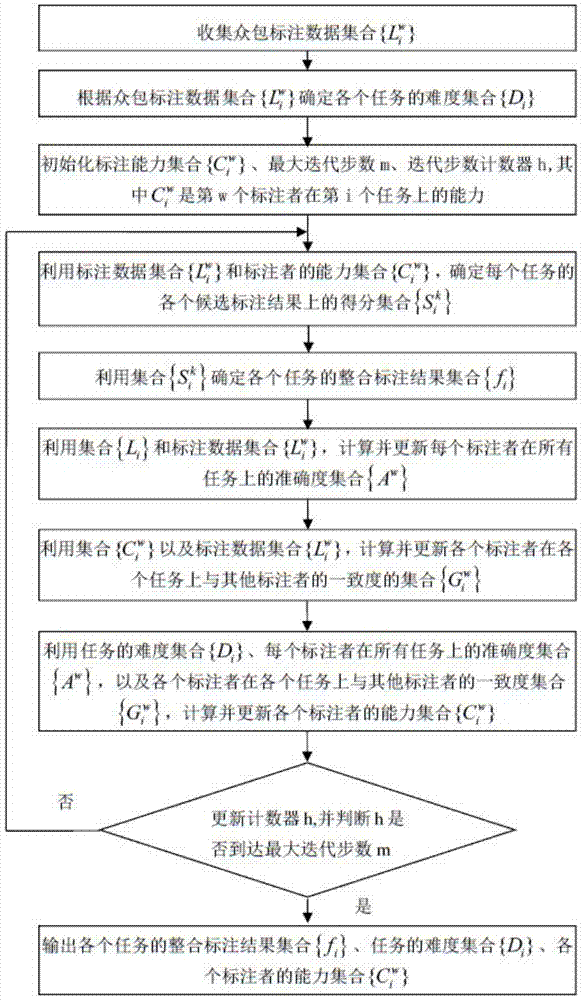
[0041] The flow process of the inventive method is as figure 1 As shown, it specifically includes the following steps:
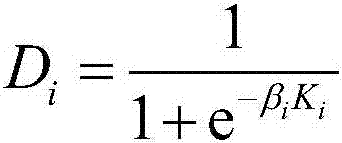
[0042] Step (1): The assessment of task difficulty is from the collected labeled data set Find the difficulty set of all tasks {D i |i∈[1,a]}; where is the tagging result of the i-th task by the w-th tagger, D i Indicates the difficulty of the i-th task, a is the total number of tasks, and W is the total number of annotators. The method is described below taking the difficulty of the i-th task as an example, and the steps are as follows:
[0043] 1-1: Collect the collected annotation data Perform statistics to obtain the number K of the types of labeling results made by all labelers for the i-th task i , and the proportion set ...
PUM
 Login to View More
 Abstract
Description
Claims
Application Information
 Login to View More