
Troponin based rule-in and rule-out algorithm of myocardial infarction
a myocardial infarction and rule-in algorithm technology, applied in the field of myocardial infarction rule-in and rule-out algorithm, can solve the problems of death and disability, low sensitivity of standard cardiac troponin assays at the time of patient's presentation, and insufficient diagnosis of electrocardiography (ecg) by itsel
- Summary
- Abstract
- Description
- Claims
- Application Information
AI Technical Summary
Benefits of technology
Problems solved by technology
Method used
Image

Examples
example 1
Methods
Study Design and Population
[0180]Advantageous Predictors of Acute Coronary Syndrome Evaluation (APACE) is an ongoing prospective international multicenter study designed and coordinated by the University Hospital Basel Reichlin T, Hochholzer W, Bassetti S, et al. Early diagnosis of myocardial infarction with sensitive cardiac troponin assays. N Engl J Med 2009; 361:858-67, Reichlin T, Hochholzer W, Stelzig C, et al. Incremental value of copeptin for rapid rule-out of acute myocardial infarction. J Am Coll Cardiol 2009; 54:60-8). From April 2006 to June 2009, a total of 1247 consecutive patients presenting to the emergency department (ED) with acute chest pain symptoms suggestive of AMI such as acute chest pain and angina pectoris with an onset or peak within the last 12 hours were recruited. Patients with terminal kidney failure requiring dialysis were excluded. The study was carried out according to the principles of the Declaration of Helsinki and approved by the local ethi...
example 2
Results
Characteristics of Patients
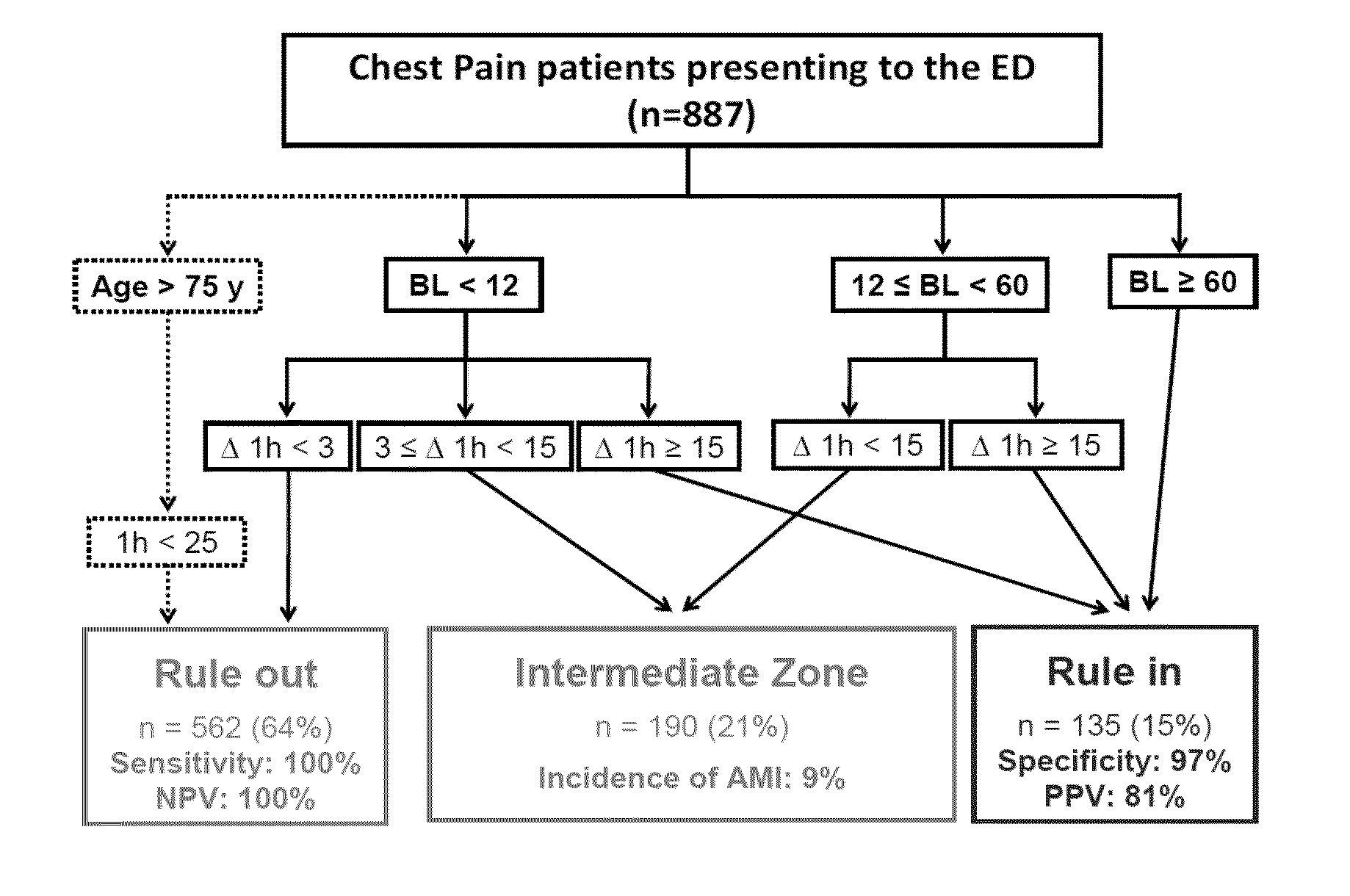
[0192]Among the 887 patients presenting to the ED with acute chest pain, the adjudicated final diagnosis was AMI in 127 patients (14%), unstable angina (UA) in 125 (14%), cardiac symptoms of origin other than coronary artery disease in 124 (14%), non-cardiac symptoms in 437 (49%), and symptoms of unknown origin in 74 (8%). Of the AMI patients, 88% had non-ST-elevation myocardial infarction (NSTEMI) and 12% had ST-elevation myocardial infarction (STEMI). Baseline characteristics of the patients are shown in Table 1.
Diagnostic Information Provided by hs-cTnT Baseline Levels
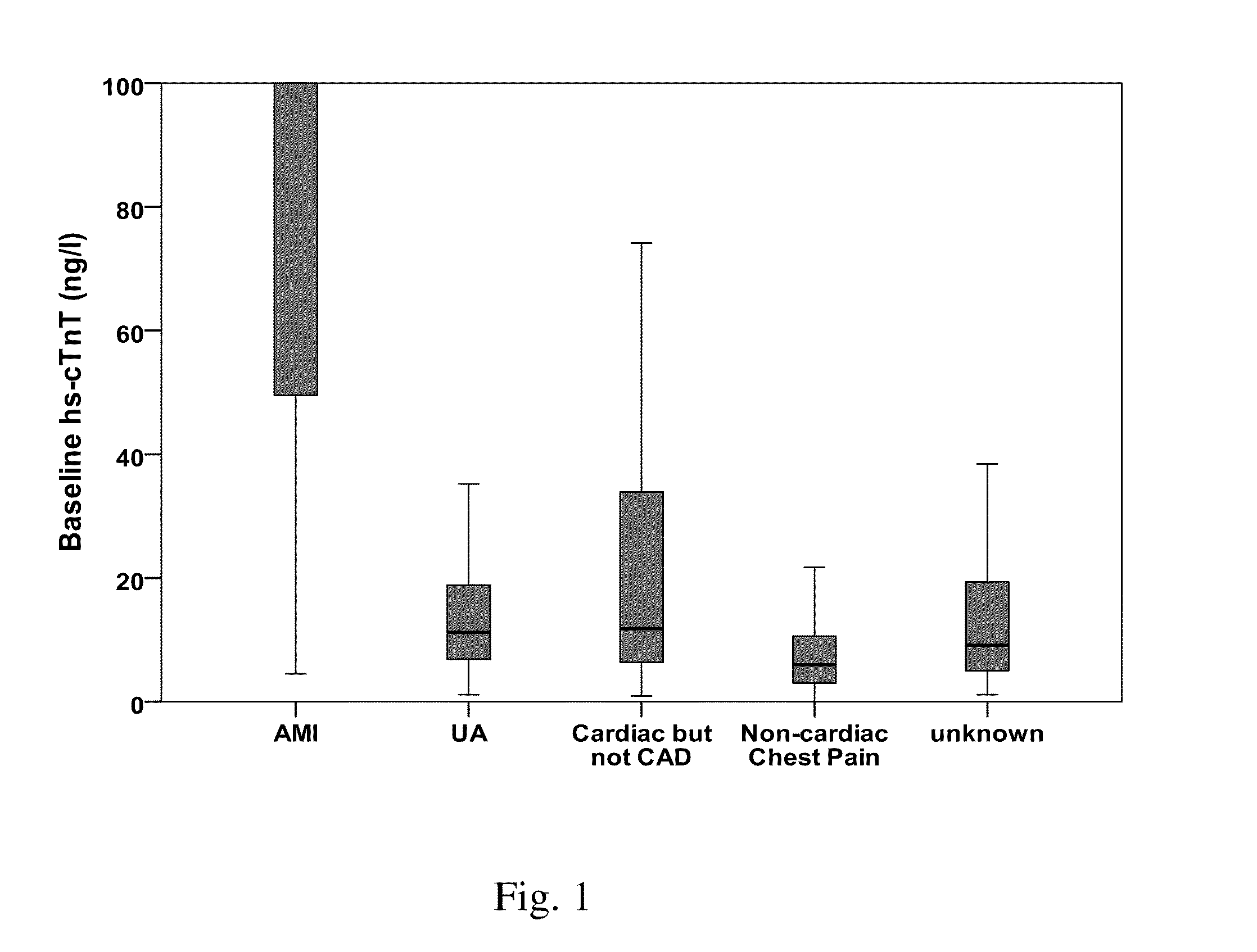
[0193]Baseline levels of hs-cTnT were significantly higher in patients with AMI as compared to the other final diagnoses (FIG. 1). Baseline values were similar in men and women, (median in men 9.1 ng / l, 95% CI 4.6-21.8 ng / l vs. median in women 8.5 ng / l, 95% CI 3.8-20.6 ng / l, p=0.40), but significantly higher in patients 75 years of age or older compared to those younger than 75 year...
PUM
 Login to View More
 Abstract
Description
Claims
Application Information
 Login to View More