
Information browsing and retrieval method based on semantic entity-relationship model and visualized recommendation
A technology of entity relationship and information browsing, applied in the service field
Patent Information
- Authority / Receiving Office
- CN · China
- Patent Type
- Patents(China)
- Current Assignee / Owner
- Publication Date
- 2012-08-22
- Estimated Expiration
- Not applicable · inactive patent
Smart Images
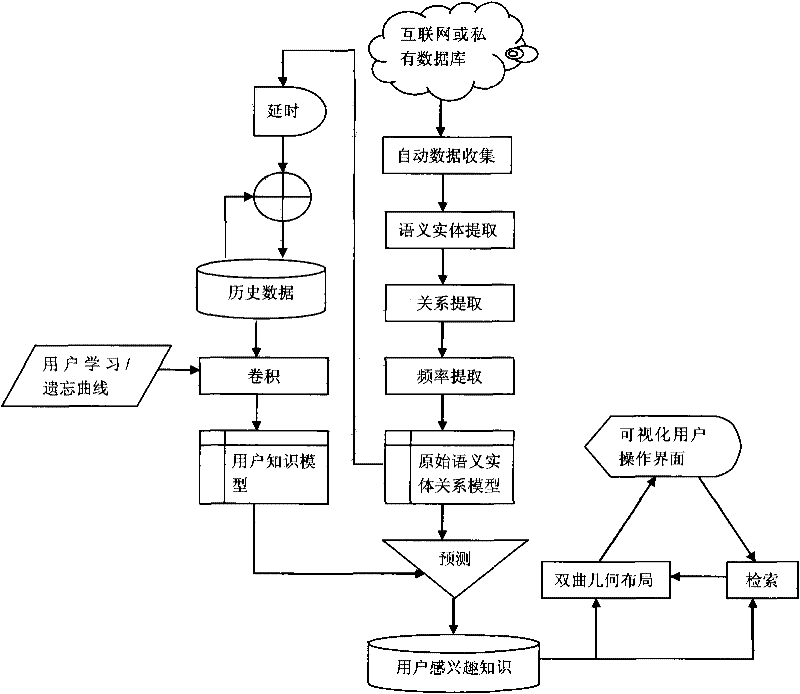
Figure 1 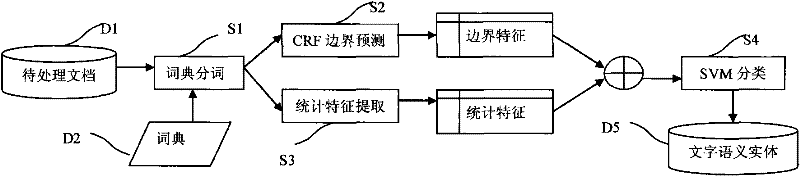
Figure 2 
Figure 3
Abstract
Description
Technical field
[0001] The invention relates to a novel mass information browsing and retrieving technology based on a semantic entity relationship model and visual recommendation, which is used for realizing services such as mass unstructured information browsing and retrieval. Background technique
[0002] There is a wealth of information hidden in massive unstructured data (for example: the Internet). This information can provide data owners with valuable intelligence in many ways. For example, national security agencies can analyze their true attitudes toward my country from news reports in other countries, companies can detect abnormal transactions from their own business data to prevent losses from expanding, and so on. However, this information is deeply hidden in a large amount of data. To obtain this information, users must browse through the data they possess and dig out the parts they are interested in. Because the amount of data is so large, it is impossible to man...
Examples
Embodiment
[0037] Such as figure 1 As shown, it is a flowchart of a method for information browsing and retrieval based on a semantic entity relationship model and visual recommendation provided by the present invention. The steps are as follows:
[0038] Step 1. Collect data regularly from the Internet or private databases. The data that users are interested in may come from the Internet or a private database, or a combination of the two. Therefore, an automatic data collection device is first used to obtain new data from the Internet or a private database on a regular basis.
[0039] Step 2. Extract semantic entities and relationships from the document data, audio data or visual data obtained in Step 1, so as to convert the data into a form represented by semantic entities and relationships. This step can be divided into the extraction of semantic entities and the extraction of relations.
[0040] For the extraction of semantic entities:
[0041] A semantic entity is defined as any entity tha...