
Method for identifying flow type of soft grain two-phase turbulence based on artificial intelligence
A flow pattern recognition and artificial intelligence technology, applied in neural learning methods, flow characteristics, biological neural network models, etc., can solve the problems of poor applicability, low reliability, low accuracy, etc., to improve efficiency and accuracy, The effect of reducing costs and reducing subjectivity factors
Patent Information
- Authority / Receiving Office
- CN · China
- Current Assignee / Owner
- Publication Date
- 2011-03-09
Smart Images
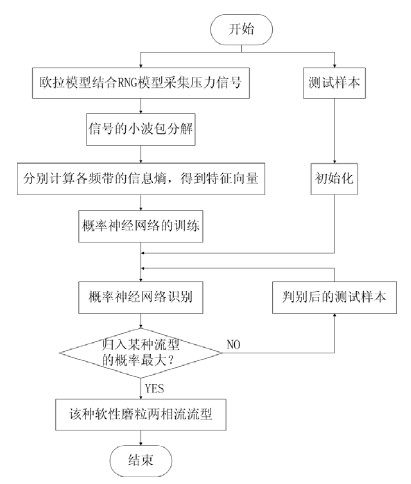
Figure 1 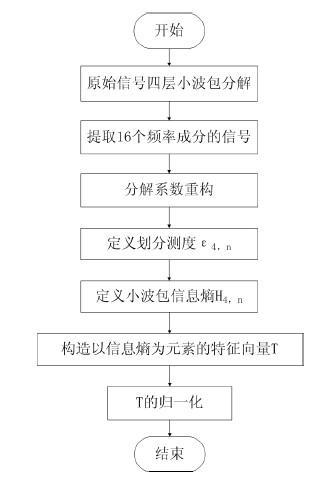
Figure 2 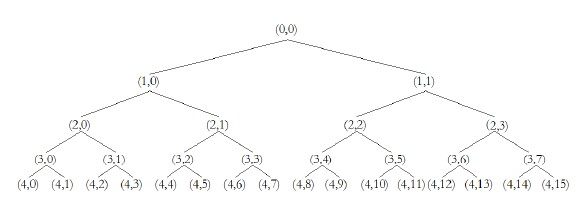
Figure 3
Abstract
Description
technical field
[0001] The invention relates to a two-phase flow flow pattern recognition method, more specifically, an artificial intelligence-based soft abrasive particle two-phase turbulent flow pattern recognition method. Background technique
[0002] The flow pattern (characterizing the flow form of the fluid) can be divided into laminar flow, turbulent flow and transition flow in between. It represents the trajectory and velocity distribution of fluid particle motion. The laminar flow pattern in the circular tube is a parabolic velocity distribution; the velocity distribution of the turbulent flow pattern obeys the Karman-Prand 1 / 7 exponential law. The two-phase flow pattern also characterizes the phase interface distribution of the two-phase flow medium. At present, two-phase flow conditions are involved in many production equipment in power, chemical, nuclear energy, refrigeration, petroleum and metallurgy industries, and even have applications in the precision mac...
Examples
Embodiment Construction
[0032] In conjunction with the accompanying drawings, the present invention will be described in detail below.
[0033] refer to Figure 1~Figure 6 , an artificial intelligence-based identification method for two-phase turbulent flow patterns of soft abrasive particles. By using the simulation technology combined with the Euler model and the renormalization group (RNG) bi-equation model, the two-phase turbulent flow reflecting soft abrasive particles can be obtained. The objective mathematical description of various flow pattern characteristics and the change law of characteristic parameters in the process of flow pattern transformation, according to the quantitative analysis of wavelet packets, use the characteristic vector formed by the obtained parameters to input the probability neural network (PNN) for training and recognition, and realize the turbulent flow. Type objective identification and classification. It generally includes the collection of soft abrasive two-phase...