

Amion thiazolidone compound, method for preparing same and application thereof in preparing antitumor drugs
A technology of aminothiazolidinone and compound, applied in the field of medicinal chemistry, can solve the problem that there is still no effective inhibition of Plk1
Patent Information
- Authority / Receiving Office
- CN · China
- Patent Type
- Applications(China)
- Current Assignee / Owner
- Publication Date
- 2012-07-18
Smart Images
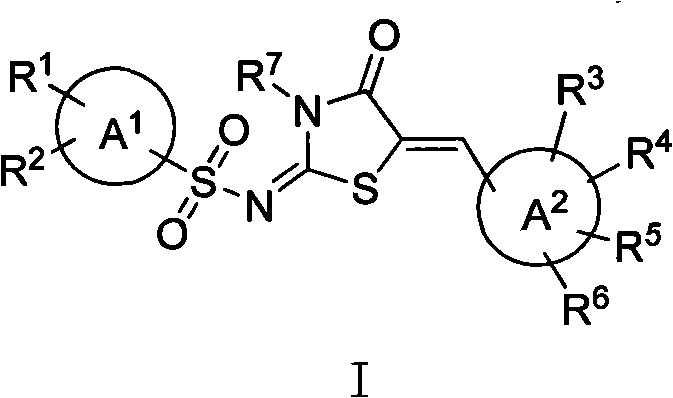
Figure 1 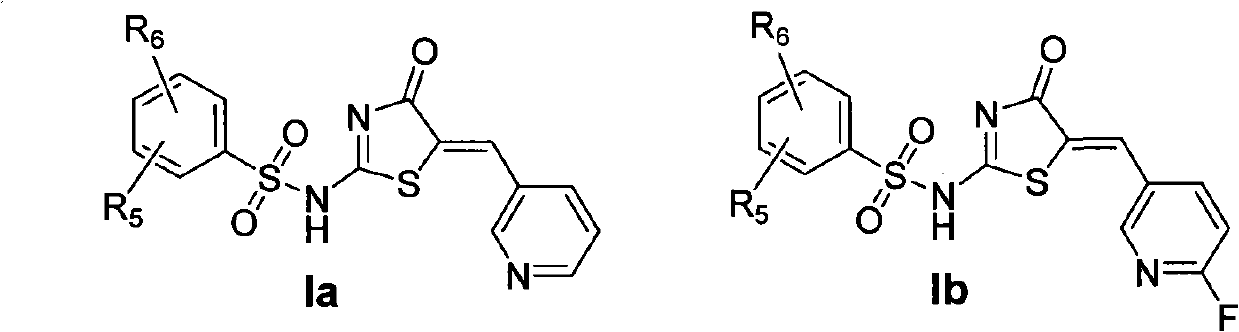
Figure 2 
Figure 3
Abstract
Description
technical field
[0001] The invention relates to medicinal chemistry, in particular to an aminothiazolidinone compound, its preparation method and its application in the preparation of antitumor drugs. Background technique
[0002] Polo-like kinase (Plk) belongs to the family of serine-threonine kinases, which exist in various eukaryotes from yeast to mammals. Polo-like kinases in mammals include four proteins, Plk1, Plk2, Plk3 and Plk4, among which Plk1 protein performs most of the functions of Polo, Cdc5 and Plo3 (Barr, Sillje et al 2004 Nat.Rev.Mol.Cell Beol. 5, 429-440). The human Plk1 gene was first cloned and reported by Golsteyn et al. in 1994. It is located at 16p12, the mRNA is about 2.3kb long, and the molecular weight of the encoded protein is about 68kD. Extensive research in the past 10 years has shown that Plk1 is overexpressed in many malignant tumors, and it is related to the occurrence, biological behavior and prognosis of tumors. The role of Plk1 in promo...
Examples
Embodiment 1
[0062] The preparation of embodiment 1 intermediate 2-amino-5-(3-pyridine methylene)-4(5H)-thiazolone
[0063] To a suspension of 13.4 g (125 mmol) of 3-pyridinecarbaldehyde and 9.67 g (83.36 mmol) of thiazolamine in 60 mL of acetic acid was added 5.2 g (58.4 mmol) of alanine at room temperature. The suspension was heated at 100°C for 4 hours. Then the suspended solid was filtered and the filter cake was washed with a small amount of acetic acid and then washed with water, and dried in vacuum (40°C, 10mmHg) to obtain white 2-amino-5-(3-pyridylmethylene)-4(5H)- Thiazolone solid (16 g, yield: 62.5%).
Embodiment 2
[0064] Example 2 The preparation method of the intermediate 2-amino-5-(3-(5-fluoropyridyl)methylene)-4(5H)-thiazolone is the same as that of Example 1. 3-(5-Fluoropyridine)carbaldehyde was used as starting material.
Embodiment 3
[0065] Example 3 The preparation method of the intermediate 2-amino-5-(3-(2,4-dimethoxypyridine)methylene)-4(5H)-thiazolone is the same as that of Example 1. 3-(2,4-dimethoxypyridine)carbaldehyde was used as starting material.