
Method for recycling used lead-acid batteries in full circulation mode
A lead-acid battery, recycling technology, applied in battery recycling, recycling technology, recycling by waste collectors, etc., can solve the problems of waste of rare metals, incomplete desulfurization, increased energy consumption, etc., to improve recovery rate and avoid equipment Loss and environmental pollution, the effect of easy operation
Patent Information
- Authority / Receiving Office
- CN · China
- Patent Type
- Applications(China)
- Current Assignee / Owner
- Publication Date
- 2014-05-14
- Estimated Expiration
- Not applicable · inactive patent
Smart Images
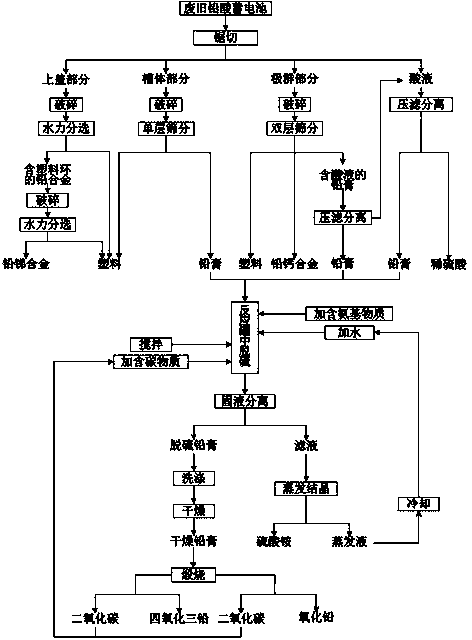
Figure 1 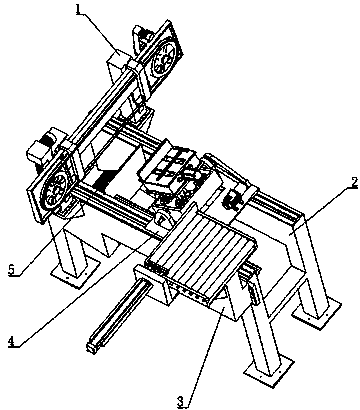
Figure 2 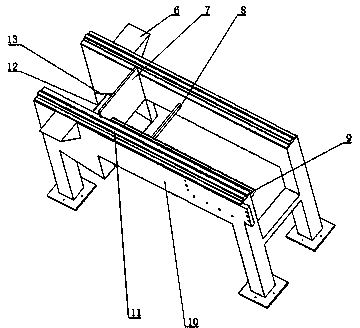
Figure 3
Abstract
Description
technical field
[0001] The invention belongs to the technical field of waste lead-acid battery treatment. In particular, it relates to a method for full-cycle recovery and treatment of waste lead-acid batteries. Background technique
[0002] Lead-acid battery is the battery with the largest output and the widest usage among all kinds of batteries in the world, and its lead consumption accounts for 82% of the total lead consumption in the world. With the increasing use of lead-acid batteries, the shortage of lead resources and the huge harm caused by a large number of waste lead-acid batteries to the surrounding environment have become problems that need to be solved urgently. Therefore, the centralized recycling of waste lead-acid batteries, the extraction of secondary lead and its oxides, and the realization of full recycling have great economic and social benefits, and also meet the basic requirements of sustainable development strategies.
[0003] At present, the advanc...
Examples
Embodiment 1
[0066] A method for full-cycle recycling and processing waste lead-acid batteries. The specific steps are as figure 1 shown:
[0067] Step 1. Sawing
[0068] Using "a band sawing machine for cutting waste lead-acid batteries", the waste lead-acid batteries to be recycled are first cut into the upper cover part, the tank body part, the pole group part and the acid solution, and then the process is carried out.
[0069] Step 1. First, crush the sawed upper cover to a particle size of 50-100 mm, and then perform hydraulic separation to obtain lead alloy and plastic containing plastic rings; then crush the lead alloy containing plastic rings to a particle size of 15 ~30mm, and then perform hydraulic separation to obtain plastic and lead-antimony alloy.
[0070] Step 2: Crushing the sawed groove body to a particle size of 15-50 mm, and then sieving through a single-layer vibrating screen to obtain lead paste and plastic.
[0071] Step 3: Crushing the sawed pole group to a parti...
Embodiment 2
[0094] A method for full-cycle recycling and processing of waste and old lead-acid batteries, the specific steps of which are as follows: figure 1 shown:
[0095] Step 1 is the same as Step 1 of Embodiment 1.
[0096] Step 2, lead paste treatment
[0097] The lead paste obtained in step 1 is added to the reaction tank, and then the amino-containing substance is added, and the ratio of the amount of the lead sulfate in the lead paste to the amount of the amino-containing substance in the amino-containing substance is 1: (6~10); then add water to adjust the liquid Solid ratio to (5~10): 1, stir at room temperature for 2~5h, finally add carbonaceous material for desulfurization, desulfurization time is 5~10h, solid-liquid separation, obtain desulfurization lead paste and filtrate; desulfurization lead paste and filtrate are obtained; The paste is washed until neutral, and the washed desulfurized lead paste is dried at 80 to 120°C for 1 to 12 hours to obtain dry lead paste.
[...