
Non-reference image quality objective evaluation method based on deep learning
A technology for objective quality evaluation and reference images, applied in image analysis, image communication, image data processing, etc., can solve the problems that classic deep learning models cannot directly apply image quality evaluation, are not accurate enough, and have high time complexity
Patent Information
- Authority / Receiving Office
- CN · China
- Patent Type
- Applications(China)
- Current Assignee / Owner
- Publication Date
- 2015-12-30
Smart Images
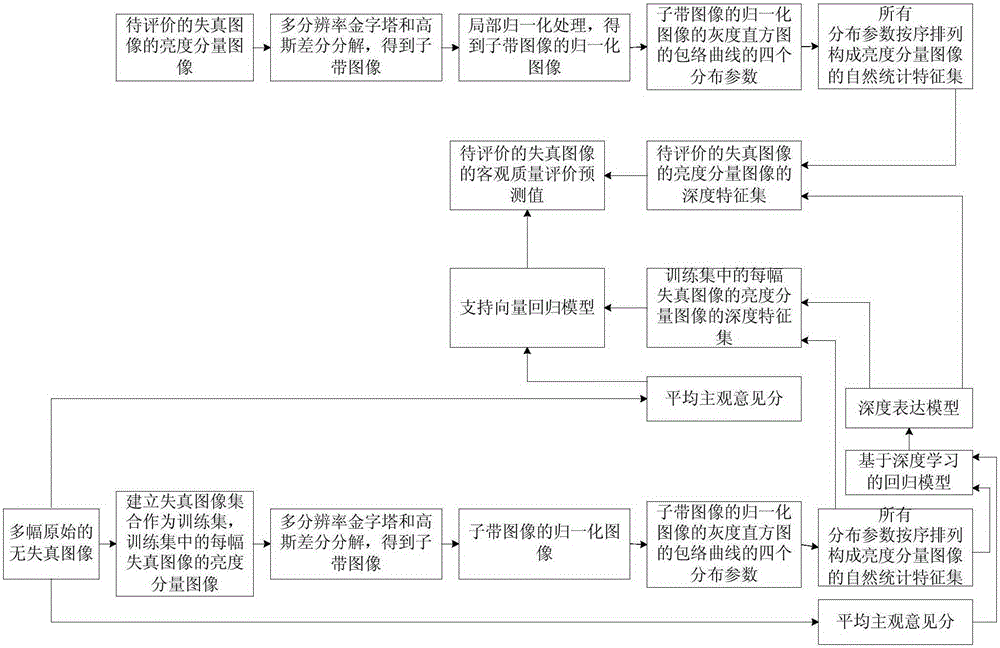
Figure 1 
Figure 2 
Figure 3
Abstract
Description
technical field
[0001] The present invention relates to an image quality evaluation method, in particular to an objective evaluation method of image quality without reference based on deep learning. Background technique
[0002] Image quality assessment (image quality assessment, IQA) is an indispensable part in many image processing applications. The objective image quality evaluation model is an algorithm that can automatically predict the degree of image distortion, and is usually used to monitor multimedia services to ensure that end users obtain satisfactory quality of experience. According to whether the original reference image is available, objective image quality assessment can usually be divided into three categories, namely full reference image quality assessment, semi-reference image quality assessment, and blind image quality assessment (BIQA). The no-reference image quality assessment method, which can predict the perceived quality of an image without a refere...
Examples
Embodiment Construction
[0027] The present invention will be further described in detail below in conjunction with the accompanying drawings and embodiments.
[0028] Since reference images cannot be obtained in many applications, the no-reference image quality assessment method is the most practical and challenging research topic, and the traditional no-reference image quality assessment has high computational complexity and time complexity, while the agreement between the objective quality of predictions and subjective perception is poor. The present invention extracts natural statistical features in the spatial domain by decomposing images, and the time complexity is very low. At the same time, multi-resolution pyramid and Gaussian difference decomposition can be used to perform multi-resolution analysis and multi-scale texture analysis on images, thereby extracting better natural statistics. feature; before the traditional shallow learning algorithm returns, the present invention adds a deep expr...