
Method for culturing selectable-marker-free herbicide-resistant transgenic plant and carrier special for method
A herbicide-resistant gene and selectable marker technology, applied in the biological field, can solve problems affecting the environment, human health and safety, and achieve obvious resistance effects
Patent Information
- Authority / Receiving Office
- CN · China
- Patent Type
- Applications(China)
- Current Assignee / Owner
- Publication Date
- 2016-03-23
- Estimated Expiration
- Not applicable · inactive patent
Smart Images
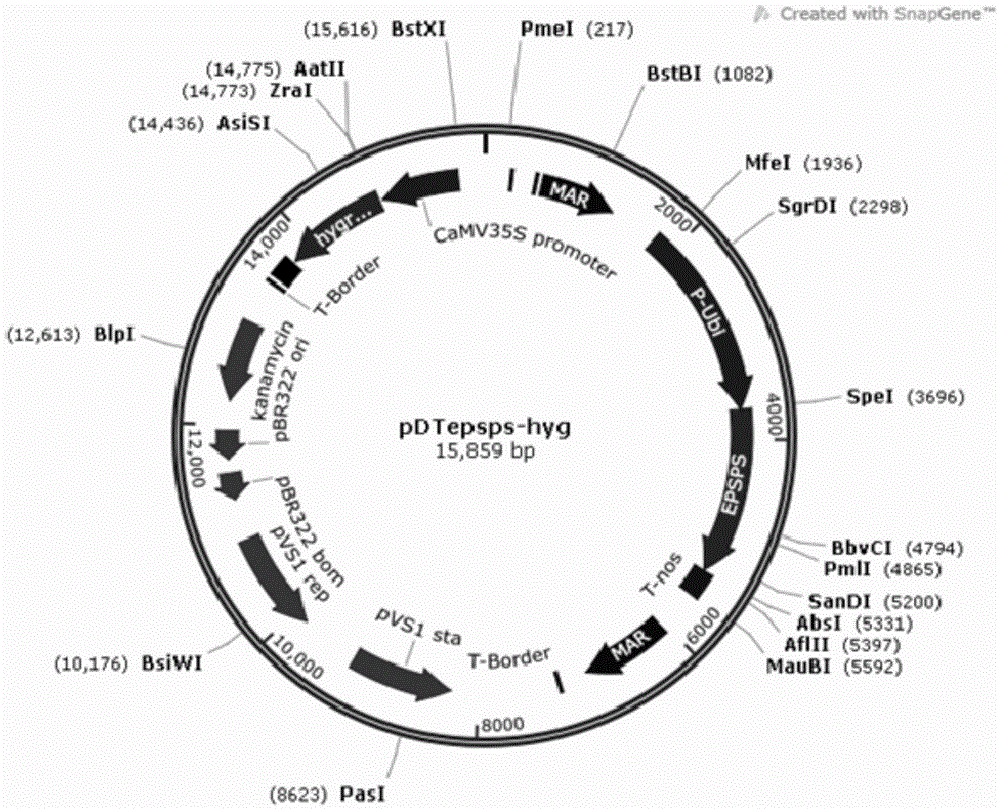
Figure 1 
Figure 2 
Figure 3
Abstract
Description
Technical field
[0001] The invention relates to the field of biotechnology, in particular to a method for cultivating a selection marker-free herbicide-resistant transgenic plant and its special carrier. Background technique
[0002] Since the world's first genetically modified tobacco (Nicotianatabacum) was successfully planted in the United States in 1983 (Zambryskitetal., 1983), the area of genetically modified crops has continued to increase. As of 2014, the planting area of genetically modified crops in 28 countries around the world was 181.5 million hectares, an increase of 6.3 million hectares from 175.2 million hectares in 2013, with an annual growth rate of 3% to 4%. The herbicide-resistant traits of genetically modified crops have made a huge contribution to global food, feed and fiber production since they were commercialized in 1996. In 2014, the herbicide-resistant traits were applied to corn, rice, cotton, rape, and alfalfa alone or in combination. , Eggplant, ...
Examples
Embodiment 1
[0069] Example 1. Obtainment of glyphosate-resistant transgenic rice without selection marker and identification of glyphosate resistance
[0070] 1. Construction of plant expression vector pDTepsps-hyg
[0071] Artificially synthesized plant expression vector pDTepsps-hyg (circular plasmid, shown in sequence 1 in the sequence table) figure 1 ). In Sequence 1 of the Sequence Listing, positions 491-516 from the 5'end are the right border B sequence, positions 563-1309 are the first MAR sequence, positions 1797-3707 are the P-Ubi promoter sequence, and positions 3708 -5351 is the EPSPS gene sequence, 5358-5620 is the T-nos terminator sequence, 6045-6906 is the second MAR sequence, 7182-7207 is the left border B sequence, 13458-13483 is The left border A sequence, positions 13533-13748 are the CaMV35SpolyA terminator sequence, positions 13777-14799 are the hpt gene sequence, positions 14835-15604 are the CaMV35Spromoter sequence, and positions 251-276 are the right border A sequence....