
Fast iterative beam forming method based on compressed sensing
A technology of compressed sensing and beamforming, applied in the direction of space transmit diversity, radio transmission system, electrical components, etc., can solve the problems that the expected effect cannot be achieved, and the hypothesis is invalid.
Patent Information
- Authority / Receiving Office
- CN · China
- Current Assignee / Owner
- Publication Date
- 2016-11-09
Smart Images
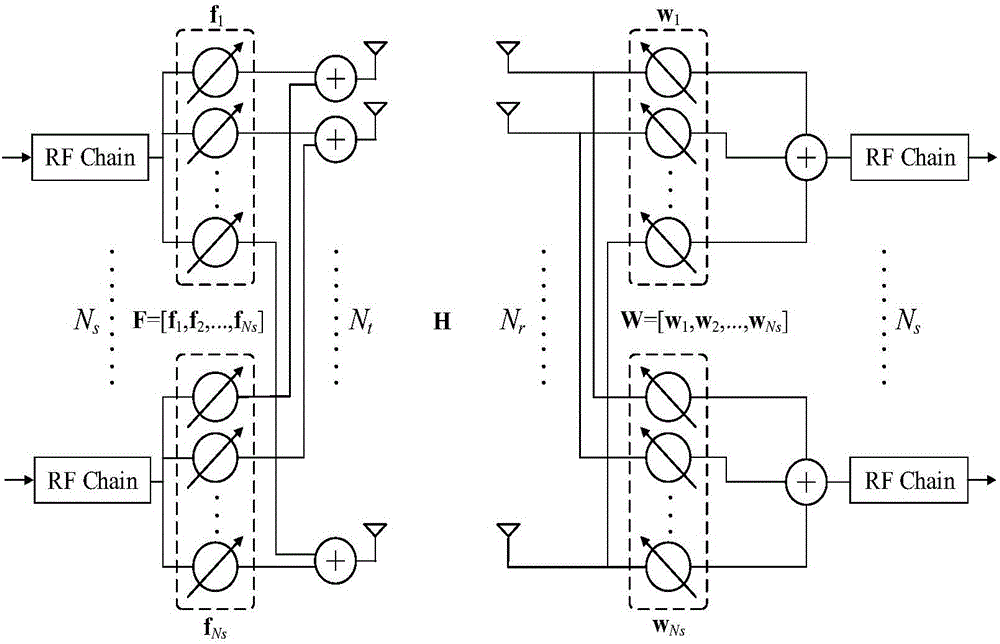
Figure 1 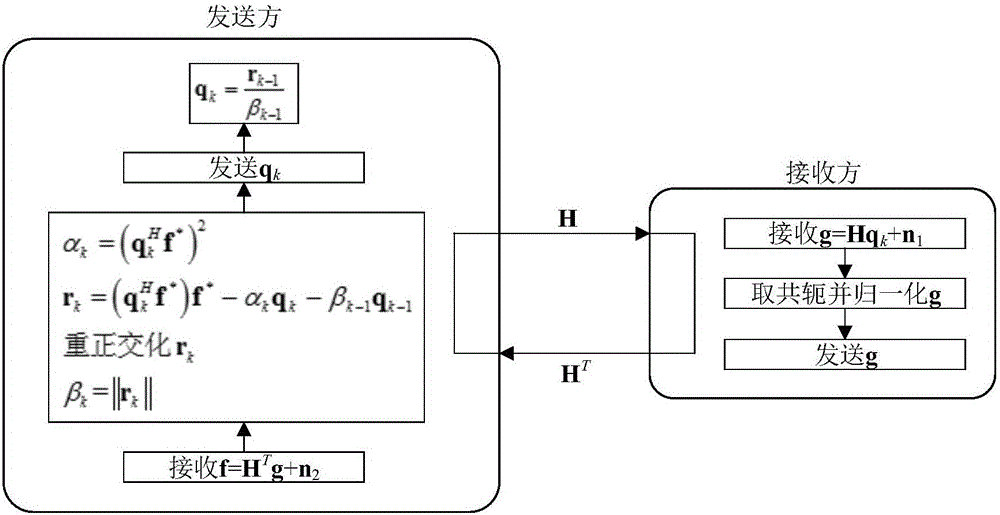
Figure 2 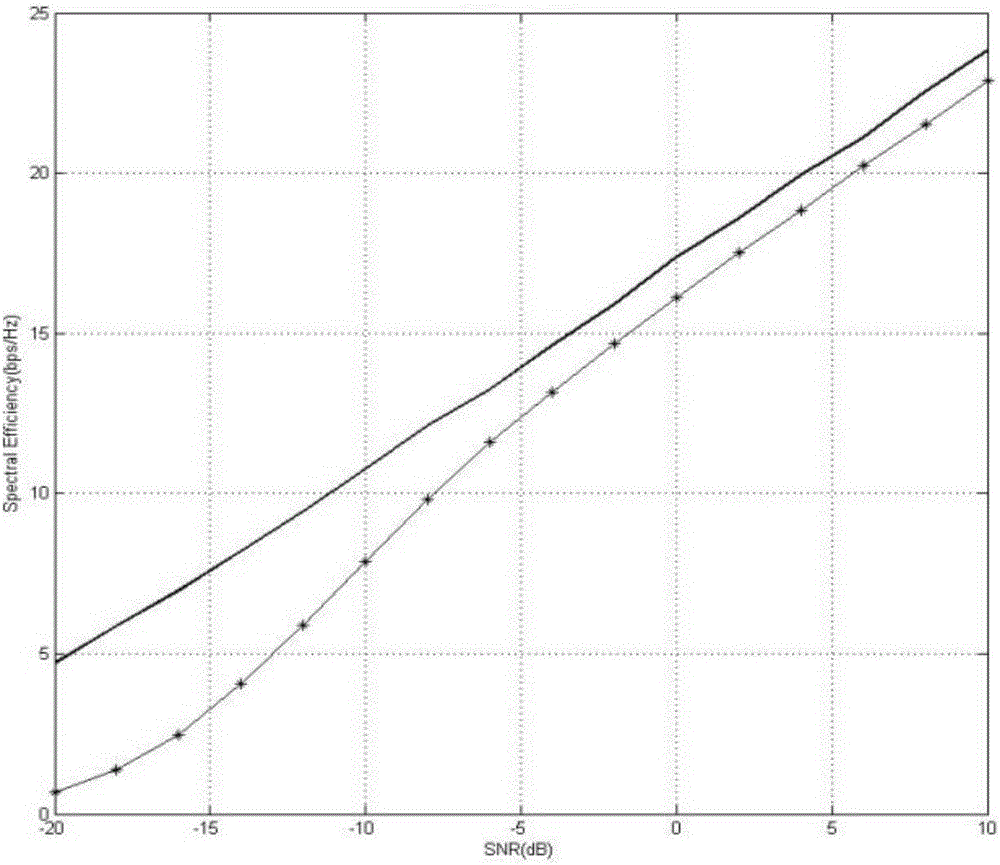
Figure 3
Abstract
Description
technical field
[0001] The present invention belongs to the technical field of wireless communication, and in particular relates to a wireless multiple-input multiple-output (Multiple Input Multiple Output, MIMO) communication system that utilizes the channel reciprocity of a time division duplex system to perform iterations to obtain multiple beamforming simultaneously and rapidly. Methods for singular vectors. Background technique
[0002] In MIMO systems, according to the criterion of maximizing the signal-to-noise ratio at the receiving end, the method to obtain the optimal beamforming matrix is the eigenbeamforming method. When the channel state information (CSI) is known to both the transmitter and receiver, the optimal transmit and receive beamforming matrices can be obtained by decomposing the channel matrix H through SVD. The specific principles are described as follows:
[0003] Assume that the number of transmit and receive antennas in the MIMO system is N T ...
Examples
Embodiment
[0053] S1. Define the receiving end dictionary matrix Define the sender dictionary matrix Among them, N represents the length of the dictionary at the receiving end, and M represents the length of the dictionary at the receiving end. The larger the M, the finer the quantization, and the smaller the quantization error;
[0054] S2. Initial stage processing, specifically as follows:
[0055] S21. The sender generates an N T ×1 vector r 0 =[1,0,0,...,0] T , the r 0 The modulus value of is assigned to the variable β 0 : β 0 =||r 0 ||, defines the zero vector q 0 :q 0 =0, define an empty matrix Q for storing the vectors generated in the iterative process: Q=[], where N T is the number of receiving antennas;
[0056] S22, define the measurement times Nmr of the sending end in this process 0 and the number of measurements Nmt at the receiver 0 ;
[0057] S23. Generate an optimal measurement matrix Φ at the sending end T 0 and the optimal measurement matrix Φ at the ...