
A resource indication method and device based on multiple time periods
A time-segment, multi-time technology, applied in the field of communication, can solve the problem of low efficiency of small packet business, achieve efficient resource indication and confirmation, and improve efficiency
Patent Information
- Authority / Receiving Office
- CN · China
- Patent Type
- Patents(China)
- Current Assignee / Owner
- Publication Date
- 2020-05-08
Smart Images

Figure 1 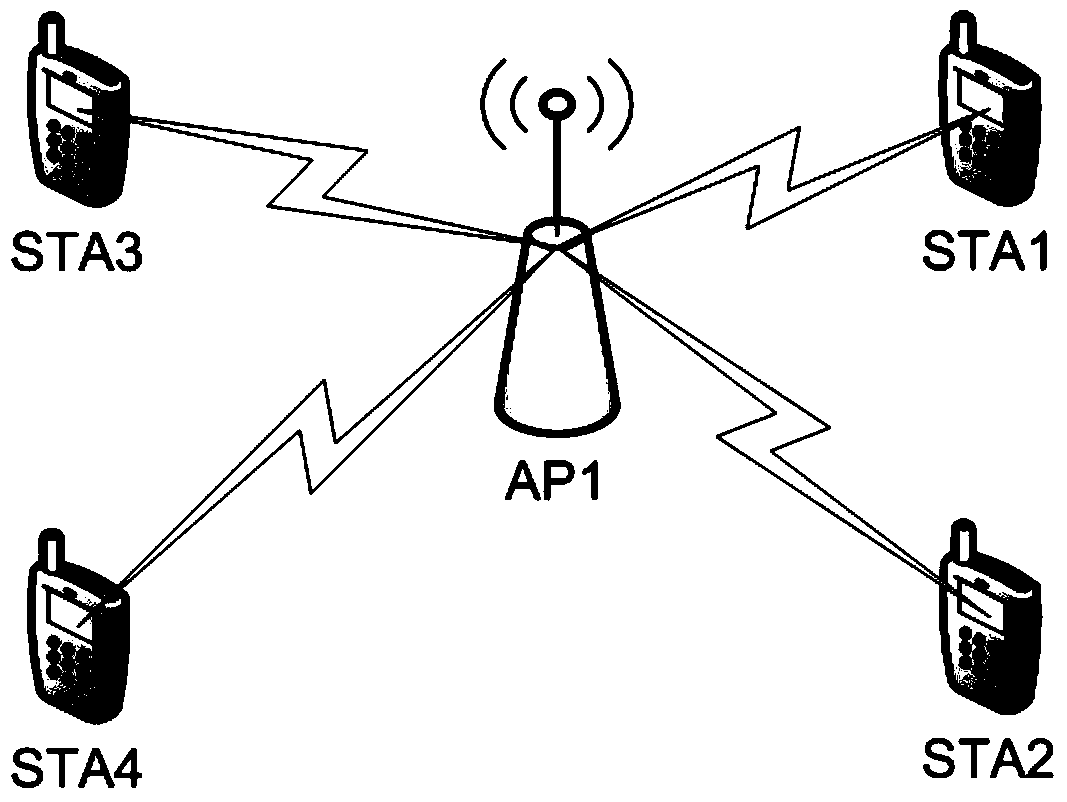
Figure 2 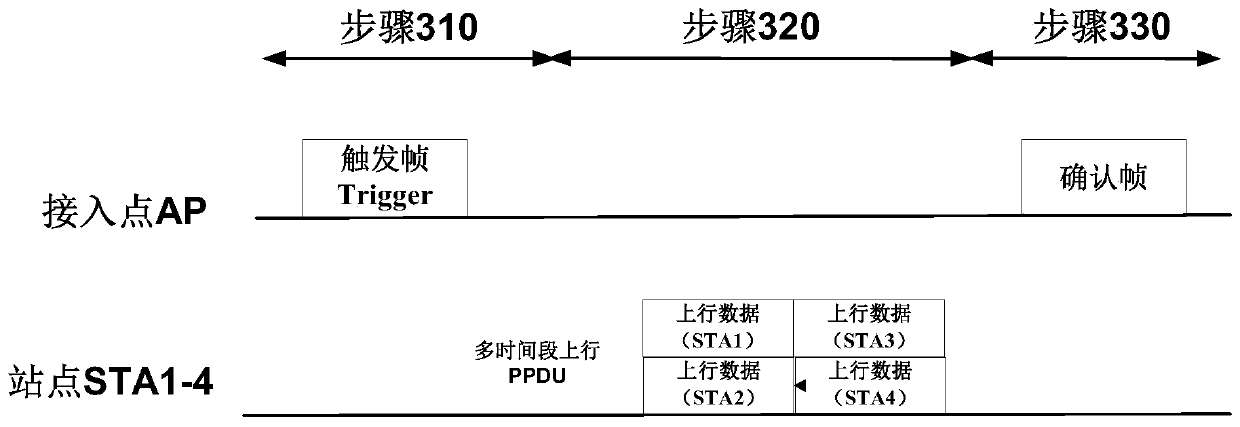
Figure 3
Abstract
Description
technical field
[0001] The invention belongs to the technical field of communication, and in particular relates to a multi-time segment-based resource indication method and device. Background technique
[0002] The existing wireless local area network (English: Wireless local Access Network, referred to as: WLAN) standard based on OFDM (English: Orthogonal Frequency-Division Multiplexing, Chinese: Orthogonal Frequency Division Multiplexing) technology has gradually evolved from 802.11a, 802.11n, 802.11 ac and other versions, currently the IEEE (English: Institute of Electrical and Electronic Engineers, Chinese: Institute of Electrical and Electronics Engineers) 802.11 standard organization has launched a new generation of WLAN standards called HEW (High Efficiency WLAN, high-efficiency wireless local area network) 802.11 ax standardization work, by introducing OFDMA (Orthogonal Frequency Division Multiple Access, Orthogonal Frequency Division Multiple Access) technology, 802...
Examples
Embodiment 1
[0070] Embodiment 1 of the present invention provides a multi-time period resource indication method, which can be applied to access points and stations, for example: figure 2 The AP and STA1-STA4 in the AP, the access point and the station can support the next generation WLAN standard, for example: 802.11ax standard. image 3 is a flowchart of the resource indication method, and the specific steps are as follows:
[0071] Step 310: the access point sends a trigger frame.
[0072] Step 320: the access point receives the multi-period uplink physical layer protocol data unit PPDU.
[0073] Step 330: the access point sends an acknowledgment frame.
[0074] Specifically, the detailed structure of the trigger frame mentioned in step 310 is as follows Figure 4 As shown, the trigger frame carries a plurality of time period information fields, and each time period information field of the plurality of time period information fields includes public information and user-specific in...
Embodiment 2
[0111] Please refer to Figure 15 , is a schematic block diagram of a multi-period-based resource indication device in a wireless local area network provided by an embodiment of the present invention. The resource indication device is, for example, an access point, or a dedicated circuit or chip that implements related functions. The resource indicating device 1000 includes a processor 1010 , a memory 1020 , a baseband circuit 1030 , a radio frequency circuit 1040 and an antenna 1050 . The resource indicating means can be figure 2 AP shown in . The AP communicates with STA-STA4.
[0112] Specifically, the processor 1010 controls the operation of the resource indicating device 1000 . The memory 1020 may include read-only memory and random access memory, and provide instructions and data to the processor 1010, and the processor may be a general-purpose processor, a digital signal processor, an application-specific integrated circuit, a field-programmable gate array, or other...