
Robust tracking method for long-term occlusion based on convolutional features and global search detection
A global search and convolution technology, applied in the field of computer vision, can solve problems such as appearance model drift and tracking failure
Patent Information
- Authority / Receiving Office
- CN · China
- Patent Type
- Patents(China)
- Current Assignee / Owner
- Publication Date
- 2019-09-24
Smart Images
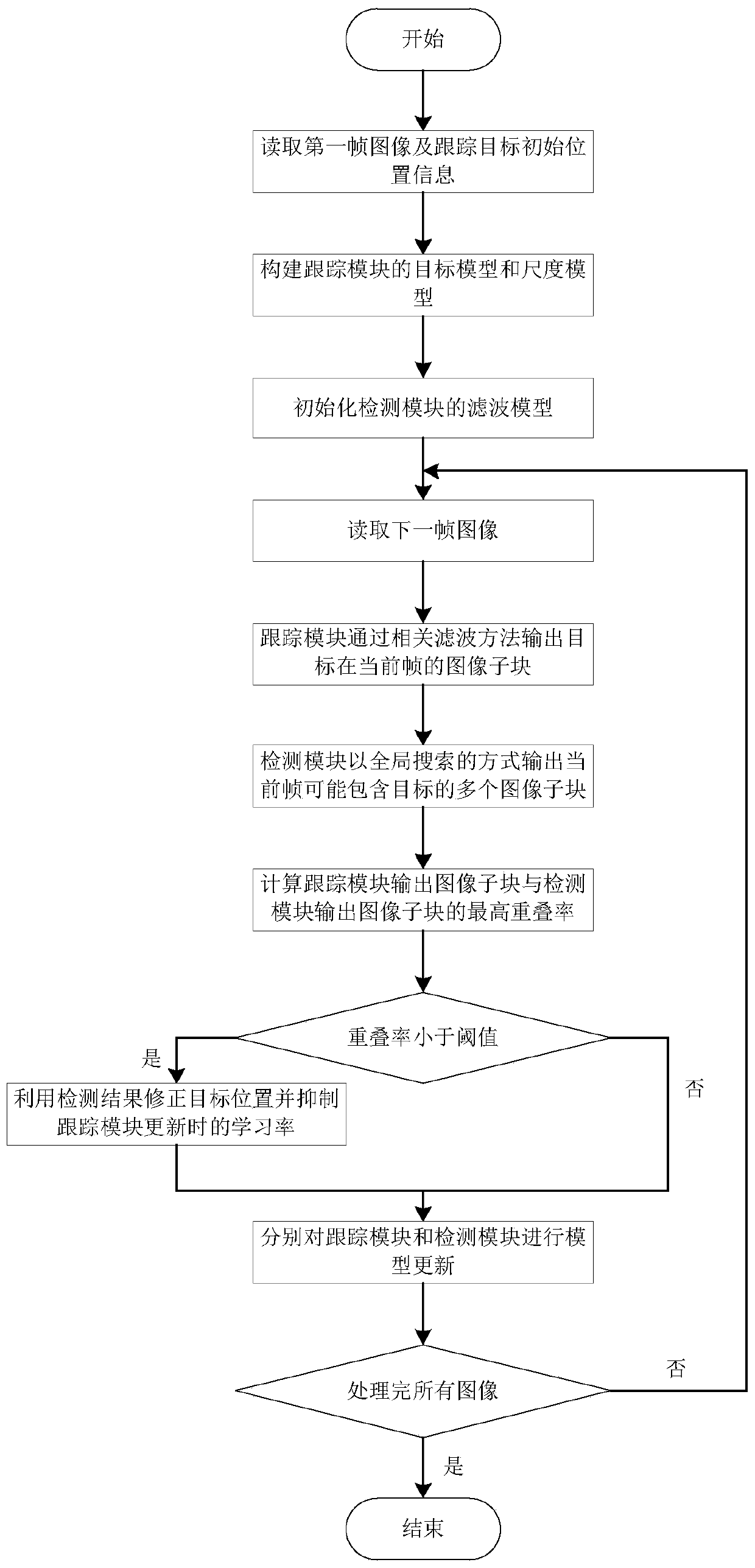
Figure 1 
Figure 2 
Figure 3
Abstract
Description
technical field
[0001] The invention belongs to the field of computer vision and relates to a target tracking method, in particular to a long-term occlusion robust tracking method based on convolution features and global search detection. Background technique
[0002] The main task of target tracking is to obtain the position and motion information of a specific target in a video sequence, which has a wide range of applications in video surveillance, human-computer interaction and other fields. During the tracking process, factors such as illumination changes, complex background, target rotation or scaling will increase the complexity of the target tracking problem, especially when the target is blocked for a long time, it is more likely to cause tracking failure.
[0003] The tracking method (TLD for short) proposed in the document "Tracking-learning-detection, IEEE Transactions on Pattern Analysis and Machine Intelligence, 2012, 34(7): 1409-1422" combines the traditional t...
Examples
Embodiment Construction
[0043] Now in conjunction with embodiment, accompanying drawing, the present invention will be further described:
[0044] Step 1 Read the first frame of image data in the video and the initial position information of the target [x, y, w, h], where x, y represent the abscissa and ordinate of the target center, w, h represent the width and high. The coordinate point corresponding to (x, y) is marked as P, and the target initial area with a size of w×h is marked as R with P as the center init , and then record the scale of the target as scale, initialized to 1.
[0045] Step 2. Taking P as the center, determine a region R containing target and background information bkg , R bkg The size of is M×N, M=2w, N=2h. Using VGGNet-19 as the CNN model, the convolutional feature map z is extracted from R' in the 5th convolutional layer (conv5-4) target_init . then according to z target_init Build the target model for the tracking module t∈{1,2,...,T}, T is the number of CNN model ...