
Photovoltaic Array Fault Diagnosis Method Based on Non-Principal Component Data Features
A photovoltaic array and data feature technology, applied in photovoltaic modules, photovoltaic power generation, photovoltaic system monitoring, etc., can solve problems such as fault diagnosis and classification of photovoltaic power generation arrays that have not yet been seen
Patent Information
- Authority / Receiving Office
- CN · China
- Patent Type
- Patents(China)
- Current Assignee / Owner
- Publication Date
- 2020-02-18
- Estimated Expiration
- Not applicable · inactive patent
Smart Images
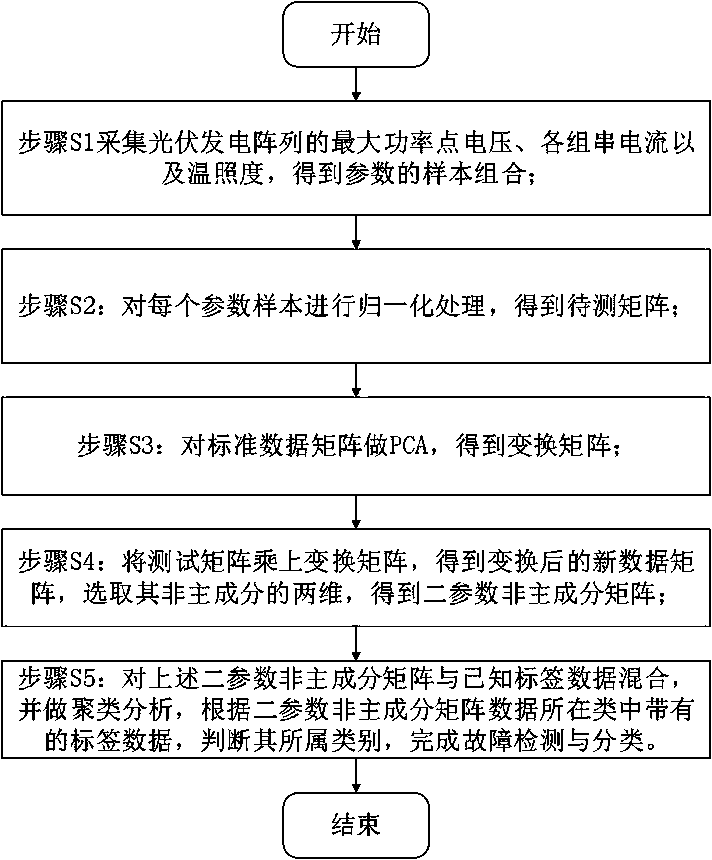
Figure 1 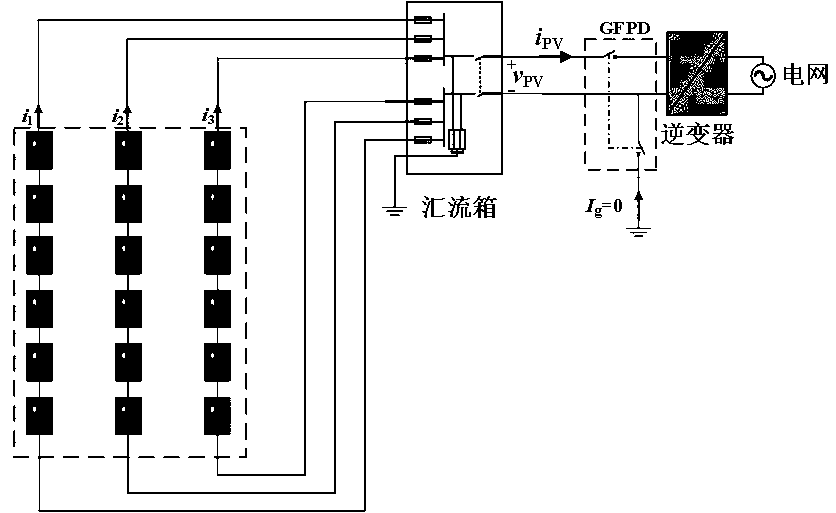
Figure 2 
Figure 3
Abstract
Description
technical field
[0001] The invention relates to the field of photovoltaic power generation fault detection and classification, in particular to a photovoltaic array fault diagnosis method based on non-principal component data features. Background technique
[0002] In order to alleviate the demand for fossil energy and solve the ecological crisis, photovoltaic technology has become the backbone of the new energy field. Benefiting from the improvement of technology level and the reduction of manufacturing cost, coupled with the easy access to and abundant solar energy, the deployment of photovoltaic arrays in the world has steadily increased, and its installed capacity has reached hundreds to thousands of megawatts.
[0003] However, due to its special working environment, photovoltaic systems are often threatened by various external or internal faults, such as component short circuit, open circuit, shadow shading, etc. Photovoltaic system failures can lead to reduced system...
Examples
Embodiment Construction
[0065] The present invention will be further described below in conjunction with the accompanying drawings and embodiments.
[0066] The present invention provides a photovoltaic array fault diagnosis method based on non-principal component data features, the flow chart is as follows figure 1 shown. figure 2 This is the topological diagram of the photovoltaic power generation system in this embodiment. The system consists of m×n photovoltaic modules to form a photovoltaic array, which is connected to the power grid through a grid-connected inverter. Under different atmospheric temperatures and irradiances, different working conditions in the daily operation of photovoltaic power generation arrays are simulated, and data collection of photovoltaic power generation systems is carried out. The concrete operation of embodiment comprises the following steps:
[0067] Step S1: Collect relevant parameter samples of the photovoltaic power generation array to obtain a parameter samp...