
Ecological reconstruction method for concrete spray layer surface based on growth of moss
A technology of concrete and moss, which is applied in the field of ecological reconstruction of the surface of concrete sprayed layer based on moss growth, can solve the problems of lack of greening and the inability to grow plants on the surface of the concrete sprayed layer, etc., achieves protection stability, solves the problems of slope protection and rapid greening , good water retention effect
Patent Information
- Authority / Receiving Office
- CN · China
- Patent Type
- Applications(China)
- Current Assignee / Owner
- Publication Date
- 2019-09-24
Smart Images
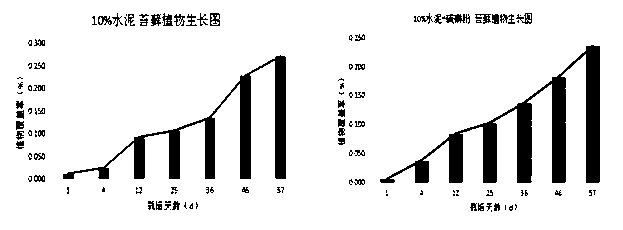
Figure 1 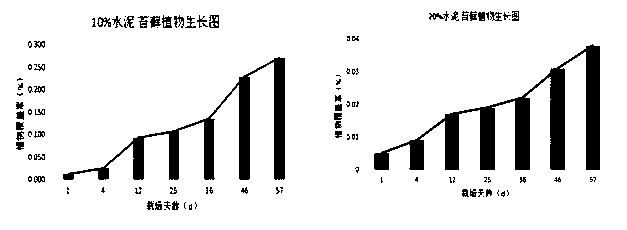
Figure 2 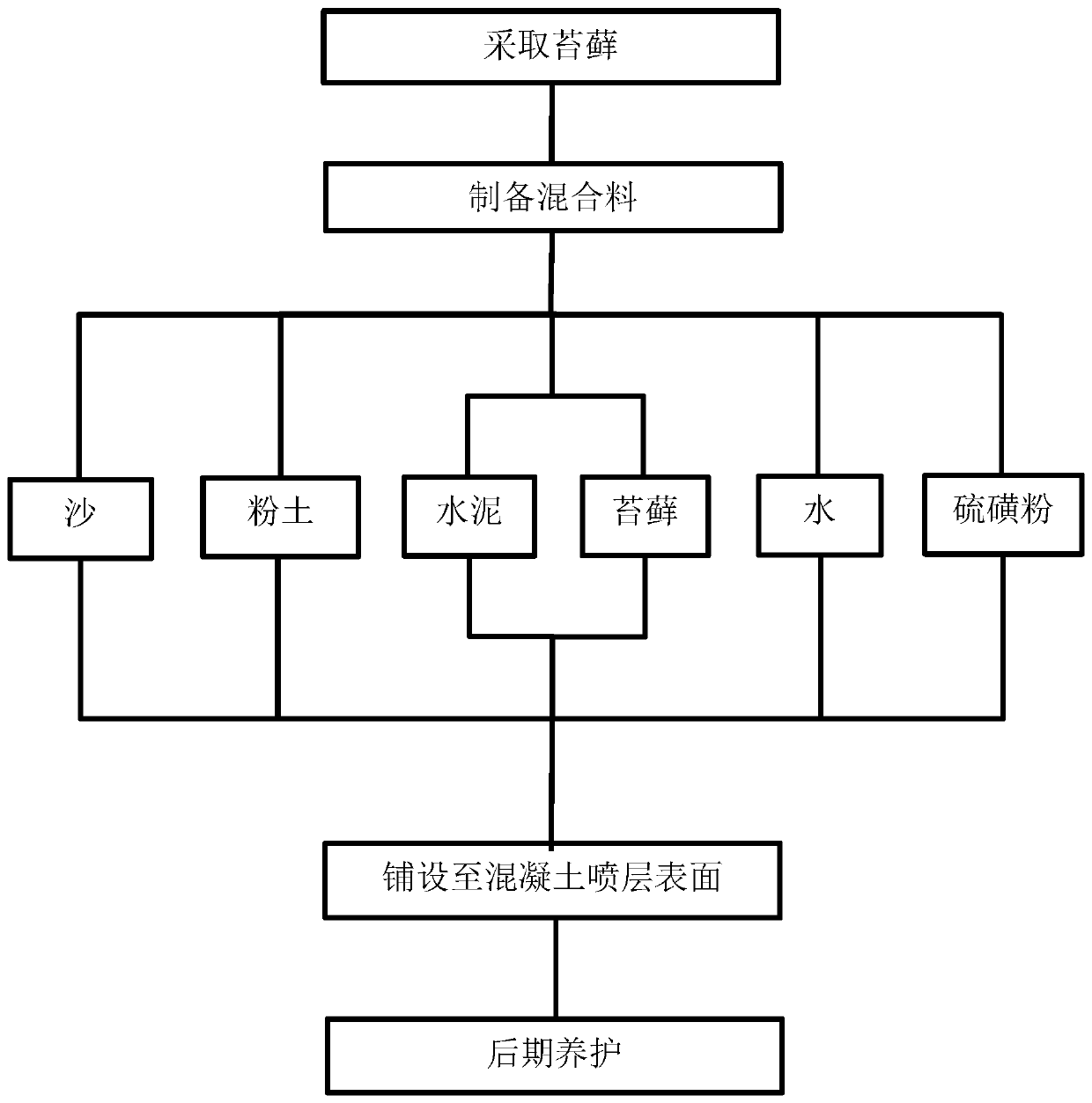
Figure 3
Abstract
Description
technical field
[0001] The invention belongs to the technical field of ecological restoration, and in particular relates to a method for ecological reconstruction of the surface of a concrete sprayed layer based on moss growth. Background technique
[0002] According to the results of the “National Comprehensive Scientific Investigation on Soil Erosion and Ecological Security” organized by the Ministry of Water Resources, the Chinese Academy of Sciences, and the Chinese Academy of Engineering, during the “Tenth Five-Year Plan” period, the disturbance area of national development and construction projects reached 55,000 km 2 , spoiled soil and dregs amounted to 9.2 billion tons. In recent years, human factors have increased soil erosion by more than 300 million tons, posing a serious threat to my country's ecological environment. Therefore, in order to promote ecological protection and construction, let the environmental restoration of the Yangtze River Economic Belt accumu...
Examples
Embodiment 1
[0030] As shown in Table 1 below, the survey of bryophytes on concrete slopes in a certain area found that under natural conditions in the field, Physcomitrella sp. The bryophytes often form flakes of communities. In this experiment, the bryophytes were subjected to a drought tolerance test to compare their ability to regenerate new branches in an artificial humidity-controlled environment, and to explore the feasibility of using concrete sprayed layers as carriers for different moss species. Provide suitable moss species for ecological reconstruction of concrete surface.
[0031] The moss species used in the test in table 1
[0032]
[0033] The steps of the indoor drought tolerance growth test are as follows:
[0034] (1) chopping after the bryophytes of taking back are dried in the shade, form moss fragment gametophytes;
[0035] (2) On the concrete surface (10cm*10cm), spread a thin layer of in-situ soil layer of moss growing in the wild, and make in-situ soil leachat...
Embodiment 2
[0043] This embodiment is carried out indoors to explore whether the bryophytes can grow normally under the condition that the substrate contains cement. The specific exploration methods are as follows:
[0044] s1. Select 4 groups of fresh bryophytes to carry out ordinary transplantation, and place them in the indoor laboratory to ensure that the ordinary transplanting process does not cause adverse effects on the bryophytes.
[0045] s2. Add 5%, 10%, 20%, and 30% cement by weight to the original culture medium of the moss, and mix them with 30g of bryophytes, and observe the growth results of the moss after one month, wherein: The bryophytes mixed with 5% and 10% cement by weight grow better, the 20% bryophytes have slower growth rate and lower survival rate, and the 30% bryophytes have almost zero survival rate, which is not conducive to growth.
[0046] It can be seen that the weight ratio of cement to the moss culture substrate should be less than 1:4; to ensure that the ...
Embodiment 3
[0048] On the basis of the indoor implementation of this embodiment, a "secondary" test was carried out outdoors, and the specific operation steps are as follows:
[0049] s11. Take moss. In the present embodiment, the main collection point is on the concrete spray layer slope in Chongqing City, and the moss species taken are mainly Eurysmus tenifolia and sand moss. Euonymus tenifolia, densely clustered or sparsely clustered. Weak, yellow-green or bright green mossy leaves, base brown, with dense rhizomes, up to 3 cm. Fruiting branches and leaves clustered on the top of the stem. Leaf leaves are often shrunken when dry, gradually widen from the narrow base, and become oblong ovate, the upper part is acuminate, and has the shape of hair tip; the leaf margin is differentiated, composed of 1-4 rows of narrow-shaped sclerenchyma cells; yellow-green, the middle part Involute, entire margin is smooth; the base of the middle rib is relatively thick, and quickly becomes thinner upwa...