
Deformable mouse whole-body atlas and mouse image registration algorithm
An atlas and mouse technology, applied in the field of small animal medical imaging research, can solve problems such as differences in the shape of individual organs
Patent Information
- Authority / Receiving Office
- CN · China
- Current Assignee / Owner
- Publication Date
- 2019-10-11
Smart Images
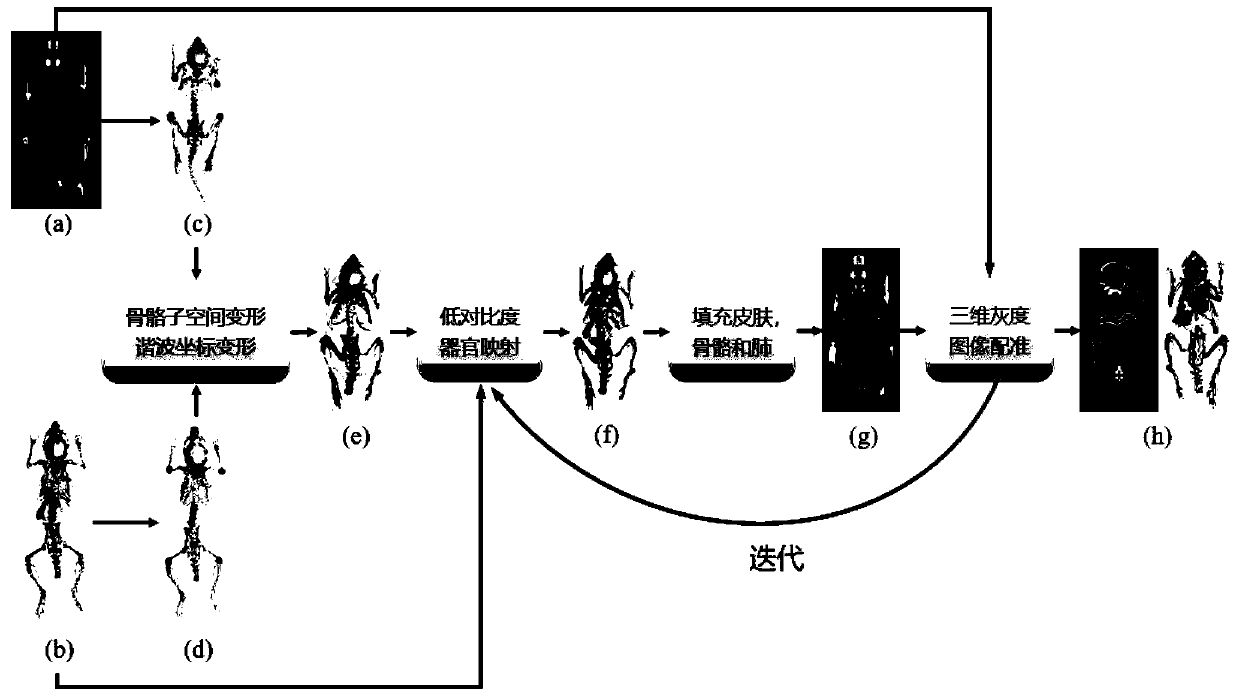
Figure 1 
Figure 2 
Figure 3
Abstract
Description
technical field
[0001] The invention belongs to the technical field of small animal medical imaging research, and relates to an algorithm for registration of a deformable mouse whole-body atlas and a mouse image. The organ regions in the image are mapped to the target image, and then the main organs of the mouse are segmented from the target image. Background technique
[0002] With the rapid development of medical imaging technology, small animal imaging research plays an important role in preclinical cancer research and new drug trial production. The advancement and popularization of small animal images has put forward new requirements for related image analysis work. A large amount of image data needs to be processed per unit time, and manual processing has the disadvantages of strong subjectivity and poor repeatability. Therefore, there is an urgent need for automated and objective small animal image analysis technology to improve the accuracy and efficiency of small an...
Examples
specific Embodiment approach
[0054] Such as figure 1 As shown, an algorithm for registration of a deformable mouse whole-body map and a mouse image. The target image is a CT image as an example, and the deformable mouse whole-body map is used for registration. It mainly includes three parts: pre-adjust the shape and posture of the skin and bones of the deformable mouse whole-body atlas; map the remaining internal organs according to the deformed skin and bones; register the deformed mouse whole-body atlas to the target through 3D grayscale image registration individual. The specific implementation is as follows:
[0055] In the first step, anatomical calibration points are selected from mouse images. The target individual anatomical calibration point (c) includes a total of 7 articulation points including the tip of the nose, the top of the cervical spine, the top of the coccyx, the elbow joint of the left forelimb, the elbow joint of the right forelimb, the knee joint of the left hind limb, and the kne...