
Full convolutional neural network and corresponding microstructure identification method
A convolutional neural network and network technology, which is applied in the field of mesoscopic structure recognition of ceramic matrix composite material preforms, can solve the problems of large memory usage and long training time of full convolutional neural network, reduce time and improve accuracy. , the effect of enhancing the ability of expression
Patent Information
- Authority / Receiving Office
- CN · China
- Patent Type
- Applications(China)
- Current Assignee / Owner
- Publication Date
- 2019-11-08
Smart Images
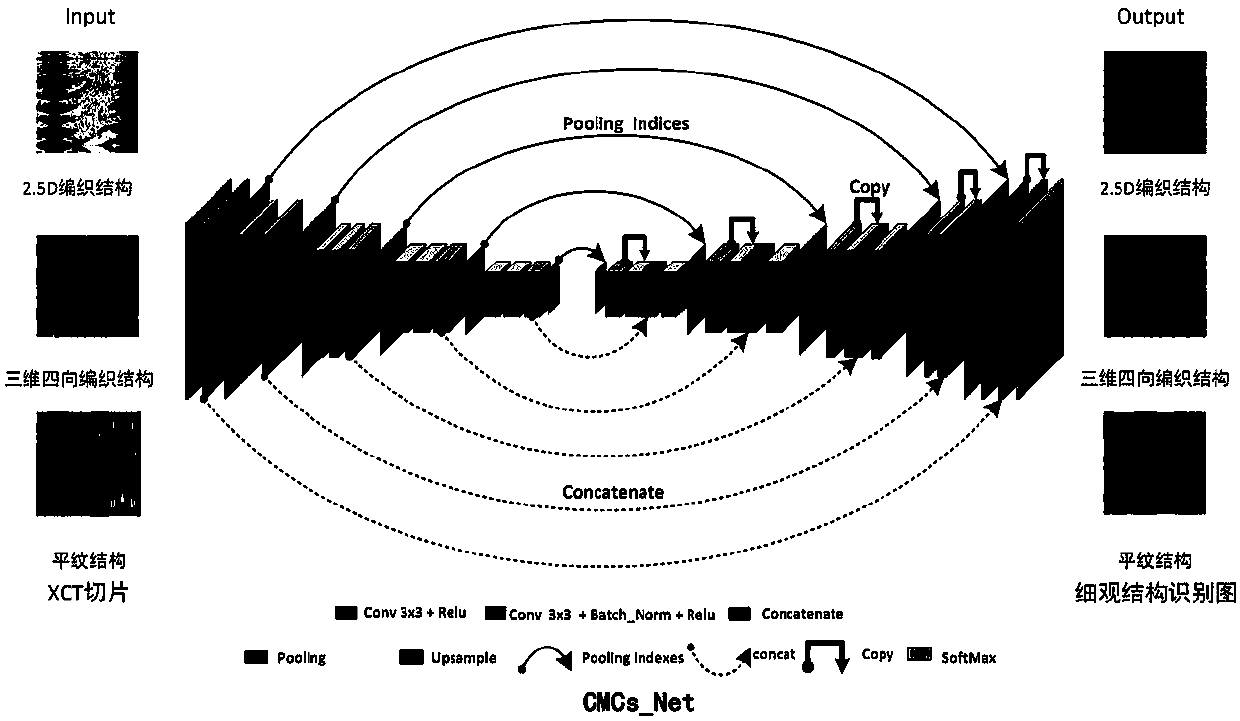
Figure 1
Abstract
Description
technical field
[0001] The invention belongs to the field of mesoscopic structure recognition of prefabricated ceramic matrix composite materials, and in particular relates to a fully convolutional neural network for semantic segmentation of XCT slices of woven ceramic matrix composite materials. Background technique
[0002] Ceramic matrix composites (CMCs, Ceramic Material Composites) usually use continuous ceramic fibers as the reinforcement phase, which is a material that can be applied under extreme conditions, and has the advantages of high temperature resistance, corrosion resistance, low density, and wear resistance.
[0003] The skeleton composed of continuous ceramic fibers is called a complex preform, and its weaving structure includes plain weave, 2.5D, three-dimensional four-way, etc. The preparation process of CMCs includes chemical vapor deposition (CVI), precursor impregnation cracking (PIP), reaction melting (MI) and other methods. Usually, CMCs are prepare...
Examples
Embodiment Construction
[0042] The present invention is described in further detail now in conjunction with accompanying drawing.
[0043] Such as figure 1 The CMCs_Net full convolutional neural network shown is composed of an encoder network, a decoder network and a classification layer. The convolution kernels in the full convolutional neural network are all 3x3, and the padding operation is performed. The padding size is 1 , to ensure that the size of the feature remains unchanged during the image convolution process.
[0044] The encoder network part consists of five encoders, which are sequentially recorded as encoder one, encoder two, encoder three, encoder four, and encoder five. Each encoder is composed of multiple convolutional layers and a layer of pooling layer in turn. The convolutional layer is used to extract the features of the picture; the pooling layer is used to reduce the resolution of the picture, and the pooling kernel is 2*2, that is The length and width are respectively reduc...