
A Rational Number Resonant Multi-Wavelength Coding Method Based on Dynamic Q-switching
A coding method and a rational number technology, applied in the field of ultrafast lasers and lasers, can solve the problems of lack of spectral energy density and peak power, not suitable for fast CARS imaging, etc., to achieve the effect of wavelength modulation and compact structure
Patent Information
- Authority / Receiving Office
- CN · China
- Patent Type
- Patents(China)
- Current Assignee / Owner
- Publication Date
- 2021-08-31
Smart Images
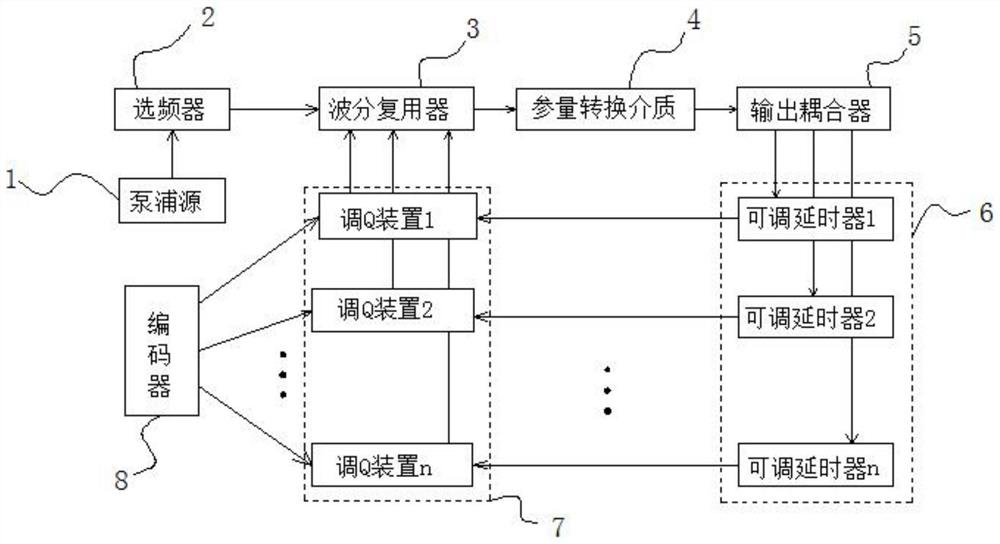
Figure 1 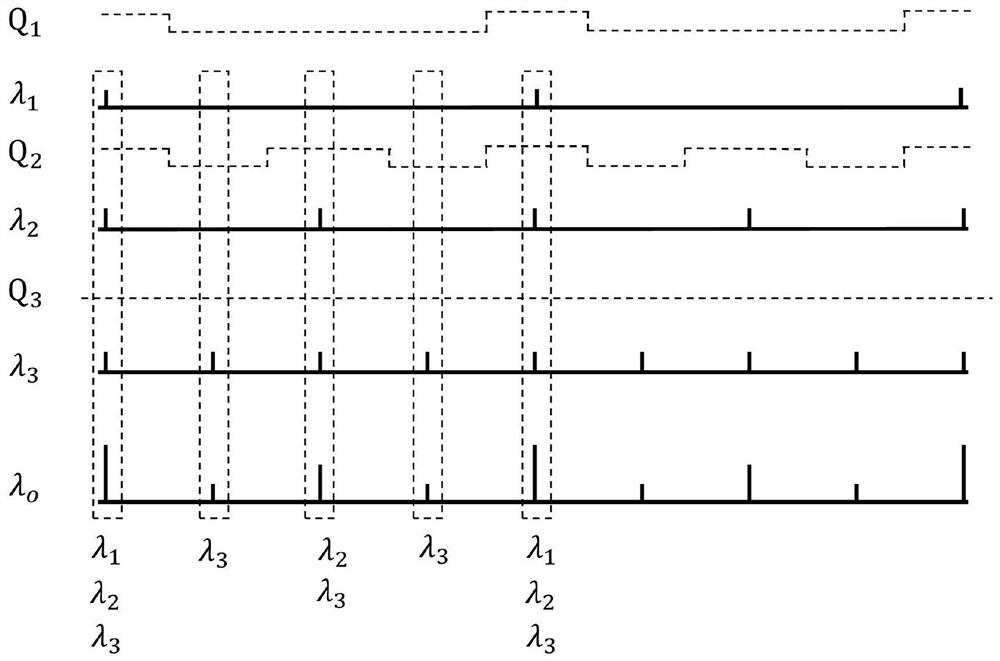
Figure 2 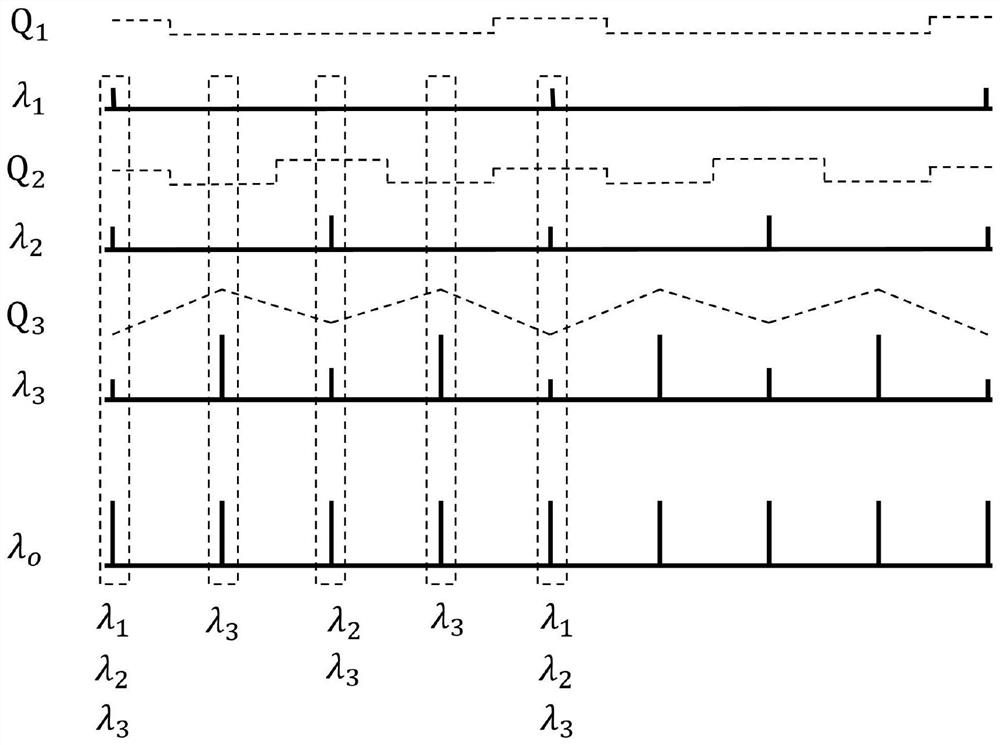
Figure 3
Abstract
Description
technical field
[0001] The invention relates to the field of ultrafast laser and laser technology, in particular to a rational number resonance multi-wavelength coding method of dynamic Q switching. Background technique
[0002] Coherent Anti-Stokes Raman Scattering (CARS) microscopy performs three-dimensional imaging by utilizing the inherent molecular vibrations of biological tissues, which has high directionality, high sensitivity, high specificity, high resolution, and three-dimensional sectioning capabilities without labeling and no photoinduced characteristics of damage. Since the performance of CARS systems largely depends on the properties of their light sources, increasing efforts have been devoted to the development of time-synchronized, spatially overlapping, and wavelength-tunable ultrafast lasers.
[0003] The optical parametric oscillator (OPO) has the advantages of robustness, compactness, and low loss, and OPO can output time-synchronized, spatially overlapp...
Examples
Embodiment 1
[0037] Such as figure 2 As shown, it includes three-way feedback, and the three Q-switching devices 7 are simultaneously controlled by the encoder 8, so that the Q values in the three-way oscillation cavity are respectively as follows: figure 2 shown; in Q 1 , Q 2 , Q 3 λ under three kinds of Q value modulation 1 ,λ 2 ,λ 3 Resonant pulses such as figure 2 shown. lambda 1 ,λ 2 ,λ 3 Combination forms the output resonance pulse sequence λ of the present invention o . through as figure 2 The Q-value modulation shown so that λ 1 The repetition frequency is f, λ 2 With a repetition rate of 2f, λ 3 The repetition rate is 4f. lambda 1 ,λ 2 ,λ 3 The first pulses of the pulse train are synchronized in time and overlap in space to form λ o The first pulse, λ o The first pulse contains λ 1 , lambda 2 , lambda 3 Three wavelengths; it can be seen from the figure that λ o The second pulse contains only λ 3 a wavelength; λ o The third pulse contains λ 2 , lam...
Embodiment 2
[0039] Such as image 3 As shown, the three Q-modulating devices 7 are controlled by the encoder 8 at the same time, so that the Q values in the three-way oscillation cavity are respectively as follows: image 3 shown in Q 1 , Q2 , Q 3 λ under three kinds of Q value modulation 1 ,λ 2 ,λ 3 Resonant pulses such as image 3 shown. In the case of such Q-value coding, λ 1 ,λ 2 ,λ 3 The intensity of each pulse is dynamically modulated periodically, so that the output pulse λ o The pulse intensities are the same, the results are as follows image 3 shown.
[0040] figure 2 and image 3 Shown is the case of three-way feedback, in which case the output pulse λ o Contains at most λ 1 ,λ 2 ,λ 3 Three resonant wavelengths, plus the remaining pump light λ p , so the output pulse λ o A total of lambda p ,λ 1 ,λ 2 ,λ 3 Four wavelengths. According to CARS microscopic imaging conditions, two different wavelengths can image a substance, and there are the following six...