
Method for improving operation safety of hydrocracking unit
A hydrocracking and safety technology, which is applied in the fields of hydrotreating process, petroleum industry, and hydrocarbon oil treatment, etc., can solve the problems of hydrocracking catalyst activity damage, reaction temperature mismatch, etc., and achieve good passivation effect, Suitable process conditions and energy saving effect
Patent Information
- Authority / Receiving Office
- CN · China
- Current Assignee / Owner
- Publication Date
- 2020-05-05
Smart Images
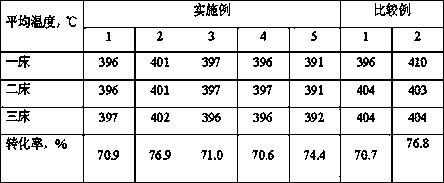
Figure 1 
Figure 2 
Figure 3
Abstract
Description
technical field
[0001] The invention relates to a method for improving the operation safety of a hydrocracking unit, in particular to a method for improving activity matching between beds of hydrocracking catalysts after frequent start-up and shutdown. Background technique
[0002] The hydrocracking process is under the action of hydrogen, high temperature, high pressure and catalysts to hydrodesulfurize, hydrodenitrogenate, polycyclic aromatic hydrocarbons, hydrosaturation and ring-opening cracking of heavy distillate oils (VGO, CGO, DAO). The process of conversion into target products such as light oil and middle distillates. The hydrocracking catalysts currently produced in domestic industry are basically oxidative. New catalysts or regenerated catalysts produced in industry contain active metal components (Mo, Ni, Co, W) in the oxidation state (MoO 3 , NiO, CoO, WO 3 ) exists in the form of The practice of basic research and industrial application shows that most of ...
Examples
Embodiment 1
[0053] When the reaction temperature of the first bed of hydrocracking catalyst is 396°C, and the difference between the outlet temperature and the inlet temperature T1 of the first catalyst bed is 2°C, the nitrogen weight content of the catalyst in the first catalyst bed is 0.18%, Cool down to 325°C and feed refined oil with a nitrogen content of 495ppm. After the nitrogen content of the liquid phase effluent from the cracking section is constant at 50ppm, feed hydrogenated refined oil with a nitrogen content of ~40ppm, and then first raise the reaction temperature to 385°C , adjust the temperature, control the conversion rate to be constant at 35%, and stabilize for 48 hours; finally adjust the process conditions to enter normal production, and the controlled conversion depth is the same as that of Comparative Example 1.
Embodiment 2
[0055] When the reaction temperature of the first bed of hydrocracking catalyst is 397°C, and the difference between the outlet temperature and the inlet temperature T1 of the first catalyst bed is 3°C, the nitrogen content of the catalyst in the first catalyst bed is 0.16%. Feed refined oil with a nitrogen content of 320ppm to 332°C, and after the nitrogen content of the liquid phase effluent from the cracking section is constant at 50ppm, feed hydrogenated refined oil with a nitrogen content of ~40ppm, and then first increase the reaction temperature to 385°C , adjust the temperature, control the conversion rate to be constant at 35%, and stabilize for 24 hours; finally adjust the process conditions to enter normal production, and the controlled conversion depth is the same as that of Comparative Example 2.
Embodiment 3
[0057] When the reaction temperature of the first bed of hydrocracking catalyst is 397°C, and the difference between the outlet temperature and the inlet temperature T1 of the first catalyst bed is 1°C, the nitrogen content of the catalyst in the first catalyst bed is 0.28%, and the temperature is lowered Feed refined oil with a nitrogen content of 421ppm to 328°C. After the nitrogen content of the liquid phase effluent from the cracking section is constant at 80ppm, feed hydrogenated refined oil with a nitrogen content of ~40ppm, and then first increase the reaction temperature to 385°C. Adjust the temperature, control the conversion rate to be constant at 38%, and stabilize for 48 hours; finally adjust the process conditions to enter normal production, and the controlled conversion depth is the same as that of Comparative Example 1.