
Preparation method of chlorantraniliprole and intermediate thereof
A technology for chlorantraniliprole and intermediates, which is applied in the chemical field of pesticide synthesis, can solve the problems of low molar yield of chlorantraniliprole intermediates and the like, achieves reduction of solvent usage, high product quality, Easy-to-use effects
Patent Information
- Authority / Receiving Office
- CN · China
- Current Assignee / Owner
- Publication Date
- 2020-07-17
Smart Images
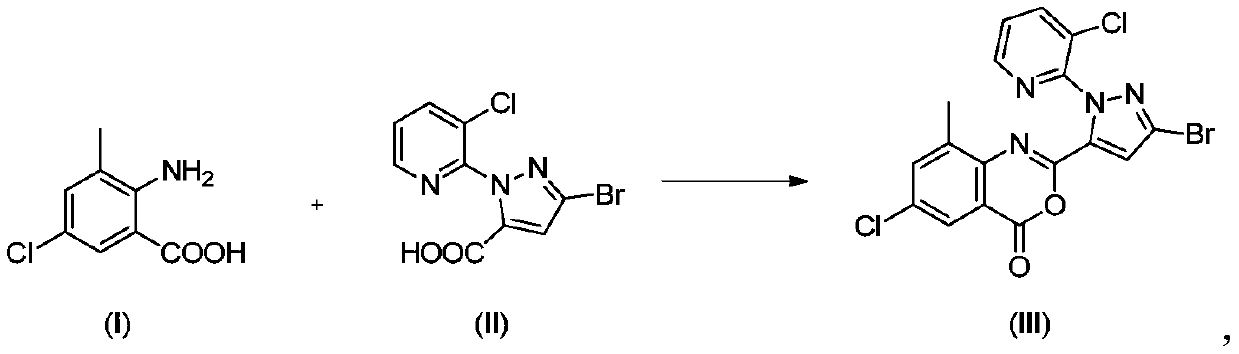
Figure 1 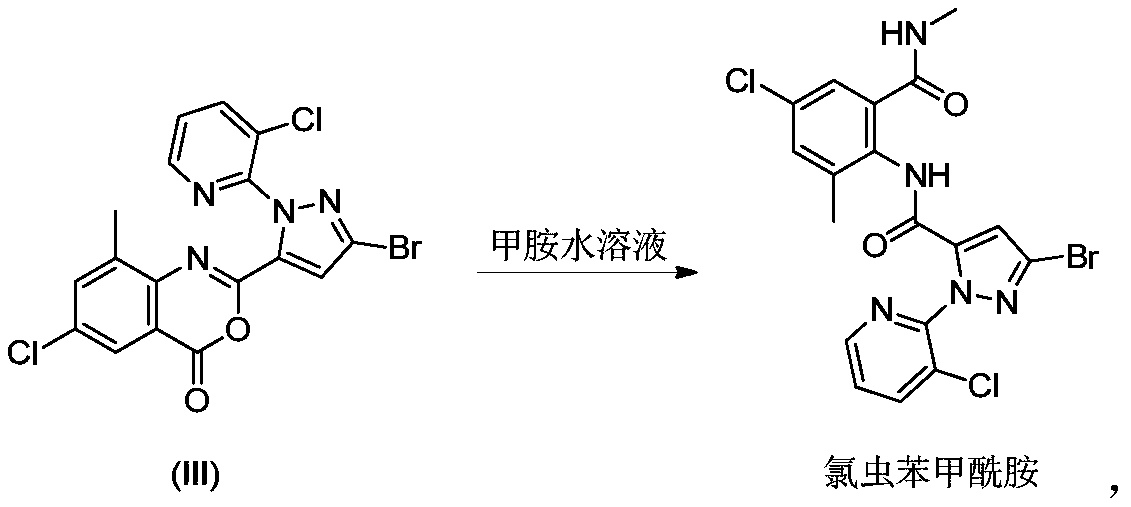
Figure 2 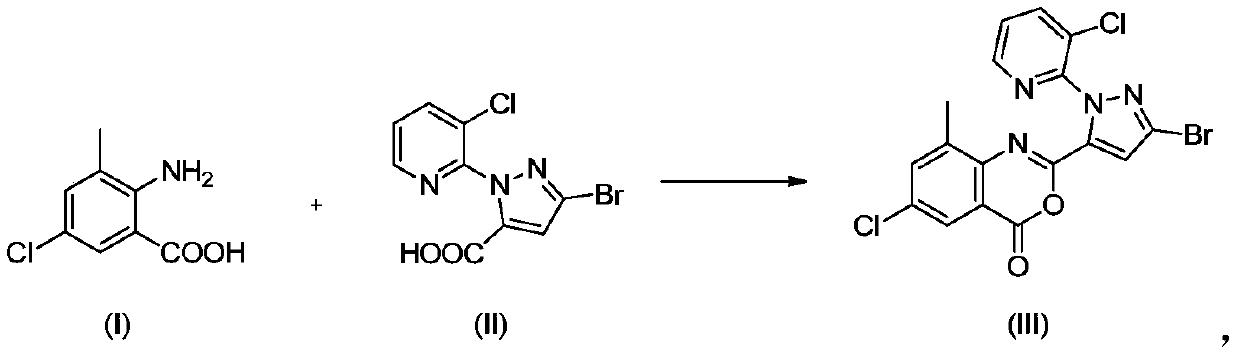
Figure 3
Abstract
Description
technical field
[0001] The invention belongs to the chemical technology field of insecticide synthesis, and more specifically relates to a preparation method of chlorantraniliprole and an intermediate thereof. Background technique
[0002] Chlorantraniliprole is a broad-spectrum insecticide with a new type of o-formamidobenzamide chemical structure first successfully developed by DuPont of the United States. It has the advantages of strong insecticidal activity, excellent field performance, less toxicity to mammals and good environmental compatibility. The compound has excellent control effects on Lepidoptera pests, acts on ryanodine receptors and has the characteristics of high efficiency, low toxicity, safety to non-target organisms, and no cross-resistance to existing insecticides, so it has attracted widespread attention. Attention, has a huge market prospect.
[0003] The chlorantraniliprole intermediate can be synthesized through various routes, as disclosed in DuPon...
Examples
preparation example Construction
[0024] According to an exemplary embodiment of the present invention, the preparation method of the chlorantraniliprole intermediate mainly comprises: in the presence of a base and a solvent, formula I compound 2-amino-5-chloro-3-methylbenzoic acid (hereinafter Hereinafter abbreviated as B-2) and formula II compound 3-bromo-1-(3-chloro-2-pyridyl)-1H-pyrazole-5-carboxylic acid (hereinafter referred to as K acid) are mixed together to form material one ; Methanesulfonyl chloride (hereinafter referred to as MsCl) is mixed with material one reaction again, obtains formula III compound 2-[3-bromo-1-(3-chloro-2-pyridyl)-1H-pyrazol-5-yl] -6-Chloro-8-methyl-4H-3,1-benzoxazin-4-one (abbreviated as BCPP hereinafter), which is the intermediate of chlorantraniliprole (III).
[0025] Among them, the preparation method of chlorantraniliprole intermediate BCPP also includes a post-treatment step of filtration, the resulting filter cake is crude BCPP, and the filtrate continues to be used as ...
Embodiment 1
[0036] Step A: Preparation of BCPP
[0037] Add K acid (200.0 g, 0.66 mol), B-2 (122.7 g, 0.66 mol) and 1 L of acetonitrile into a 2 L three-necked flask, and start mechanical stirring. Weigh 3-methylpyridine (320.2 g, 3.44 mol) into it, and stir at room temperature for about 5-10 min. The system was moved to a low temperature bath to start cooling down. When the internal temperature of the system is 0-2°C, start to slowly add MsCl (181.8g, 1.59mol) dropwise in total, keeping the internal temperature of the system not exceeding 5°C. After the dropwise addition, the temperature was naturally raised to room temperature, and the stirring reaction was continued until the reaction was complete. The filter cake and filtrate are obtained by filtration, the filter cake is the crude product of BCPP, and the filtrate is used as solvent recovery.
[0038] Step B: Preparation of Crude Chlorantraniliprole
[0039]Add 1 L of acetonitrile to the reaction flask containing the above-mentio...
Embodiment 2
[0043] Step A: Preparation of BCPP
[0044] Add K acid (200.0g, 0.66mol), B-2 (122.7g, 0.66mol) and solvent 1L respectively in 2L there-necked flask, this solvent is made up of filtrate 0.95L and acetonitrile 0.05L in step A among the embodiment 1, Turn on mechanical agitation. Weigh 3-methylpyridine (320.2 g, 3.44 mol) into it, and stir at room temperature for about 5-10 min. The system was moved to a low temperature bath to start cooling down. When the internal temperature of the system is 0-2°C, start to slowly add MsCl (181.8g, 1.59mol) dropwise in total, keeping the internal temperature of the system not exceeding 5°C. After the dropwise addition, the temperature was naturally raised to room temperature, and the stirring reaction was continued until the reaction was complete. The filter cake and filtrate are obtained by filtration, the filter cake is BCPP crude product, and the filtrate can still be used as a solvent for the recovery of the next batch.
[0045] Step B...