
Method for improving charging efficiency of lead-acid storage battery
A lead-acid battery, charging efficiency technology, applied in lead-acid batteries, battery electrodes, secondary batteries, etc., can solve the problems of reduced utilization of active materials, increased internal resistance of batteries, weakened conductivity, etc., to reduce charging losses. , The effect of improving charging efficiency and improving service life
Patent Information
- Authority / Receiving Office
- CN · China
- Current Assignee / Owner
- Publication Date
- 2020-09-04
- Estimated Expiration
- Not applicable · inactive patent
Smart Images
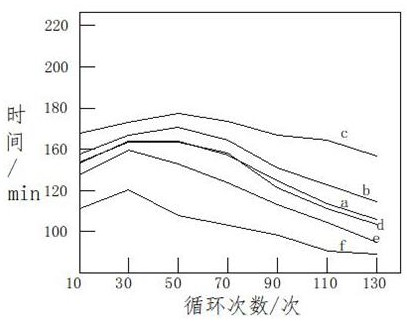
Figure 1
Abstract
Description
technical field
[0001] The invention belongs to the technical field of storage batteries, in particular to a method for improving the charging efficiency of lead-acid storage batteries. Background technique
[0002] The Frenchman Plant invented the lead-acid battery in 1859. It has experienced nearly 150 years of development. Lead-acid batteries have made great progress in theoretical research, product types and varieties, and product electrical properties. Lead-acid batteries have played an indispensable and important role in various economic fields such as transportation, communication, electric power, military affairs or navigation and aviation.
[0003] According to the difference in the structure and use of lead-acid batteries, batteries are roughly divided into four categories: 1. Lead-acid batteries for starting; 2. Lead-acid batteries for power; 3. Fixed valve-controlled sealed lead-acid batteries; 4. Other types , including small valve-regulated sealed lead-acid ba...
Examples
Embodiment 1
[0066] A method for improving the charging efficiency of lead-acid batteries, preparing composite powder:
[0067] The tin powder and the zinc powder are sintered at high temperature in a carbon dioxide atmosphere to obtain a sintered material, and the mixing mass ratio of the tin powder and the zinc powder is 6:2. The high temperature sintering temperature is 680°C;
[0068] Add selenium powder treated with a coupling agent to the sintered material, grind it in the presence of a dispersant, and then dry it, then heat it at a high temperature in an aerobic atmosphere to obtain a high-temperature composite product. The high-temperature heating The treatment temperature is 250°C, and the selenium powder treated with the coupling agent is as follows: the selenium powder is evenly dispersed in the ethanol solution, heated to 40°C, and then the coupling agent is added to the ethanol solution, while adding While stirring, after the addition is complete, continue to stir for 1 hour,...
Embodiment 2
[0071] A method for improving the charging efficiency of lead-acid batteries, preparing composite powder:
[0072] The tin powder and the zinc powder are sintered at high temperature in a carbon dioxide atmosphere to obtain a sintered material, and the mixing mass ratio of the tin powder and the zinc powder is 10:3. The high temperature sintering temperature is 780°C;
[0073] Add selenium powder treated with a coupling agent to the sintered material, grind it in the presence of a dispersant, and then dry it, then heat it at a high temperature in an aerobic atmosphere to obtain a high-temperature composite product. The high-temperature heating The treatment temperature is 300°C, and the selenium powder treated with the coupling agent is as follows: the selenium powder is evenly dispersed in the ethanol solution, heated to 45°C, and then the coupling agent is added to the ethanol solution, while adding While stirring, after the addition is complete, continue to stir for 1 hour...
Embodiment 3
[0076] A method for improving the charging efficiency of lead-acid batteries, preparing composite powder:
[0077] The tin powder and the zinc powder are sintered at high temperature in a carbon dioxide atmosphere to obtain a sintered material, and the mixing mass ratio of the tin powder and the zinc powder is 8:2.5. The high temperature sintering temperature is 720°C;
[0078] Add selenium powder treated with a coupling agent to the sintered material, grind it in the presence of a dispersant, and then dry it, then heat it at a high temperature in an aerobic atmosphere to obtain a high-temperature composite product. The high-temperature heating The treatment temperature is 280°C, and the selenium powder treated with the coupling agent is as follows: the selenium powder is evenly dispersed in the ethanol solution, heated to 42°C, and then the coupling agent is added to the ethanol solution, while adding While stirring, after the addition is complete, continue to stir for 1 hou...